Translated material
The whirling and spinning of suffering
Critic Lisa Birger examines Sergei Kuznetsov’s novel “Moss’s Meat Grinder,” where there is a place for dystopia, a bloody thriller, and almost pornography
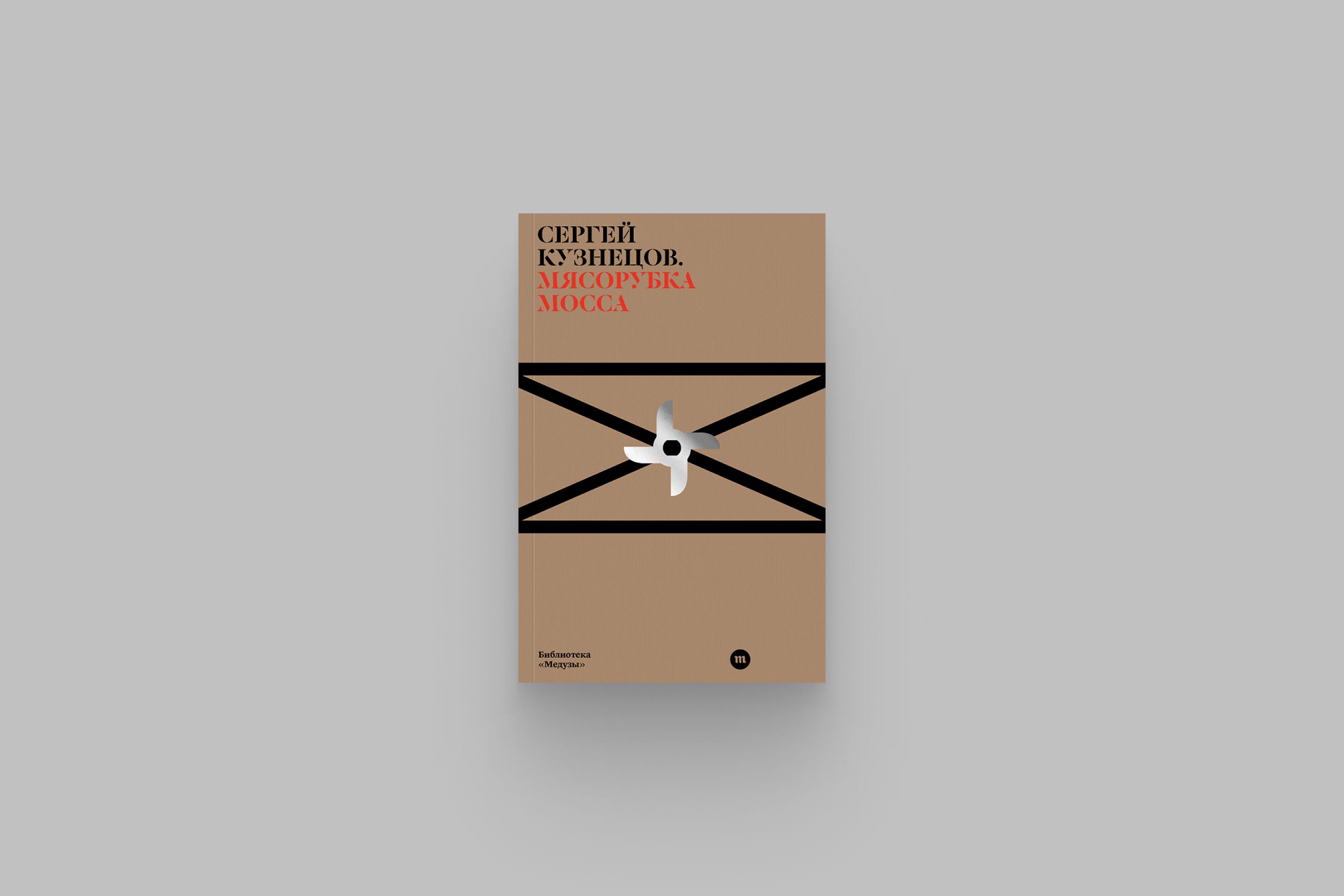
In November, the Meduza publishing house published the novel “Moss’s Meat Grinder” by Sergei Kuznetsov (“Teacher Dymov”, “The Skin of a Butterfly”, “Round Dance of Water”) - about how people who do not know each other in different parts of the world in 2030 commit or attempt to commit suicide. Literary critic Lisa Birger dug into the complex novel and found that it is much more relevant and topical than it pretends to be.
✽ ✽ ✽
This is a review of a book published by Meduza. Everything written in it is the opinion of a literary critic. The editors respect the author's right to his own point of view and does not influence his position in the preparation of the text.
✽ ✽ ✽
Attention! This text contains spoilers. If you don't want to see them, read the book first - and then come back to read the review. By the way, you can buy the book in our “Shop” (there are paper and electronic versions).
Sergei Kuznetsov prefaces every public conversation about his new novel with assurances that the book, although it may seem like a commentary on the real events of recent years, is “never about the war” and he himself tries to stay as far as possible from “relevance” in the sense of “in the morning in the newspaper, in the evening in a verse.” Let us begin here by assuring the reader that Moss's Grinder is the least topical novel published abroad in recent years - and this does not always work out to its advantage. For example, the author says that he wrote most of it during the pandemic and after 2022 did not change or add anything. It is clear: in 2030, when the action takes place, the memory of Covid lives in the characters, as if the pandemic ended yesterday and its trauma will be eternal, and as if other events never happened after. And it is in this year, 2030, that a new pandemic occurs in the world - or rather, a parasite is rapidly spreading, causing an increased sense of guilt.
In general, it is difficult to blame the writer Kuznetsov for trying to pursue current commentary. His complex books, with their multitude of voices and characters, seem to resist all speed. What is more important is to globally rework space and time, entire geographical layers and centuries, to subordinate them to the author’s thought and will. The writer’s most ambitious novel is “Kaleidoscope. Expendables" (2016), a mosaic of events and characters covering more than 100 characters from 1885 to 2013, from Victorian England to modern Russia. However coincidentally these characters may have been related to each other, it was their diversity that allowed for the fullest exploration of a century in which people remained expendable, but each was nevertheless important to the larger picture.
This principle - the complexity of the structure of the novel as a reflection of the complexity of the structure of the world - remains the main one in most of Kuznetsov’s novels, and he has more than a dozen of them - from “No” (2004), written together with Linor Goralik, a dystopia about a future world in which pornography has replaced cinema, to the family sagas “Round Dance of Water” (2010) and “Teacher Dymov” (2017) about three generations of Moscow teachers and their service to the profession; from the psychological thriller “The Skin of a Butterfly” (2005) about the meeting of a serial killer and a masochistic journalist to the fantastic trilogy “Alive and Adult” (2011–2018), young adult in the scenery of a parallel Soviet reality, by the way, another book that seems more relevant today than when it was written.
It remains to add that Sergei Kuznetsov is one of the pioneers of Russian Internet journalism, an entrepreneur, in the past the founder of a marketing agency, that he wrote a monograph on Joseph Brodsky and is considered the best expert on Thomas Pynchon in the Russian-speaking space, that for more than ten years he has been living in Paris and creating educational projects, and by education he is generally a chemist - and perhaps then it will become a little clearer that the complexity of his novels is partly dictated by the complexity of his own figures.
The new book also has a little bit of everything: there is a dystopia, a bloody thriller, almost pornography, a chorus of characters, without each of whom the story would be incomplete, and an author’s voice with somewhat verbose philosophical digressions.
The difficulty with this book is that it takes a very long time to explain to the reader what is actually happening in it. Only in the middle, at the end of the next bloody episode, does it become clear what kind of Moss is on the cover and why the meat grinder becomes the central image for the novel: this is not a metaphor, but a literal description of the death of one of the heroes, whose body is torn to pieces by giant blades - a direct reference to bloody slasher films in which the methods of killing heroes are more important than the plot. Until then, the reader has to trust the author, trust that he knows where he is going, and accept that conversations about the nature of guilt and violence may be more important than the plot.
Until the middle, we see seemingly unrelated characters in different parts of the world, the center of which in the novel inevitably tends to Eastern Europe. The characters include an elderly Croatian who was a former soldier in the Serbo-Croatian War; a Serbian artist (not Marina Abramovic!), a former sex worker, and even earlier a prisoner in a Croatian camp; a very rich couple of American entrepreneurs of Russian origin; a middle-aged French woman with a great sexual appetite; newlyweds who escaped from Paris to an almost uninhabited tropical island; a Pole who is haunted throughout his life by the bloody trail of past genocides; researchers, scientists, young slackers, single mothers and a whole crowd of others. They all find themselves in similar circumstances: first they fall ill with something similar to a cold, then they recover sharply, then they have very strange, vivid and bizarre dreams, after which they remember the mistakes of the past and monstrous torment from guilt and conscience begins. All this is heavily mixed with references to classic cinema and New Hollywood and extremely graphic scenes of sex and violence, and for good reason.
Although the novel does not provide answers for a long time as to where exactly it is leading, the clues the reader needs can already be found in the epigraphs. There are three epigraphs: Joseph Brodsky that man is his own terrible judgment, Adolf Hitler about freedom from “the dirty and humiliating self-torture of the chimera called conscience” and Albert Camus that absurdity “dooms remorse to uselessness.” Additionally, the author tells us that the back cover was supposed to feature a reproduction of Saul Fletcher's (1967–2020) latest painting, but "for reasons beyond the author's and editor's control, this was not possible." The work in question is called "Don't Let the Darkness Get You Down" - a few days after it was exhibited in Venice, Fletcher killed his former partner, the famous curator Rebecca Bloom, and then committed suicide at her country house in Brandenburg. The artist's method was to collect found objects, plants, branches, dead animals, Polaroids, paintings, drawings or pages torn from notebooks into a single composition, carefully documenting the process and himself against its background. As he himself said about his work: “I use everything at hand, trying to make something good out of something bad.” In Fletcher's works, the same plot was repeated in different variations. It seems that their structure and the artist’s personal history tell quite a lot about the structure of the “Moss Meat Grinder”.
The images as a whole are important for a novel consisting of continuous film references: one of the main characters studies the history of cinema at the university, another satisfies her craving for self-harm by watching films in the genre of torture porn , the third, a professor from Stanford, conducts a seminar on New Hollywood, which has become a point of intersection for many heroes. Here they constantly discuss films and even, willingly or unwillingly, reproduce movie plots in reality, for example, the death of Belmondo’s hero in Godard’s “Breathless.” The choice of era is not accidental: in the 1960s, after the abolition of the Hays Code, which dictated the rules of morality in cinema, Hollywood discovered violence as a form of protest, and aggression and the desire for destruction as natural manifestations of human nature. “Breathless”, as well as “Apocalypse Now” by Coppola and horror films like “The Texas Chainsaw Massacre”, in which a bunch of people are cut up in various ways with the caveat that they are not very good people, is one of the main keys to the novel. Slasher films have a simple logic: we kill heroes because they are unlikable, and whoever survives is good. And this is perhaps the central question of Moss's Grinder: who will survive - and why?
The novel is full of blood, sex and graphic physical imagery - partly to ensure that the reader is entertained if he gets a little bored. But this also creates a strange effect when Kuznetsov’s novel, facing the future, does so with the language and methods of the past. Younger readers, well-versed in an agenda that the author seems to strongly dislike, may be irritated by the constant ridicule of woke culture and, in general, rather strange ideas about how the world of non-binary people and postcolonial studies works. But both in language and themes, “Moss’s Meat Grinder” is addressed to “adults,” to those who would be glad to get out of this past, but cannot. And here it is just important that the action in the book takes place in a world in which the last war in Europe happened forty years ago, and the heroes, even if they decided to feel guilty, have almost nothing to show themselves. On the one hand, a strange parallel reality, without wars in Ukraine and Israel, seems somehow liberating. It was as if the elephant was taken out of the room and it became noticeable that there are not only elephants in the world. On the other hand, how can we not talk about this today? Everything else seems too fine adjustments against the backdrop of the horrors of reality.
Even if we imagine that Kuznetsov’s novel diligently avoids topicality, that its heroes do not know the true reasons for our constant living and uttering guilt and grief, it still ends up being a book about what we constantly talk about. Because at the center of the novel is guilt, and guilt, as the fictional Serbian artist Marija Miletić says, “is absolute evil”: “Genocide begins with collective guilt, and what individual guilt leads to can be heard on the news.” And here the novel becomes more relevant than ever - instead of ethereal attacks of guilt, which we would be happy to sweep under the rug, it invites the reader to deal with his own conscience in a long, tedious and much more productive way.
Since Moss's Grinder is a meta-novel and explains itself a little, there will be a hero at the end who will perfectly describe it - as a twenty-first century Plague, "a novel about how guilt and shame brought the world to the brink of disaster - and a novel about endlessly lonely people, devoid of conscience, unfamiliar with guilt, incapable of experiencing intimacy." “I would ask the reader to choose between self-destructive guilt and boundless, lonely despair,” fantasizes the failed author of this already written book, “and then leave him alone with this choice.”
If you think about what the reader of “Moss’s Meat Grinder” is left with, the outcome is not at all so tragic. Of course, you need to know Kuznetsov and his books at least a little in order to understand for sure: this therapeutic effect was not planned in The Meat Grinder. But sooner or later you come to him. The novel repeats one plot again and again - the character’s immersion into the depths of guilt, its horror and hopelessness, including through vivid, imaginative, sometimes completely surreal dreams, and through extremely explicit sex scenes. And as a result, for 700 pages you look into this whirling and spinning of suffering, like into the drum of a washing machine, and the longer you look, the easier it is to let go: after all, in the end, the book shows that pain in us is inevitable - but we cannot live without it.