
Translated material
On perpendicular rails
The railways split into eastern and western ranges. And this reflects a strong imbalance in the economy
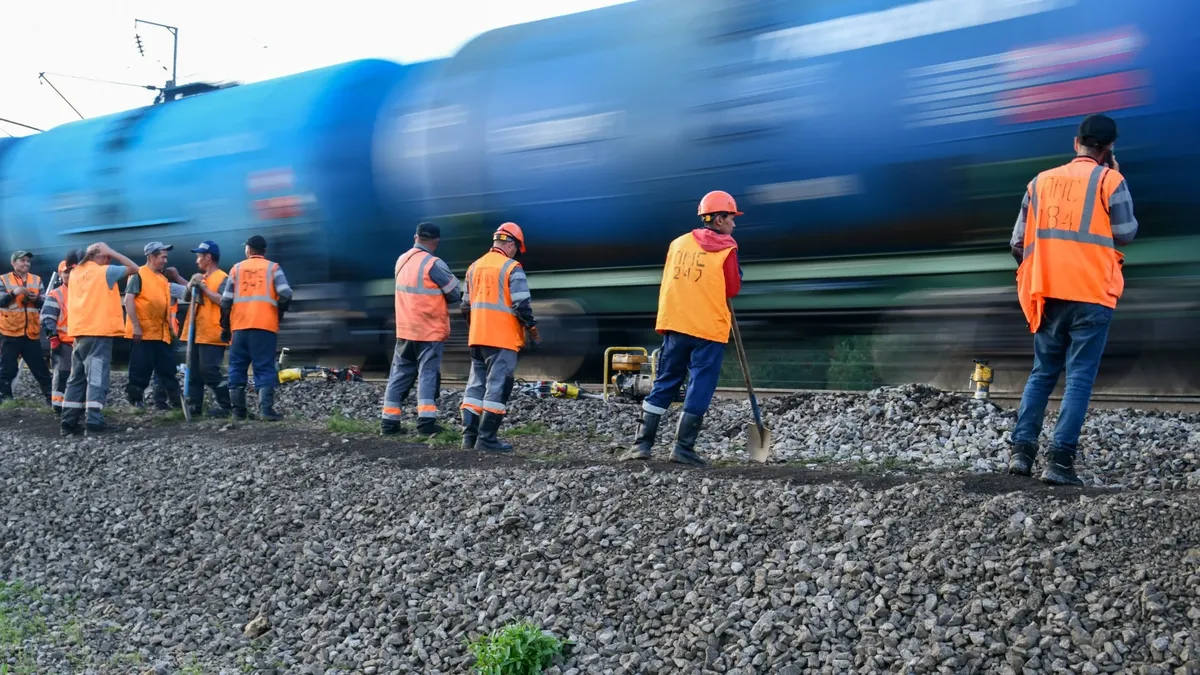
Photo: Evgeny Epanchintsev / TASS
The railroad has always served as a barometer of economic conditions. But the statistical figures for 11 months of 2025—loading 1021.3 million tons (-5.6%) and cargo turnover 2269.3 billion tons (-1.4%)—are only symptoms of underlying processes. Behind them lies a new reality: JSC Russian Railways is ceasing to be a universal integrator of the national economy and is turning into a specialized operator of export corridors, mainly in the eastern direction. This transition is accompanied by painful but natural processes: atrophy of some functions and hypertrophied development of others.
Imagine a large apartment where two neighbors live. One neighbor (let’s call him “Exporter”) is actively working, ordering goods, sending parcels - his life is in full swing. The second neighbor (“Internal Consumer”) has been depressed this year - he sits at home, spends less, and has put off repairs. Russian railways in 2025 are like a corridor between the rooms of these two neighbors. It is constantly being carried either by parcels from the “Exporter” or purchases from the “Domestic Consumer”. And now the situation is this: the “Exporter” works, and the “Domestic Consumer” almost never leaves the room.
Anatomy of a schism
If earlier the railway resembled the circulatory system of a single organism, today it is more like two independent circuits, loosely connected to each other. The first circuit is export, raw materials, “eastern”. It lives by the laws of the global market, is focused on buyers in Asia and demonstrates amazing stability and sometimes growth. The second circuit is internal, industrial. It depends on the investment climate within Russia, the state of the construction industry and the purchasing power of the population - and is in deep depression. This multi-speed economic model is reminiscent of a “pair of bay” team, where only one horse pulls.
The export circuit works like a machine gun. Let's take coal - the traditional “bread” of Russian Railways, occupying 29.1% of all loading. It would seem that a small drop of 1.5% is not a disaster. But behind this figure lies a real revolution:
Less and less coal is being transported within Russia, but exports to the East increased by 5.3%.
Coal-fired power plants in the European part of the country receive less fuel by rail, but coal terminals in the ports of Vanino and Nakhodka are operating at capacity.
The problem of tariffs for transportation of hard coal is one of the most pressing industry issues. More than half of coal is exported, and these shipments critically depend on world prices, the ruble exchange rate and tariffs. Over 2022–2024, the overall increase in railway freight tariffs was +64.5%, with the revenue rate for coal transportation increasing by 78%, and for exports by 91%, while the average rate for all cargo was only 53%. Although the profitability of coal transportation at the end of 2024 is 45% lower than the average for all cargo, the tariff burden on coal miners has increased by almost a fifth.
An even more telling story is with fertilizers. Here we see not just stability, but a real takeoff: overall growth by 4.5%, and exports to the east by a phenomenal 72.3%! The chemical industry has accomplished what many other industries have failed to do—not just maintain, but significantly increase exports in new geographic conditions.
But the most paradoxical case is iron ore. With almost zero change in total volume (-0.6%) this is what happens: exports increased by 10.5%, and deliveries to Russian metallurgical plants fell by 8-9%. Ore is the link between the mining and metallurgical complexes. Its reorientation to export means breaking one of the key chains in the domestic industry.
The internal circuit is experiencing a systemic crisis. Ferrous metals - a drop of 17.4%, and negative dynamics were observed for all 11 months without exception. The share of railways in transportation of metallurgical enterprises has decreased from 60% to less than 35%. Even more eloquent is the collapse in transportation of ferrous metal scrap by 33.2% - scrap appears during the dismantling of old facilities and active metal processing.
Data for construction materials (-11.0%) and cement (-12.6%) complete the picture. The share of rail transport of cement plants fell from 70% to about 35%. Under the influence of external negative factors, the delivery of construction goods decreased by 11%, but part of this decrease is a consequence of the switching of volumes to road transport and water delivery. There were additional volumes of cargo, but they could not be sent to Russian Railways due to logistics restrictions. The reasons for the loss of cargo are the duration of delivery, accelerated growth of tariffs, unpredictable timing of cargo acceptance and unpredictability of delivery times.
Grain stands apart - an ideal example of seasonal export cargo. The overall decline of 16.6% over 11 months masks explosive growth from August to November: +8%, +4.6%, +22.6% and +26.8% respectively. The new harvest has launched the conveyor belt. However, the conveyor is for export.
When speed increases but efficiency decreases
The quality of operational work on the Russian Railways network has changed. On the one hand, trains moved faster: section speeds increased by 9.0% in 11 months - the best result in five years. On the other hand, the railcar fleet plunged into a deep crisis.
Increased speed is not an unambiguous benefit. It was largely the result of a decrease in traffic density: fewer trains - easier to manage. Plus, the flow structure has changed: the share of long-distance export trains (more than 3,000 km), which require less shunting work, has increased.
The carriage crisis is a painful problem for the entire system. The numbers speak for themselves: there were 1.4 million cars on the tracks in November, of which 252,000 (18%) were not in the working fleet. They are simply idle. This is the “frozen” capital of operators, amounting to billions of rubles.
But the main problem lies in the analysis of car turnover. Time under cargo operations (that is, with customers) increased by 25.1%. And the time at Russian Railways technical stations decreased by 13.6%. What does this mean?
Russian Railways have learned to process cars faster at their hubs. But when the car arrives at the client - at the factory, at the port, at the warehouse - it gets stuck there for weeks.
According to a survey of non-public track owners, 96% experience delays, and the average downtime has reached 49 car-hours and continues to grow. The carriages pass all checks, but remain standing.
The reasons are a shortage of train and shunting traction, personnel and technological failures. One shunting locomotive today serves up to four stations, and the wait can last up to two days. More than half of the companies have already received claims from contractors and fines, although objectively they cannot free up the infrastructure: their tracks are clogged with cars that Russian Railways does not accept on the network.
Commodity mirror of the economy
Container shipping is a glimpse into the world of goods, an indicator of the health of the manufacturing industry, trade and consumer demand. The volume of container traffic in January–November 2025 decreased to 6.9 million TEU compared to 7.2 million TEU for the same period in 2024.
The picture is consistent.
On the one hand, there is a fall. Automobiles and components: -41.3%. Construction materials in containers: -37.1%. Machines and machines: -19.5%.
On the other hand, growth. Non-ferrous metals: +25.0%. Paper: +8.6%. Sugar: +21.6%. Other food products: +16.4%.
Key fact: The total volume of containers loaded fell 6.7%, but the volume of containers shipped for export rose 8.9%. This is a micromodel of the entire system: the internal container flow is compressed, the external one is expanding.
At the same time, it is not entirely correct to talk about the transfer of cargo to road transport. In fact, cargo goes into a single technological complex “warehouses + vehicles”. Over the past 20 years, the truck fleet in Russia has grown by more than 2 million units, and the length of public roads has doubled in 14 years. The fleet of medium- and large-tonnage trucks has practically not grown since 2015 - government pressure makes this segment less attractive. Over 25 years, more than 55 million square meters have appeared. m of class A and B warehouses - almost always without railway connections.
A new type of logistics has emerged: manufacturer - large truck - warehouse - light truck - consumer. It was this model that “ate” a significant part of the cargo base. Container trains are poorly integrated into this system. The chain with the railway is longer, container terminals are not logistics centers, and Russian Railways and operators do not have the competence to manage warehouse logistics.
The carriage is rocking
The year 2025 was marked by a reduction in car production volumes. Production fell especially sharply in the second half of the year, when monthly production amounted to less than 4 thousand cars. In October, the production volume of rolling stock fell by more than 50% compared to last year.
Over 10 months, the production of gondola cars decreased by almost 23%, platforms - by 19.4%, hoppers - by 81.5%, covered cars - by 34%. Of the mass types, only tanks turned out to be in the black - their output increased by 48%, to 15 thousand units, mainly due to oil and gasoline.
Car manufacturers have to adjust their strategy. The smallest decline in volumes was observed among manufacturers that entered the tank car market and increased the production of gondola cars with an axle load of 25 tf. And such low demand for freight cars in Russia is expected until 2030 - partly this is a global phenomenon.
In 2026, 43 thousand cars may be built, approximately 40–42 thousand. The production volumes of gondola cars and tanks will be reduced, but car manufacturers will focus on the production of a specialized fleet.
How much production is needed? In 2018, the calculation was given: 30–35 thousand cars annually. Now the optimal figure is about 50 thousand, but this depends on the type of rolling stock. It is important to take into account not only current demands, but also the established service life of modern cars, including innovative models with a longer service life.
East and everything else
Russian railways today are like a body in which one arm (Eastern training ground) is actively training and becoming stronger, while the other (internal network) is gradually atrophying from inactivity. The railway system does not simply reflect the split between the export and domestic sectors; it reifies and reinforces that split.
The East and West of the Russian railway network today live in different realities. The eastern testing area is a point of concentration of resources: 42% of Russian Railways’ investments (28% in 2020), load 87–92% of the designed capacity. Megaprojects are underway here to double the capacity of the BAM and Trans-Siberian Railways.
The “Western” network is slowly degrading. Reduced load on the routes Moscow - St. Petersburg (-18%), Moscow - South (-22%), Ural - Center (-15%). The economy is ruthless: the cost of maintaining 1 km of track is 1.8–2.4 million rubles per year, and the profitability of inactive sections is only 0.3–0.8 million rubles.
Essentially, these are two different railroads under one company. The railway has always ensured the unity of the economic space. Its current transformation is a projection of deeper processes: the transition from a model of an integrated national economy to a model of enclave development ensured by government spending.