
Translated material
“Today it is easier to be an anti-hero than a hero.” A conversation between Dmitry Bykov* and Andrey Kozov about his book “Exiles. Pasternak and my family"
In October 2025, the Parisian publishing house Grasset published Andrei Kozovoy’s book “Les Exilés. Pasternak et les miens" (“Exiles. Pasternak and my family”). This is the biography of his mother, philologist and memoirist Irina Emelyanova, and his father, poet and dissident Vadim Kozovoy. But in addition to the family chronicle, these are also extremely interesting reflections on how the force field of Boris Pasternak transformed the destinies of everyone who fell into this field.
Irina Emelyanova is the daughter of Olga Ivinskaya, the famous Moscow beauty and Pasternak’s muse, one of the prototypes of Lara from Doctor Zhivago, the recipient of Date and Summer in the City, the woman with whom Shalamov was in love and whom Lydia Chukovskaya branded in her memoirs. The grandson of Olga Ivinskaya told Dmitry Bykov about his book of memoirs, Pasternak in love, indifference to Zhivago, partiality to Kharms, the fifth wave, the white horse, his father’s poems, the shoulders of a fighter and scandals in the Anti-War Committee**.
— On the cover of your book there is Pasternak with your mother, Irina, but it seems that Pasternak and your grandmother Olga Ivinskaya are not the main characters of this book?
— My book is a family saga, written by “Lara’s grandson” and at the same time a historian who had access to unpublished documents from the family archive. I was born in 1975 in Moscow and lived for 10 years in the same apartment near Chistye Prudy, on Potapovsky Lane, where Pasternak once visited. Due to various ups and downs that I describe in the book, at the age of ten I emigrated to France with my parents and older brother. So my communication with my grandmother was interrupted early and resumed only in the late eighties, when she was allowed to go to Paris.
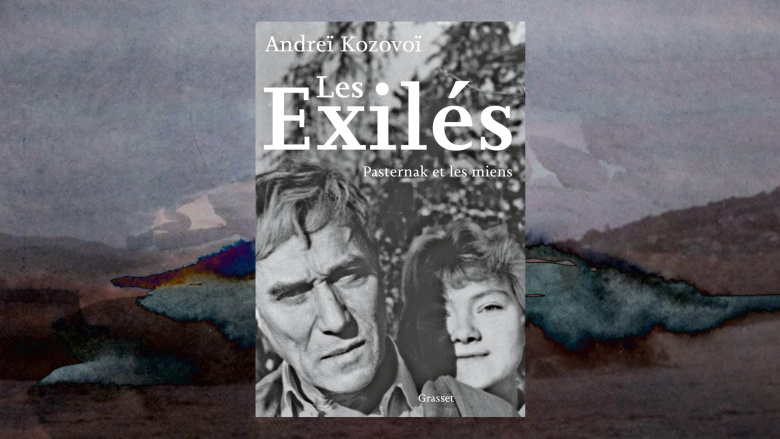
Cover of Andrei Kozovoy’s book “Exiles. Pasternak and my family"
The book begins with the death of his father on March 22, 1999. This death was a complete surprise. Then I write about my father’s roots: the Kozovys are Ukrainian Jews, my grandfather is an anti-Stalinist Marxist. My father was born in Kharkov. In 1957, as a student at the history department of Moscow State University, he was arrested as a member of Krasnopevtsev’s circle, sentenced to eight years in the Mordovian camps. Then - the maternal line, where, of course, a chapter is dedicated to the grandmother, but she is not the main one. The main thing is how the parents met at the camp and how they were united by their love of poetry. After liberation, I describe their fates in the Brezhnev USSR against the backdrop of detente with the West: my father became a translator of French poets and a poet, corresponded with French authors and fought with the authorities for the right to travel to France with my older brother Boris (Borya was born in 1965, he was ill - he has ASD). They were finally released in 1981, then there was a separation for four years and a reunion in 1985 after a trip to the USSR by President Mitterrand, with whom my father met.
I am writing about how my father loved Russia, the Russian language, how he suffered in exile, how my parents became immigrants and spent some time in Russia after 1989, rooted for Yeltsin in 1991 and became disillusioned with him in 1995, after Chechnya (my grandmother then tore up the portrait of Yeltsin that hung on her door: “A small people in their own land,” she said). How they tried in vain to return Olga Vsevolodovna’s archive, confiscated by the KGB in 1960. At the end of the book, I return to the death of my father and talk about how the death of the poet father led to the choice of his son’s profession as a historian. So, of course, the spirit and fate of Pasternak are present, but I wanted to to some extent distance myself from this story, about which so much has been written. I wanted to emphasize the role of the mother, her fate. Fit the novel into the general context of family history.
If we use film terms, the book is simultaneously a prequel, a sequel and a spin-off of the history of OV and BL.
— By the way, how was your relationship with Doctor Zhivago? According to my observations, everyone has their own love affair with this novel, and I consider it not only great, which is obvious, but also good, which is rarely combined. There are pages there that make me cry like a child (or like an old man). How do you like him - and to what extent was Olga Vsevolodovna similar to Lara, according to your observations?
“I may disappoint you, but I never had any special feelings for this novel.” Like many others, I first met him through the film. Music and cinema - that’s what interested me in the first place. Literature itself has never been my passion, and, to be completely honest, I always had to force myself to read the “classics” that my parents fed me. For many years I was deaf to poetry, greatly upsetting my father (with age I began to appreciate poetry more, but I think I will never grow up to his works). But I always took humor, especially black humor, well. I felt the absurd and fantastic in my gut. My favorite authors were and remain Gogol and Kharms.
I certainly inherited from my paternal grandfather, Mark Ilyich, a love of political history and an interest in international relations. I read and re-read “1001 Anecdotes” by Julius Telesin, then Dora Sturman. And then, don’t forget, for some time everything connected with Russia disgusted me: I thought of myself as a Frenchman, I wanted to be “like everyone else.” Reading the novel in 1989, when it was finally released in the USSR, I could not understand much - the emotional impulses of the characters and discussions about the revolution, civil war, the Gulag and collectivization. In addition, the name Lara - Larisa - seemed ugly to me, in no way combined with my “Iga Seevna”, as I called her in childhood. And my parents hardly taught me about family history; they probably wanted me to have a “normal childhood.”
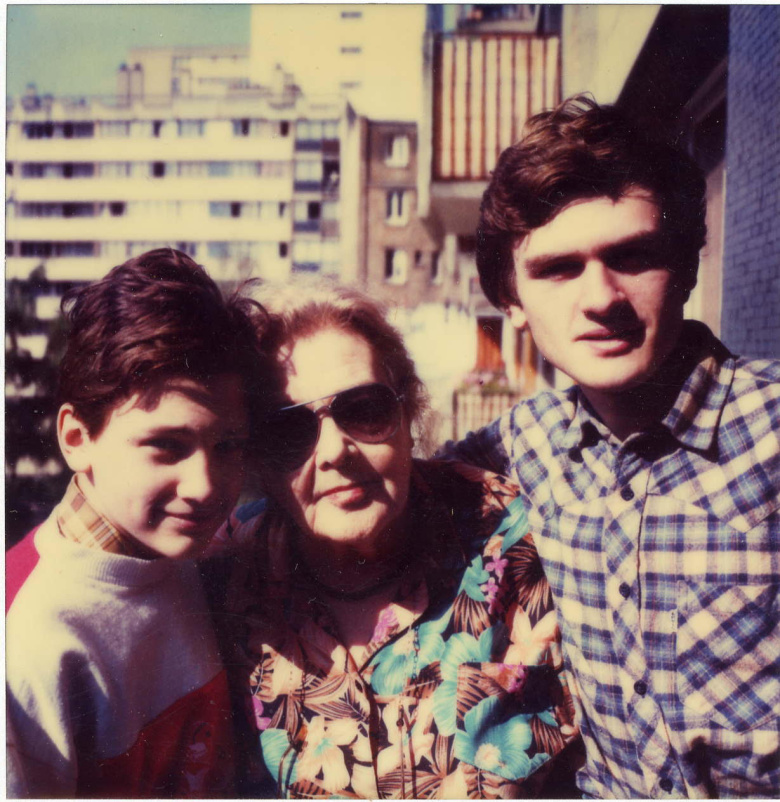
Olga Ivinskaya with grandchildren Andrei and Boris
from the personal archive of Andrei Kozovoy
Much later, I began to understand what was happening: in the late 1990s, after the success of The Black Book of Communism (1997) in France and the publication of my mother’s memoirs in Russia, which were also successful, I became interested in the fate of the family, the role of the Central Committee, the State Security Agency, and the CIA. I became interested in what historians usually call the Cultural Cold War. On behalf of OV, by the way, I can say that her attitude towards the novel was also cool.
- It can’t be.
- Mom testifies. My grandmother grew up reading another of Pasternak’s prose (“Childhood Grommets,” for example, or a very early one). And this first part is about a schoolgirl seduced by her old cousin... She admired something else - the beautiful pages about immortality, Christianity, etc.
— Lara, as Dombrovsky puts it, “a woman of playing fate.” What was so fatal about Ivinskaya that relationships, storms, denunciations, arrests, suicides, oaths, etc. swirled around her? Why exactly do the eras of terror give rise to this type of fatal beauties, and to what extent can Ivinskaya be called a Russian femme fatale?
Subscribe to read in full
Subscribe to Redefine.Media to read Republic
Subscribe [You can pay with a Russian or foreign card. The subscription is renewed automatically. You can unsubscribe at any time.]
Where does the subscribers' money go?