
Translated material
All-Russian telephone census
Why is the state introducing a new register, adding hassle and expense to citizens?

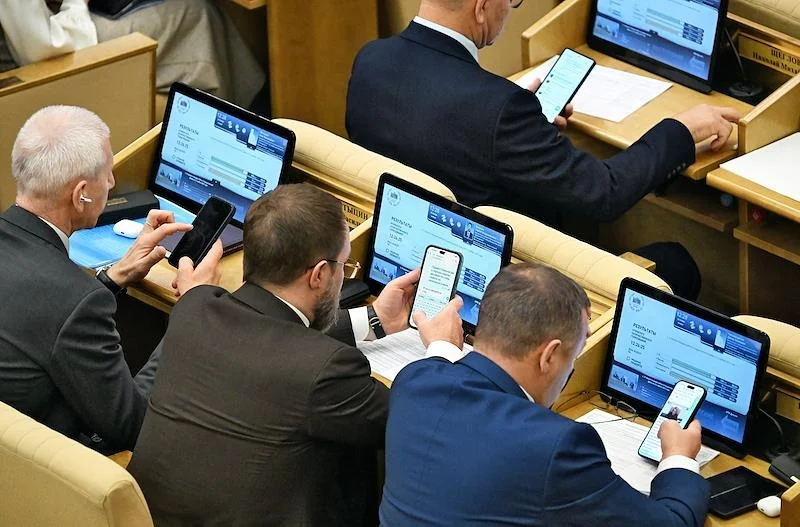
Photo: Kirill Kukhmar / TASS
As part of the “electronic warfare against citizens,” the Ministry of Digital Development proposed the creation of another register. This time it is a database of IMEI addresses, unique device identifiers. Various options are being developed, including registering the device in a contract and linking it to a phone number. The implementation of the initiative will require investment and will inevitably lead to an increase in the cost of both smartphones and the services provided. And (looking ahead) it will not lead to anything good.
Getting into the technical part of the question: each device has a unique identification number. It can be seen by entering the special command *#06# or simply on the box with the device. In addition to simple online registration, the address can be used for additional security - for example, if the phone is stolen. Or, which is especially common in banking applications, as a guarantee that it is not the fraudster who is authorizing, but the user himself.
It probably won’t be a big secret that every operator already sees all these addresses. How they are stored there is a separate question. But in general, this is a completely open and accessible identifier. In some countries, it is quite used to find stolen devices. However, these are all rather superficial solutions. Because there is one more fact, which is also not a big secret:
With the help of simple manipulations and more than affordable software, IMEI can be changed. It is clear that this is not entertainment for every student, but still. Attackers may find options.
Currently, with the exception of the aforementioned banking applications or other software that requires additional protection, there are no serious implementations for working with IMEI. Intelligence services, thanks to SORM and access to operator billing, have the opportunity to obtain data on the registration of a device on the network. Albeit pointwise and without scale, but that is why changing not only the SIM card, but also the device itself is one of the main requirements when ensuring personal safety.
What is going on not in theory, but in normal life? Phones tend to break down, some have several SIM cards from different countries, others just like to experiment and change devices. In this sense, additional registration will only significantly complicate the lives of users and provide an opportunity for others to earn money.
If we consider the initiative from the point of view of ensuring the safety of citizens, then this is an idea from the series “from a gun to sparrows.” Somewhere, like personal searches, it is relevant. For reference: most often this happens not in order to find something from you, but in order to look at your behavior. An ordinary person in large cities is accustomed to this procedure and no longer pays attention to how they rummage through his backpack. Some random hooligan might get nervous. But even here, judging by the effectiveness, this does not save us from terrorist attacks. This is more targeted work.
The story with IMEI is about the same. Let’s say that all the ideas of the Ministry of Digital Development will be implemented in full.
For starters, this is the wildest hemorrhoids within households, where old phones are passed down by inheritance. Now - I cleaned my data and gave the device to the child: just change the SIM card, and that’s it. If there is a registry and registration, you need to go to the salon, call the operator, register the new device.
Prompt replacement of a smartphone, for example in case of loss, is no longer out of the question. Users receive a bureaucratic procedure, interested companies receive large budgets: the development of such a database, integration with operators, maintenance, etc. - this is all very expensive and will not appear out of thin air.
And those who are interested in breaking the law will find a way around it. There would be a desire.
In addition to security, they are talking about fighting the gray market, which is estimated at 200 billion rubles. And these are not only endless channels like China, where hundreds of thousands of inexpensive devices from unknown brands come from. These are also quite honestly purchased devices abroad. Of course, in theory, the opportunity to buy a conditional iPhone abroad will remain, but the number of questions during registration may increase: why? And for what money? This is ironic, but quite plausible. If you imported an expensive device, you pay. Twice: some kind of customs fee and also for registration.
The responsibility for the gray market lies with everyone, but not with the end consumer. We, in the end, are guided by prosaic motives (where it’s cheaper, we bought it there) and the last islands of freedom - it is not yet legally prohibited to buy household communications equipment (after all, these are not industrial radio stations).
If we fantasize and assume that the registry started working right today (which, of course, is fantasy, but acceptable in this genre), it will be a disaster worse than turning off mobile communications. In percentage terms, half the country can fall. In large cities, every phone is an iPhone. And the province, which makes up the main market, is just such, not very white devices. As a result, everything will simply stop working. Moreover, all this does not interfere with the absolutely legal parallel import model. A bunch of devices (subject to sanctions) are imported through parallel channels. What kind of customs inspection is there! And whether they are counted according to the notorious IMEI is not a fact.
Realistically speaking, in the current financial and political situation, the implementation of the registry is possible, but doubtful. To begin with, operators are already experiencing problems with new investments and network development. Endless legislative pressure forces prices for services to increase. Importers are also having a hard time and are forced to raise prices - importing new devices is becoming more difficult and expensive.
And in the end there remains the consumer, on whose neck (more precisely, whose wallet) all this falls. The latter is not getting rich either. Considering rising taxes, falling incomes and other consequences of what is happening, we can say that the supplies in the nightstand are running low.
However, there remains a chance for the threat to be carried out. And within the framework of everyone’s favorite forecasting of the future unknown to us, we can easily assume where the “work” of such a registry will begin. Haven't guessed it yet? Right! From hacking and leakage, as happened with the registry of electronic summonses, the Central Department Store database, the air ticket booking system and other sources of valuable information. We will read what will come of this on the pages of still existing investigative publications.
And after the mythical (for now) registry starts working, hell awaits all owners of smartphones, even those who purchased them absolutely legally and beautifully. Because it will work crookedly and poorly, any problems will take a long time to solve and individually, and in some cases they will require additional costs. If your operator tells you that your device is “not made of glass,” that’s it, buy a new phone. You have to live somehow.
A fashionable trend has emerged in Russia - to solve all problems by creating registries. The idea is clear - it's money. For developers, for fiscal authorities. This is a big corruption hole even in its banal manifestations: if you want to get on the register, you have to pay. If you want to be expelled, you also have to pay. And if it all worked, we would have lived in a happy and safe country a long time ago. But judging by the fact that the weather outside is different, it doesn’t turn out very well. So we can safely say: the registry of IMEI addresses of devices is just a way to make money and once again complicate people’s lives. There are no more reasons for it to appear.