
Translated material
“The theater deliberately did everything to become a victim of repression.” Lisa Birger's conversation with Mikhail Kaluzhsky about censorship in the theater
The publishing house Palgrave Macmillan published the book “Performing Censorship: The Russian Case” by Mikhail Kaluzhsky and Yana Meerzon - the first monograph on censorship in Russian theaters in the 21st century. Mikhail Kaluzhsky is one of those who can speak about Russian theatrical censorship as a witness, participant and researcher at the same time. A journalist, theater curator and playwright, he directed the theater program at the Sakharov Center (2012–2014), at the time the only venue in Moscow where LGBT* activists could perform and plays about Soviet repression were staged. Mikhail Kaluzhsky told Lisa Birger about how and why the theater in Russia became the object of large-scale repression.
— Don’t you think that 300 pages is very little for the chronicle of Russian censorship in the theater?
- Undoubtedly. Moreover, this book is strange, and my co-author Yana Meerzon and I are clearly aware of this strangeness. For example, the first chapter, historical, begins in the middle of the 18th century and ends with the year 2000. And the remaining chapters are focused on the events of the 21st century - we end our chronicle with the dismissal of the appeal in the Berkovich-Petriychuk case in the summer of 2024.
This is our common decision with the publishers, since theatrical censorship in Russia before 2000 has been more or less described. Although this is not to say that there are many books on this topic. For example, the only monograph devoted specifically to theatrical censorship was published in 1917, even before the revolution. This is Baron Driesen's book “Dramatic Censorship of Two Epochs”. He was a playwright, a censor, and an impresario - as often happened in tsarist Russia. Quite a lot has been written about the Taganka Theater; Bulgakov’s censorship misadventures are well known. But Russian censorship in modern theater, oddly enough, has not been systematically described.
It seems to me that we were the first to put all this together and compile what, in fact, the book begins with - a table of laws that are used by the authorities for censorship purposes. After all, Article 29 of the Constitution of the Russian Federation directly prohibits censorship - but censorship nevertheless exists.
— At the same time, you and Professor Meerson are quite far from the subject of your research. And you haven’t seen many of the performances you write about. Did this somehow affect the quality of the study?
— Since we are not talking about theatrical criticism, it is not always important for us to see the performances themselves. Some are on video, then for the book we talked with Marina Davydova, Mikhail Durnenkov, Elena Kovalskaya and other people from Russia, whose names I cannot name for security reasons
But the main source of information for us was the Russian laws themselves and public discussions about certain performances. Let’s say we might not have seen the play “First Bread” in Sovremennik, after which “Officers of Russia” attacked Liya Akhedzhakova - for our purposes, what was important was the fact of this attack and the public discussion around it, and not the acting.
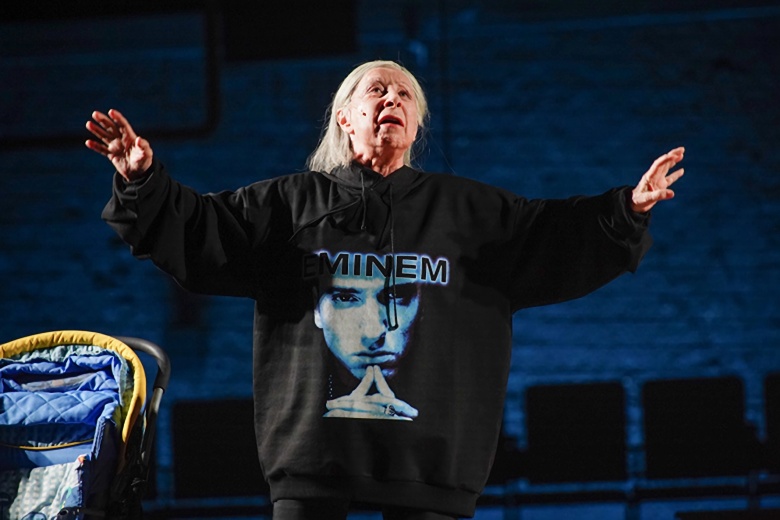
Liya Akhedzhakova in the play “First Bread”, dir. Beniamin Kots, Sovremennik, 2021
— As far as I understand, for you the history of censorship in the Russian theater is also a personal story. You were originally a philologist and journalist - where did theater begin for you, how did you end up in it?
— It all started in 2007 or 2008, I was then the editor of the culture department of the Russian Reporter and spent a lot of time at Theater.doc. And one day director Georg Geno suddenly said to me: “Don’t you see yourself as the host of an interactive play? What if your co-host is Verochka Polozkova*?” I chuckled. As a result, we turned out to be a good couple - such a combination of Woody Allen and Scarlett Johansson: energetic, detailed, bursting with energy Vera and such a boring me. The performance was called “Society of Anonymous Artists.” We played it in Doka, took it all over the country from Vladivostok to Petrozavodsk. And then I came to the Sakharov Center - and everything started to happen.
My first independent performance was about the Holocaust, about personal responsibility. In Tomsk, at the Youth Theater, the play “Uprising” about the uprising of special settlers in 1929 was staged for two years. In the Sugar Bowl - a joint performance with Alexandra Polivanova “Second Act. Grandchildren,” which we also took all over the country. Then there was “The Weight of Silence” based on Dan Bar-On’s book about conversations with the children of former Nazis and “Stalin’s Funeral” for Serebrennikov.
— It turns out that the subject of your research is, among other things, yourself, and in some way your book is an autoethnography?
“I feel very well the duality of this position. Moreover, I myself don’t really like it when an activist becomes a journalist or researcher. But at the same time, as a person who has been inside, I have a much larger amount of information, as well as an understanding of where and how to look for this information, who to talk to, and so on. In addition, I had a co-author who was fine with research distance.
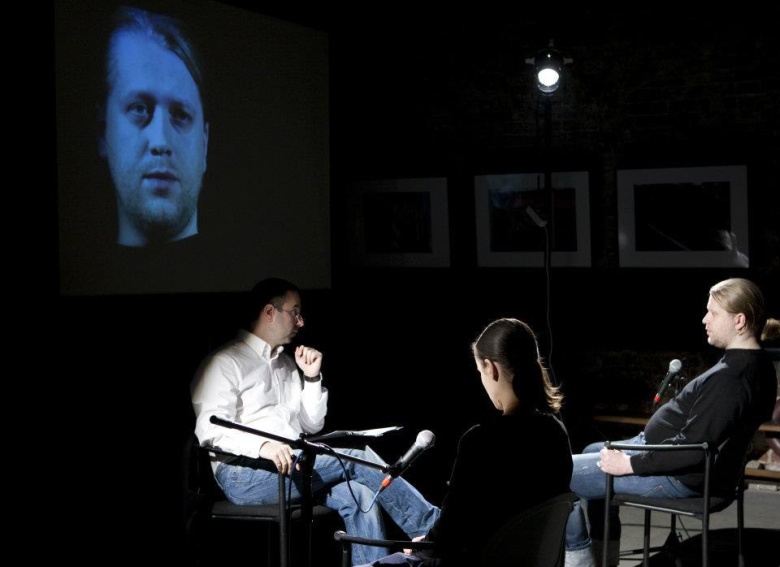
The play “The Weight of Silence”, dir. Mikhail Kaluzhsky, 2012
And besides, for me Russian theater is already a thing of the past. I left Russia in 2014, did some small things, wrote plays in English for various small theaters and festivals. But now, one might say, he has finally moved to the position of an observer. I don't do theater anymore - I watch it.
— Let’s talk about the story of the play “Moscow Trials,” which was staged at the Sakharov Center under your supervision and became, as I understand, an important episode in the development of Russian censorship in the theater.
Subscribe to read in full
Subscribe to Redefine.Media to read Republic
Subscribe [You can pay with a Russian or foreign card. The subscription is renewed automatically. You can unsubscribe at any time.]
Where does the subscribers' money go?