
Translated material
SVO supporters are again bots
How many Russians actually want the continuation of hostilities in Ukraine: results of a telegram survey

Photo: Alexander Shcherbak / TASS
A large survey by Novaya showed that there is an absolute minority of supporters of continuing the SVO, but the illusion of “popular” support is being constructed with the help of bots. Nobody represents the real majority of Russians in power. How it works is in our analysis.
Military operations in eastern Ukraine continue. Diplomatic efforts that had begun fell by the wayside. Now they are publicly discussing something else: the resumption of comprehensive nuclear tests...
Government agencies show the results achieved: here are the ruins of Marinka, a former city of 10 thousand, where today only one resident, Galina, lives in the only surviving kitchen with a broken window, who herself does not believe that the city can be restored.
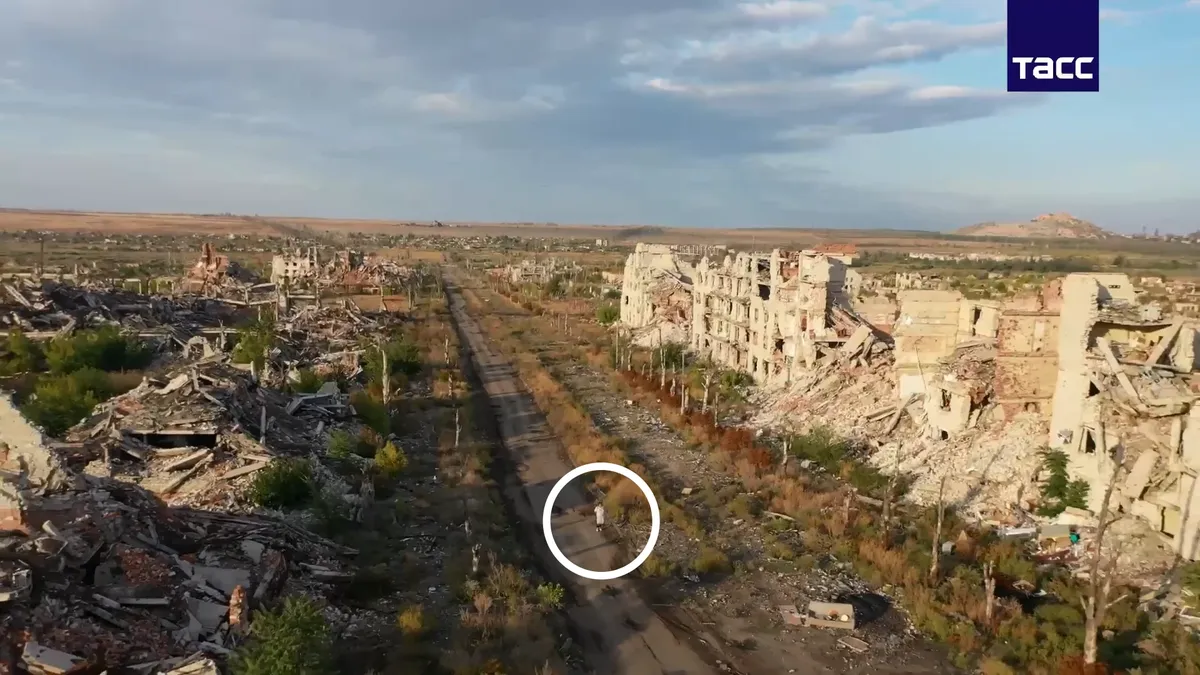
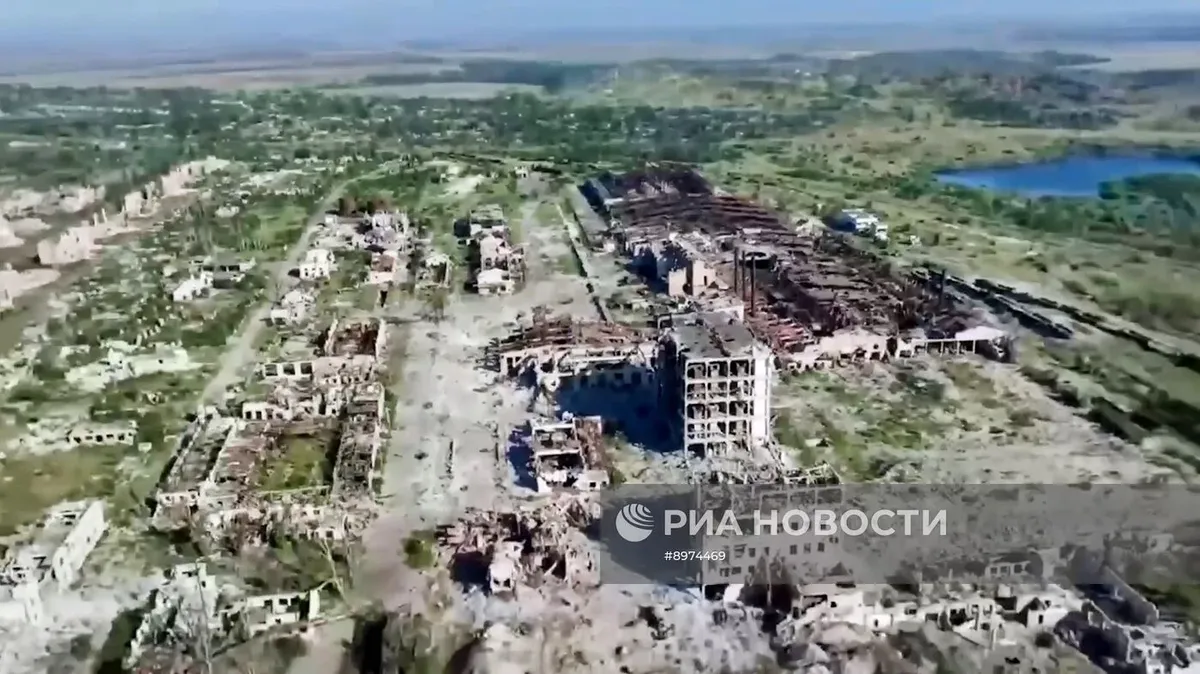
Here are the ruins of Chasov Yar from the RIA Novosti chronicle - the “key city” to the Northern Donbass, in which not a single intact house remains.
Are there voices calling for a ceasefire? Eat. Russian politicians and activists talk about this - but only in courts and in the status of those accused of “discrediting”.
Meanwhile, the Northern Military District will soon “overtake” the Great Patriotic War in its length.
Do politicians base their decisions on public sentiment? They tell us: yes, they focus only on them. What then do Russians think?
Even according to official data, the share of supporters of a cessation of hostilities is steadily growing, as is the number of those tired of fighting. But still, what is it like at the end of 2025, the third year of the Northern Military District?
Novaya Gazeta has repeatedly over these three years tried to demonstrate this ratio in our telegram surveys, the “purity” of which we are able to monitor using reliable technical means**.
REFERENCE
We understand that when we talk about a survey in the telegram channel of Novaya Gazeta, we are talking about the views of an audience consisting one way or another of like-minded people. And not all of Russia uses telegram.But, firstly, the audience of other telegram channels, including million-plus channels, is coming to large and important polls - and we see this from the open statistics of our channel.
Secondly, during such surveys we have a good opportunity to observe how online voting in telegram generally works on fundamental issues in our country, and whether it is worth it to easily take on faith what the authorities present to us as voting results, citing popular support, on issues such as SVO. Or, for example, tax increases. Or the issue of communication blocking.
Let’s take such surveys in our channel only for the last year.
In August 2025, when the Nobel laureates called for a truce, we asked our readers about this, and 95% of all those who voted supported the Nobel laureates’ initiative, demanding an immediate ceasefire. We got 95% by subtracting votes cast by bots. We recorded cheating only for the option that the SVO should be continued, and we told in detail how we caught the bots, how much they threw in and where. And they threw in a lot: if the real ratio turned out to be 95% / 5%, then with bots and in full view it was completely different: 54% for SVO / 46% for termination.
The point of the attack was a clear signal: the majority is supposedly still calling for the trenches.
This signal gives rise to that very familiar contradiction to many: why, if everywhere they talk about a certain “majority” that supports the SVO, among my friends there are very few of them, if any.
Who accuses bots of voting, which they present to us as “popular” support?
In October 2025, links appeared to closed polls by VTsIOM for officials, in which 56% of Russians admitted that they were supposedly “very tired” of the SVO, and less than 20% of citizens wanted to continue hostilities.
How many “bots” were within this 20%?
***
On November 10, we launched a new poll: should we cease fire immediately or continue hostilities between Russia and Ukraine? At the time of completion, almost 50 thousand votes were counted in the survey. And again the results “signaled”: 63% of the votes went to supporters of continuing the SVO.
But let's not rush. How many of this number were real votes and for which option the bots “sank” - we will tell you and show you in pictures.
REFERENCE
Signs of a bot attack
First, let's remind you why we believe that we are being attacked by bots, and, for example, we are not dealing with people and their beliefs.
The fact is that there are two ironclad conditions that invariably appear during algorithm attacks:
The number of votes for one of the answer options rises sharply, and then drops just as sharply, while the other options do not react in any way to this anomaly, and in open sources at this very time there are no announcements calling on other bloggers to come and vote in our poll.
During “anomalies,” votes are cast in equal portions per unit of time—living people simply cannot vote.
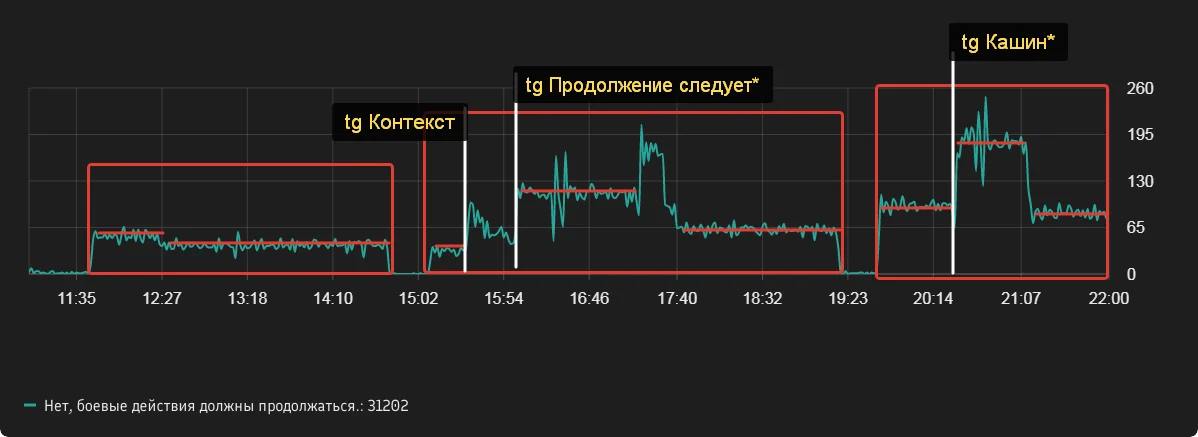
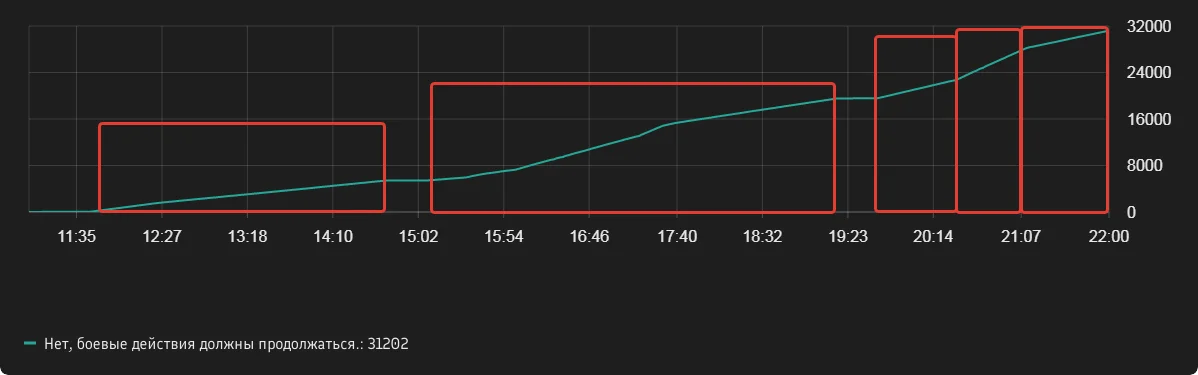
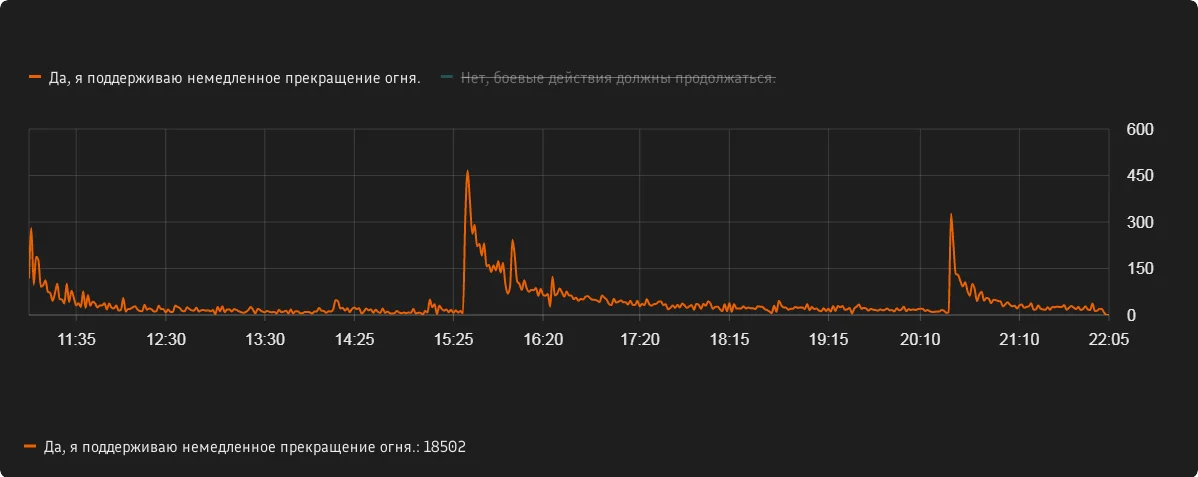
First attack. We launched at 11.07 Moscow time on November 10 - and after 40 minutes we received the first attack. The bots came to vote for the option: “the fighting must continue,” and they spent exactly three hours pumping up the statistics, throwing equal batches of votes into the poll (about 40 every minute). On a graph of minute-by-minute voting, this looks like a “plateau.”
Therefore, we added up the votes during this three-hour anomaly, subtracted from them the “norm” of votes that would have been cast by living people during these three hours, and found that during this attack we were given at least 5,000 votes for the option “SVO must be continued.”
(Hereinafter, we will round the number of suspicious votes down to the nearest thousand.)
Then there were several minutes of silence. And - a new attack, of even greater intensity.
The second attack lasted more than 4 hours - from 15.09 to 19.18 Moscow time. Its intensity this time was different, but the “plateau” remained everywhere.
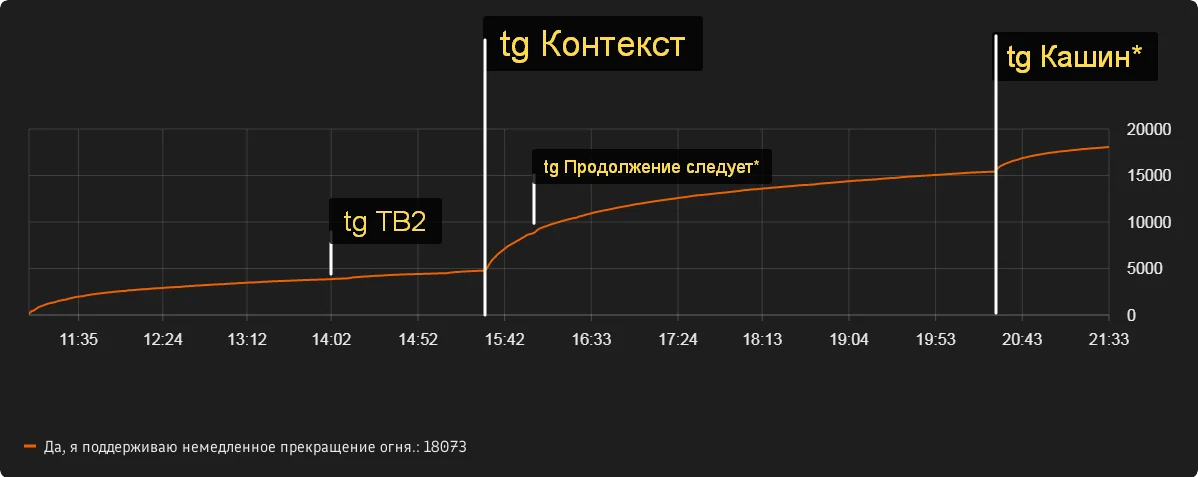
We summed up the votes of the second attack, subtracted from them the “norm” of votes for this answer option during this time, and subtracted votes with signs of organic (at 15.30 the survey was talked about in the large telegram channel “Context” with 800 thousand subscribers, and at 16.00 - in the channel “To be continued” * with 50 thousand readers). It turned out that at least 11 thousand more votes were thrown into the second attack.
The third attack took place another 15 minutes after the second and was the most intense. Again, as expected: a sharp increase and a “plateau”, already 70 votes every minute... We curtailed this attack by stopping the poll. We count: from 19.42 to 22.02 more than 11.5 thousand votes were cast, there were two waves (the second began after the telegram channel Kashin* with 70 thousand readers gave a link to the survey), we subtract the “norm” of votes and votes with signs of organic matter. There remain at least 8 thousand suspicious votes.
How much has been thrown
In total, over the course of three attacks, we received at least 5+11+8=24 thousand votes for the option “fighting must continue.”
What does a normal vote look like?
Why only this option? Let's take a look at what 100% organic voting looks like. Here is a graph with curves for the option: “I support an immediate ceasefire” and the normal behavior of the graph of votes cast every minute.
“Clean” survey results
All we have to do is subtract all the bot votes from all the poll votes and recalculate the new 100%.
49,729 - 24,000 = 25,729 votes. This is how many living people, according to our calculations, voted in the survey. 25,729 is the new 100% of accepted votes.
Then the “clean” results will look like this:
Do you support the call for an unconditional and immediate ceasefire between Russia and Ukraine?
72% ( 18,502 votes) - Yes, I support an immediate ceasefire.
28% ( 7,227 ) - No, fighting must continue.
We excluded 24,000 suspicious votes (bots) from the survey. All of them were submitted for the option: “The fighting must continue.”
Conclusions
The main conclusion: the request for peace exists, but is completely “trampled down” in the interests of the authorities on any platform. Response time is 30 minutes (almost the standard for an ambulance). You can imagine how the octopus control bot works and where it has already extended its tentacles.
However, it is a fact: the “popular support” of the “continuators” of hostilities is imaginary.
The opportunity to show the mechanism of stuffing and cheating gives us reason to doubt the legitimacy of other mass surveys presented to us as “popularly approved.” Not only regarding support for military operations, but also the idea of raising taxes, expanding lockdowns, and unleashing even more repression against “internal enemies.”
The state “pictures” a comfortable people for itself and tries to convince people that their thoughts and desires do not find support in society, that they are alone.
And he begins to believe it himself.
* The Ministry of Justice included “foreign agents” in the register.
** Telegram survey monitoring tools from KONSKY.media.
This material was published in the fifteenth issue of Novaya Gazeta. Magazine". You can buy it in the online store of our partners.