
Translated material
First quarter of this century
2025 has become a year of great anxiety - not only for Russians
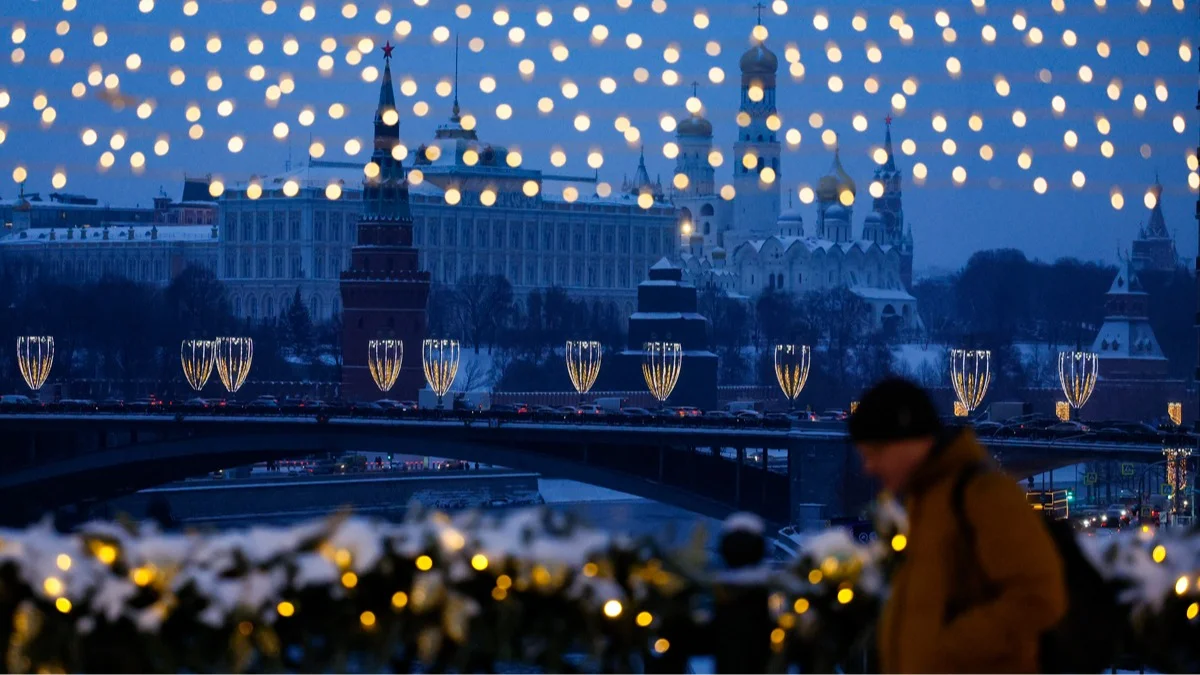
Photo: Sergey Ilnitsky / EPA
2025 turned out to be a time of unfulfilled hope for peace. Official sociology in Russia says that two-thirds of citizens are in favor of immediate peace negotiations. A noticeable part of these sentiments is associated not only with the desire to return to normal life, which persisted in the previous years of the war, but with the legalization of the idea of peace negotiations. Propaganda promised people peace with the arrival of Trump. Russian propagandists probably always understood this peace as the capitulation of Ukraine on Putin’s terms, but they were often embarrassed to talk about it openly. As a result, throughout 2025 the whole country was waiting for “it all to end,” but Putin again chose war.
A familiar reality in 2025 has collapsed not only in Russia: the entire planet is engulfed in political and technological processes, the results of which are difficult to predict.
Humanity has just experienced a technological revolution that has led to a radical democratization of information processes (anyone can say anything to an unlimited audience), but has also concentrated unprecedented global power in the hands of the owners of major media platforms (Elon Musk's purchase of Twitter back in 2022 is a case in point).
This revolution has made possible the figure of the influencer - a person who spreads his views to a huge audience. It has also given rise to a new type of politician who rejects traditional party systems or the media and prefers to address their supporters directly. Donald Trump became a typical example of such a politician, and by 2025, every democratic country from Argentina to the Czech Republic had its own equivalent of Trump. Ukrainian President Vladimir Zelensky is also one of the new types of politicians, and unfortunately for the Kremlin, the former actor turned out to be a military leader who chose resistance over flight. At the same time, the emergence of a new type of politician led to the collapse of the “West” as a political idea. While the European Union still defends the rules and values of a post-war world focused on human rights and institutions, the United States has started a new game of its own: the Trump administration is being carried away by tariff wars aimed at global peace and a concept of national security that says goodbye to the US role as a defender of democracy on a global scale.
In previous eras, one such media revolution would have been enough to redraw the political map of the world and the economic structure. This was the case with the invention of mass propaganda (radio) and the development of totalitarianism in the 20th century. But in our case, on top of the first technological shocks of the last decade, comes first the first pandemic of the global world (COVID-19), and then artificial intelligence.

Because of Putin’s obsession with war, Russia has found itself on the sidelines of the artificial intelligence race (in this area the country literally no longer has “raw materials and personnel”). The revolution of neural networks occurred exactly at the moment when all the Kremlin’s resources were aimed at storming Avdeevka. China and the United States, meanwhile, are competing to create AGI, an “artificial general intelligence” that would match human-level cognitive abilities and quickly surpass humans in the ability to solve our human problems. The discovery of AGI will give one of the superpowers a decisive advantage over competitors in the fields of scientific discovery, medicine, the development of new technologies and war.
No one will seriously predict what the world will be like in five or ten years, given the frequency and scale of technological revolutions that current generations of people are experiencing. No one knows how the main social institutions will be structured in the world where children born in the first quarter of the 21st century will grow up. And this leads to anxiety: just as a century ago, when the world experienced accelerated urbanization and the destruction of pre-modern life patterns, people are looking for simple answers in the face of new challenges. Today, only irresponsible populists can seriously offer simple answers, who base their politics on calls to return to the “golden age” and find a social group that will be named guilty for the general anxiety. Depending on the regional specifics, the culprits may include migrants, bureaucrats and representatives of the Deep State, queer people, leftists, or representatives of the wrong ethnic groups or religions.
Humanity is entering the second quarter of the 21st century, and this century risks repeating and scaling up the worst crimes of the previous century, in relation to which many of us were firmly convinced that deportations, genocide, civil wars and world wars were a thing of the past.
Three groups of political structures will determine what awaits us in the near future. These are dictators of the old type, who managed to survive all the technological revolutions of recent times and retain power. They have reintroduced the fashion for war, and their dream of a multipolar world in practice means the right of the strong to do arbitrary acts against their neighbors. Then there are the new populists who, without any basis, promise their voters in democratic countries a predictable future: you just need to trust the populist for a golden age to come. And finally, democratic systems of the old type, waging a rearguard battle for values like human rights, which the further they go, the more they look like a vestige of the second half of the last century.
The era of change has been somewhat delayed. We are its witnesses and participants. And if not for the war, all this would have been an endlessly interesting experience. At the end of this series, everyone will know whether the proponents of democracy succeeded in reinventing it for the second quarter of the century. The alternatives, called populism, techno-feudalism and even techno-fascism by researchers, are not very impressive.