
Translated material
Best David Bowie joke. Kirill Kobrin - about a man who fell to the ground
David Bowie was born on January 8, 1947, and died on January 10, 2016 - 10 years ago. But the Bowie myth continues to live even after the musician’s death - only in 2025, David Stiasny’s film “Bowie: The Final Act” was released, the Arte channel released its tribute film to the anniversary of his death, and the artist’s 80th birthday coming a year later will certainly be celebrated on a grand scale. Republic publishes an essay by Kirill Kobrin about a man who fell to the ground to offer this world - let's dance!
“I have two pieces of news,” he wrote to his friend Gary in the summer of 2015. “The bad thing is that I have a big R. The good thing is that my cheekbones are back.”
“Big R” (English big C, Cancer) then returned to David Bowie, as did the cheekbones that appeared on his face due to sudden weight loss: a remission at the beginning of the year was followed by a relapse in the summer. The joke is great, like all Bowie jokes I know; Below in the text I will even try to use a couple of them. Now let’s not be distracted from talking about jokes on a specific issue - about the “big R”. After all, I’m also trying to joke about his return, like he missed me, my friend, he can’t live without me, something like that. Or this: thank God, finally I don’t have to make long-term plans, let those around me think about the future, and I can relax, enjoy the moment, and finally live for my own pleasure. The pleasure is not very great, that’s true, but there is something in all of this.
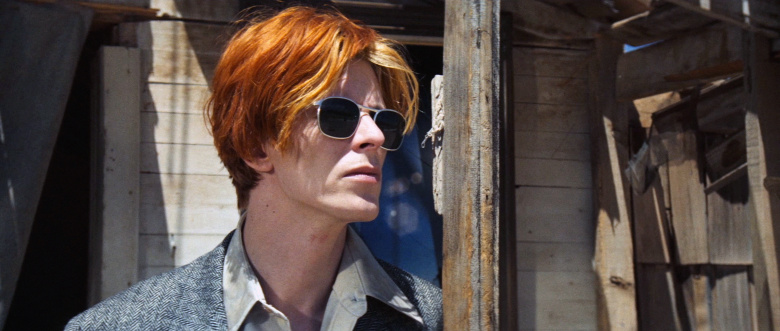
David Bowie in The Man Who Fell to Earth (1976, dir. Nicolas Roeg)
So my jokes about my “big R” come out quite sour, even cheerful and elegant, like Bowie’s, I hope. And here the question arises, for the sake of which I started this conversation - am I in this case an epigone of David Bowie, or are we going, so to speak, on parallel courses? Or does Bowie's influence occur rather at the levels of existential intention and cultural intonation, and then I myself make jokes from the material of my own life? It turns out this way: the very desire to joke about the return of my “big R” - which seems to imply a different kind of reaction and emotion - appears under the influence of Bowie. And the way this joke is “delivered” to the audience, the structure of this “medium” (but not the “message” itself!) - here Bowie has a direct influence on me. Otherwise, no. My jokes are different. So, I'm not an epigone.
Which is very important to understand, because it answers a question that has been tormenting me for several decades.
Why did Bowie, who influenced a huge number of pop musicians, have virtually no epigones?
I only know one, Gary Numan, and he's the only musician I know of that Bowie was openly hostile towards.
Bowie, especially in the last 40 years of his life, was a model of tact, politeness, and good manners, at least in his relations with the outside world. We don’t know what he was doing there in the company of friends and relatives, no one let it slip. However, since the 1980s he didn’t really have any friends, especially after his marriage to Iman. Bowie waved his hand to the world and retreated to the carefully guarded privacy of a wealthy New Yorker. Coco Schwab built an impenetrable wall around Bowie, having appeared near him back in the mid-1970s - she managed to look after him even in the Berlin apartment that he shared with Iggy Pop, and this says a lot, almost everything.
But we have strayed away from the all-important question of influence. Young Gary Newman in the late 1970s adored Bowie, imitated him, tailored his image to him - and teenagers followed Newman. Of course, in a sense he was an epigone, but he didn’t understand it or something. But Bowie was seriously angry. Evil tongues and well-meaning commentators unanimously claim that the aging (more than 30!) hero of the pop underground became angry with a nimble young competitor, who allegedly appropriated the makeup the classic deserved and stole his fans. Indeed, at the turn of the 1980s and at the very beginning of that decade, Bowie began to lose ground. The milestones that he reached starting from 1975-1976 turned out to be occupied by others, and, moreover, occupied as if by his own, but younger and - what is important - musically more monotonous, or rather, one-sided.
https://www.youtube.com/watch?v=na8xgu-KLAk
As soon as Bowie in 1974 gave up playing “real rock” with gashes and the like (and glam, musically, is rock and roll taken to a comical limit), said goodbye to Ziggy (Ziggy played guitar, jamming good with Weird and Gilly!) and the Aliens, he began to play with a variety of pop genres, from soul to the then young electronics, from the Crooner stage to the funk. The whimsicality, richness, lightness and, ultimately, a strange disinterest in the result of this game cannot be compared with anything that has ever been done in pop music. In five years, from 1975 to 1980, six albums were released (plus Iggy Pop's "Idiot" - let's be honest: it's David Bowie's album, sung by Iggy Pop), about which it is even difficult to write something ordinary, positive or negative, good or bad, praise or scold. These are things that exist on their own, a kind of musical monads, we can admire or hate them, or simply not relate to them at all, which is what the vast majority of people do, but these are some very special cases of pop culture. Aliens, if you will. The strangest thing is that they were very popular, especially among teenagers.
Subscribe to read in full
Subscribe to Redefine.Media to read Republic
Subscribe [You can pay with a Russian or foreign card. The subscription is renewed automatically. You can unsubscribe at any time.]
Where does the subscribers' money go?