
Translated material
How Russians try to get asylum
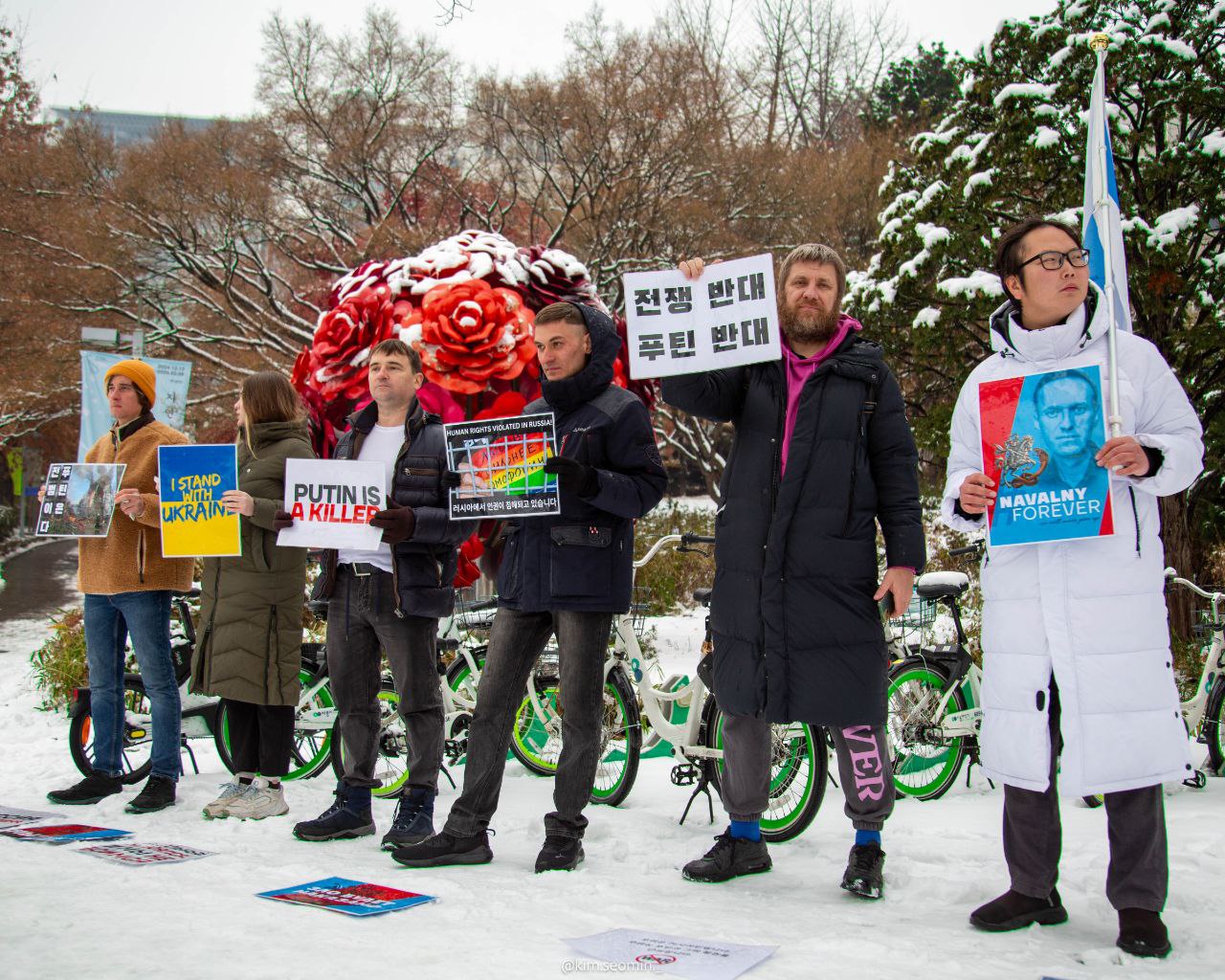 In a normal situation, a person moves to another country, having prepared himself, with documents and legal grounds to live in a new place. Among the hundreds of thousands of Russians who have emigrated in recent years, many have big problems with legalization, and the Russian passport is now only an additional irritant for the bureaucracy in a number of countries. Russia is left not only by people with stable jobs and opportunities for fulfillment in new countries, but also by those who are fleeing repression and criminal cases, persecution for words or anti-war actions. Journalist Ilya Azar, specially for Cherta, tells the story of an activist who has lived in Korea for many years and is trying in vain to achieve asylum.
Alexander Koloskov, an opposition activist from the city of Artem in Primorye, left Russia before the war, on April 20, 2019. He was warned by his acquaintances in the special services: “There is bad information about you, in a week you can go missing, there will be extrajudicial decisions. We will not be able to intervene.”
— We have such customs in the Far East. People are being killed here, and the security forces are connected with bandits in one way or another. That’s why I took it seriously and didn’t take risks,” says Alexander.
He had reason to fear the more usual—criminal—prosecution. Back in 2017, Alexander’s apartment was searched in connection with a libel case. “I then participated in the elections to the Legislative Assembly of the Primorsky Territory, and a representative from the government was greatly offended by my words that the elections were rigged, filed a lawsuit and wrote a statement to the Investigative Committee,” recalls the activist.
Two years later, he borrowed money for a ticket, quickly packed his things and flew to Korea. Because it’s nearby, and he didn’t have a Schengen visa.
- I had no choice. Where else? It’s not a good idea to go to China. No visas, no money, nothing,” Alexander explains his decision.
— What about Tbilisi? Kazakhstan? — I name the more popular destinations for emigrants from Russia.
— Korea is clearer for us, we had acquaintances here, but Tbilisi is far away, I don’t know anyone there — it’s just going into the unknown .
Although Alexander hoped that he was leaving for just a couple of months, they soon clearly hinted to him that he should not return. “They said that I got everyone there with my team, and if I’m not there, there will be silence,” Alexander conveys the essence of the conversations.
That's when he made his first mistake. Requested political asylum in South Korea.
“I didn’t think that I left the country forever,” explains Alexander. - Yes, I still don’t think so! Someday, maybe we'll come back.
Denied Asylum
There were more than 5 thousand Russians like Alexander in 2023 alone . This is more than for all the years from 1994 to 2019 combined.
However, Korea is reluctant to provide asylum to foreigners. “They don’t give it to almost anyone,” admits Alexander. Some even have to live in the airport transit area. However, in June 2024, South Korea granted asylum to a draft evader for the first time.
While Alexander was waiting for the trial (and it took four years), he did not waste time: he met the Filipina Hazel and soon married her. They had a daughter, Alena, although Alexander had not seen her in person for a very long time.
“When she was a month old, we sent her to her parents. In my status, I can’t fly to see her, but my wife flies about once every six months,” explains Alexander.
- But why? - I’m surprised.
- Many people ask, but understand: we both work, but we live on one salary - we send the second to the Philippines. If my daughter had stayed here, someone would have had to stop working. Plus there’s a village there, a whole street of relatives, she’s very socialized there, but here it’s a concrete jungle,” Alexander explains his position and assures me that this is better for his daughter.
Moreover, Alexander says that one salary would definitely not be enough to provide for his family and pay the lawyer who is accompanying his refugee case.
He, according to Alexander, was sure that with such a powerful case as that of the activist from Artyom, it was impossible to lose the trial.
“There are criminal cases, detentions, and protests in Seoul not even since the beginning of the war, but even before that - against dishonest elections and in support of Navalny,” says the activist. “He told me: “I’ve won a lot of cases, but this case is the strongest I’ve ever seen.” He reassured me, and when I was denied asylum in 2023, he didn’t know what to say.
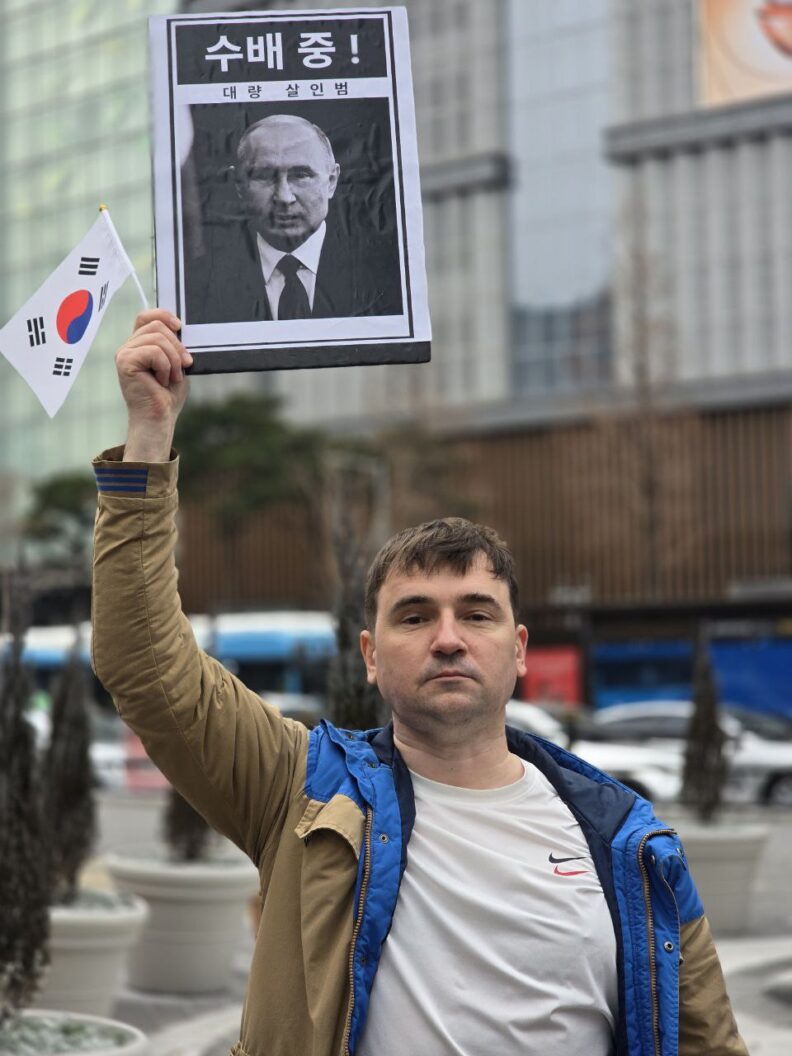
Later, all other authorities, including the Constitutional Court, agreed with the first judge. Formally they refused due to insufficient grounds. One of the obvious disadvantages of Alexander’s case is the absence of an open criminal case or presence on the Rosfinmonitoring list of extremists and terrorists.
“But my mother lives in a military town near Vladivostok, and once a friend, whose daughter works at the airport, told her that I appeared on some lists there. I asked the guys to check the Chimera, and indeed beacons appeared on me that I was an extremist terrorist and organizer of protests,” says Alexander.
But for Koreans, according to him, “Chimera” is incomprehensible; they believe that since he has not been in prison, and there is no case, then the risk of returning to his homeland has not been proven.
Systemic views, service in Chechnya
Alexander has other suspicious moments in his medical history.
Alexander’s father was a career military man: first he served at an air base near Vladivostok, then for five years in Germany, in Belarus and again in Vladivostok. The mother did not work, she raised Alexander and his older brother.
“I grew up in military camps and, naturally, I wanted to become a military man myself,” says Alexander.
He served his military service, after which he joined the private security service of the Ministry of Internal Affairs, and two years later, in the early 2000s, he decided to transfer to the riot police.
“I wasn’t such a bun then as I am now, and they immediately asked me: “Will you go on business trips to Chechnya?” I was a little over 20 years old, and I answered that I would be there and went on one business trip,” he says.
According to Alexander, for six months he stood at the 112th checkpoint near the village of Mesker-Yurt , not far from Argun: “a four-way intersection where we made sure that stolen oil was not transported, people were not stolen, all that.”
- Did they shoot?
- In different directions. There were several attacks on the checkpoint; they fired at us from somewhere in the forest belt, and we fired back at them. Sometimes it later turned out that it was our troops who were shooting from another road,” Alexander answers. “But we did not participate in purges, did not kill the local population, did not torture.
True, he immediately admits that if such an order had come, he “would not have doubted it at all.” He explains this by the work of the political officer and psychologists.
- They say: “No, you don’t kill anyone, especially not a person. You destroy the enemy’s manpower, you eliminate the danger to society. And such work is carried out constantly,” says Alexander. “And an employee is never punished for excess. On the contrary, they will say: he’s handsome and well done.”
Alexander was fired from the riot police: “there were frictions with the leadership.” Having worked as the head of the security department in one of the retail chains, in 2008 Alexander signed a contract with the Ministry of Defense: “I already had some years of service. That is, another 10 years, and a pension.” Served as an aircraft technician.
Alexander admits that he does not like to remember Chechnya, because his views have long changed.
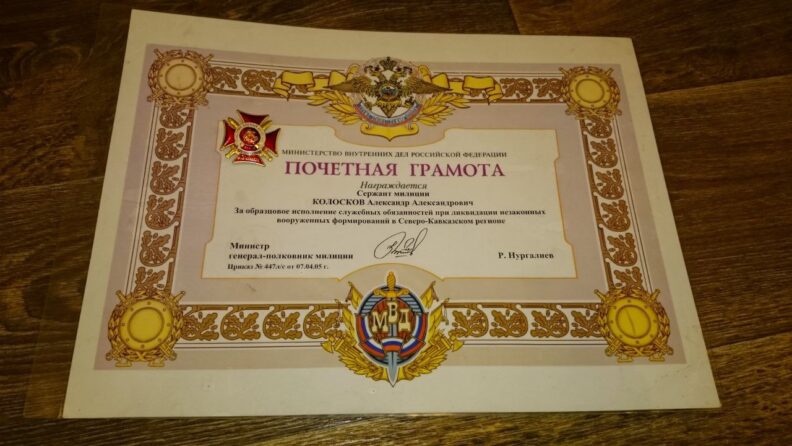
- It's like a dark spot, right? I understand that I was a cog in the system for 11 years. I also have a certificate from the Minister of Internal Affairs for exemplary performance of official duties in the counter-terrorist operation in Chechnya. “I was an excellent police officer, the best employee of a special unit,” Alexander says almost guiltily and immediately grins. “It’s funny that now I’m the one the KGB follows in Seoul.” That is, the roles have changed!
Alexander says that he still doesn’t understand how he “broke out” of the system, but he definitely doesn’t regret it.
“We are now on the side of light and goodness, no matter how stupid it may sound.” Being against war is downright cool. When everything turns upside down in our country, I would be very interested to see, including some of my relatives, who support all this. To hear them say: “Yes, we are simple people, how could we know?” - Alexander argues.
Without rose-colored glasses
Alexander’s epiphany came thanks to higher education and a new circle of friends, he believes. And also because of Russian corruption and the reaction of fellow citizens to its exposure.
“Suddenly you realize that you kind of looked at everything through rose-colored glasses, and everything is really wrong,” he says.
In 2016, Alexander was fired from the army because he “handed over” information to the Investigative Committee, the Prosecutor General’s Office and the media about the theft of kerosene from his military unit.
— I told how fuel trucks leave with drained kerosene. I shouted to the whole subject about what was considered normal for 50 years, and became enemy number one,” says Alexander (however, I was unable to find any mention of this event on the Internet).
Society did not accept his action. "Everyone asked why I told about this, because the military camp is supported with this money. I said: “These are the enemies of the people.” The war will start, and they stole all the kerosene." They answered me: “No, you are the enemy, because you told about it,” Alexander complains.
Then Alexander began to wonder what was wrong with those around him and gradually took up activism.
— It all started with little things: a landfill, some open hatches. Then he grew into a team and began to do various things in the city, then in several cities, and then the entire region was covered,” says Alexander.
That same year, he joined the Communist Party of the Russian Federation: “We, young and active, were drawn into the party. And then, when you want to fight, they tell you to wait, they demand that you coordinate everything with the leadership, they don’t let you take part in elections, they offer you to stand with the flag for now, and in 10 years, maybe they’ll let you run for elections to the Artyom city council.” Alexander calls party life in Russia “a refrigerator for hotheads.”
He was also expelled from the Communist Party of the Russian Federation. According to him, for “telling the media who they really are.” For example, Ishchenko called the decision of the Communist Party of the Russian Federation not to nominate Andrei Ishchenko as a candidate for governor of Primorye in 2018 “a leak of popular protest” and “a betrayal.” True, the news wrote that Alexander’s career in the Communist Party of the Russian Federation was interrupted due to the publication of a home video with his participation.
When Alexander asked for asylum in Korea, the Artem Portal news agency wrote about him like this: "Alexander is a scandalous person, with whom the largest rallies in the city of Artyom are associated against parking, against the sale of the stadium... and the closure of FEFU branches. He went on a hunger strike against the cutting down of trees and openly supported orphans who were not given housing, organizing a hunger strike in front of the administration of the Primorsky Territory."
After his departure, Artyom clearly became quieter. “They clearly identified who the initiative came from. Of our assets in the region, some left, some stopped doing anything, and some sat down,” says Alexander. True, the only example he cites is ex-deputy of the Primorsky Territory Legislative Assembly Artem Samsonov, who was given 13 years in a maximum security colony on a very dubious charge of molesting minors. Alexander was his assistant.
Good event
Alexander continued to be active in Seoul. Every week he and like-minded people go out to anti-war protests.
“We immediately agreed that we would do this every week, although of course no one understood then that the war would last 4 years, or maybe more,” says Alexander.
To avoid getting bored, anti-war activists constantly change locations in Seoul and sometimes gather in other cities. "We need to reach the maximum number of people, but we communicate with doubting Russian-speaking people. Some broadcast, others conduct a dialogue with half-witted ones, if they come," explains Alexander.
He admits that fatigue has accumulated, and thoughts have arisen of switching to a monthly format: “I have one day off on Sunday and it seems like I want to be with my wife. For now, at best, I take her with me, I say: “There is a beautiful area, you can take a walk there, and we will have an action,” he complains, but he does not give up activism.
- In fact, you are looking forward to this day as something good. You meet friends and acquaintances there, you see people like you who do not support the war, and you understand that maybe things are not so bad. Then you go to a cafe, talk, write letters to political prisoners. This is such a good event for all of us! - he says.
True, recently, according to Alexander, more and more “Gebni” are appearing at rallies, which is why there are fewer participants in the action, and the Korean authorities seem to be dissatisfied. True, they did not make this clear in any way - the actions take place without police intervention, but Alexander says that “you can feel it.”

“We attract unnecessary attention, we strain the situation, the special services come,” he says. “We irritate the Koreans with our shouts and screams.” Why do they need strained relations with Russia? They want to trade, they want to sit on two chairs.
“They joined the sanctions and in general for Ukraine, ” I object.
— Yes, we also joined for Ukraine, but everyone wants to eat. They send goods to Russia through China, and, as far as I know, they purchase fuel for nuclear power plants.
Get stuck in Korea
Alexander’s second mistake is that, having trusted his lawyer, he did not leave Korea before his Russian passport expired (as most activists do). They refused to give him a new passport twice without explanation.
However, there is a plus here: this is confirmation that in his homeland Alexander is unlikely to be welcomed with open arms. The lawyer even told him: “If they give you a passport, don’t take it. With a new passport they will refuse you faster - this means no one is persecuting you.”
Although Korea does not seem to welcome migrants, the fight against them is rather sluggish. So, in March 2024 there were 419 thousand illegal migrants. Last year, the publication “People of Baikal” published a detailed report about Russian guest workers who go to Korea to earn money.
- Here it is put on stream. You come here, they prepare a case for you for $1,000. With them, people apply for asylum, and they have three to five years to earn money. Everyone knows about this,” says Alexander. “And those caught in the middle are activists who didn’t come to work, but who are really running away from something.”
“People of Baikal” wrote that they began to raid foreigners on the streets, although previously they only came to their workplaces to check their documents.
— In seven years, I was never stopped. Once I was leaving the subway and saw a raid, but it was mostly dark-skinned guys who were stopped. They didn’t even look at my documents,” says Alexander.
According to him, nationalism in Korea is quite mild, and he began to notice it after about five years of living here.
“But I understand that I will never belong here.” To obtain citizenship and join this society, you need to know the Korean language perfectly and have a Korean spouse,” says Alexander. According to him, Koreans treat foreigners with European appearance well, but do not like Africans, Pakistanis and dark-skinned people in general.
“For them, dark skin is a sign of a poor life, it’s embedded somewhere inside,” Alexander claims and says that this is why Koreans don’t sunbathe on the beaches. — My wife has a complex about her skin color, but I tell her that it’s beautiful and that’s why I chose her.
In general, Alexander likes it in Korea, although “he has to work like a horse.” He works in a warehouse as an assembler for 7/11 stores.
“They gave me seven years of a good and quiet life.” Inexpensive housing - we rent a two-room apartment for $200. The crime rate here is low. You go outside and you know for sure that nothing will happen to you,” says Alexander and says that his wife recently lost her iPhone 15 Pro Max and “came home in a panic.” He said that we shouldn’t worry, but go to the police, because the phone was probably already there.
— We arrive, I say: “We lost the phone.” They take out the phone: “This one?” Like this. And a week after moving from Korea to Barcelona, activists I knew had their phone snatched out in the park by a guy on a moped,” says Alexander.
Second try
Discussing the reasons for the refusal to grant asylum, Alexander believes that the Koreans did not like his background. “I’m such an incomprehensible type: a former special forces officer, a military man, then I also joined the Communist Party of the Russian Federation, and for Korea this is suspicious (apparently because of its proximity to North Korea - author’s note),” he says.
During the interview, migration service employees asked Alexander: “Have you criticized Putin from the first days?” He answered honestly: “No, of course. I was a military man. Then I became an activist, but how it happens: first you scold the mayor, then the governor, and only then you understand where all the evil comes from and then you start scolding the Kremlin.”
Even in the refusal, they wrote to Alexander that he was confused about the testimony and the dates. He also has his own explanation for this.
— So they ask when I received the status of assistant to a State Duma deputy. I say that I have three of them and offer to show them. They answer: “No need! Don’t you remember?” Why should I remember this?! 10 years have already passed, and this is a completely insignificant point: the date of receipt of the certificate, especially since I have the original with me,” says Alexander.
He was repeatedly called in for long - six or eight hour - interviews, during which they went over the same questions, hoping to “find some inconsistencies.”
However, the main reason for Alexander’s refusal, apparently, was that he simply annoyed everyone in the migration service.
— All my interviews were always tense. Well, I see where this is going and I say that I refuse to interview this officer because of his bias. And with a translator, because he doesn’t translate well enough. That is, I constantly put a spoke in their wheels, sent a complaint to the prosecutor after each conversation,” says Alexander and asks with what seems to be sincere surprise: “Well, what else? Why make their life easier? It’s like a cat that was forgotten in the refrigerator, and he ate all the sausage - they’ll kill him in the morning anyway.”
According to Alexander, all his interviews were conducted by different officers and different translators. “They all hated me already,” the activist admits, but he himself does not believe that this could have influenced the judges’ refusal.
***
Realizing that the likelihood of refusal was high, Alexander began to fuss and began to turn to Russian oppositionists in exile and various human rights organizations for help.
Neither the Anti-War Committee, nor “Go Through the Woods,” nor “OVD-info” could help, usually losing contact after studying the details of the case. Alexander was most pleased with Ilya Yashin’s reception room, where they immediately told him that they couldn’t get him out, but “they sent him a letter of support.” Leonid Volkov from FBK did the same.
On January 19, 2026, Alexander’s current ID card runs out (without it, a person is considered an illegal immigrant), and the lawyer is going to re-submit Alexander’s case for asylum.
— I will remain in a semi-legal position. My bank accounts will be blocked, I don’t know if my medical insurance will work. I’ll walk around with a piece of paper that needs to be renewed once a month at the migration service,” says Alexander.
According to him, it has already happened in Korea that activists were asked to come to the renewal with their belongings. Taking the hint, they switched to an illegal position.
“I was also told that I could do this, but I don’t want to.” When you just came to work and you get caught, you’re like, “Okay, I’ll go home.” But when you have a wife here, and you are not going home, but to prison for 25 years for treason, at a minimum, then this is a different matter,” Alexander argues. - But if they refuse again, then, unfortunately, there is only one way out - through a Russian prison.