Translated material
Who is the owner here?
Thriller "The Maid" and the Sydney Sweeney phenomenon
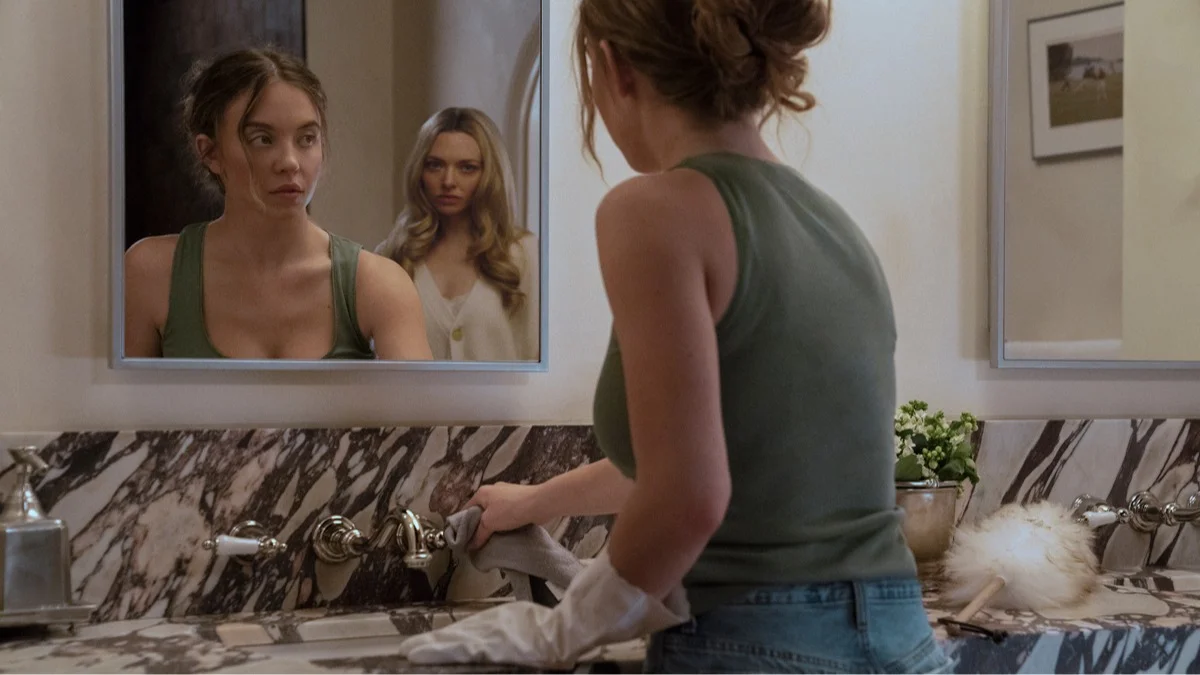
Sydney Sweeney as Millie and Amanda Seyfried as Nina in The Housemaid. Photo: Daniel McFadden/Lionsgate
“The Maid” is an audience hit of the winter and a rare mainstream thriller that pretends to be a detective story for one evening, but turns out to be a litmus test for the beginning of 2026. How do we look at female vulnerability—and how is the erotic thriller perceived after decades of stagnation as a genre? Sydney Sweeney is not only the best face of this comeback, but also the engine behind it. Film critic Katya Stepnaya believes that the most sexualized and controversial young actress in Hollywood revealed herself in all her contradictions in “The Maid.”
A girl with a criminal past, Millie (Sydney Sweeney), released on parole, tries to start living again and gets a job as a live-in maid in the house of a rich couple. Everything shines there, but this light is unpleasantly sterile, and the order is clearly paid for by someone’s anxiety. Successful wife Nina Winchester (Amanda Seyfried) is preparing for a new addition to the family and hires Millie in advance to take care of first the house and then the unborn child. The ideal husband Andrew (Brandon Sklenar) disappears from morning to evening at work, but returns with a warm smile on his face. "The Maid" sells the comfort of recognition from the first minutes: you've seen stories like this a thousand times.
But gradually the film begins to change temperature. What seemed like the eccentricities of the owners is revealed as a power structure. What looked like a well-found live-in job was obsessive control. You have a room and a formal work schedule, but there is no way to maintain personal boundaries. How the movie is made is deliberately clear: Paul Feig (“Bridesmaids in Vegas,” “A Simple Favor”) does not go into the arthouse fog and maintains a balance between detective and black comedy, relying on the leading actors. "The Maid" is important as a film that happened at the right moment and hit the right body - the body of Sidney Sweeney.
In recent years, Sweeney seems to have been conducting a public experiment: how far can you go from the obvious image of the “American cutie” and still remain hostage to it.
Few modern movie stars have so many haters: she is simultaneously considered overrated and underrated, overly sexualized and exploitative, a product of the male gaze and a modern iteration of Marilyn Monroe. From all these mutually exclusive labels, she builds a career as if they do not conflict, but form a profile that is understandable to the market. In The Maid, Sweeney is always in a low neckline, at the Variety party he appears in a transparent dress, and in memes he appears with a grin, which in American usage is called a resting bitch face.

Sweeney first rose to fame several years ago in HBO's flagship series Euphoria and White Lotus, both playing a spoiled and hysterical teenage beauty. After nominations for the most prestigious American television award, the Emmy, she came to producing and her own projects through the company Fifty-Fifty Films (the name already suggests market fairness - 50/50, and so that everyone is happy). And this is where The Maid comes in: a film about a woman who is both looked at and not heard; about a house where everything is beautiful, but everything is arranged so that the woman remains a function; about social roles that are put on you without asking once and for all. Even if the script did not set out to talk about Sweeney, the film inevitably begins to read through her.
Both Sweeney and Seyfried are listed in the credits not only as actresses, but also as executive producers. Sweeney's Millie is neither a sad-eyed victim nor a damsel in distress. This is a character who knows the value of her vulnerability and knows how to use what is expected of her to her advantage. Sweeney plays not naivety and inexperience, but concentration and enterprise - this is perhaps the main emotional twist of the film.
Her screen energy is not hysteria or breakdown (like Cassie in Euphoria), but the intense rationality of a person who understands all too well that any mistake will be fatal.
At the level of the phenomenon, Sydney Sweeney today exists at the intersection of three industries: acting, producing and media. In each one, her body and hourglass figure become a talking point. The paradox is that she is both a symbol of sexualization within mainstream Hollywood feminism and one of the few young stars who is publicly trying to move the conversation back from the realm of looks to the realm of performance and endurance. But media reality still pulls her back into the field of the war of symbols. 2025 added a new layer to this story: the scandal surrounding her campaign for American Eagle grew into disputes about what exactly is being advertised through the image of Sweeney, what kind of “great jeans” and “great genes” we are talking about, what does the Republicans have to do with it, and why society reacts so nervously to a set of obvious signs of attractiveness. It must be said that everyone suddenly remembered the American Eagle brand, and the company that generated waves of hate increased sales (!) without sinking Sydney.

And now about Seyfried, because without her this design does not work. Amanda Seyfried in "The Maid" gives the necessary twist to the second heroine: she is both a glossy housewife and a person forced to live, constantly adjusting her behavior. In a duet with Sweeney, the film gets the main thing - not intrigue, but the energy of two actresses of different generations, each of which has its own set of (industrial) expectations. Once upon a time, Seyfried, like Sweeney, was a starlet and became famous for her roles in “Mean Girls,” “Mamma Mia!” and “Jennifer’s Body.” But as the years go by, it’s easy to replace an “adult” blonde with a “fresh” one, and if you haven’t taken care of your acting future in advance, you’ll simply become a victim of this conveyor belt. Both Seyfried and Sweeney are trying to avoid this.
Today, the industry simultaneously wants the old type of star (blonde, sex symbol, box office, name recognition) and is afraid of being accused of exploitation - and this is where the Sweeney phenomenon hits the nail on the head. That's why The Maid is a good subject to talk about, not so much about the film, but about the moment. First, it's the return of a genre that tries to allow itself to be dirty and straightforward. Secondly, the response to the viewer's request for an attraction with a social nerve. And thirdly, here the actress turns her own scandalousness into a working tool. Instead of arguing with the world, Sydney Sweeney changes the topic of conversation: not “now I will prove to you that I can play,” but “look what I have to offer.”
On the plus side, The Maid makes the erotic thriller not a guilty pleasure, but a genre that can once again talk about power and the body in the post-#MeToo era.
The film has a strange, sometimes indecent energy of the 90s - the era of Basic Instinct: stories about home, sex, control and danger without any mask of nobility. The Maid is thus a thriller about the film industry as a whole, where women are both commodity and author. And if the film works, it is primarily because Sweeney plays not a damsel in distress, but a man who knows that you are most dangerous when you are underestimated.