
Translated material
“We work for food and diesel fuel.” Thousands of cargo carrier companies in Russia are at the stage of liquidation
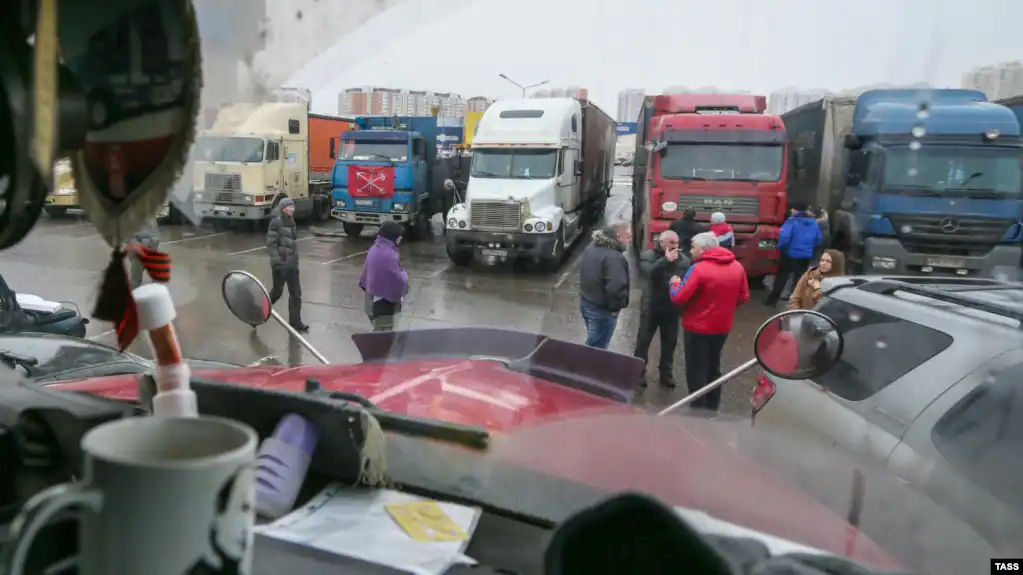
About 7 thousand cargo transportation companies in 2025 found themselves at the stage of liquidation or bankruptcy. Due to increased fuel prices and leasing payments for equipment, increased vehicle maintenance costs, high bank key rates, as well as increased recycling fees, freight carriers spend more than they earn, transportation becomes unprofitable. In addition, experts say that the general decline in industry is also affecting transportation.
“Diesel fuel costs almost the same as gasoline”
Oleg (the name of this and other editorial interlocutors has been changed for security reasons) from the Kirov region admits that he “leaned both of his trucks against the fence” and adds that many truck owners did this.
“Recently it has become simply impossible to work.” Diesel fuel has skyrocketed – it now costs almost as much as gasoline. And they installed scales on the roads, which can’t be bypassed at all; there are just wild fines. “Platon” ( abbreviated as “payment per ton” - a system of collecting fees from vehicles transporting cargo over 12 tons to compensate for the damage caused by trucks to federal highways - “Window” ) is also becoming more expensive, I don’t know who needs it. Spare parts have also skyrocketed, and we still have to wait 2 months for them to arrive. So it became simply unprofitable to work.
Small businesses of truck drivers go bankrupt en masse, and leasing companies do not forgive late payments and quickly buy up idle trucks at half the price, or even a third, they state in the public page “Dalnoboi is my life” and add that the surviving companies “actually work for food and diesel fuel,” in the expectation that the situation will improve. But, apparently, the crisis has not even reached its peak yet.
“Look at the new fines for trucks... and all the desire to work will immediately disappear!”
“We...carriers have been driven deep into the f**k, just like the whole of Russia,” drivers write in the comments. Many people remember how they “went to Finland,” how the whole of Europe was open to them, and dream of a return to those times.
– There are too many of us, so companies are closing, because before there were few carriers and a lot of cargo, but now it’s the other way around. There is, of course, the option to sell the cars, but it’s very difficult to find a buyer today,” says Oleg.
Economist Evgeniy (name changed) explains the drop in delivery volumes by the general slowdown of the economy: costs are rising and profits are decreasing, enterprises are producing less products, and the demand for transportation is falling sharply.
– On the one hand, fuel prices are rising, on the other, taxes; these two counter-trends lead to bankruptcies and unprofitability. Moreover, different companies have different problems,” says the expert. -For example, dump trucks that carry raw materials for construction have been at war with customers for more than one year. Builders and quarry owners are forcing drivers to overload in order to reduce the number of trips. They say: “Yes, even if you go back and forth 10 times, we will pay for one trip.” And if you want to reduce costs, then transport all the cargo at one time.
Vladimir Matyagin, President of the National Association of Freight Road Transport Gruzavtotrans (NAGAT Gruzavtotrans), explains what this approach means for truck owners: “Overload... greatly wears out tires and other vehicle parts. All this significantly increases costs. For example, when driving with overload, wheels wear out in two to three months, but when driving without overload, the car can run for years. But one wheel costs about 100 thousand rubles.” Overloading also increases wear on other vehicle parts. In addition, this exposes drivers to huge fines.
– Fines have now been raised to 600 thousand rubles, so now it is not profitable for transporters of crushed stone and sand for construction to take risks. And the construction itself is languishing, the pace is decreasing, so there are few orders for cargo transportation,” says Evgeniy.
In the transport system, everything is interconnected, experts note. Transportation by rail has been reduced - fewer trucks are needed to transport goods to trains.
– This is a common story, all markets develop according to a sinusoid. With eggs, for example, the same problem. There was a shortage of eggs in 2023, prices tripled, and many small poultry farms bought equipment, expanded, overproduction arose, prices began to fall, and they began to go bankrupt. At the same time, the carriers had crazy incomes, they decided that this would always be the case, and bought Chinese trucks. And now, as the economy tanks, demand has dwindled and trucks are sitting idle. – says Evgeniy.
Vladimir Matyagin believes that the problem is not only the downtime of trucks, but also competition with Chinese carriers, which noticeably worsens the situation: “We are allowed to pick up cargo from China only within the border zone, no further than 50 km from the border, and the Chinese can safely transport cargo from China even to Moscow. And they travel freely all over Russia - they bring cargo to Moscow, and on the way back they take... passing cargo to Novosibirsk or Irkutsk for 3 kopecks... And... they take our work.”
“Army jammers also affect Plato”
Sergey (name changed) has been driving trucks since 1998, heavy trucks since 2010. Now he works for a company located in St. Petersburg, transporting cargo in the North-West region. The company is small: five heavy-duty vehicles and several Gazelles for urban transportation. Sergei manages to earn about 150 thousand rubles a month, but, he says, “often he has to work for 2 weeks without days off.”
Recently, he has had a new problem - the shutdown of the Internet in the region due to the fight against drones.
– These jammers also affect Plato. For example, this year I have accumulated fines for “Platon” amounting to 30 thousand. You just receive a fine saying you didn’t pay for Platon on the way, even though it was paid for. And this despite the fact that “Platon” is already 10 years old, and the roads haven’t gotten any better because of it. They come with snow every spring, or even earlier. It's just a rip off.
Now they want to expand Platon - charging fares not only on federal, but also on regional highways.
– This will not help the roads, but will only bring additional taxes. At the same time, we pay quite a bit of transport tax. Prices for diesel fuel are equal to 95 gasoline, if not more. And excise taxes on fuel, fines - all this, in theory, should go to the road fund, but then I don’t understand what Plato is taking on. – says Sergei.
His company works in the production of technological films and packaging materials - it transports raw materials to the enterprise, and products to consumers.
– In February 2025, delivery rates decreased by almost a third. And the cost of transportation, on the contrary, increased by 15%. Fuel prices have become very expensive, and we are also under sanctions - that is, prices for spare parts, maintenance, repairs, and car maintenance have also increased. Toll roads have become more expensive.
Sergei also complains about other extortions.
– Here, for example, is a tachograph ( a control device installed in a car. Designed to record the speed, work and rest hours of drivers - SR ). There are Russian-type tachographs, and there are European ones. Let’s say the car was imported from Europe, but we have an obligation to install our tachograph for 50 thousand, and also calibrate it every 3 years - this also costs money. The inspector will ask for a printout - yeah, you drove an extra 5-10 kilometers without resting. And in the Moscow region, for example, there are few parking lots. And why would I stand on the side of the road for 9 hours, waiting for my car to be robbed or for someone to crash into it? I need to get to a parking lot where there is a cafe and some amenities.
Therefore, Sergey explains, you have to violate the work and rest schedule, drive in excess of the norm prescribed by law, all this is reflected in the tachograph and entails considerable fines.
– But the most terrible thing for drivers is the weight and size limits. A frame on the road reads the weight of the car while driving. There are dimensional standards - for example, no more than 20 meters in length, 4 meters in height and 2.5 in width. In case of deviations, fines are automatically assessed, which are almost impossible to appeal. And they reach half a million. Recently, in the Yaroslavl region, my frame detected a frame that was supposedly larger by 18 centimeters, I received a fine of 300 thousand, with a discount they offered to pay 225. And the court will be on the side of the state, technical transport supervision. And this is electronics, there can be malfunctions, or, let’s say, on a tilt car the tarpaulin can blow away - it’s no longer the size.
At the same time, the cargo transportation market, according to Sergei, “is spinning in a tricky way” - cargo can be direct, that is, from the manufacturer, a direct supplier. And it happens that another logistics company cannot cope with the work due to a lack of transport and sells its transportation to another company. Sergei’s company, he explains, tries to work directly, which is why it stays more or less afloat. She has permanent contracts with manufacturers who ship their products to or from St. Petersburg.
But Sergei knows owners of small companies who closed their businesses and went to work “for their uncle.”
– It’s too expensive to maintain the machines yourself, especially if there are no constant loads. You can work for several logistics companies: one has a job today, but not tomorrow. But when concluding a contract for freight (transportation), they can cheat - pay not all, but half. That's why many people try to work for large companies.
But they often fail to cope with the situation. The founder of Furgonof, Georgy Polyansky, worked in the cargo transportation industry for 15 years. But he was left with millions in debt - the business had to be closed on June 12.
“I made this decision because I was afraid to move on. There have already been a number of irreparable losses. There was a feeling that if we continued to work, we would let clients down and lose part of the cargo. At that time, it was no longer possible to pay drivers’ salaries, taxes or pay for fuel,” says Polyansky.
His company transported household appliances, clothing, shoes, sporting goods, and cosmetics within the Golden Ring. In August 2024, the price of transportation began to fall sharply. It had not grown by the new year either, contrary to the expectations of the carriers.
“In September, banking products were turned off: overdrafts, credit lines, due to the increase in the Central Bank rate,” recalls Polyansky.
All this led to a sharp drop in turnover. The debt to carriers at its peak reached 66 million rubles. The company's management decided to sell the cars. According to Polyansky, many of his colleagues could not survive the crisis: “Just yesterday we were integrated into the economy, creating jobs for families. And then we became sharply outcasts, and en masse. I found myself seriously in front of creditors, leasing companies, and banks.”
The founder of the Leader Trans company, Mikhail Ustyuzhanin, also complains about what is happening in this business: “The cost of transportation for the first half of 2025 increased by 15% due to increased prices for fuel, equipment maintenance and driver salaries.”
For many road carriers, 2025 has become the year of the arrival of the “black swan,” says Sergei Osipov, owner of the Vector group of companies.
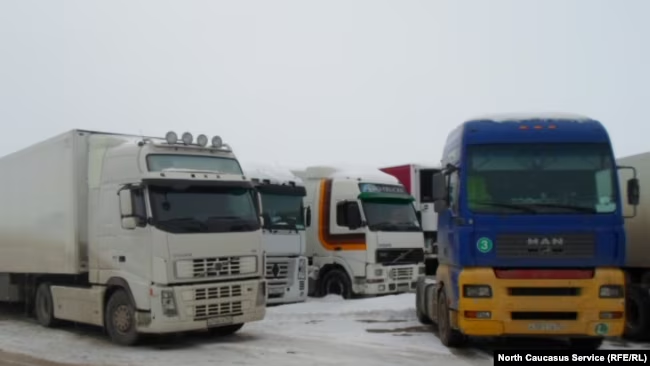
“There was an aggressive growth model, with European brands, when the car paid for itself in 3-5 years, and it was sold practically new. But this model broke down. Now a story has arisen that leasing companies have begun to take cars from those who do not pay. This is a big tragedy for the guys. In all cities, parking lots are overflowing with these cars. If you imagine that 50 thousand cars were taken, and the average company, for example, is 10 cars, then that’s 5 thousand companies. These are ruined destinies. A very scary story,” Osipov emphasizes.
The crisis in the transportation sector will only get worse, says economist Evgeniy.
– By the way, 10 years ago 90% of the cargo transportation market was in the shadows; cargo was transported by small individual entrepreneurs who worked illegally. And now it will be the same. They bought trucks, something needs to be done with them. And it is not profitable for everyone to pay taxes, especially VAT, and illegal agreements will be concluded with carriers. In general, the gray sector will increase everywhere - both in industry, that is, among transportation customers, and among cargo carriers themselves. Shadow Russia will expand.