
Translated material
Catholicos Geopoliticus
Pashinyan’s power now depends only on whether lasting peace is established in Armenia. But such a world will reformat the entire country - and the “old” Church stands in the way

Prime Minister of Armenia Nikol Pashinyan during the Christmas religious procession. Photo: Alexander Patrin / TASS
The episcopal meeting of the Armenian Apostolic Church, which was supposed to take place in December, has been postponed to February and will be held in St. Pölten, Austria. The last time such a meeting took place outside the country was 70 years ago, in Cairo. True, then Catholicos Vazgen I agreed to this to preserve the unity of the Armenian churches, and not because of pressure from the authorities, which the current Catholicos Karekin II complained about when making the decision to leave.
Neither sword nor peace
And on January 5, on the eve of Armenian Christmas, Prime Minister Nikol Pashinyan, together with ten church hierarchs, signed the Roadmap for the renewal of the Armenian Apostolic Church, which he presented a month earlier.
Of the five main points, the most important one is number two: the removal, as stated, of the actual head of the Holy Armenian Apostolic Church.
Garegin, in the world Krtich Nersisyan, is not called Catholicos. This will be the one who (in accordance with paragraph five) will be elected “in due course.” Until then, again in accordance with the established procedure (in accordance with point three), the Church will be governed by the locum tenens of the Catholicos.
No one remembers the established order on this topic in the almost two-thousand-year history of the Armenian Church, as well as any precedents for removing a sitting Catholicos. And also that his name is not mentioned during the liturgy, as happens today in services conducted by priests loyal to the authorities. And no one hides that the conflict between the authorities and the Church is one of the central plots of the parliamentary elections scheduled for June, the intrigue of which the authorities are clearly spinning much more than they are probably worth.
It would seem that for the authorities, especially in Armenia, to quarrel with the Church is like checking the voltage in an outlet with your fingers.
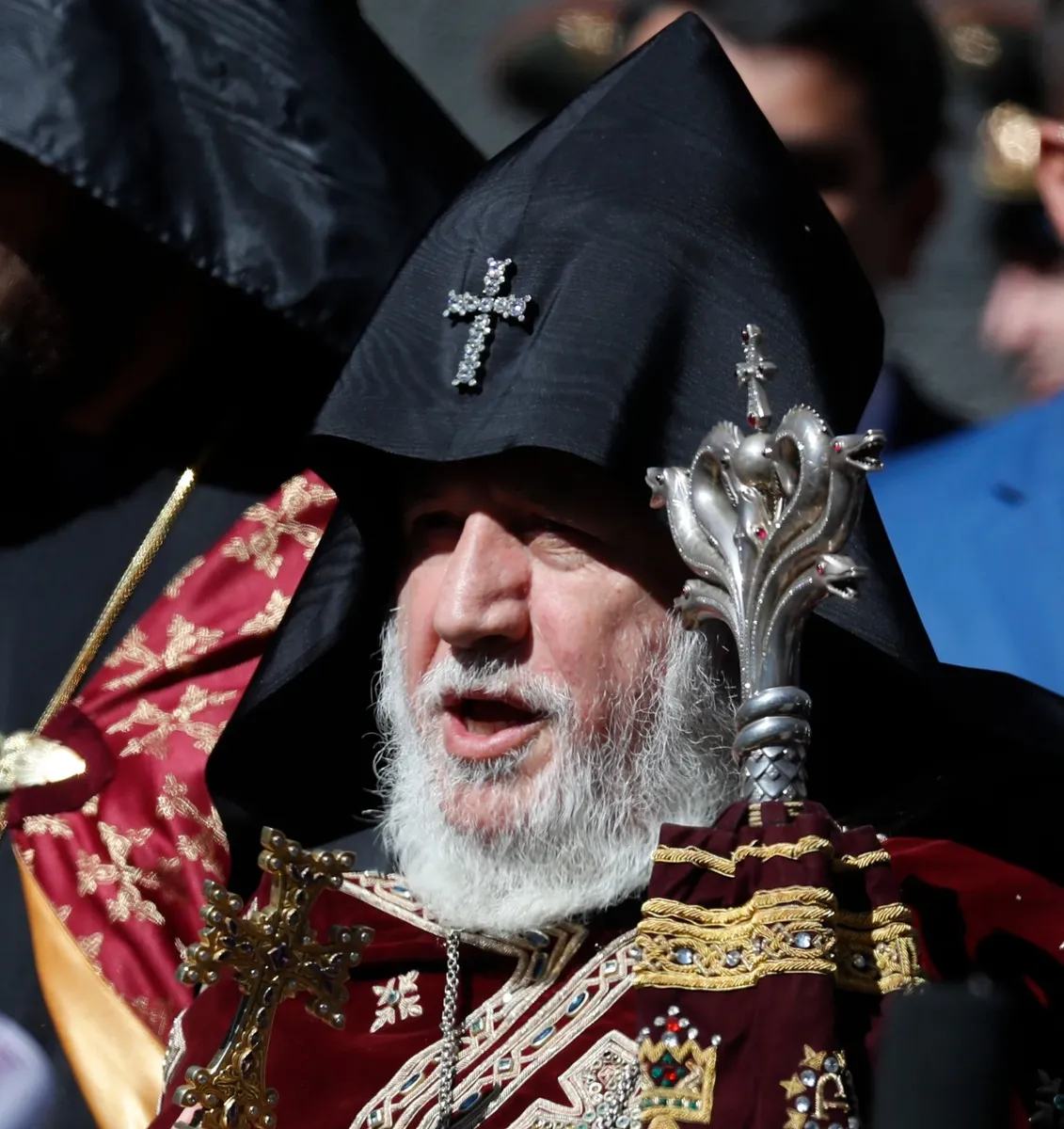
Nikol Pashinyan, who in a matter of months reduced widespread admiration for himself to a rating of 13–15 percent, spoke out against an institution that is considered one of the symbols of Armenianism and, according to the same sociological calculations, has almost 60 percent of trust. Of course, Etchmiadzin, the spiritual center and residence of the Armenian Apostolic Church, never showed any kindness to Pashinyan.
But with all his actions, based on centuries-old political practice, he made it clear that if you treat him like a human being, then he too can get into the situation. At first, the new government followed this commandment. Although already in 2021, on the eve of the last parliamentary elections, Pashinyan, as part of a similar campaign, already reminded the Church of its attempts to fail the revolution. And it wasn’t just about the elections then.
Time on credit
By virtue of its very status as the custodian of the Armenian tradition, the Church was obliged to show special sensitivity to issues related to Nagorno-Karabakh. It itself was considered a form of Armenian spiritual matter; monasteries were located there, which became centers of pilgrimage. The Artsakh diocese throughout its modern history - since 1989 - was headed by Archbishop Parkev, one of the most authoritative clergy.
But the main thing is that the entire history of the struggle for Karabakh has become one of the symbols of Armenian self-identification, along with genocide and the Church itself, albeit not on such a scale. And if before the disaster in the 44-day war of 2020, the Church took a position towards Pashinyan, albeit not very friendly, but correct and detached, then after it the Catholicos had to say his word, and he said it: Pashinyan must leave in order to avoid further shocks and confrontation.
In April 2023, after the final loss of Karabakh and the exodus of its inhabitants, Catholicos Garegin recalled that his call for Pashinyan’s resignation was indefinite. A year later, the artillery preparation turned into an open offensive, which the Armenian opposition, due to the lack of better leaders, was forced to entrust to the Archbishop of the Tavush diocese Bagrat Galstanyan.
Tavush was not accidental. It was from Tavush, a region on the border with Azerbaijan and Georgia, that the delimitation of the Armenian-Azerbaijani border began, which the opposition used as a reason to accuse Pashinyan of treason and surrender of Armenian lands. It was in this conflict that the positions of the parties were finally formed, which became their political credo.
For the authorities, peace became the super idea of the political agenda; only with it could Pashinyan ensure his further political survival after defeat in the war
and give his continuation a political meaning: maybe he is to blame for the fact that the worst happened, but one way or another the worst is over, and there is nothing more to fear.
This did not increase sympathy for Pashinyan, but it worked. The final refusal of confidence in him was postponed until the silence became irreversible. Pashinyan was quite happy with such a loan, Galstanyan’s opposition rebellion quickly fizzled out, and it would seem that it was possible to return to a cold peace with the Church, since it, as expected, did not show much support for its colleague, and Pashinyan had plenty of enemies even without Etchmiadzin.
Pashinyan preferred a reckless offensive to a defensive doctrine.
This is not the time to be a patriot
In systemic political logic, such a truce would look organic and in demand. But Pashinyan, who came to power anti-systemically, continues to survive in an equally anti-systemic logic, and so far without a single serious defeat.
The weakness of any post-Soviet opposition stems, among other things, from the fact that, in the absence of resources to propose its own agenda, it is forced to follow the agenda of the authorities. And falling into the traps that the authorities set for it, because the authorities know all the cards, because they themselves deal them.
Pashinyan is a monopolist of the main topic that worries voters. He is not surprised by the poor life, bribery and bad morals of officials - as a post-Soviet citizen, he is not spoiled by anything else, but he knows the value of peace. And if Pashinyan is for peace, he easily passes off any criticism of the opposition as a position of war. Moreover, the opposition itself gladly raises patriotic banners, which, after a series of defeats, inspire only the most impressionable and romantic. And against this background, Pashinyan opens a new front: he accuses the Catholicos of violating his vow of celibacy, for which reason he must leave.
Some puzzled analysts believe it's a matter of statistics. According to various estimates, the number of those who have not decided on their pre-election sympathies is around 60 percent, and the fight is for them. Pashinyan most likely did not lose his voters during numerous demarches, so the operation was most likely a win-win. It’s hard to say how successful it turned out to be:
The rating of the Church has been steadily growing over the past year, in contrast to the rating of the authorities and the opposition, which also does not shake the foundations - the Church does not need to be elected. Then why?
Temptations on the buskins
Perhaps it is a matter of political temperament. Perhaps the scale of the enemy, which should have turned Pashinyan away from the idea of entering into a duel with him, was precisely what motivated him.
But for all its extravagance and anti-system nature, this challenge is entirely consistent with political logic. In Pashinyan’s ideological structure, peace with Azerbaijan is built into the system of ideas about reformatting Armenia in general. In this model, the entire Karabakh plot, which ended in disaster, is the result of Russian influence, into the sphere of which, as follows from today’s Armenian historiography, all the former leaders of the country fell into the sphere from the very first day of independence. And only the geopolitical turnaround made by Pashinyan restores the original and verified alignment of priorities. Those who want to return it to Russia and thereby again plunge it into war with its neighbors are trying to push Armenia out of this orbit. And the main force in this collective is the Church...
There is a lot that is indisputable in this system of ideas, although Pashinyan’s problem is that for many in Armenia he is the last person from whom they are ready to even listen to the multiplication table. But the current opposition, for the most part, are really representatives of those forces that for a long time led Armenia to the catastrophe that Pashinyan confidently put an end to. These are the people who built the model of relations with Russia, within the framework of which President Serzh Sargsyan, overnight in the fall of 2013, turned the country from association with the European Union to the Eurasian Community.
And reconciliation with Azerbaijan in Pashinyan’s concept is not just an election video, it stems from the rejection of the fundamental myths on which more than one generation grew up - and on the theme of eternal brotherhood with Russia, and great history with geography, and inescapable sacrifice with all the complexes that flow from it, and all this is built on ancient Christian buskins.
It would be a mistake to say that the Armenian Church is ideologically and politically inseparable from Russia. The desire for equidistance in this matter has always been its historical tradition. But from the point of view of completely worldly temptations, Pashinyan hits the mark in his attack.
It is no secret to anyone in Armenia that the Moscow business preferences of many hierarchs, including the brother of the Catholicos, the head of the Russian diocese, Ezras Nersisyan. Not everyone saw the new Armenian Cathedral in Moscow, but everyone heard about it, mostly in the forgotten genre of jokes about the “new Russians.” In this regard, the Church is indeed closer politically to people from the opposition.
Walking in the Arctic Circle
In the fight against church tradition, church tradition helps Pashinyan in an unexpected way. From the point of view of normal legality and modern ideas about a secular state, claims against the Catholicos, no matter what he violates from a church point of view, are, of course, absolute and tragicomic nonsense. But the general and widespread agreement to see in the Church more than the Church, no matter who steals from it, bears false witness or covets their neighbor’s wife, to consider her one of the pillars of Armenians, turns out to work in the opposite direction.
And the statements of representatives of the Armenian government that if the Church interferes in politics, then why can’t the state deal with the Church turn out to be a vulgar and simplified version of this manipulation:
The Church is too important for Armenians to trust its priests.
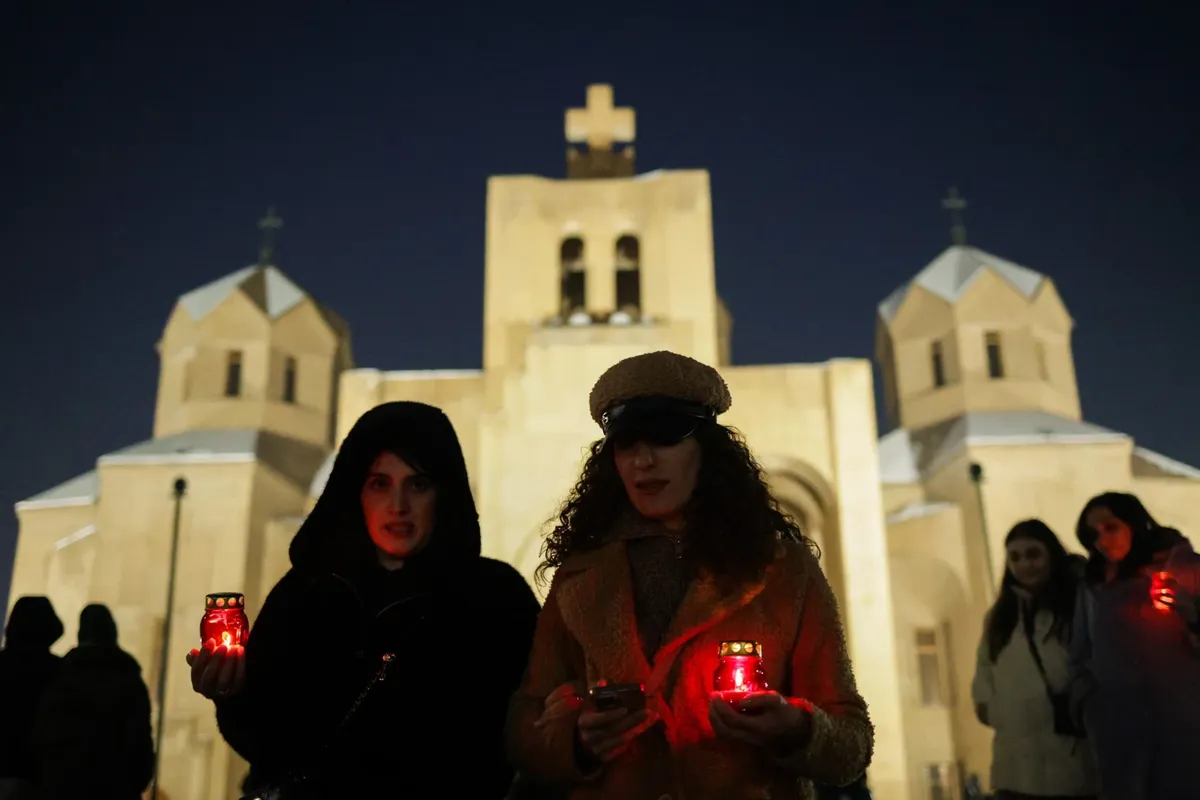
At the same time, the scale of the fight against the Church clearly exceeds the election objectives - few doubt that Pashinyan will win in June even without this confrontation. So, perhaps the crusade is the foundation for a much more strategic future, and Pashinyan’s plans are not limited to June.
All possible political, economic, and media calibers are involved in defeating the Catholicos, and it is impossible to lose to Pashinyan - at least in a way that cannot be passed off as a compromise. But if compromises were included in his plans, the prime minister would easily achieve them, since the Church does not hide its readiness for them. And the reluctance to compromise, perhaps, is also part of a large political technology that also justifies itself.
It's called polarization.
Pashinyan raises the degree of confrontation with the Church much higher than even the most desperate political necessity requires, and the situation is heating up as if for the sake of heating up. Political necessity does not require alternative liturgies, invasion of churches by an ideological enemy, or, in general, the risks that are brewing in this conflict.
As the practice of neighboring Georgia shows, dividing the civilian masses along various, sometimes clearly fictitious, front lines works for the authorities - precisely because it dictates the agenda, and the opposition is forced to catch up, falling into trap after trap, and so on in a circle. The question of the eternity of this political engine remains open. There is no optimistic sociology for Pashinyan, the number of bishops who have gone over to the side of the authorities is not in his favor yet, but he has not lost so far, and he is clearly playing for the long haul. So much so that he may simply not have time to lose.