
Translated material
Very Cold War
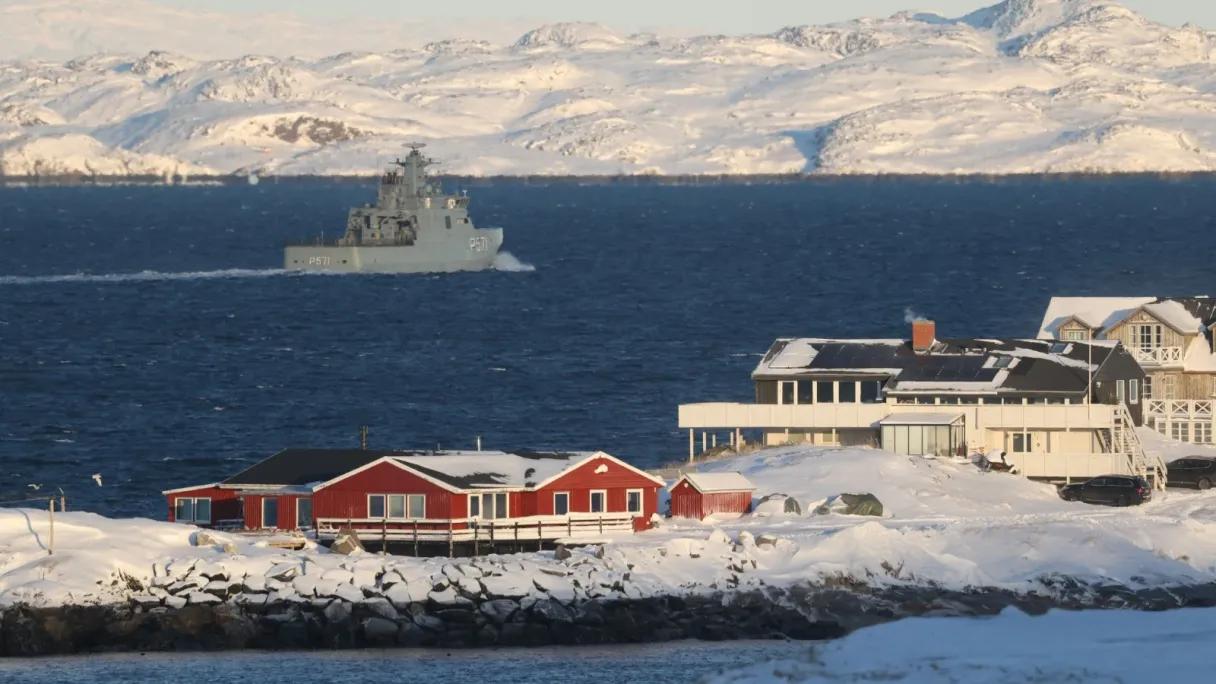
How Greenland is becoming a victim of a geopolitical game
For the second year in a row, the Arctic begins with the Greenland issue: the US President insists on full control over the island for national security purposes. Greenland is a key topic in the media, which, as observers note, has pushed even the negotiation process on Ukraine out of sight.
If in 2025 the claims to the island looked eccentric and as if they were not taken seriously, then after the operation in Venezuela the attitude of the public, media and politicians to the new statements changed. The US President has earned a reputation as a politician who ignores the usual order of things and international law. Now it's the Arctic's turn.
The fight for a “giant piece of ice”
A new round of escalation began on December 21, 2025, when Louisiana Governor Jeff Landry became the US Presidential Special Envoy for Greenland. Landry has never worked with the Arctic region, nor indeed in the field of international relations. Of course, the leadership of Denmark and Greenland reacted with protest . They said that the new appointment shows that the US President has not abandoned his intentions, despite earlier calls to respect the territorial integrity of countries, including NATO partners. “Greenland is not for sale,” were voices from continental Europe and Greenland at the beginning of 2025, and were reminded again at the end. Landry, in turn, actively participated in a public campaign to convince the public of the correctness of the president’s statements, but in reality he did not take any part in the relevant meetings.
The January statements about the need for US control over the island contain fear - if the US does not occupy the island, then either China or Russia will get it, because the warships of these two countries have allegedly already surrounded the island. Thus, on January 4, a statement was made that the waters of Greenland were “teeming” with Russian and Chinese ships. At the same time it was said that military methods of gaining control over the island were not excluded.
Analysts and military commentators have taken stock of the assumptions underlying the island's claims. There are no Russian ships around Greenland, and Russia itself or its associated businesses do not have any assets on the island. Chinese authorities called on “not to inflate the Chinese threat.”
As for Chinese economic participation, there is practically none at the moment. China actually came close to taking control of a significant portion of Greenland's rare earths a few years ago, and may have also secured airport construction contracts through the China Communications Construction Company in 2018. But nothing came of it. In the case of rare earth metals, Australian companies retained control, now gradually moving into US jurisdiction, and in the case of airports, Denmark, after the intervention of Washington, fully financed their modernization.
Greenland is indeed rich in resources, but the development of deposits, including rare earth metals, requires quite large investments, and even if money is found, the reserves of the island and the United States combined (1.5 million tons in Greenland and 1.9 million tons in the United States) will still be less than, for example, in China (44 million tons) or Brazil (21 million tons). In Russia, such reserves are estimated by the US Geological Survey at 3.8 million tons. Projected estimates of natural resources in general may be different , but in any case, economically justified production is a matter of the future, the availability of technology, infrastructure and natural conditions.
As part of the current round of exchanges of statements, Europe and Denmark have repeatedly pointed out the possibilities for both business and the military to increase their presence on the island within the framework of existing agreements - simply following the 1951 agreement.
Tariff escalation and reaction from the US and Europe
One of the first reactions was a remark from Danish Prime Minister Mette Frederiksen, who pointed out that if the United States “takes” Greenland, this will mean the end of NATO - states cannot be allies if one of them does not take seriously the territorial integrity of the other. Other European countries supported Denmark and Greenland, and together with NATO offered to increase the number of troops on the island, conduct Arctic Endurance exercises and confirmed their readiness for negotiations.
In response to these actions, Trump on January 17 imposed tariffs (essentially sanctions) of 10% on imports from countries that sent their military to the island. This affected, among others, Great Britain, France, Germany, Denmark, Norway, Sweden and Finland. If there is no deal by June 1, tariffs were to increase to 25%.
European countries, for their part, were ready to introduce tariffs against American goods, and the European Parliament froze the ratification of a trade agreement with the United States.
But in a speech at the economic forum in Davos, the US president softened his rhetoric and said that he was only asking for a “giant piece of ice” and would not use military force. Despite this neglect, he completed the tariff escalation on January 21, without ever implementing the threat to European countries. A “conceptual agreement” has been reached between US and NATO authorities on the fate of Greenland.
What is Russia saying?
Back in 2025, Vladimir Putin commented on the situation at the International Arctic Forum in Murmansk. Then he said that US claims to the island have a rather long history and therefore Trump’s position can be understood. Putin assessed the new round of the Greenland crisis in the same spirit - this issue does not concern Russia, but he recalled both the sale of Alaska to the Americans in the 19th century and Denmark’s “cruel attitude” towards the indigenous inhabitants of Greenland. According to the Russian leadership, historical references seem to justify the rhetoric and threats against Greenland, but do not take into account the fact that this will be another shock for the Arctic after the end of Arctic cooperation in 2022.
Civil society response
On January 17, protests took place in Copenhagen and Nuuk, the administrative center of Greenland. Their participants opposed the US demands and recalled that Greenland is not for sale. More than 15,000 people protested in the Danish capital.
Public opinion clearly does not support the initiatives of the US leadership. According to a survey of US citizens conducted by YouGov on January 7-10, 2026, less than a third of respondents are ready to support Trump’s initiative to include Greenland in the United States, while only 13% of respondents are ardent supporters of this idea. Polls also show that the vast majority - 73% - are against the “force scenario”. Ipsos provides similar data.
33% of respondents categorically do not support the rhetoric of the US President. At the same time, the majority of Americans surveyed support the independence of Greenland - 55% for and 9% against.
Among those surveyed, the overwhelming majority of opponents have Democratic views, while supporters have Republican views. At the same time, among respondents with republican views there are ardent opponents - 12%.
The Greenlanders themselves strongly opposed joining the United States in 2025—85% were against it.
Consequences for the Arctic
The discussion about Greenland is essentially taking place now within the framework of geopolitical logic. This moves us further away from the image of a sustainable Arctic that has dominated since the end of the Cold War.
Without a meaningful response from the US authorities, there remain calls to listen to the Greenlanders themselves. It is as if they do not exist in this next round of the great “Arctic game”. Russian authorities indirectly acknowledge the possibility of changing the island's metropolis, noting the “historical cruelty” of Denmark. Manipulation of facts and appeals to historical justice are typical for public justifications of geopolitical transactions. It is obvious that if the United States occupies the island, the process of Greenland gaining independence, towards which autonomy is gradually moving, will stop. What future the United States offers the Greenlanders, other than the Golden Dome and mining, is an open question.
The variability of public rhetoric on the part of large countries is characteristic of international politics in recent years. For Greenland, this contrasts with the ongoing issue of climate change and the need to combat the climate crisis in the Arctic. Unlike politicians, climate sees no boundaries and knows no history.
Research shows that the melting of the Greenland ice sheet is already responsible for a fifth of the current rise in global sea levels. In Greenland itself, this will paradoxically lead to the retreat of water, which will create additional difficulties for residents. According to satellite data , annual losses average 264 gigatons of ice, raising global sea levels by 0.8 mm. And this trend has not changed for the last 29 years. The militarization of the region and the intensification of economic development are a direct consequence of climate change, which geopolitics ignores and is unlikely to be able to somehow resist.
Cover photo: Sean Gallup/Getty Images