
Translated material
Window in the schedule
From September 1, there will be one hour less English in secondary schools. How will this affect students' English proficiency and what can parents do?
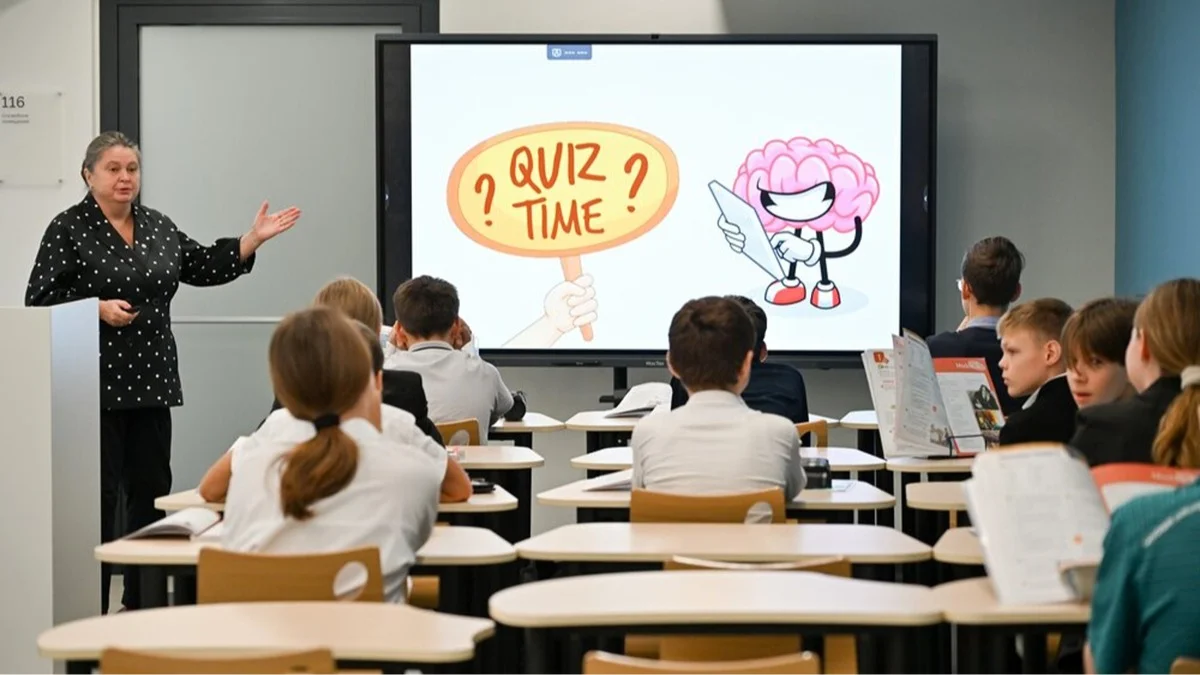
Photo: Vladimir Novikov / press service of the mayor and government of Moscow / AGN “Moscow”
From September 1, 2026, Russian schools will reduce the number of English lessons for students in grades 5–7: instead of three lessons per week, there will be two, according to the draft order of the Ministry of Education of the Russian Federation. As a result, the amount of English will decrease by about 100 hours - from 510 to 408 during high school. The department explains the changes by optimizing the teaching load, emphasizing that a foreign language remains a compulsory subject. English teachers object: you can’t learn a language that way.
Linguistic default
The process of language acquisition is subject to strict biological laws. At the age of 11–13 years, the child’s brain goes through the final stage of lateralization of functions, when one or another activity is finally “fixed” to one of the two hemispheres. In linguistics this period is called critical. Linguist Eric Lenneberg, in his work Biological Foundations of Language (1967), argues that after a critical period, language acquisition ceases to be a natural process and turns into hard cognitive work.
An English teacher with 27 years of experience, Marina ( name changed for security reasons. - Ed. ) explains how work should be structured during this period and why cutting hours breaks the entire structure.
“Preschoolers and primary schoolchildren learn best through play,” she says. — First, oral practice, special attention to phonetics, vocabulary should be thematically close to the child and interesting. Then reading, then writing. In the middle classes, special attention is paid to communication. But all methods rely on regular frequency of classes.
According to the teacher, it is in grades 5–7 that the foundation is laid, on which complex grammatical structures and academic writing are later layered. If this foundation is not laid on time due to lack of time, all further education in high school turns into building a castle on the sand.
Linguist Stephen Krashen coined the term “Comprehensive Input” in his work Principles and Practice in Second Language Acquisition (1982). The essence of his theory is that we acquire language only when we understand a message that is slightly more complex than our current level. With two lessons a week, the teacher does not physically have time to create this “signal” through live communication. The program inevitably slides into mechanical translation of texts, which, according to Krashen, does not lead to real language proficiency, but only creates a short-term memory of the rules.
Forgetting curve
We may forget skills that we once acquired, for example, in sports, if there is a long break between training sessions. In psychology, this effect is described by Hermann Ebbinghaus's forgetting curve . Ebbinghaus conducted experiments on himself and on students: subjects learned nonsense syllables in different ways, and then measured how quickly they forgot what they had learned. The experiment showed that after 20 minutes about 60% of the material is retained in memory, after nine hours - about 40%, and after a month - just over 20%. Memory research also shows that if new information is not repeated within 24-48 hours, the brain loses up to 80% of the connections formed as irrelevant - this is called the forgetting curve.
Teacher Marina is categorical about the frequency of classes:
— The minimum number of hours per week is three, preferably five.
When there is a gap of 3-4 days between lessons (standard schedule at two hours a week), progress stops. The teacher is forced to spend half of each lesson reviving the material from the previous lesson in the students’ memory.
According to Cambridge University Press research and CEFR standards, between 530 and 680 hours of “guided learning” are required for a teenager to reach level B1 (the threshold for independent proficiency). The current Russian program (510 hours) barely made it possible to approach this level. A reduction to 408 hours actually drops high school to level A2, which is not enough for either reading serious literature or for normal communication.
Digital lockdown
The problem of hours is superimposed on a difficult situation with educational resources. English teacher Kira ( name changed for safety reasons. - Ed. ), who has been working in her specialty for more than 25 years, says that blocking familiar tools turns learning into an obstacle course.
“There are currently no good resources of Russian origin for learning English, and YouTube, where, for example, useful educational materials from the BBC and various films, is blocked,” she complains. — I have to use a VPN to show anything to the children. It turns out that there is no opportunity to freely use additional materials, although the textbooks are often very bad.
Lack of access to authentic materials deprives students of the opportunity to hear real speech - which, according to sociolinguistics research, is a key factor for success.
Kira does not like the technologies that are now being introduced into teaching.
“The same applies to MES ( Moscow Electronic School - Ed. ) - this resource is completely stillborn, a pointless waste of time,” she says. - For the child - because he does not understand where the error is, because this resource does not show errors in its tests, and for the teacher - because he does not understand what exactly the child does not understand. And we are required to do tasks there.
As a result, the educational process turns into imitation: children do not learn the language, but learn to deceive the system. Kira notes bitterly:
— Children receive an assignment, look for it on the Internet, copy it into a notebook, and hand in the notebook. The teacher is happy, the child is happy. All! The ability to search for information and transfer it - this is what the children have mastered very well. But not English.
"In its own juice"
The reduction of English language hours cannot be seen in isolation from its ideological context. Officially, the Ministry of Education calls the reduction of English hours “optimization”: part of the freed up time will be taken up by a new subject - “Spiritual and Moral Culture of Russia” (DSCR), which, according to the explanatory note, should form a worldview in schoolchildren based on “traditional values” and examples of heroes of a “special military operation.”
A textbook on the subject “Spiritual and Moral Culture of Russia” is being developed by Moscow State Pedagogical University with the participation of the Russian Orthodox Church, represented by Metropolitan Tikhon (Shevkunov) of Simferopol and Crimea. The subject is required and cannot be refused.
From the perspective of the theory of motivation in second language learning, developed by sociologist Robert Gardner in his book Social Psychology and Second Language Learning (1985), 70% of a learner's success depends on his desire to integrate into the global community or use language as a tool for success.
When the state conveys the idea that English is an “enemy” or a secondary subject, students’ motivation decreases. Kira confirms:
— Modern youth, it seems to me, are very conflict-free. They tend to agree with everything the government tells them. And if they see that the state is not interested in them speaking English and learning English, they will shrug their shoulders and stop doing anything at all.
What to do?
First of all, it is necessary to hire a tutor for the child - this, according to Kira, is the best way to solve the problem of reducing English hours. If the family budget does not allow this, you need to try to create a language environment yourself. The easiest and free method is to translate all home devices, phones and game consoles into English.
The second important tool is the use of the “flipped classroom” principle at home. According to Edgar Dale's classic "learning pyramid," we remember only 5% of information from lectures, but 90% of it when we teach others. Parents can ask their child to explain to them each new topic covered at school. This not only reinforces the material, but also turns the child from a passive listener into an active user of the language.
“It’s important to listen and do everything the teacher says at school and not copy,” says Kira. — In order to regain the lost hours of English, you will most likely have to look for a new school - either a specialized one, with an emphasis on foreign languages, or with appropriate specialized classes, where the number of hours and quality of education will remain at the same level.