
Translated material
National Bolsheviks, “National Military District Veterans” and Neighborhood Communities
National Bolsheviks, “veterans of the Northern Military District” and communities of neighbors. How war, bans and censorship are changing St. Petersburg city protection
In recent years, the city protection movement in St. Petersburg has been forced to exist under conditions of total bans and censorship. Security forces come to rallies and meetings, issue fines, and initiate criminal cases. But there are no fewer people willing to defend the city. Democratic politicians are being replaced by right-wing activists, and instead of calls for reforms, patriotic slogans and references to “SVO” can increasingly be seen in city-protection telegram channels.
“Paper” tells how the methods and forms of city protection activism in St. Petersburg have changed over four years and why it cannot be apolitical.
“It was a neighborhood fraternity.” How VNIIB united St. Petersburg residents
Early in the morning of January 8, construction equipment, workers and some masked “security guards” arrived at the building of the All-Union Research Institute of Pulp and Paper Industry. In addition to them, several dozen more people came to the building - neighbors, city activists - members of the community that has been defending the building for almost seven years.
The night before, a screenshot of the message was sent to the chat of the building’s defenders. It was an announcement about the recruitment of young people “for the cordon.” It was necessary to “stand along the perimeter to prevent local residents from entering the territory.” The address of the building was not indicated in the advertisement, but VNIIB defenders decided that it was better to be on the alert.
The equipment arrived at the site around 7:30, and activists and concerned local residents began to gather by 8 am. Dmitry (the activist’s name has been changed at his request) told Bumaga that neighbors woke each other up with phone calls. By 9:30 a.m. several dozen activists had gathered outside the building.
“There were grandmothers who survived the siege, intellectuals like me, who were not at all familiar with the topic of arrests and rallies,” Dmitry lists. — There were several boys from 17 to 22 years old from among the residents of neighboring houses, some of them came out for the first time that day to defend the building. Scientists, engineers, computer scientists, housewives, musicians.
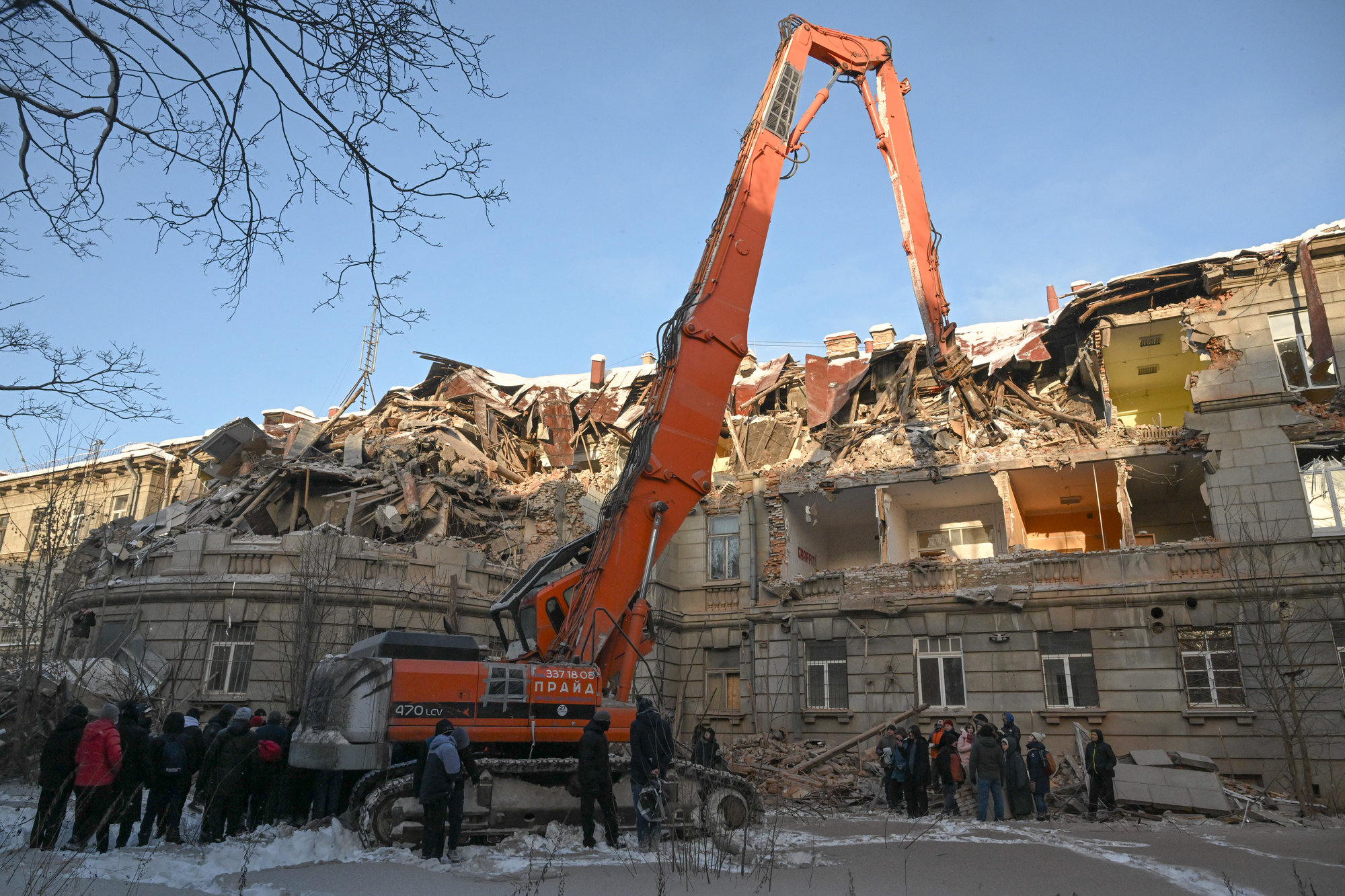
The VNIIB building was built in 1957 according to the design of architects Boris Zhuravlev and Vera Filippova in the style of Stalinist neoclassicism. The history of the struggle against its demolition began back in 2019, when the right to develop was received by the “2nd Murinsky Specialized Developer” - a company owned by the Moscow FSK group of companies. The developer wanted to build a 13-story residential complex on the site of the former research institute.
At first, residents of the surrounding houses spoke out against it, but they were soon joined by city city defenders and deputies of the Svetlanovskoye municipal district, on the territory of which VNIIB is located. On May 23, 2019, several dozen people lined up in front of the building with blank sheets of paper and children's drawings to recall the past of the paper industry institute.
In 2020, local residents organized round-the-clock watches at the building. Every week, up to 150 people came to public gatherings at VNIIB - they tried to prevent the building from being disconnected from communications, wrote appeals to the court. And besides this, they talked about the problems of the area and even all celebrated the New Year together with mulled wine near the walls of the building.
“It was a neighborhood brotherhood, like in Kolomna , ” local resident Alexandra explained to Paper , “only the people were mostly older.”
On the day of demolition, “security guards” hired by the developer managed to push activists away from the building for several hours. Many of the “guards” were wearing masks; defenders of the building later claimed that some of the hired men were drunk. Some of the activists tried to talk to people from the cordon, someone from one side or the other shouted insults. At some point, the activists broke through the ring and stopped the work; the police intervened, but they only detained the activists.
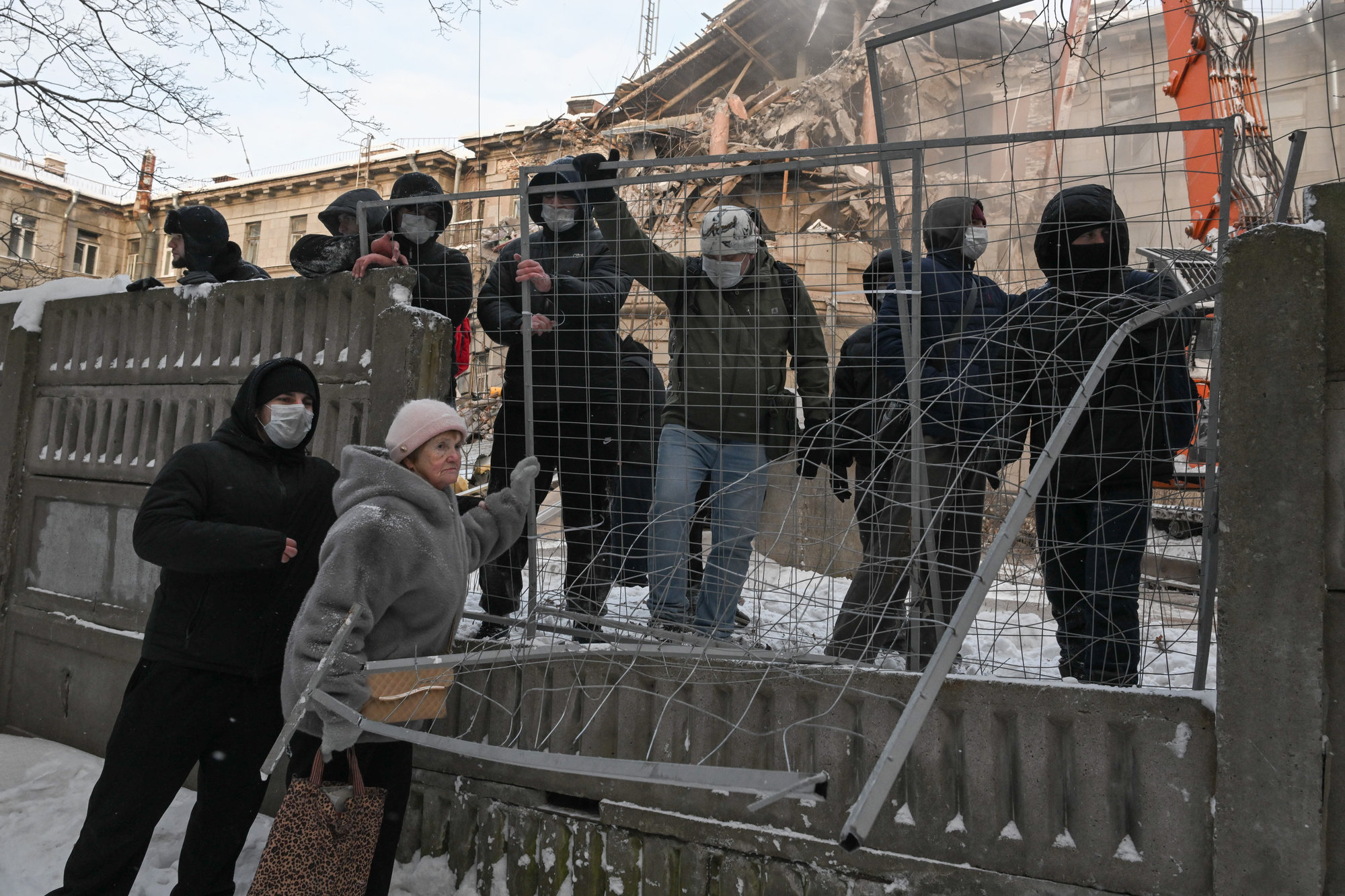
Dmitry was detained on January 8 and spent the night in the police department. He calls the VNIIB defenders “friends” and says that he would not fight for any other building.
“We all ended up in the department together and slept on the same floor. They drank from the same glasses, which were not enough for everyone, and had conversations at night on all sorts of topics.
In total, 15 VNIIB defenders were detained along with Dmitry on January 8. A criminal case was opened against one of them. This was the largest mass detention of city defenders and the loudest attempt to defend a historical building since the beginning of a full-scale war in Ukraine.
“Urban defenders until 2022 are diplomats.” How did urban protection change after the start of the war?
On June 22, 2022, the head of the Admiralteysky district branch of the All-Russian Society for the Protection of Historical and Cultural Monuments (VOOPIK), lawyer and city defender Anna Kapitonova was forcibly removed from the branch meeting.
On this day, delegates were to be elected to the city conference of VOOPIK, a public organization with the right to control and approve urban development projects. These delegates would, in turn, elect new leadership for the city chapter. The replacement of the independent leadership of the St. Petersburg branch with one controlled and loyal to Smolny was brewing. The delegates from the Admiralteysky district were people unknown to Anna, who had not previously participated in urban protection.
“Not only in the field of monuments, but also in other areas at that moment, a course was formed to strengthen the administrative apparatus,” Anna Kapitonova tells “Paper ,” “a course to ensure that no objections would be accepted anymore.”
On June 29, elections were held for the new leadership of VOOPIK, which city defenders still call a “raider takeover.” In addition to Kapitonova, city defenders and opposition politicians Boris Vishnevsky and Alexei Kovalev and activist Alexander Kononov were expelled from the organization (the latter was fined in May for “discrediting” the Russian army due to posts on social networks). Instead, the presidium of the department included the director of the Hermitage, Mikhail Piotrovsky, loyal to Smolny, the rector of the Academy of Arts Semyon Mikhailovsky and the rector of the Polytechnic University Andrei Rudskoy.
A little earlier, a similar rotation occurred in the Council for the Preservation of Cultural Heritage, an advisory body under the city government that dealt with the issue of historical monuments. City defenders Alexander Margolis, Alexander Kononov, Alexey Kovalev and Yulia Minutina-Lobanova were removed from the council. At the same time, the city protection “Sokurov group”, which included many city defenders who were removed from the work of official associations, actually ceased to exist.
2022 put an end to the dialogue between city defenders and the St. Petersburg authorities, activist and member of VOOPIK Sergei Vasiliev explains to Paper . Deputies who were members of VOOPIK, such as Alexey Kovalev and Boris Vishnevsky, were “in the same weight category” with the developers, so they could act more effectively.
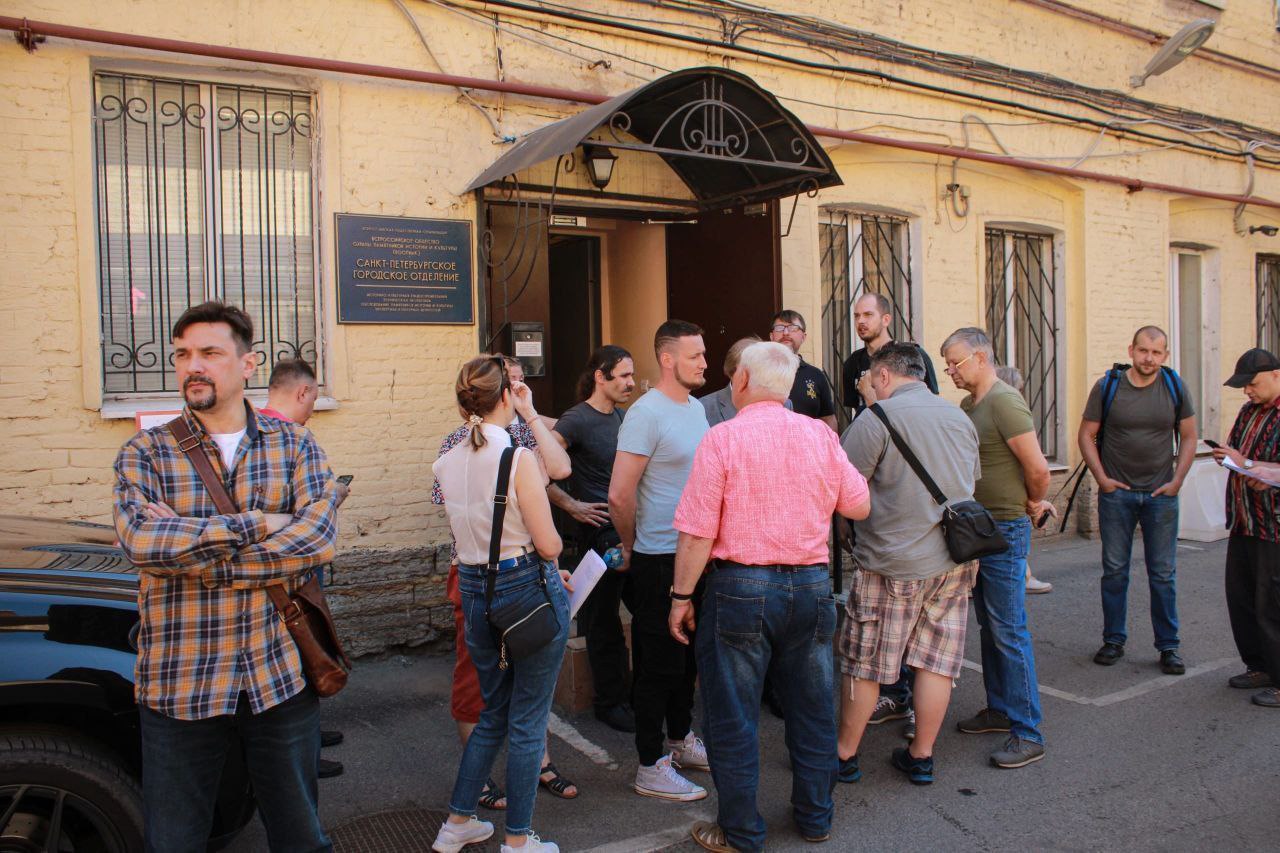
St. Petersburg city defenders until 2022 are diplomats, believes Anna Kapitonova. These are people focused on dialogue, business communication, “mutual concessions, sometimes uncompromisingness, but also the ability to persuade.”
“There were people who did not accept these negotiations for various reasons. They were more for some kind of street activities. But then everyone worked together, interacting. Sometimes it was possible to achieve more through street activities, sometimes through negotiations.
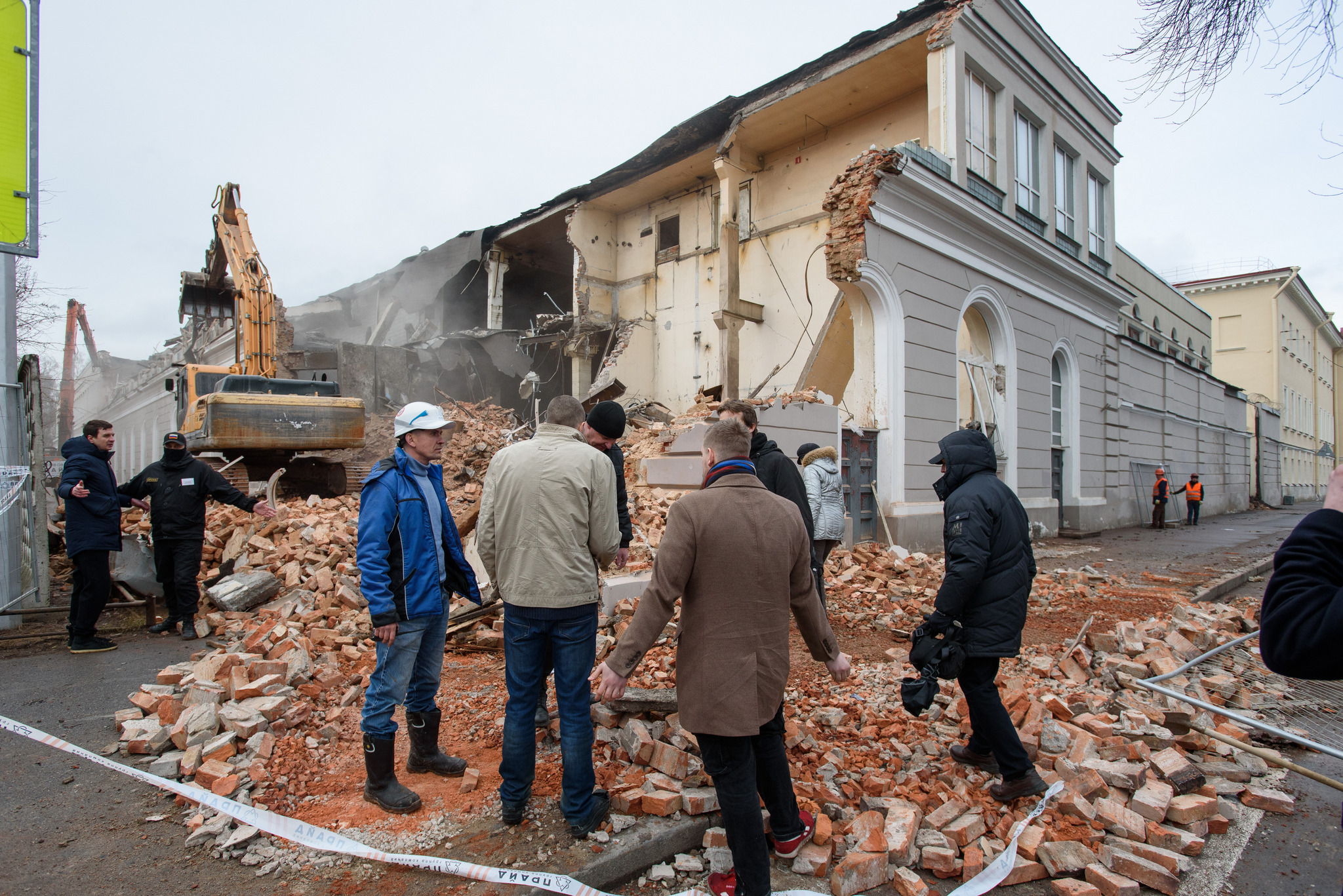
The destruction of official urban protection communities occurred against a backdrop of high-profile demolitions of historic buildings. In 2022, the arena of the Life Guards of the Finnish Regiment was demolished - the Investigative Committee later opened a criminal case, but the 19th century building had already been lost. At the same time, the building of the Vasilyevsky Wine Town was demolished, and the demolition of the Ekimova Trading Baths began. City defender Oleg Mukhin says that it quickly became clear: there will be no dialogue between city defenders and the authorities: “the dark Beglov times have come.” According to him, the time has come to unite, go out into the streets and defend the interests of the city there.
“Homeless Petersburg” and “civil squads”. How activists looked for new options to protect the city in the face of censorship and pressure
After the change of leadership of VOOPIK, the city defenders who left it founded the organization “Old Petersburg”. She conducted excursions and lectures about the historical heritage of the city, participated in the protection of many historical buildings, sent official appeals to the authorities, but no longer played a key role in urban protection. After dialogue with the authorities became impossible, notes Anna Kapitonova, completely different people entered the arena - more emotional and uncompromising.
The search for new formats began in conditions when there was almost no free press and independent courts left, public hearings were canceled , and public actions were banned . Some of the old city defenders were able to find themselves in this new reality, notes Sergei Vasiliev, while others no longer do.
The “Living City” movement, which arose back in 2006 and initially specialized in public actions , as well as the “SOS demolition” community, created after the demolition of the Finnish Life Guards Regiment arena by activist Oleg Mukhin, came to the fore . At the same time, the role of local communities, such as defenders of VNIIB, Okhtinsky Cape or the Zarosli Park, has grown .
Mukhin and his associates tried to unite communities - for example, there was an attempt to assemble a coalition “Homeless Petersburg” and a coordinating council of initiative groups . Now activists, according to Mukhin, are hatching the idea of creating regional “civil squads” that will help their neighbors.
In May 2023, the City Court refused to impose preliminary protective measures on Basevich’s house on Bolshaya Pushkarskaya Street, and its demolition began. On the day the work began, about 30 activists from “Living City” and “SOS Demolition” surrounded the house with a human chain, and several people even climbed into the building itself - the workers had to stop the equipment and search for them for several hours. Three defenders were eventually detained for petty hooliganism, and one, Kirill Kaverin, was expelled from St. Petersburg State University.
Urban defenders constantly have to walk on the brink, says Oleg Mukhin. The police or employees of Center “E” come to any meeting, any meeting, and you constantly run the risk of being detained. So the police came several times to city protection exhibitions, to a meeting about a referendum on limiting the height of construction in St. Petersburg, and to collect signatures for a referendum.
In August 2022, Mukhin himself was beaten while trying to record the demolition of the courtyard outbuildings of Saltykova’s mansion on Bolshaya Morskaya, and in 2024 he was fined twice under the protest article - for an action in defense of the Schroeder House and for a photo shoot in defense of the Kirov meat processing plant. At the same time, Mukhin continues to insist that urban protection is outside of politics, the main thing is that the city is not demolished.
“It was some kind of St. Petersburg of the 90s.” The community around “Thickets” is an example of adaptation to the new reality
In the 2010s, when the fence on the territory of the former Kalinin plant was demolished, a new exit to the Malaya Neva was opened for St. Petersburg residents. Its shore in this place - an island of greenery with green maples, birches, poplars and shrubs - received the popular name "Thickets".
The people who came to the park were not urban defenders or activists. Mothers with strollers, dog walkers walked there, and fishermen sat on the shore. People themselves kept order in the park and removed trash.
In 2021, local resident and urbanist Ilya Kuleshov submitted an application for the improvement of the park to the Urban Projects of Ilya Varlamov and Maxim Kats Foundation - the foundation financed such initiatives through sponsorship and crowdfunding. A small community of activists has formed around Ilya and his ideas. They developed a concept for improving the park: they proposed laying walking paths, developing a beach, fishing and grilling areas, planting a public garden in the park and building a small pavilion with a cafe and toilets. By this time , it was already known that the city authorities were going to build a highway on the site of the park that would connect the two parts of the Makarov embankment.
Urbanists, environmentalists and artists joined the community. “Zaroslya” hosted events, urban festivals, and meetings of cyclists.
“It was a platform of complete freedom in the city,” Ilya Kuleshov tells “Paper,” “you could build something there, make crafts, light fires, draw on fences, build a climate shelter, swim, build rafts, put up tents. It was some kind of St. Petersburg in the 1990s.
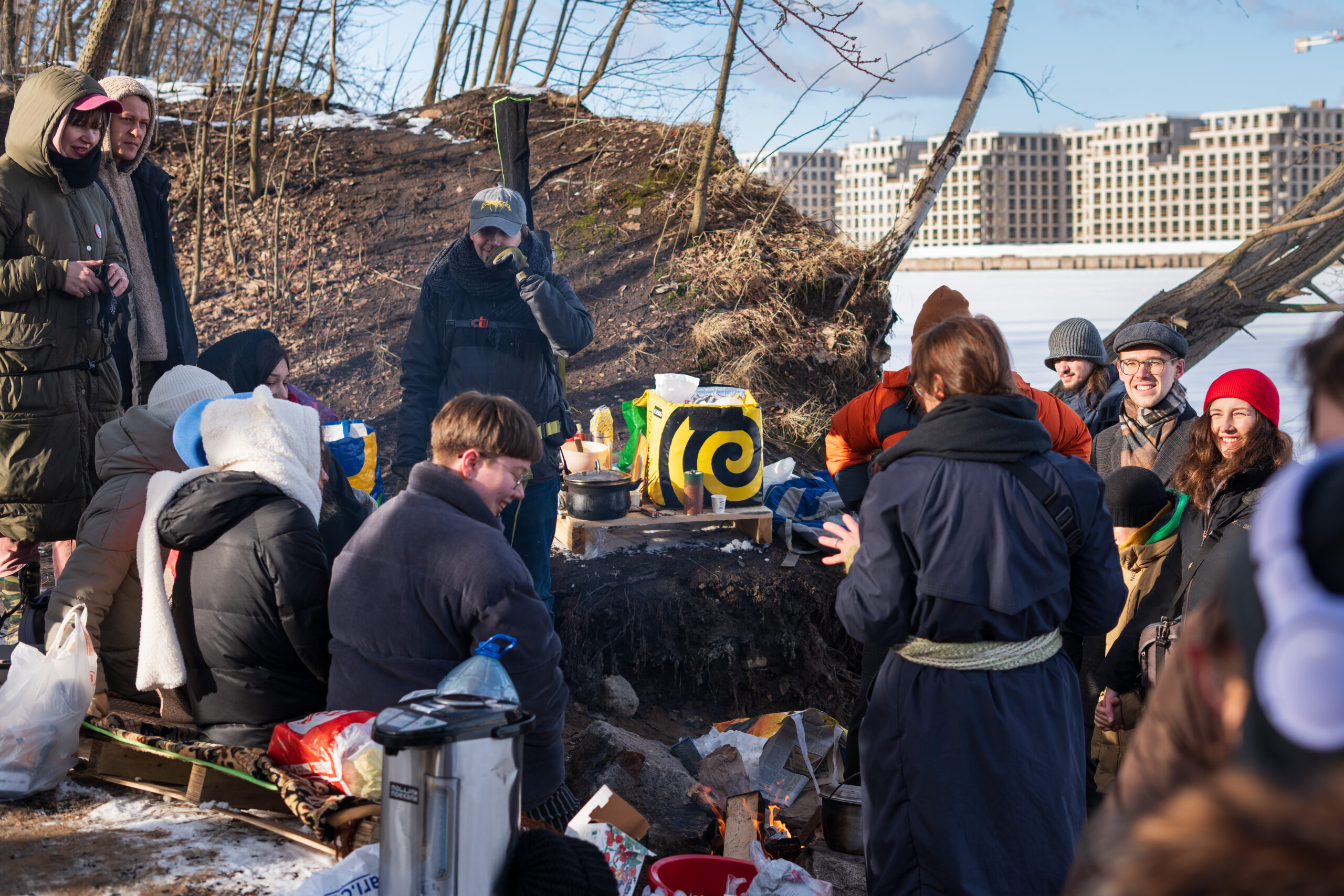
Since 2022, some of the “Thickets” activists have left, and the rest have become more focused on protecting the park. Activists wrote appeals, collected signatures, sought protective status for the green zone, and conducted patrols.
Urban defender Sergei Vasiliev believes that it was during this period that horizontal neighborhood communities began to grow throughout the city: “a web of people who don’t need to explain anything.” Simply demanding something from the authorities, according to the city defender, has become ineffective and unsafe. Now it was necessary to go through all the stages: “communicate with lower-level, middle-level officials, with management companies to find out something, with some contractors to learn to understand them.” The activists of “Thickets” also did this.
In August 2024, it became known that the road would still be built. In November 2025, the “Thickets” were cut down .
“Thickets” is a vivid example of how activism in Russia is adapting to the new reality, Lyubov Chernysheva, a senior researcher at the Sociological Institute of the Russian Academy of Sciences, explained to Paper .
“[Traditionally] collective action always has clear leadership,” says Lyubov. — There is some core, some group of people who formulate the situation, the conflict, indicate what we are doing, why we are doing it, and so on.
The Thicket did not have a core to guide the others. The people who started calling this place "The Thicket" were never the sole drivers of the community. Separate chats, discussions, the park’s Instagram profile - all this was managed by different people.
— They did something in common. They were interested in the idea of some incomprehensible green area that was potentially threatened by something somewhere. They are interested in the place, they are interested in coming there, they are interested in creating something that is not yet on the map.
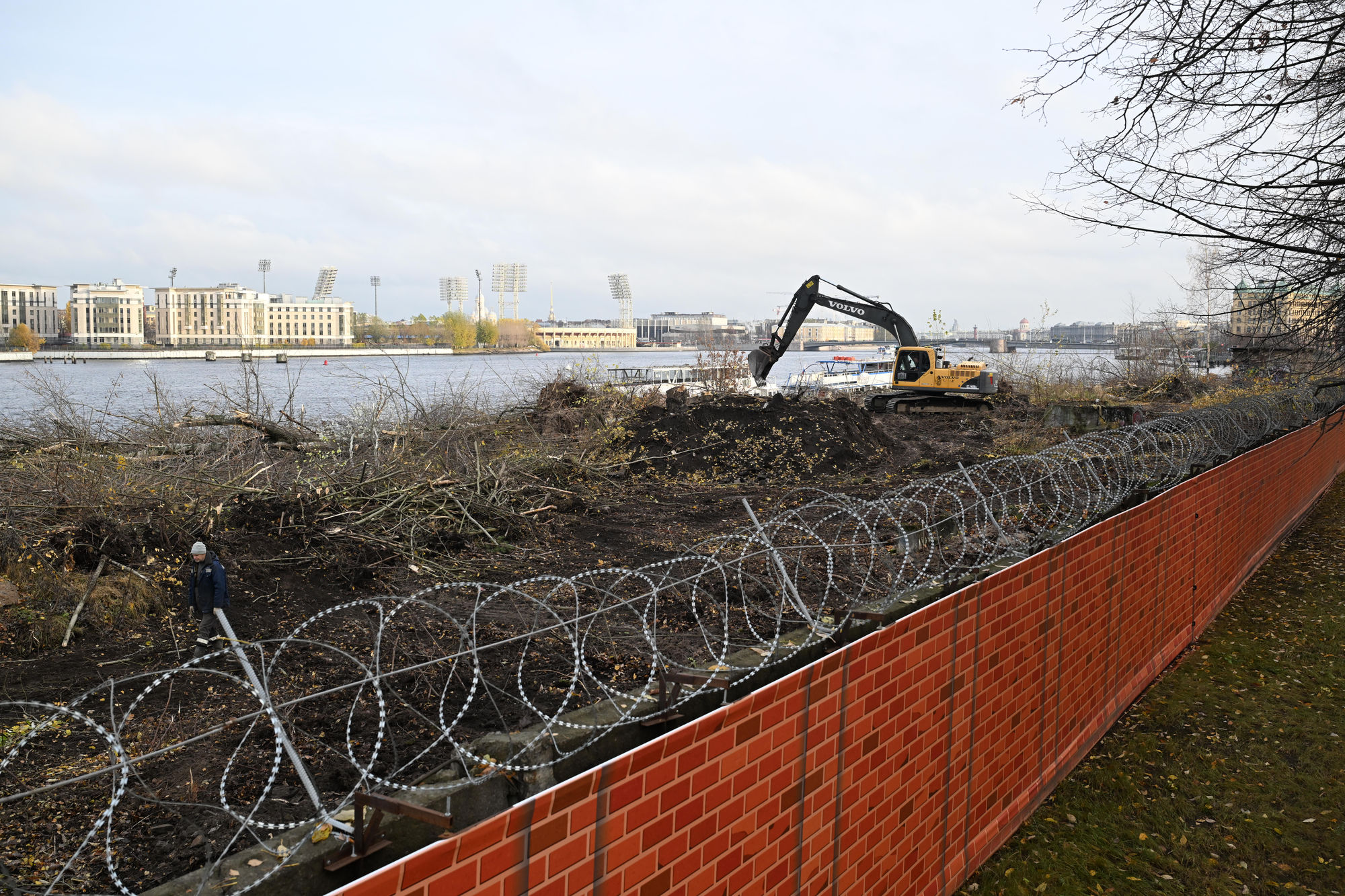
Since 2022, as the researcher notes, being an organization with a leader, core and agenda has become unprofitable - the risks are too great. It turned out to be much easier not to be an organization at all. Therefore, local horizontal communities, the format of which was determined by the digital platforms themselves, came to the fore.
— We learned to keep in shape, maintain an organizational structure through chats, we learned to be so digital, mediated. Then, maybe we don’t need to be gathered through this official organizational structure, through some name, registration, and so on. Maybe that’s why digital platforms have won such popular love.
“People used to be involved in politics.” How right-wing activists came to urban protection
Activist Dmitry emphasizes: for him, protecting VNIIB has always been outside of politics. In the community of opponents of the demolition of the building, according to him, there were people of very different views: “National Bolsheviks and those called Navalnists, old communists, Orthodox believers, young people without definite views,” but the backbone was always made up of pro-war-minded people of the older generation from among local residents.
During the demolition, the National Bolsheviks joined the defense of the building. Including Kirill Travkin, who fought in Ukraine, and was detained for seven days because of an attempt to break through the resistance of the Chopovites. Dmitry notes that he had never seen young National Bolsheviks at gatherings before.
“I was impressed by the guy who walked around in some kind of uniform,” recalls Dmitry, “And the girls were very beautiful and vulnerable, it seemed, I was also impressed by them.” But these people and I are not on the same path. We didn't quarrel, but we didn't make friends with them at the [police] department either. They were somehow apart.
The National Bolsheviks are known in St. Petersburg for their actions against censorship , migrants and, for example, in support of Igor Strelkov . They support the war in Ukraine and sometimes go to the front as volunteers.
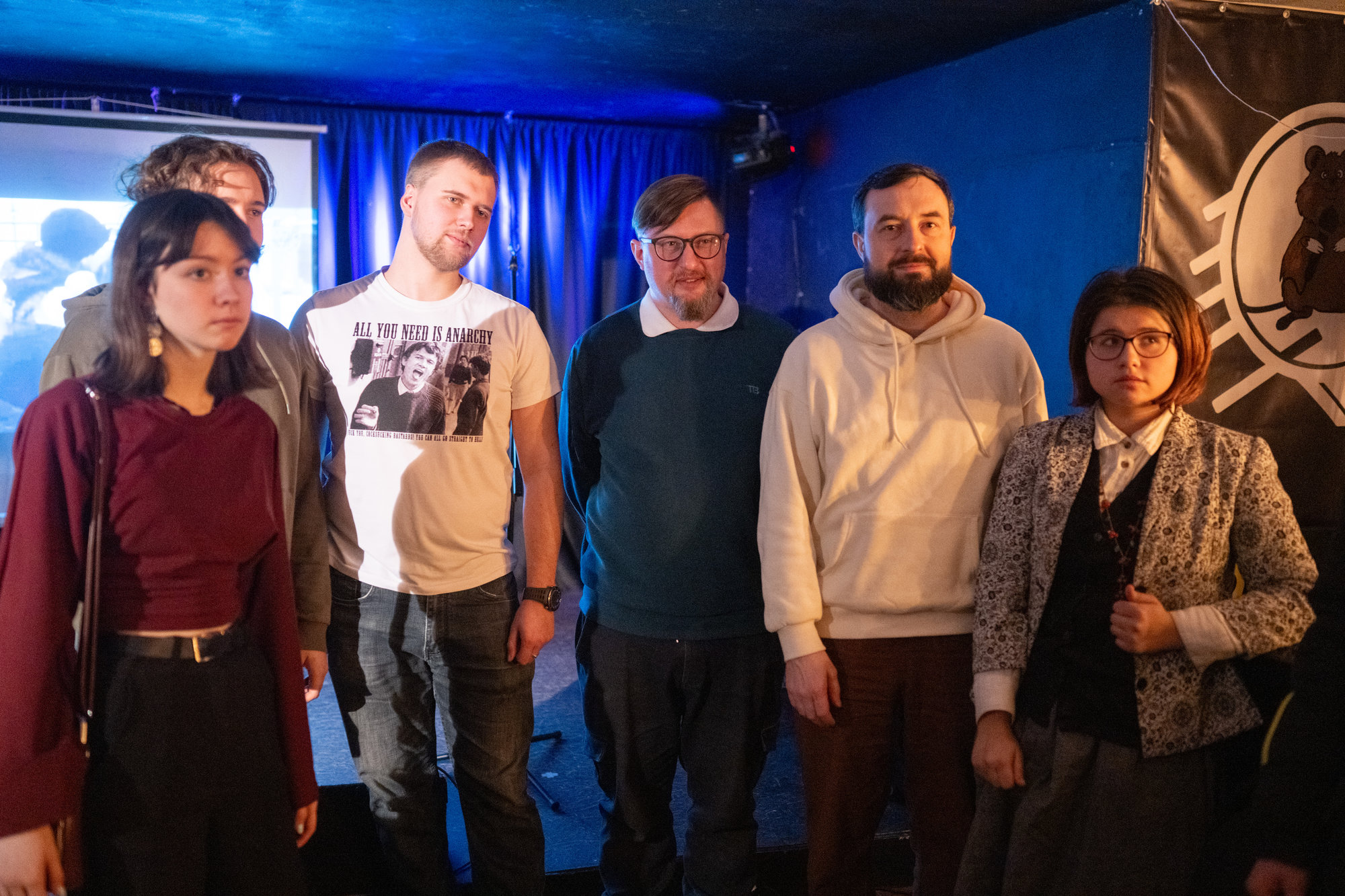
Judging by their social networks, St. Petersburg Limonovites began to take an active interest in urban protection in December 2025. In city-protection posts, they criticized the policies of the administration of Alexander Beglov and spoke about the need to protect historical memory, primarily the memory of the Great Patriotic War. This determined the choice of monuments, which the National Bolsheviks first of all paid attention to.
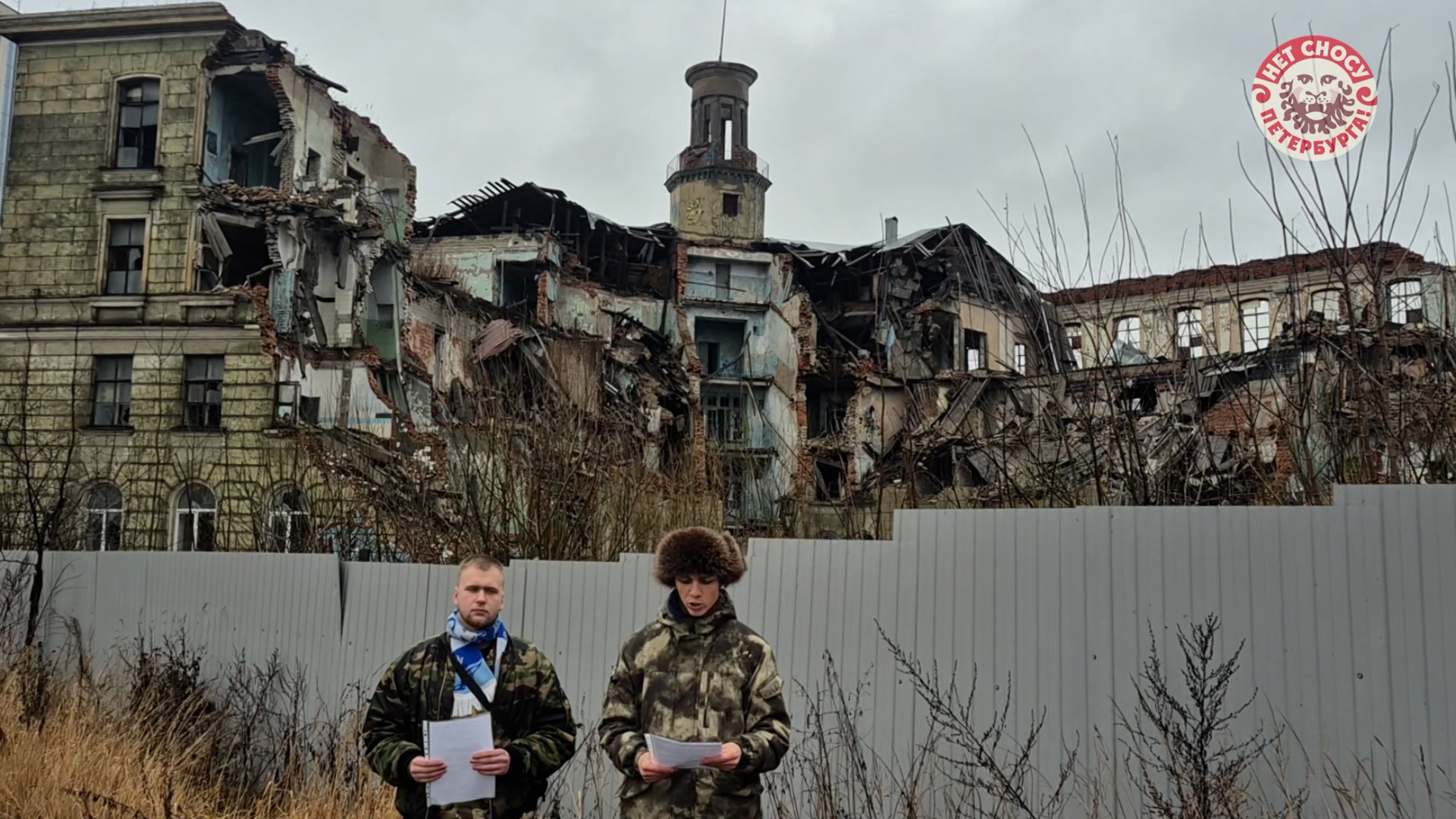
On December 24, Kirill Travkin and another former serviceman, Viktor Zaitsev, recorded a video message to the president, government and State Duma deputies in support of the Bergholz School building, which is being prepared for demolition, and the Rocket Forces Research Center, which has already begun to be demolished.
“Do you know how the current St. Petersburg authorities treat the memory of the muse of besieged Leningrad?” Travkin reads from the page.
Behind the young people is a dilapidated scientific center of the missile forces. “We are recording this video from St. Petersburg, although it may seem that we are still there, behind the ribbon,” says Zaitsev. He explains that the building was not damaged by a missile strike or drones: “our bureaucrats sold it for apartments, and then the grabber developers used dismantling equipment to tear the walls of the Stalinist Empire style into pieces.”
The news of Travkin’s arrest in early January was quickly picked up by right-wing telegram channels. The authors of the posts call city defenders patriots and scold the city authorities. “Apparently, the year 2026 in St. Petersburg will pass under the banner of urban protection,” writes right-wing activist Savva Fedoseev in his Telegram channel.
"Paper" tried to contact Travkin and other National Bolsheviks who participated in the defense of VNIIB, but they refused to answer questions. Additionally, Travkin asked the Bamagi correspondent “whose Crimea is.”
“People used to be involved in politics,” says activist and urban defender Dmitry Kuzmin, who was forced to leave Russia in 2024 due to persecution by the authorities, in a conversation with Bamaga . “Now the state puts a lot of pressure on and makes such activities difficult.” But people need to show their civic initiative. They come to urban protection. This also applies to the National Bolsheviks.
According to Dmitry, besides urban protection, there are not many areas left where you can continue to defend your rights in Russia. These include, for example, support for prisoners or the environment.
“Against anti-Russian and anti-Russian Nazism.” Why urban protection has become even more politicized
After the demolition of the VNIIB building, the chat of defenders released a number of posts criticizing officials and the developer. One of them, for example, said that the developer FSK used “déclassé, Russophobic representatives of the Caucasian peoples” to guard the building, while “for 4 years now, a military action against anti-Russian and anti-Russian Nazism has been carried out.”
“SOS Demolition” dedicated a post to the arrested National Bolshevik Kirill Travkin, mentioning that “while Vladimir Putin is talking about the high role of special operation veterans, in St. Petersburg they are first beaten by Beglov’s guest workers, and then thrown into jail.”
“Northern Military District veterans,” like the siege survivors, have long become a permanent element of city protection rhetoric. Sergei Vasiliev does not see anything surprising in this. The city defender compares these references with Soviet references to authorities: “Lenin lived in this house, let’s preserve it.”
So, on January 18, “veterans of the Northern Military District”, together with city defenders, laid flowers at the Mitrofanievskoye cemetery, along which they plan to build a road. In December, SOS Demolition published an appeal from veterans Travkin and Zaitsev regarding the building of the Bergholz School and the Rocket Forces Research Center. And in July 2025, “Living City” called on the authorities to renovate historic houses and transfer them to “SVO participants and large families.”
Another already familiar rhetorical tool of activists is an appeal to Vladimir Putin. He is the addressee of most of the appeals in which city defenders ask to prevent the St. Petersburg administration from destroying the city. Typically, such requests remain unanswered or are redirected to local authorities. They don’t react in any way to patriotic speeches.
“This is called the weapon of the weak,” agrees Dmitry Kuzmin, “when you use any tools, any methods available to you in order to fight the authorities.” Even her own language.
He is confident that, with rare exceptions, such references say nothing about the views of the majority of urban defenders. There have always been people with pro-government views in the ranks of city defenders, Bamaga’s interlocutors explain, but now they have the opportunity to sound louder. Some anti-war activists left Russia after 2022, others are afraid to express their views. Much depends on the specific community, activists explain, and on whether its moderators are dominated by people with pro-war or anti-war views.
“I’m afraid that this will not go away,” says Sergei Vasiliev, “this is the polarization of society, and it leaves its mark on everyone, including city defenders.” City defenders are different. It is wrong to assume that they belong to any camp.
At the same time, right-wing activists do not at all believe that by protecting historical buildings they are not engaging in politics. “Urban defenders continue to insist that they are “outside politics,” although they are busy with very political tasks,” writes Savva Fedoseev. — Yes, and the call to leave his post to the head of the city is not a political statement? What a great one! This is politics."
Let's find out what's really going on
Make a payment in favor of the editorial office of Bumaga
What else to read:
- Demolition of VNIIB began immediately after Christmas. Look how St. Petersburg residents resisted this
- How did the appearance of St. Petersburg change under Beglov? “Tuchkov Buyan” was not built, urban protection lost its independence, but there were more public spaces.