
Translated material
Mama's boy
The story of the “Siberian ripper” Alexander Spesivtsev
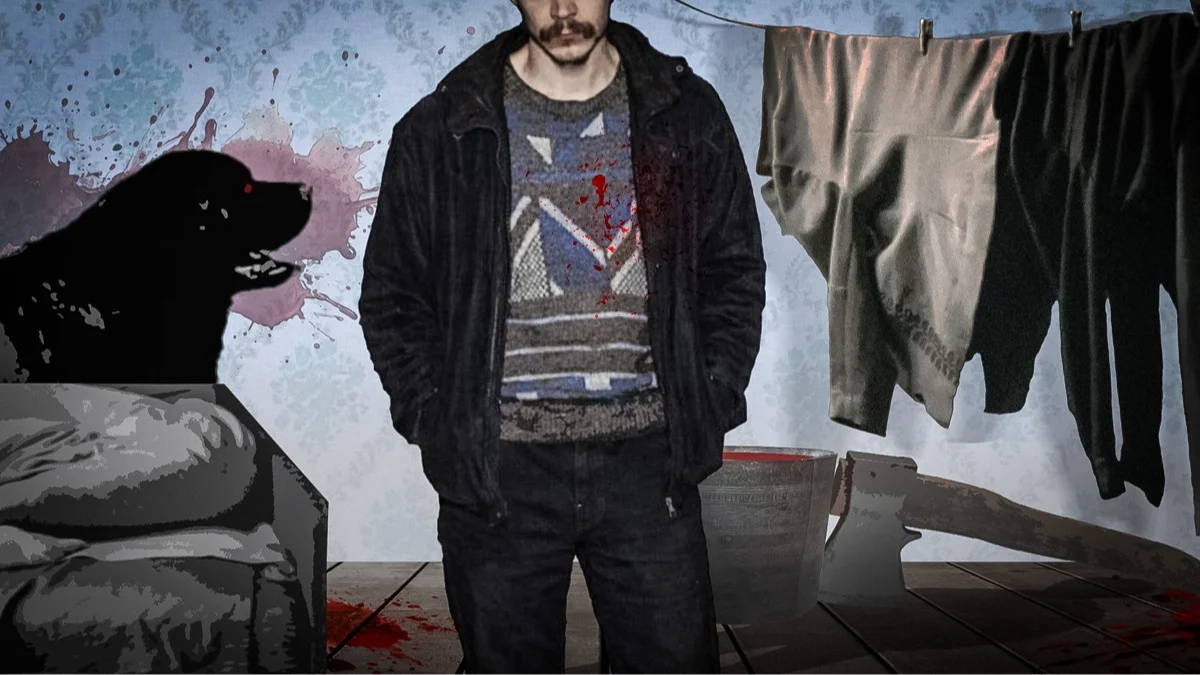
Illustration: “New Newspaper Europe”
Alexander Spesivtsev, who was nicknamed the “Siberian Ripper,” can be called the most “productive” maniac: in a year he killed and ate at least 19 people. Before killing, he tortured and raped the victims for a long time. After the murder, he dismembered the bodies, filmed everything with a camera, cut out parts of the bodies, cooked and forced the next unfortunates to eat it. His own mother supplied him with victims. She later helped get rid of the remains.
Alexander was born in Novokuznetsk on March 1, 1970 in the family of Nikolai and Lyudmila Spesivtsev. My father, a factory worker, drank heavily and went on holidays, almost never appearing at home. Another older sister, Nadezhda, grew up in the family. His mother, Lyudmila, gave birth to a son at home and did not register for a long time. Alexander received his birth certificate only in 1972. The mother considered her son “weak and mentally vulnerable,” he was underweight, so the boy grew up in conditions of overprotection.
Already from childhood, Spesivtsev began to show a bad character and lack of upbringing. He painted the entrance with slogans about Hitler, filled the neighbors' locks with matches, set fire to buttons in the elevator, and scattered garbage. The neighbors caught the hooligan and complained to the mother. But she invariably took her son’s side, accusing everyone of lying.
However, by the age of 14, the age of criminal responsibility, Spesivtsev had calmed down a little. He stopped being a hooligan and started stealing. In 1985, Lyudmila divorced the father of Alexander and Nadezhda. By that time, my father might not be home for weeks, so the loss was unnoticeable. But in the social service, the Spesivtsev family moved into the disadvantaged category. And soon Sasha was caught stealing radio components from the school office and was registered with the police in the children's room.
The question of sending Spesivtsev to a special school was raised , but his mother again came to the defense. She then worked as a caretaker at a school (during her studies, Alexandra Lyudmila changed three institutions), in the end she was fired under Article 33 (theft) and she was no longer accepted into schools. The daughter, who in 1985 already worked as a secretary to a judge in a district court, helped her mother get a job as an assistant to a blind lawyer. Having become proficient in legal law, Spesivtseva overwhelmed teachers, the district education department, the police, and the prosecutor's office with a heap of complaints and appeals. And they gave up on the hooligan, warning that next time he would not get away with a special school, but would end up in a juvenile colony.
Lyudmila Spesivtseva often brought home materials from criminal cases. Sasha loved looking at photographs of victims of violent crimes. As he later admitted to investigators, these cases interested him more than books and television.
In 1988, Alexander Spesivtsev was convicted of several thefts and ended up in a pre-trial detention center. An examination revealed that he had schizophrenia, and the court sentenced Spesivtsev to treatment. In October 1988, he was placed in a psychiatric hospital, from where he safely escaped (the regime of detention was not strict) in March 1989.
After his escape, they didn’t really look for him. Spesivtsev lived quietly in his parents' apartment. In 1991, he met 17-year-old Zhenya Guselnikova and began dating her. A couple of months later, the girl tried to break up with the guy because he was open-handed and humiliating her. In May 1991, he brought Zhenya home (her mother and sister went to stay with relatives so as not to “disturb the young people”) and tormented her for almost a month.
The neighbors, accustomed to giving the Spesivtsevs a wide berth, tried not to pay attention to the noise and screams. Guselnikova’s parents also did not immediately miss their daughter, since Spesivtsev told them that they decided to live together and test their feelings. Only a month later they finally turned to the police and insisted on a joint visit to the Spesivtsevs’ apartment. Nobody opened the door. Neighbors reported screams from behind the door, and only then did the police break down the door.
Zhenya, beaten, covered with scabs, emaciated, was still breathing, Spesivtsev was sleeping calmly next to her. The girl was taken to the hospital, but she could not be saved. Spesivtsev was arrested, but during the investigation he stated that Zhenya lived with him voluntarily, could easily leave the house, and in this (beaten) state she appeared the day before after a two-day absence.
Despite clear evidence of the forcible detention of the girl, Spesivtsev did not end up in a colony: he was again recognized as suffering from schizophrenia and was placed in a special hospital in Orel, from where he was released at the end of 1995 as cured.
Bureaucratic mistake
In June 1996, fragments of children's bodies were discovered on the banks of the Aba River. In those days, genetic testing was an expensive and not yet well-developed procedure. But experts were able to establish that fragments of the bodies of at least 15 children and teenagers were buried. After his arrest, Spesivtsev confessed to the murders (however, he recanted his testimony in court). This is how he himself spoke about the episode with the murder of six teenagers:
“In essence, I explain that around April-May 1996, at the construction site of a department store under construction opposite the Novokuznetskaya hotel, I met six boys about the age of twelve and offered to rob an apartment (I offered them to rob my apartment). We arrived at my apartment. I opened it with the key. The seven of us went into the apartment, and the last guy closed the door behind him. I invited them to come into my bedroom. They became worried, suspected something was wrong, one of them began to scream, I took a knife that was lying on the table in the bedroom and hit him in the chest, the rest began to scream too. I then began to cut them, landing about one blow each in the chest. I realized that they all died at once. Next, I moved them all to one place in the bedroom, near the closet, and covered them with a rag.
They remained in this state for four days. Then I took them out into the corridor. About a week later, my mother Lyudmila Yakovlevna Spesivtseva came. I made her take the bodies away, and I went to the bedroom to sleep. In the morning when I woke up, there was nothing in the corridor. I don’t know what my mother did with them; I didn’t talk to her about this topic.”
A couple of days later, Spesivtsev met two girls aged 12 and 14. He lured them to the apartment under the pretext of a commercial offer. He invited the girls to go door to door and sell soap, which he would give to them. The girls agreed. Their remains were also among those found on the banks of Aba.
The discovery of so many fragments of children's bodies excited the entire city. Specialists with a genetic analysis laboratory were sent from Moscow. Investigators from the Prosecutor General's Office and operatives from the Criminal Investigation Department of the Ministry of Internal Affairs also arrived. However, all the dirty work, as always happens, was entrusted to the police “from the ground.” They did a tremendous job checking all those with previous convictions who were registered with the police and the PND. Versions about “black transplantologists” and the filming of “deadly porn” were considered. But still, the main direction for work was the version about a maniac.
But no one came to the Spesivtsevs. It was a matter of ordinary negligence. When discharging Spesivtsev from the clinic in a state of remission, the hospital management simply forgot to report this to the Ministry of Internal Affairs and the PND at the patient’s place of residence. So, according to the documents, Spesivtsev was still listed as being treated at the Oryol clinic.
And if they had visited his home, they could have easily arrested Spesivtsev red-handed. The fact is that while the police were looking for the “Siberian ripper,” he killed four people just in June: two girls, one woman about 40 years old and a man about 35. The identities of the latter two could not be established. All of them were killed and dismembered. He cut out loin parts from all Spesivtsev, which he and his dog, a Newfoundland, ate.
In July, 19-year-old Natalya V. found her death in Spesivtsev’s apartment. In August, two 12-year-old girls died. The last victims of the maniac were three girls (15-year-old Olya and 13-year-old Zhenya and Nastya), whom some grandmother asked to open an apartment. The kind girls responded to the request and went to help the old woman. This grandmother was Lyudmila Spesivtseva, who in September 1996 brought her son further victims.
Can a maniac come out?
Here's how one of the girls talked about what happened to her and her friends:
“On September 9, 1996, I was admitted to the hospital for examination for gastritis. At the hospital I met two girls - Nastya, I don’t remember their last name, and Zhenya Barashkina. Sometimes, when the weather was good, we went for a walk together outside the hospital.
On September 24, 1996, in the afternoon, the three of us left the hospital and walked in the courtyard, along the street not far from the hospital. As the three of us walked past a store located near a parking lot with many kiosks, a grandmother approached us. She looks very old, gray-haired, small and thin, I can recognize her. She turned to us for help, said that she had closed the door to her apartment and could not open it, and asked us to help her open the door. We agreed, she led us to a nine-story building, we went up to the ninth floor, and this grandmother knocked on the door. The door was opened by a man with a dog - a large black diver. I was scared, Nastya and Zhenya too. We began to tell my grandmother why she did this, but she immediately silently went into the apartment. This man began to drive us into the apartment. We went in because we were afraid of him and the dog. In the apartment, in addition to this grandmother and the man, there was a woman about thirty years old (Spesivtsev’s sister). Dark-haired, with a tail of hair. This man appears to be 27–28 years old, short, with a thin face, and on his right hand is a tattoo of a naked woman.
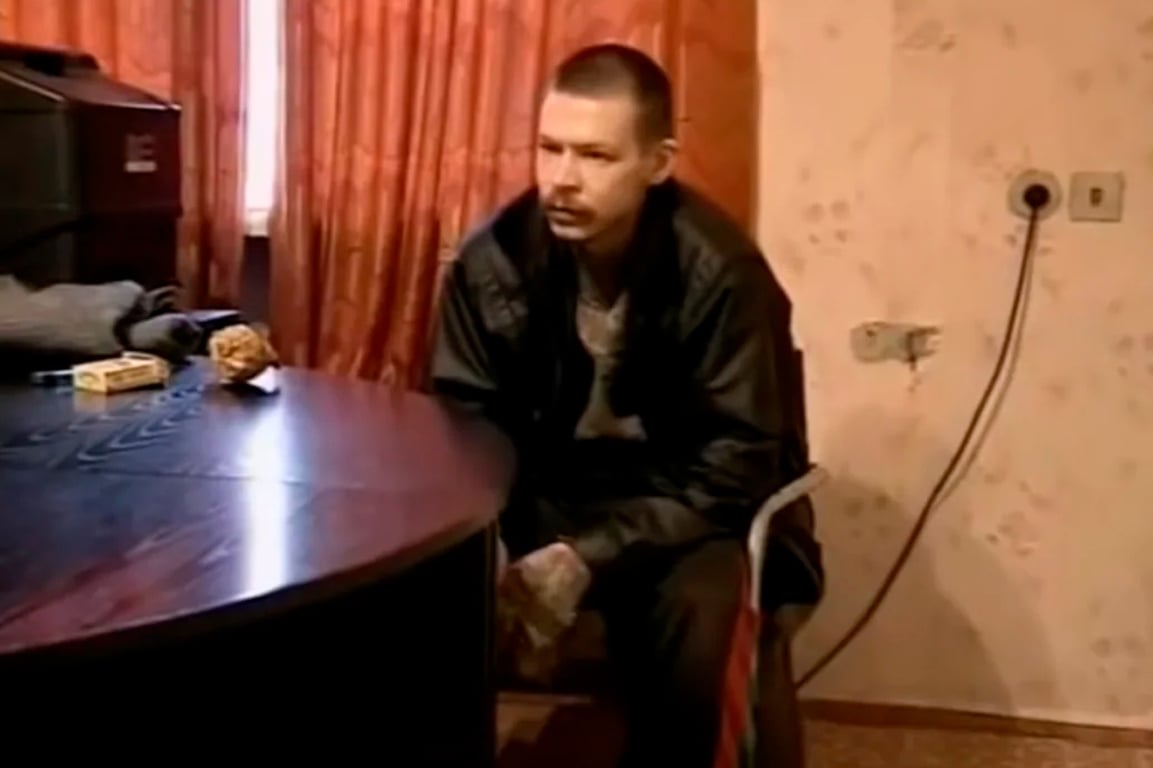
He immediately took all three of us into the room where there was a chest of drawers and a bed, told everyone to sit down, said that he had not slept for two days and that’s why he was angry. He was called Andrei . We all began to ask him to let us go, but he said that now someone should come and look at us, and if it’s not us, then he will let us go. He told us to sit quietly in the room, went out, and came in again. Nastya suggested that I hit him on the head with a bottle and run away. The bottle stood by the bed. I said I couldn't. Then she decided to hit him herself. Andrei came in and, since Zhenya continued to ask him to let us go, he said that he would now give her a sedative injection, brought a syringe with yellow liquid and took Zhenya by the hand. He told her to “pump up” the vein by pulling her arm. Nastya hit him from behind with a bottle, but hit him not on the head, but on the shoulder. He took a knife with a button from his pocket and stabbed Nastya in the stomach. She immediately sat down and began to say: “No need.” Andrei stabbed her three more times in the chest and stomach. He grabbed the pantyhose that was lying around and began to choke him. A grandmother came in and asked: “What are you doing?” Andrei told her to leave, otherwise she would get it too...
...He fed us soup made from meat from Nastya’s corpse, or whether he ate it himself, I didn’t see. The grandmother cooked the soup, she knew and saw where Andrei gave her from and what kind of meat. In addition, I saw that the grandmother, when leaving, took parts of the corpse into a bag and took it somewhere, I don’t know where. From their conversations, I realized that Andrei owed his grandmother some money for bringing us to him. He always addressed his grandmother only as “e” and never called her anything. The woman was called Nadezhda Nikolaevna or simply Nikolaevna. Neither the grandmother nor the woman lived in this apartment or spent the night. They came sometimes. Andrei always told his grandmother when she needed to come.
On the morning of Friday, October 18, 1996, Andrei slept with Zhenya on the bed, and I slept on the armchair. Waking up, Andrei began to rape Zhenya, she asked: “Don’t,” to which he replied that there was nothing to lose, she would die anyway. Seeing that I woke up, he told me: “Go fuck,” I refused. He said he would put me in the bathroom. In general, I sat there very often, he handcuffed me there. On the same day, the newspaper with the TV program disappeared somewhere, Andrei began to beat us, saying that we had stolen it.
He hit Zhenya's head against a corner, kicked me, and tied me up in the bathroom. Then he came in and asked me if I knew how to do artificial respiration. He unfastened me, Zhenya lay on the floor and was not breathing, but her heart was beating weakly. I gave her artificial respiration for about an hour, but she died.
Andrei said that he liked her and needed her soul to leave, opened the window and did not touch the corpse for three days. On the same day that he killed Zhenya, he raped me. Three days later, he fed me fried potatoes and told me to cut the corpse into pieces and put everything in an empty tank in the bathtub. Both the grandmother and the woman came and saw Zhenya’s corpse. Andrei told the grandmother that all parts of the corpse should be buried in one place. I don’t know where and what parts she took.”
The day after giving this testimony, Olya died in the hospital.
The maniac was caught by accident. In October it is already quite cold in Novokuznetsk. So the heating is turned on in September. But the radiators remained cold, and one of Spesivtsev’s neighbors called plumbers. They walked along the entire entrance, checking the batteries. We reached the ninth floor, where the maniac lived. But he refused to open the door, shouting: “I’m mentally ill! Mother locked me up!”
Everyone heard about the remains of people that began to be found in the area. Therefore, upon hearing Spesivtsev’s “confession” of insanity, the neighbors called the police. They decided to break the door.
There was a corpse smell in the apartment and a terrible mess reigned. The maniac kept his victims' belongings at home, including jewelry. In addition, before his death, he took pictures of his victims on an old Polaroid. The police found Olya barely alive on the floor of one of the rooms. The girl was taken to the hospital, she managed to give evidence, but died three days later from peritonitis and pulmonary edema.
The maniac himself managed to escape up the fire escape to the roof and left the house when the police left the apartment. A couple of days later, Spesivtsev returned to the entrance, where he was detained by police officers on duty.
The killer did not hide the fact that his mother helped get rid of the bodies. At the same time, Lyudmila denied most of the criminal episodes. “I will answer for four buckets of remains, I don’t know anything about the rest,” she repeated during the investigation.
82 sets of bloody clothes belonging to different people and 40 sets of jewelry were found in the apartment. This indirectly confirms that there could have been many more victims. A repeated psychiatric examination concluded that although Spesivtsev was not mentally healthy, he committed the murders in a state of sanity. In May 2024, the Kemerovo Regional Court found that Spesivtsev was involved in another 15 murders for which he was originally accused. As a result, Spesivtsev was held responsible for only 19 murders, including the murder of Zhenya in 1991. A surviving victim was also found - at that time a 12-year-old boy, who was initially discovered and interviewed by employees of the Federal Penitentiary Service of Russia for the Republic of Buryatia in the subordinate colony where he was kept. Thus, almost 20 years later, in 2022, these indications gave rise to additional verification.
The maniac's sister Nadezhda escaped punishment: the court failed to prove her involvement in covering up her brother's crimes. Lyudmila Spesivtseva was found guilty of complicity in three murders and sentenced to 13 years in prison. She was released from prison in 2008. Together with their daughter, they left for one of the villages in Kuzbass.
Spesivtsev is currently undergoing indefinite treatment in a special type of psychiatric clinic in the Volgograd region. The apartment in Novokuznetsk is also registered with him, and legal proceedings have begun regarding debts to pay for utilities.