
Translated material
The Empire came to Moscow State University
What the Orthodox oligarch Malofeev is going to tell students
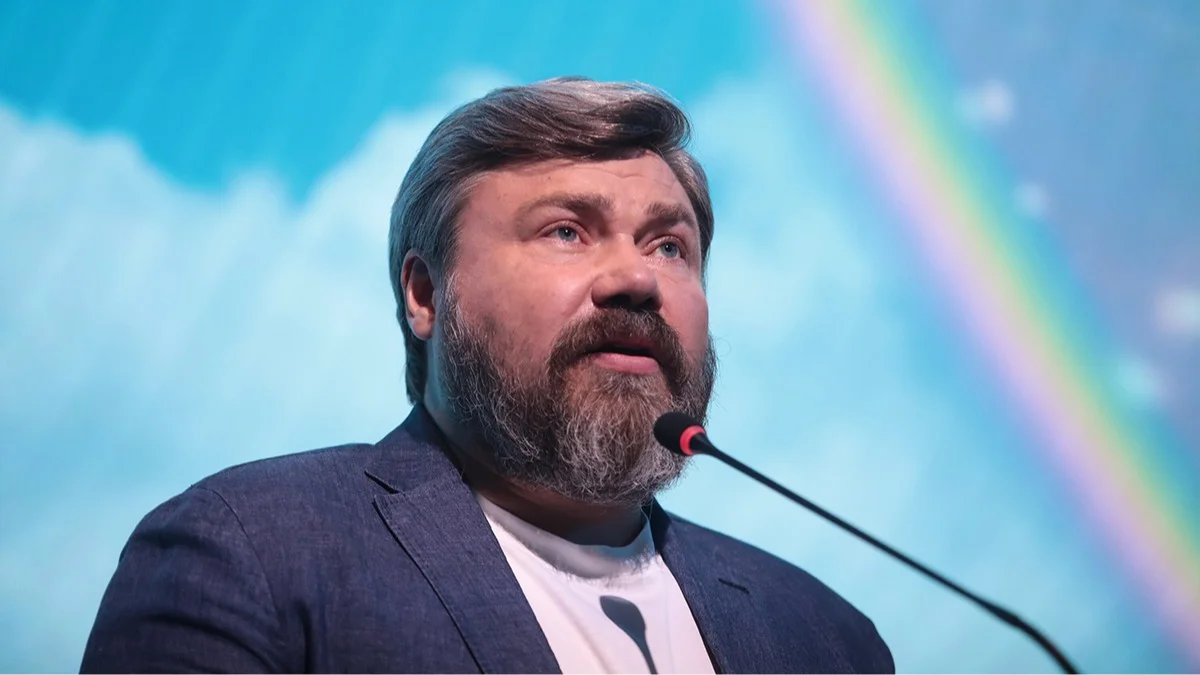
Konstantin Malofeev at the “Future Forum 2050” in the Lomonosov educational cluster, June 9, 2025. Photo: Artur Novosiltsev / Moscow Agency
Orthodox billionaire Konstantin Malofeev, who played an important role in inciting the war with Ukraine and supports the far right, according to Meduza, is going to give lectures to Moscow State University students. What an Orthodox Z-propagandist can teach and how odious lecturers in general influence the academic community was discussed with experts.
A traditionalist who got rich in investments and telecoms
According to Meduza's source, Orthodox oligarch Konstantin Malofeev will give lectures at the Faculty of Political Science of Moscow State University for second-year students.
The publication claims that a subject called “History of the Empire” is already included in the schedule, where the name of the teacher is also indicated - K. V. Malofeev. Meduza has a screenshot of the schedule. It was not possible to find any MSU teachers who would be Malofeev’s namesakes.
So far this information has not been officially confirmed. On the website of the Faculty of Political Science of Moscow State University for the second year, the schedule is published only until December 31, 2025, and Malofeev is not listed as a teacher there. He also did not say anything about this himself in his Telegram channel. There is also no mention of the new lecturer on the social networks of the Faculty of Political Science.
Previously, Malofeev had already established himself as a great writer; he published four books: “Empire. 4000 years", "Empire. Third Rome", "Empire. Present and future" and "Empire. Image of the future." The books are dedicated to Konstantin Malofeev’s view of world and Russian history.
On the air of his own TV channel Tsargrad, Malofeev explained to the ultra-right ideologist Alexander Dugin that he defines an empire as a multinational state accountable to a ruler who receives power from God. According to Malofeev, empires personify goodness and order.
Empires, according to him, throughout human history have been opposed by “anti-empires,” where the main values are not service to the authorities, but personal enrichment, comfort and money:
“We live in a civilization of victorious anti-empire. This is the world of oligarchy. Now this is the world of transnational Internet corporations,” Malofeev said in an interview with Dugin.
At the same time, Malofeev’s business is absolutely worldly: the Orthodox billionaire made his fortune through banking operations, investments , cryptocurrency and projects in the field of telecommunications.
The author of the course on the history of the empire, Malofeev is not a historian by training: in the mid-1990s he graduated from the Faculty of Law of Moscow State University. He received his PhD degree from the same law faculty in 2022. He wrote a dissertation “The Constitutional Assembly of the Russian Federation as a subject of revision of the Constitution of the Russian Federation.” The fact that it was oligarch Malofeev who defended himself, and not his full namesake, is proven by the recording of his dissertation defense posted on YouTube.
Konstantin Malofeev is one of the most politically active oligarchs in modern Russia. He helps a number of foreign movements loyal to the Kremlin. He also played a key role in supporting pro-Russian separatism in Ukraine in 2014. Now in Russia he owns the Tsargrad TV channel and gives money to a number of patriotic associations.
In 2010, Vedomosti wrote that Malofeev was a parishioner of the temple at Moscow University. In his Telegram channel, he remembers Moscow State University as his alma mater on Tatiana’s Day , January 25. In the same posts, Malofeev advertises the right-wing student organization “Brotherhood of Academicians,” which he himself finances.
In the summer of 2025, Malofeev held the “Future Forum 2050” conference at Moscow State University; among the conference’s honorary guests was Elon Musk’s father, Errol (Elon himself probably couldn’t).
Patriotic attack on universities
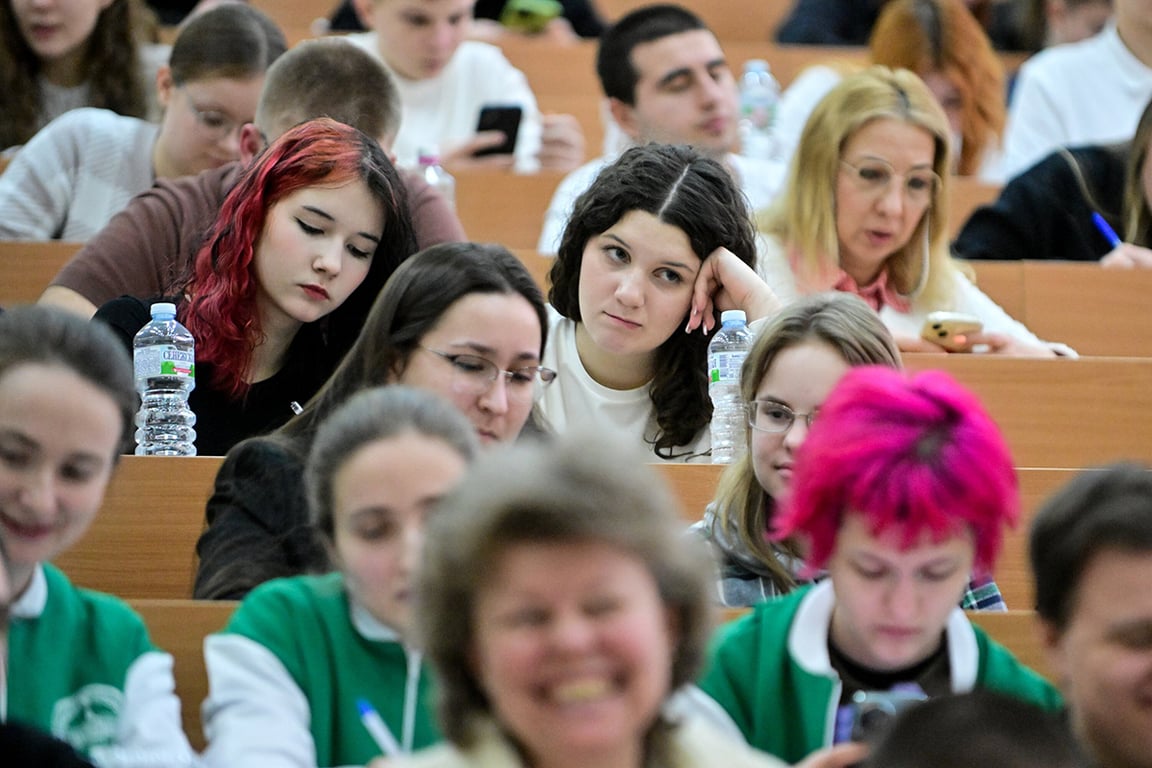
In the fall of 2025, a series of public lectures “Lessons from Untold History” was held at Moscow State University with the support of the Moscow City Hall. The lectures covered different periods, from Ivan Kalita to SVO. The event was organized by a certain “Russian Union”; among the lecturers was, for example, Lieutenant General of the SVR Leonid Reshetnikov. Malofeev, however, did not participate in this project.
Mikhail Lobanov, a member of the Moscow State University Initiative Group, notes in a conversation with Novaya Gazeta Europe that, in principle, all political forces are striving to enter universities. This is one of the most promising platforms for communicating your position and attracting supporters. Initially, it was not imposed by officials, but was invited by the students and teachers themselves.
— Dugin spoke at Moscow State University even before he was “made” a professor of social sciences. At Moscow State University there were discussion platforms at different faculties. Dugin could be called there as a funny outcast who carries funny things. People did not imagine that this could lead to massacres, war and the radicalization of the regime,” he recalls.
In 2017, the far-right Orthodox organization “Forty Forties” held an event at Moscow State University, but this was also an initiative of students, not the administration. Lobanov notes that in 2015, students of the Russian State University for the Humanities managed to cancel a speech by one of the Anti-Maidan leaders, conspiracy theorist Nikolai Starikov. After the overthrow of Viktor Yanukovych in 2014, Anti-Maidan was created in Moscow to counter Russian oppositionists.
— Before the war, these attempts caused protests: in universities, where students and teachers cared about their reputation. When Dugin appeared at Moscow State University as a professor, there were continuous protests against him, says Lobanov.
He emphasizes that in war conditions it is difficult to resist the arrival of Z-propagandists in universities.
“If you speak out against them, you may be labeled as one who opposes the war, and you may end up under a steamroller.” The campaign against Ivan Ilyin’s Dugin center [in 2024] was largely initiated by the Communist Party of the Russian Federation, which has been fighting Ilyin for decades. But we see how young people poured into this campaign, what a great demand for resistance there was,” he says.
A supporter of the invasion of Ukraine, writer Zakhar Prilepin and his team collaborated with the Faculty of Political Science of Moscow State University - this was noted by Dmitry Dubrovsky , an employee of the Boris Nemtsov Center for Russian Studies at Charles University (Prague), in a conversation with Novaya Gazeta Europe.
According to him, teaching at Moscow State University is “a way to strengthen expertise” and show one’s involvement in the intellectual elite.
— These projects do not meet with support within the university, and not because MSU employees are oppositionists, but because they are strangers to the university. Just like in the late 1920s, Hitler was not allowed into decent houses: not because they were against Judeophobia. But because Hitler is a plebeian, he spoke somehow crookedly... A man from the street can buy himself a doctorate and become the head of a department, but the corresponding reputation will remain, he explains.
Pro-war projects have so far failed to take deep root in universities, the expert believes.
“Even with the start of the war [jingoistic projects at universities] start loudly, and then disappear somewhere. Even before the war, Dugin was a professor and head of the department at Moscow State University. And now this department does not exist. All the ideological nonsense that they are trying to pin on Russian universities is produced outside of them. This is a blip that has not yet changed anything meaningful within Russian education,” notes Dubrovsky.
According to Dubrovsky, the normalization of the invasion of Ukraine and the Kremlin’s policy in general in the Russian scientific community is happening, but is not yet on a tragic scale. And now only people trying to quickly make a career are really interested in Z-projects.