
Translated material
Disposable agents
How does Russian intelligence recruit Ukrainian refugees for sabotage in Europe? Retelling of The New Yorker material about two teenagers who fled mobilization
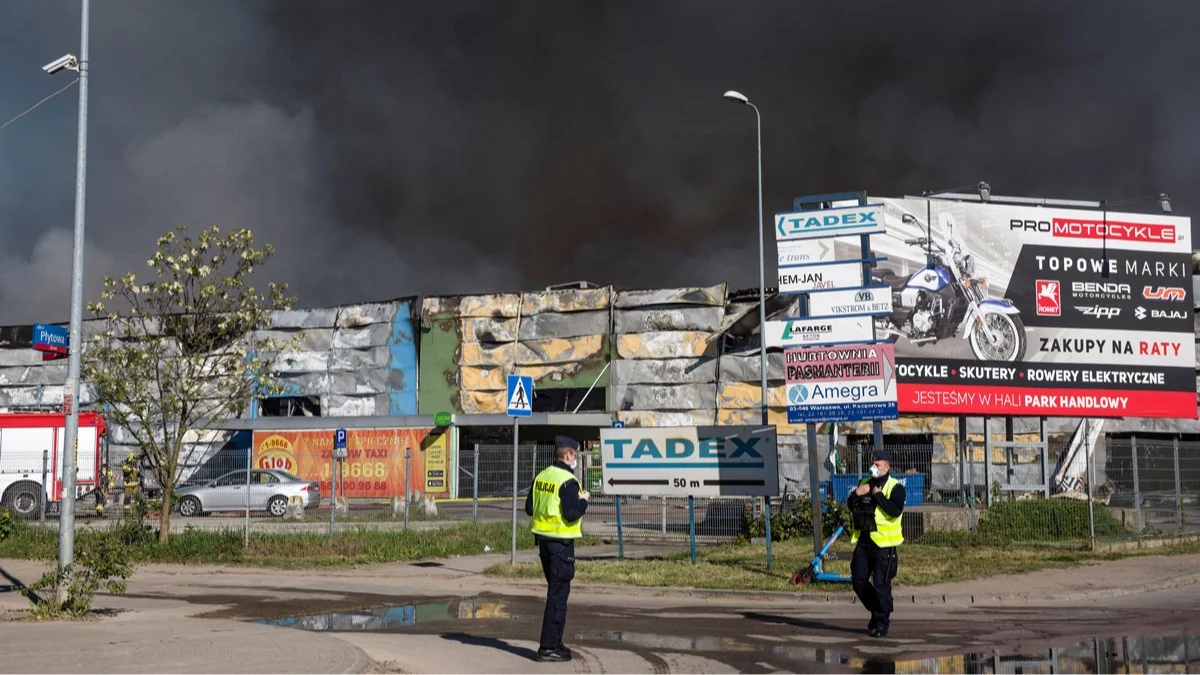
Police officers stand near a shopping center that was burned after an arson attack in Warsaw, Poland, May 12, 2024. Photo: SOPA Images Limited / Alamy Live News / Vida Press
The New Yorker magazine told the story of two Ukrainian teenagers from Kherson, who fled from mobilization shortly before coming of age and were drawn into the network of the GRU - Russian military intelligence. The example of Daniil and Alexander clearly shows the scheme by which the GRU finds and recruits people for espionage and sabotage in Europe. Read more about the history of Kherson residents in the retelling of Novaya Gazeta Europe.
Flight from mobilization
At the center of The New Yorker's material is 17-year-old Daniil Bardami from Kherson. The publication describes him as an ordinary teenager who lived with his parents and brother. When he was 15 years old, Russian troops occupied Kherson. The young man himself worked briefly at a gas station at that time.
In November 2022, Ukrainian troops liberated the city, and a year later, in November 2023, Bardim moved with his family to Gayvoron, a small Ukrainian town near the border with Moldova.
Bardim graduated from 11th grade. The teenager was dissatisfied with low wages in the city and was afraid of being drafted into the army after turning 18. So he gathered his savings—three thousand hryvnia, or about $75—and, together with a friend from Kherson, Alexander, who also once worked at a gas station, he made a plan to escape from Ukraine “so that he wouldn’t have to fight.”
In March 2024, friends crossed the Polish border and arrived in Kluczbork, a small city in the south of the country. An acquaintance arranged for them to load sofas; they paid about $50 a day in cash. A month or two later, an acquaintance from Kherson named Sergei Chaliy invited them to Warsaw.
Chaliy is a 31-year-old man from the same district of Kherson, the former owner of a gas station where two friends worked. During the occupation of the city, according to The New Yorker, Chaliy worked on the black market, selling fuel and stealing cars with the connivance of Russian forces, and also drove around in a BMW “like a gangster.” Bardamim heard that
Chaliy sent the stolen cars to Russia and either sold them or transported them to Europe. After the liberation of Kherson, fearing arrest, Chaliy fled to annexed Crimea.
Chaliy told Daniil and Alexander that he had a job for them in Warsaw - “something related to car repair.” Chaliy began to take care of them, sending them small amounts of money for food and accommodation, which he later demanded to return. Then he gradually began to give them assignments of a criminal nature - for example, to drive a stolen BMW from Romania. Chaliy communicated “as if he were superior - he gave them orders, intimidated them and spoke rudely to them,” and the teenagers “did everything without objection.”

IKEA arson in Vilnius
In April 2024, Chaliy met Daniil and Alexander at McDonald's in Warsaw, ordering them to leave their phones in the car. At the establishment, he invited them to leave the package in the shopping center and promised that for this they would “always have money in their pockets.” Exactly how much he offered the teenagers is not specified in the text. Soon Bardadim received an order through Chalia to install the Zangi messenger and go to Vilnius, the capital of Lithuania.
The next day, a man named “Q” wrote to Bardami and gave him his first task: to take photos and videos of the parking lot and the interior of the IKEA store. He suggested paying special attention to the mattress department. Bardami, not understanding the purpose, carried out the order.
Returning to Warsaw, Daniil received a new task: to drive the car to Vilnius and take with him a package with orange cables. There, “Q” ordered him to buy a moped, gasoline, diesel, soap and matches. Bardamim later said that he bought half the amount of fuel that “Q” ordered. “I began to guess what they wanted from me. I wanted the damage to be less,” he later told investigators.
In a Vilnius hotel, following illustrated instructions, Daniil mixed fuel with crushed soap, thus creating homemade napalm. Alexander helped him scrape the sulfur heads from the matches. The teenagers used matchboxes, sulfur, cables and a charger to create a ignition device with a timer on their phone.
The final component, timer phones, was later taken by Bardami from a photo of the receipt from a storage room at the Vilnius train station. “Q” ordered him to put on a motorcycle helmet to hide his face from the cameras and pawn the device in the mattress department of IKEA. Moreover, by order of the curator, he had to wear a helmet not only while riding a moped, but also inside the store itself. This idea seemed “ridiculous and suspicious” to the teenager.
As a result, Bardim pawned only one device instead of two and left the store. "Q" then instructed him to return to the store the next day at four in the morning to "film what was happening." The device went off at the appointed time, but due to the prompt operation of the fire alarm and fire extinguishing system, the damage was relatively small (about 500 thousand euros).
Fire in a Warsaw shopping center, a new assignment in Riga - and an arrest
Returning to Warsaw, Bardami received a BMW, which he had once driven, as a “reward” from Khaliy. He never saw the promised money, and help with housing and other expenses stopped. Daniil and Alexander spent the night in the car.
Soon, “Q” instructed Bardamim to come to the Marywilska shopping center in Warsaw early in the morning and shoot a video. The teenager later admitted: he only guessed what exactly was going to happen.
On May 12, 2024, the shopping center burned down. Bardim was late - he fell asleep on the bus and missed his stop - so he saw only ashes. Alexander sent him news about the fire, and Daniil stated that he was only filming the consequences of the fire and did not set anything on fire himself.
On the same day, Q sent Bardamim to Vilnius for a “new package” for the operation in Riga. Bardamim took the bag and boarded a bus to the Latvian capital, but a GPS tracker allowed Lithuanian intelligence services to determine his location and detain him on the territory of their country.
How did the Lithuanian intelligence services find out about the saboteur?
According to The New Yorker, a woman named Anna gave the tip to Lithuanian intelligence services. She knew nothing about the saboteur operation.
At the request of a friend, Anna took the parcel from a storage room at the Vilnius train station and then, frightened by what she saw inside and with whom she interacted through the messenger, she transferred all the information to Lithuanian counterintelligence.
During interrogation, Daniil confessed to everything. As a result, a Lithuanian court found him guilty of committing a “terrorist act” as part of a “terrorist group” and sentenced him to three years in prison.
What happened to Chaliy
After Bardadim's arrest, Chaliy panicked and began trying to urgently leave Poland. First, he went to the border with Belarus, but was unable to cross it because of his name on the “black list.” An attempt to get to Bratislava also failed: he was unable to board the bus because the name on the ticket issued by his acquaintance did not match the name on his passport.
After this, Chaliy turned to taxi owner Pavlo Tkachuk, who used to do small errands for him, and paid about $400 for a trip to Bratislava. Afterwards, according to Tkachuk’s words in a conversation with investigators, on the way Chaliy discussed tickets to Istanbul and Dubai on the phone, and then said that a friend had bought him a ticket from Prague.
On the way, Tkachuk asked what was happening, and Chaliy told him about Bardamim. When asked about the fire in Warsaw’s Marywilska shopping center, he replied “no, it wasn’t me,” adding that he knew the organizers.
Already not far from Prague airport, Chalia received a call and was informed about Alexander’s arrest in Warsaw. He asked to stop at a gas station and called a man he called “Uncle Sasha.”
Polish and Lithuanian authorities believe the man in question is Ukrainian Alexander Varivoda, an alleged crime boss living in Krasnodar with ties to Russian authorities and likely the handler of Chalia's operations.
It is his investigation that the person behind the pseudonym “Q” considers.
After a conversation with Varivoda, Chalia’s plans changed again: “Uncle Sasha” said that there was a man of his in Vienna who could help with fake documents to escape from Europe through Sicily. Early in the morning they arrived in the Austrian capital.
Tkachuk, who by that time was wary of Chalia, paid for his hotel room and left. After this, Chalia's trace is lost.
A few days later, Tkachuk was arrested in Warsaw and then sentenced to six months in prison for facilitating the escape. He later said that Varivoda probably “collected orders for crimes in the EU,” and Chaliy “executed them” - from car theft and illegal border crossings to arson and sabotage on behalf of the Russian special services.
In May 2024, Interpol put Chalia on the wanted list under a “red notice” at the request of Poland. He is accused of “participating in an organized group or association of an armed nature or aimed at committing a crime of a terrorist nature.”
Who becomes a victim of provocateurs
The story of two Ukrainian teenagers is an example of the strategy of Russian intelligence services, in particular the GRU, to use so-called “disposable agents.”
Western intelligence services believe that a specific GRU unit, the Department of Special Tasks, is behind these Russian operations. At the same time, it is extremely difficult to establish a connection between “disposable agents” and higher-ups from Russia.
Sabotage and sabotage, notes The New Yorker, are aimed not so much at preventing the West from helping Ukraine, but at influencing public opinion and sowing doubts about the need for this support.
Vulnerable people become “disposable agents” - not only Ukrainians, but also Russians and Belarusians. Often these are teenagers, migrants who find themselves in difficult circumstances,
who are first recruited to carry out small tasks (posting leaflets, installing cameras), and then for serious crimes.
“They [Russian intelligence services] are trying to find vulnerable people - loners, outcasts, <...> inexperienced and perhaps not very smart or wise. <…> Ukrainian migrants, especially teenagers, fit this description perfectly,” Polish lawyer Irena Lipowicz told the publication. Refugees from Ukraine fleeing the war do not have long-term residence documents or a stable income, The New Yorker emphasizes.
In almost all cases, an unnamed Polish intelligence officer noted in a conversation with the magazine, such agents are apolitical, need money and do not realize in whose interests they are working. In his opinion, these are “idiots who want easy money and don’t ask many questions.”