Translated material
Coal in the lungs, money in the holding
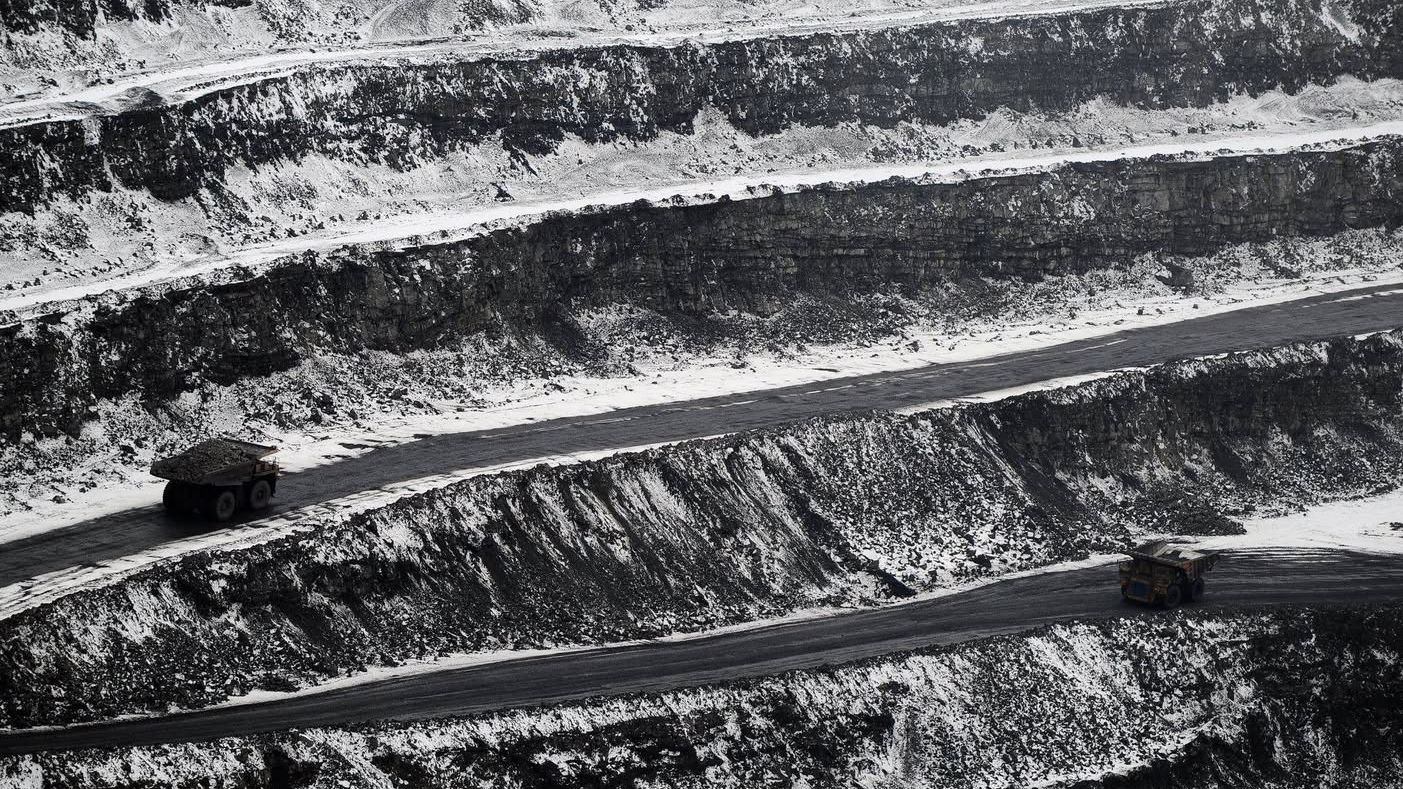
How Yakutugol became a financial donor to Mechel to the detriment of itself and the region
Yakutugol is a once stable city-forming enterprise in the Republic of Sakha (Yakutia), on which thousands of people depend. It now pollutes the air and water, has problems with workers' compensation payments, and has multibillion-dollar debts to suppliers.
Arctida's investigation, based on an analysis of public and closed financial statements, shows how the holding's management used Yakutugol for years to service the group's debts, pumping out liquidity, turning it into a center for accumulating liabilities and depriving the enterprise of the opportunity to recover. We also assessed how the lack of funds for production modernization negatively affects the company and the region.
The Toxic Trail of Debt
In May 2025, an explosion occurred at the Neryungrinskaya enrichment plant, owned by JSC Yakutugol Holding Company. One person died, three were injured. By that time, Yakutugol was already in a deep crisis. In 2024, its net loss amounted to 9.97 billion rubles. The company has accumulated a debt to suppliers of almost 10 billion rubles, some of them are already publicly recommending cooperation with Yakutugol only with 100% prepayment.
At the same time, the company’s personnel are forced to work on worn-out equipment , labor safety rules are massively violated in production, and the company delays payments. Thus, after the explosion at the factory, the Neryungri prosecutor’s office identified 280 violations of industrial safety conditions , and the list of Yakutugol court cases in recent years contains dozens of lawsuits from individuals demanding the recovery of unpaid wages and compensation. Workers who have lost their ability to work due to occupational diseases are fighting for legal benefits through the courts.
The environment also suffers.
Arktida found out that Yakutugol is the largest air polluter among all coal mining companies in the Republic of Sakha.
According to the report of the government of the republic for 2025, emissions of pollutants into the atmosphere from stationary sources of enterprises at Yakutugol amounted to 9.518 thousand tons per year. From the reporting it follows that this figure for the company remains unchanged from 2021 to 2024. Taken together, Yakutugol accounts for about 40% of emissions from the region’s coal industry. This is a significant share for a company that produces three to five times less coal than industry leaders - UK Kolmar and Elgaugol.
“Yakutugol has an older and more worn-out infrastructure compared to its competitors. And if the enterprise did not have the opportunity to invest in equipment modernization, this naturally affects the volume of pollutants that enter the environment,” explains Arctida climate and environmental analyst Raya Levashova.
According to her, repeatedly identified violations in environmental pollution monitoring indicate that the enterprise has systematic problems with control and reporting.
They concern not only air pollution, but also the management of industrial waste and the treatment of oily wastewater.
“The data on the amount of pollutant emissions into the atmosphere provided by Yakutugol are also cause for concern: from 2021 to 2024, identical indicators are indicated. But even if we close our eyes to the fact that statistically this development of events is doubtful, “Yakutugol” continues to remain the most “dirty” enterprise in the republic, which, among other things, is located in close proximity to residential areas,” says the Arctida analyst.
Indeed, in the village of Dzhebariki-Khaya, where the Yakutugol coal mine is located, particles of coal dust settle in a black layer along the road, on the Aldan River and next to people’s houses near the boiler room, which is visible even on satellite images.
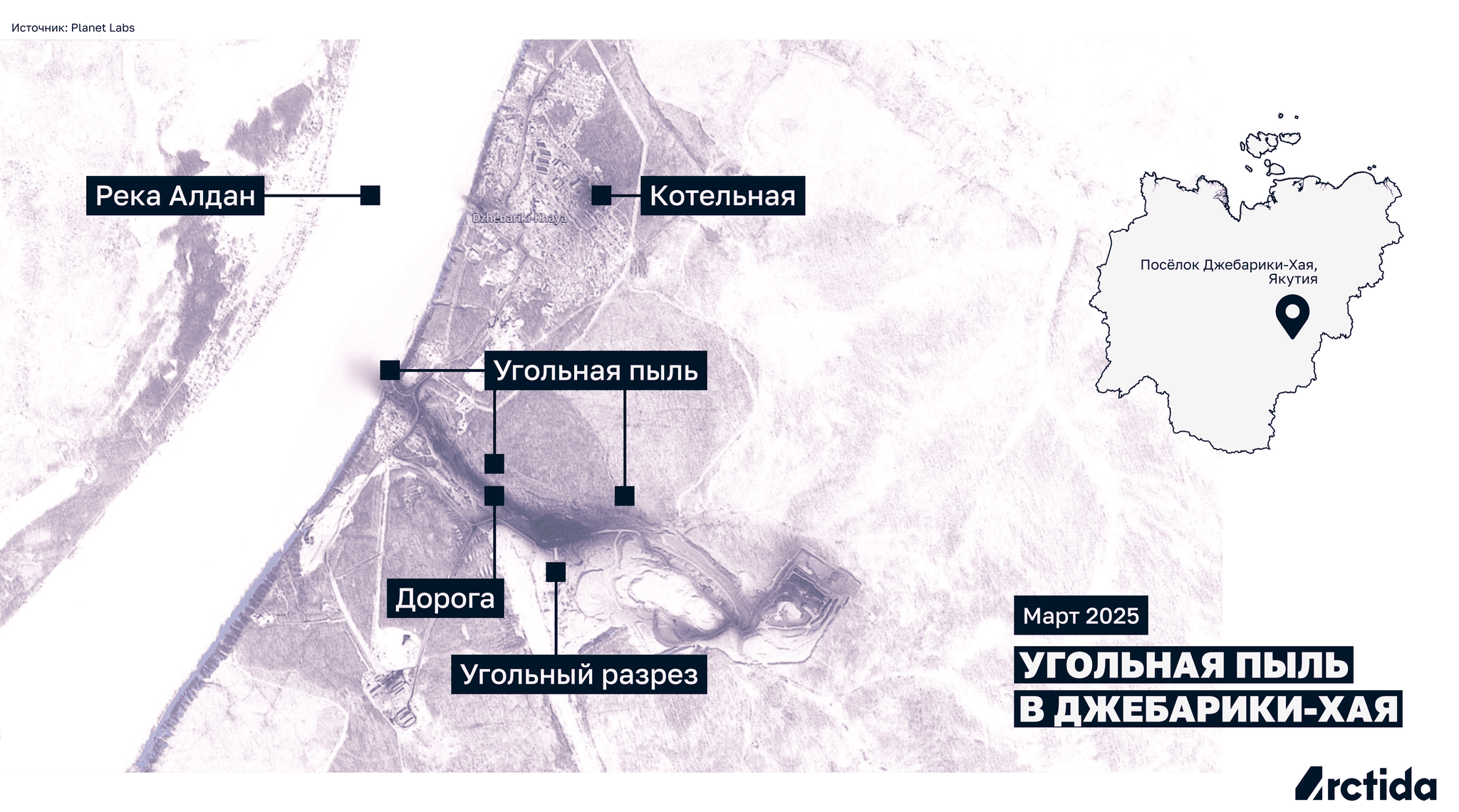
Toxic components of coal dust can cause cancer and mutations. The greatest danger is posed by fine particles ranging in size from 2.5 to 10 micrometers, which can accumulate in the lungs. With prolonged exposure, this leads to serious diseases, for example anthracose .
Coal dust turns into gold
Mechel PJSC became the sole owner of Yakutugol in 2007. At that time it was a profitable and sustainable enterprise, but after a few years everything changed. Since the beginning of the 2010s, Yakutugol began to be used as a collateral for the holding’s debts, pledging its property for loans taken out by other structures of the group.
Who are the beneficiaries of Mechel holding?
As a result, by 2014 the company became technically bankrupt . After this, Yakutugol had to pledge shares in subsidiaries mining coal at the Elginskoye deposit, one of the largest coking coal reserves in the world.
Arctida previously reported on violations by the Elgaugol company:
03/31/2026 Arctic... Mining companies +2Dust and noise
In 2017, against the backdrop of growing financial problems, 15.5 billion rubles were added to Yakutugol’s balance sheet, which formally brought the company into the black. Thanks to this, Yakutugol remained profitable until 2021. The company ended that year with 16 billion rubles of net profit with debts of 33.2 billion rubles. This was the moment when the company could at least partially get out of the debt trap and reduce its liabilities by almost half. But this did not happen.
Yakutugol continued to take out loans at high interest rates, issue practically free intra-group loans and pay multi-billion-dollar dividends to the parent company Mechel Mining JSC, which owns 100% of Yakutugol's shares.
In 2021 alone, the company issued 18.3 billion rubles in loans to three holding companies and transferred 37.9 billion rubles as dividends. These actions of the company potentially violate the federal law “ On Joint Stock Companies ” . The dividends paid in 2021 are 2.3 times more than the company’s net profit; they collapsed retained earnings from 12.2 billion rubles to a negative value of minus 9.7 billion. Against this background, that year Yakutugol was able to invest only 338.6 million rubles in the repair and modernization of equipment and machinery. At the same time, according to the report of the government of the Republic of Sakha , it was in 2021 that Yakutugol experienced a fourfold increase in emissions of pollutants into the atmosphere.
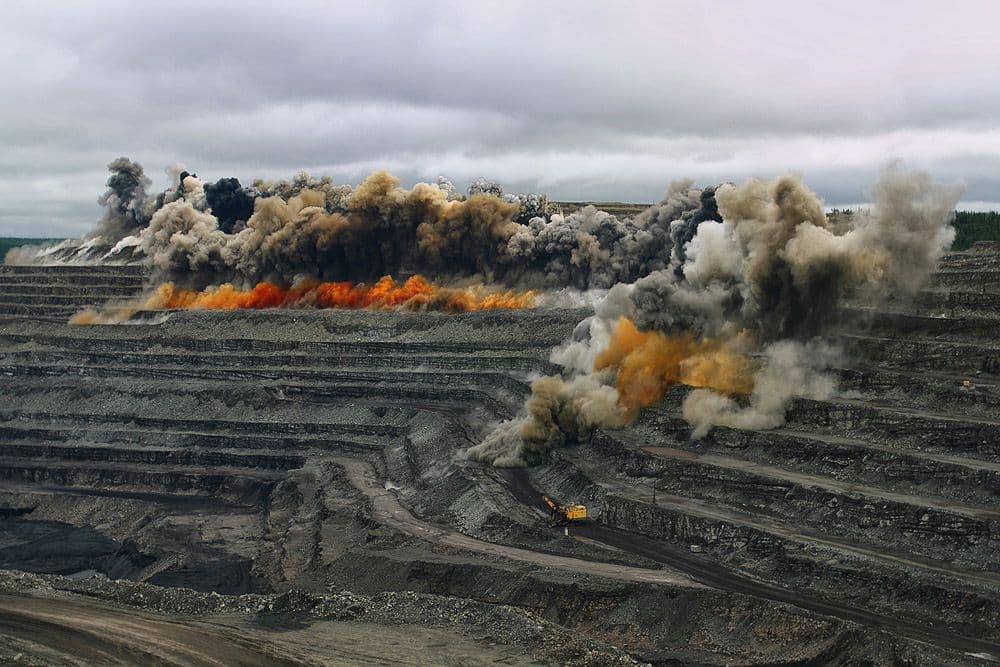
Let us note that the 56.3 billion rubles withdrawn that year not only had a negative impact on Yakutugol, but also deprived the regional and federal budgets of possible taxes.
If this money remained at the enterprise in the form of profit, then the potential tax to the budget of the Republic of Sakha could amount to 9.5 billion rubles, and to the federal budget - 1.69 billion rubles. In reality, Yakutugol then paid only 1.1 billion rubles in income tax.
Lost taxes could potentially cover part of the needs of the Sakha Republic for social facilities such as a modern hospital complex in the Arctic zone of Yakutia worth 1.1 billion rubles.
Cyprus carousel: where did the Yakutugol dividends go?
In October 2021, a Cessna 560XL business jet landed at the Cyprus airport, carrying the owner of the Mechel holding, Igor Zyuzin, as well as his security guard and confidant Ivan Bershadsky . Around the same time, the Cyprus company Zoneline Ltd carried out a series of transactions between subsidiaries of the Mechel holding.
According to Arctida, these transactions were part of a financial scheme associated with the record 37.9 billion rubles in dividends from Yakutugol. We traced the path of these funds sent in 2021 through Uglemetbank, the holding’s key bank, and found signs of a “circular circulation of funds,” or “debt carousel.”
This principle of debt guarantee within one’s own structure allows one to underestimate real profits, minimize taxes and withdraw money “cleared” of debts through foreign “subsidiaries”. In front of creditors and officials, this helps maintain the appearance of healthy activity and vitality.
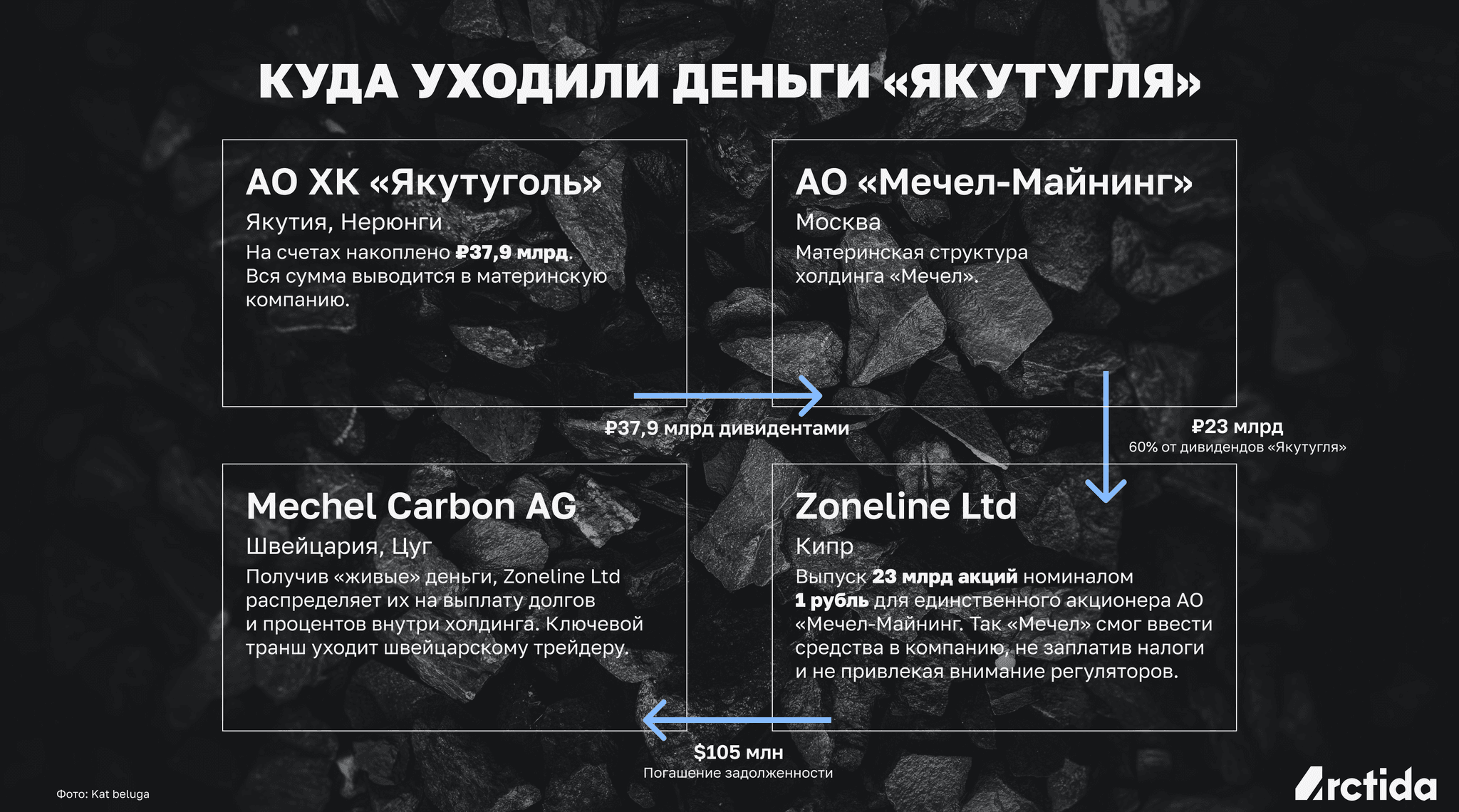
According to information at the disposal of Arctida, a significant part of Yakutugol's dividends - 23 billion rubles - were immediately transferred in mirror tranches from Mechel Mining to the Cyprus subsidiary Zoneline Ltd. This company, according to reporting data, did not conduct full-fledged activities - it only passed through huge flows of loans between Mechel’s subsidiaries for years, which led to the accumulation of debts .
When debts became too much, they were written off through the issue of shares. This is exactly what happened with 23 billion rubles: Zoneline issued the same number of shares with a par value of 1 ruble for the sole shareholder of Mechel Mining JSC. The real value of these shares was close to zero , but thanks to such operations the holding was able to introduce funds without paying taxes and without attracting the attention of regulators.
Next, Zoneline distributed the funds to pay off debts and interest within the holding; a significant part of the “real” money - $105 million, approximately 7.6 billion rubles at that time - went to pay off the debt to the Swiss subsidiary of the holding Mechel Carbon AG. The circle is closed. Intragroup debts were closed, which had a positive impact on the reports without additional tax costs.
It should be noted that after these operations, Zoneline still had a VAT debt in the amount of $369,625, which the company, in violation of the laws of Cyprus, simply wrote off instead of paying it to the country’s budget. Auditors from HLB Cyprus argued in vain for two years in a row that the write-off was illegal. However, their comments were ignored. In May 2024 Zoneline Ltd liquidated .
The carousel rotates - profits are reduced
In 2022, the financial bleeding of Yakutugol intensified, which affected profits. Against the backdrop of high coal prices, the company reached a peak revenue of 48.6 billion rubles, but net profit was halved. A significant role in this was played by the growth of so-called “other expenses,” including the cost of servicing debt obligations.
However, the main task of Yakutugol remained the interest of the holding. Circular payments with Cyprus continued. They were joined by a scheme with the purchase of a certain “product” by Yakutugol from Mechel Mining JSC for 9.1 billion rubles , the payment of financial assistance for 62.7 million dollars to the Swiss “subsidiary” of Mechel International Holdings GmbH, as well as a “debt carousel” for 3.9 billion rubles with the “daughter” of the holding from the British Virgin Islands Caroleng Investments .
The volume of Yakutugol's guarantees for the companies of the Mechel holding gradually increased: by the end of 2023 it reached 199.1 billion rubles, which is equivalent to 78.8% of the group's total debt. In fact, most of the holding's debt is legally guaranteed by the property and future income of Yakutugol alone . The holding itself was in crisis at that time. Due to accumulated losses from previous years, huge interest costs on debt and foreign exchange losses, Mechel ended 2023 with a negative equity capital of 77 billion rubles.
Under these conditions, the group aggressively withdrew resources from subsidiaries in order to prevent the parent company from defaulting on the banks.
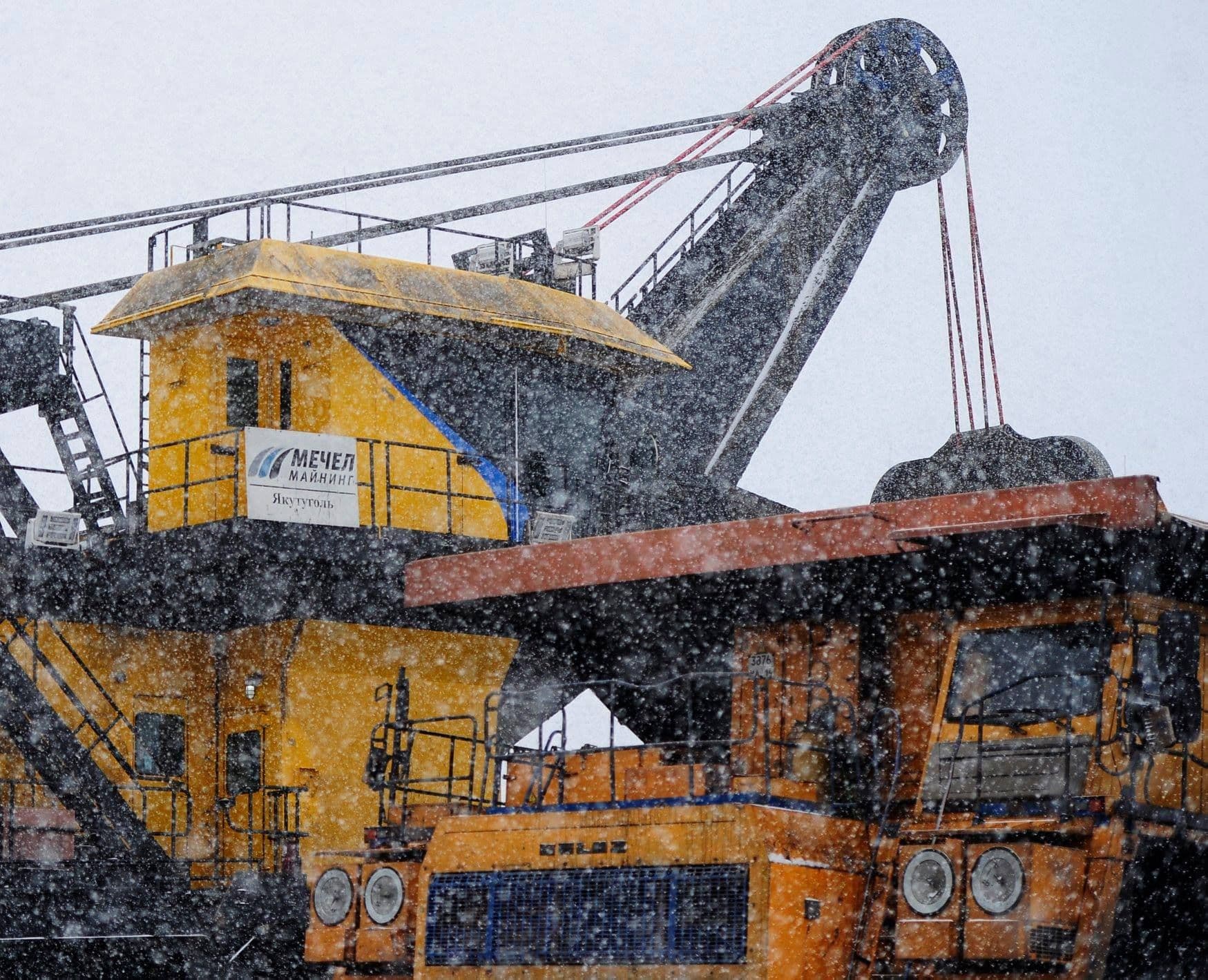
It is not surprising that in 2024, Yakutugol remained the donor and holder of virtually interest-free loans issued for 15.7 billion rubles. At the same time, the enterprise itself took out loans at a high interest rate: over the year, their maintenance cost 3.7 billion rubles.
All these financial transactions led to a shortage of money in the cash register for current payments of 1.6 billion rubles. When the company’s revenue fell in 2023–2024, there was no margin of safety - Yakutugol developed a liquidity deficit. This manifested itself in debts to suppliers, as well as a lack of funds for production modernization and environmental obligations.
The position of Yakutugol turned out to be much more difficult than in the 2010s: the enterprise now bore a significant part of the debt load of the entire holding, and the Russian coal industry plunged into crisis.
An industrial giant with feet of clay
The systematic concentration of debts of the entire holding company at Yakutugol can be explained by several reasons. An expert in the field of economics and management, Master of Economics Tatyana Pankova, notes that:
- firstly , “the rest of the holding companies look stable against this background”;
- secondly , in this you can see elements of tax optimization: “the larger the loss, the lower the income tax”;
- thirdly , the concentration of all risks in one enterprise “creates the possibility of a “controlled” decline: if the situation worsens, such an enterprise can “collapse” and go bankrupt.”
“You can always declare an enterprise bankrupt, write off all huge debts, while all dividends are withdrawn in the right direction. The value will be withdrawn through the subsequent sale of assets, and all liabilities will remain with this legal entity,” explains Tatyana Pankova.
An additional factor may be socio-economic significance. Yakutugol is one of the city-forming enterprises of the administrative center of the Neryungri district. It is the second most populous region in the Sakha Republic, accounting for 98% of all coal production in the region.
“When a large company from a city-forming industry is in a constant state of pre-bankruptcy, banks and creditors are not interested in its bankruptcy and willingly agree to restructuring, prolongation, and write-off of debts,” -
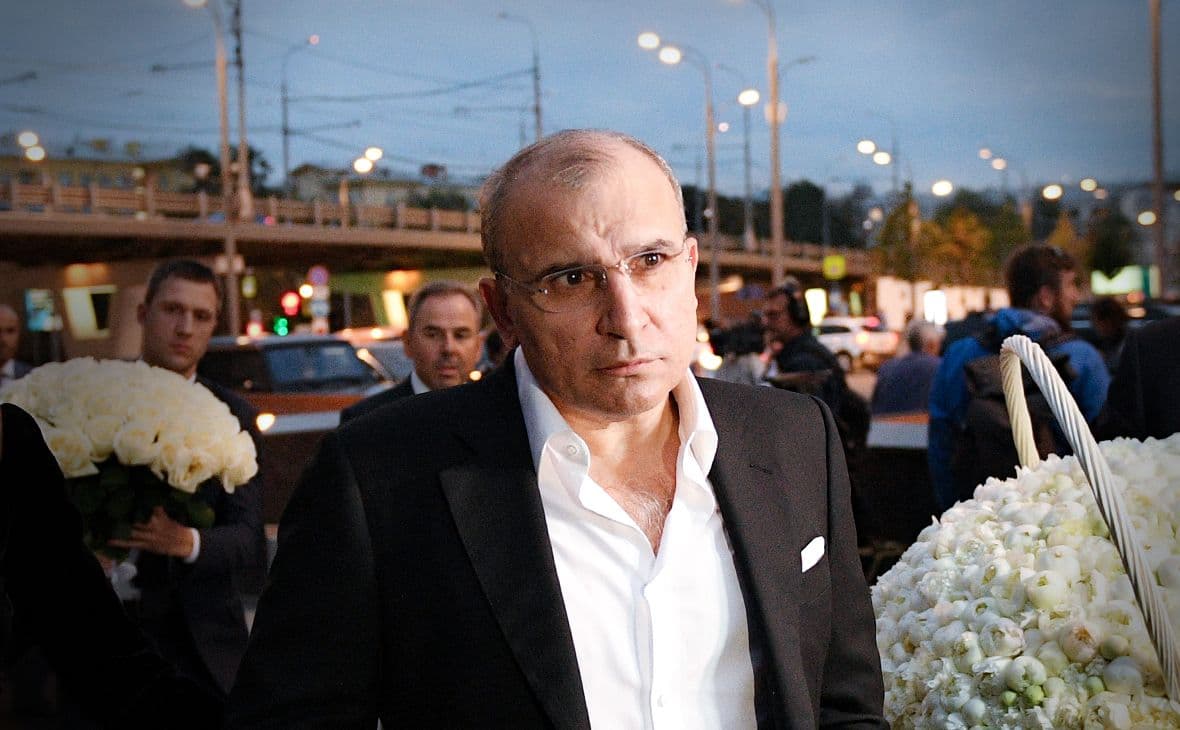
For years, the owner of Mechel, Igor Zyuzin, has been teetering on the brink of bankruptcy of the holding, whose net debt is already 279.3 billion rubles. But every time the government, Vladimir Putin personally and state banks save the holding of the “poorest oligarch .” And Yakutugol plays an important role in this.
How does the family of the “poorest oligarch” live?
In 2020, the main creditors Gazprombank and VTB forced Igor Zyuzin to sell Albert Avdolyan’s A-Property shares in three companies involved in the development of the Elga field. The transaction amount was 89 billion rubles. So Yakutugol actually paid off Mechel’s debts with its key asset.
To maintain agreement with the holding's creditors and demonstrate sustainability, the company's management even resorted to the use of deferred tax assets (DTA). This allowed Yakutugol to reduce real losses by billions of rubles in its reporting.
How did this scheme work?
Lenders eventually allowed Mechel to optimize loan payments and repay the “body” of the debt from 2027. And in June 2025, the holding even received targeted government support against the background of the general crisis in the Russian coal industry in the form of a three-year installment plan for tax and insurance payments of more than 13 billion rubles.
However, the latest financial report of Mechel PJSC shows that the holding is in the most severe phase of its financial crisis.
The group's revenue fell by 26%, at the same time Mechel sharply reduced capital investments, that is, it began to save, including on updating and maintaining its production base. And the holding’s current operating profitability does not cover the cost of the group’s debt of 279.3 billion rubles.
On the other side of the carousel
In global and Russian practice, the provision of guarantees by subsidiaries for the parent holding is standard practice.
However, in the case of Yakutugol, the scale of such obligations goes beyond normalcy, according to experts.
The company's off-balance sheet liabilities are so huge that it is effectively cut off from market financing and is forced to take out short-term, expensive loans, which grew by 568.7% in 2024.
In addition, problems in any other division of Mechel could lead to bankruptcy of Yakutugol, even if the enterprise itself is operating efficiently. The key threat is related to the possible implementation of guarantees.
“As long as they are not implemented, the enterprise continues to operate, generates revenue, can take out new intra-group loans, that is, it is the source of the cache [cash] of the entire structure. As soon as the guarantees are activated, there will be an instant collapse, a complete loss of financial independence, and operating activities will also collapse,” explains Tatyana Pankova.
But even without such a scenario, negative consequences appear. In 2025, auditors from Energy Consulting described Yakutugol's debt load as an "important circumstance" that raises "significant doubts about the Company's ability to continue as a going concern." Even without this assessment, the problems are obvious: from accidents at production facilities and systemic safety violations to growing environmental and social risks for the Sakha Republic.