
Translated material
Eighteen moments of winter
The history of the performances of the national teams of the USSR, CIS and Russia at the White Olympics

Olympic village in Milan, 2026. Photo: Mikhail Tereshchenko / TASS
After the 1920 Summer Games in Antwerp, where the hockey and figure skating competitions were successfully held, the IOC was inundated with letters from winter sports fans who demanded to expand the Olympic program to include cross-country skiing and speed skating competitions. Stern officials reacted sharply negatively to this idea, since they believed that it was necessary to follow the traditions of Ancient Greece and promote exceptionally hot fights every four years. Even Pierre de Coubertin was initially against the separation of snow species into a separate group, as he was afraid that this could lead to a split in the Olympic movement.
However, in 1922, at the IOC session in Paris, the Marquis de Polignac and Count de Clary convinced Coubertin that “cold” performance would be of interest to the general public. And the great baron, in turn convincing the stubborn oppositionists, insisted on holding cool January-February starts in Chamonix. The 1924 Games were not formally the Olympics, although athletes from 16 countries competed for 16 sets of medals in 9 sports, including curling. But, as expected, the tournament caused the necessary resonance and, having retroactively received the status of the first Winter Olympics in history, became the starting point for new official battles. The Soviet Union joined the sacred, dazzling holiday in 1956. Although relatives of hockey players could have come to the 1952 Games in Oslo, the authorities delayed the application for participation. And so the red debut came in the city of Cortina d'Ampezzo. Since then, our country has participated in 18 grandiose winter battles. The USSR won the team competition 7 times, Russia - 2, and the CIS team in Albertville missed out on powerful Germany, which placed in the top 3 ten times. The Norwegians, who have 24 cool forums behind them, have 9 team quizzes. “Novaya” offers a brief recollection of all the most interesting things that have happened at the White Olympics since 1956.
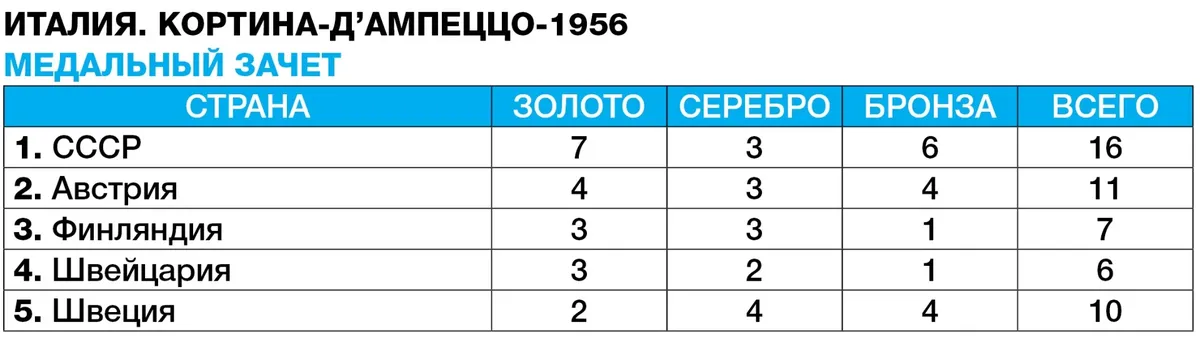
…It’s funny that the Games began with the curiosity of the century: speed skater Guido Caroli, who was carrying the Olympic torch at the opening ceremony, tripped over a television cable and fell, dropping a device with a fire on the floor, which went out. The debut of the USSR national team (53 athletes) turned out to be a victorious pancake. The hockey players, led by Vsevolod Bobrov, notably wiped the Swedish, Canadian and American noses (5:1, 2:0, 4:0) and climbed to the highest step of the podium. Speed skaters Evgeny Grishin and Yuri Mikhailov raced across the smooth skating rink with world records. Lyubov Baranova (Kozyreva) gilded her skis and brought the country a historic winter victory, defeating her compatriot Radya Eroshina and Swede Sonya Edström at a distance of 10 km. Here we need to make a clarification: our first Olympic champion is figure skater Nikolai Panin-Kolomenkin. But he beat his competitors at the 1908 Summer Games in London, and therefore his medal is considered a “summer” medal.
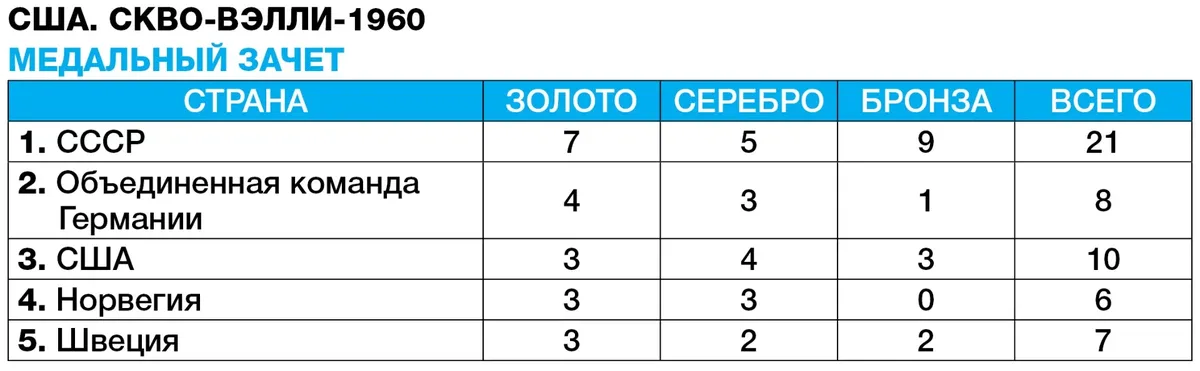
Biathlon, which used to be held under the name “ski patrol competition,” appeared in the Games program 40 years later. And Alexander Privalov won bronze in the only individual race. The third place went to the Ice Knights. But the speedsters did not disappoint again: Evgeniy Grishin and Viktor Kosichkin won three victories. The female troops also performed well: Lidiya Skoblikova and Klara Nesterova (Guseva) also took three golds out of four. Well, the entire podium in the 10 km ski race turned out to be purely Soviet - Maria Gusakova (gold), Lyubov Baranova (Kozyreva) - silver, Radya Eroshina (bronze).
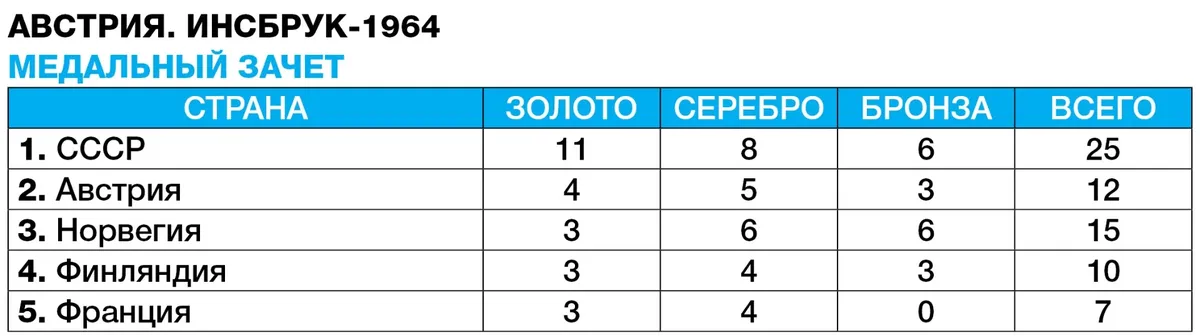
More than 1,000 athletes came to the small town, but few were able to adequately resist the USSR national team. If we switch to the language of numbers, then every third gold was in the account of our squad. The main heroine was “Ural Lightning” Lidia Skoblikova, who excelled at all four distances (500 m, 1000 m, 1500 m, 3000 m). The hockey players regained their title. Three gold medals (5 km, 10 km and relay) were won by skier Klavdiya Boyarskikh. And the first Olympic gold in figure skating was won beautifully by Lyudmila Belousova and Oleg Protopopov (they would repeat their success in 1968).
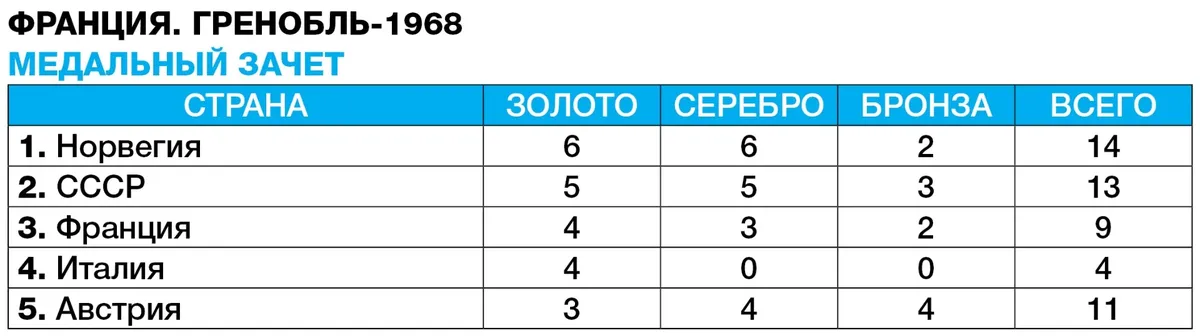
The Games, held in the homeland of Pierre de Coubertin, in which the teams of the Federal Republic of Germany and the German Democratic Republic competed separately, ended in a Norwegian triumph. Soviet fans were happy for debutant biathlete Alexander Tikhonov, who took silver in the individual race and gold in the relay. Speed skater Lyudmila Titova raced the fastest over the 500 m distance. And the planet was also surprised by Vladimir Belousov, who flew the farthest from a large springboard. Since then, our athletes have not won in this type of program. The hockey players once again knocked out their opponents in a golden way, and the top scorer of the tournament was Anatoly Firsov, who scored 16 points (12+4) using the “goal+pass” system and was included in the symbolic team.
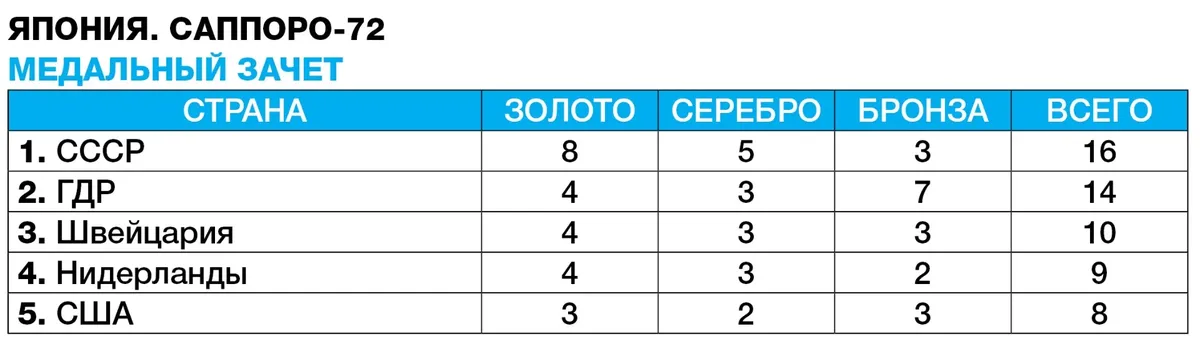
The island of Hokkaido was visited by 4,000 journalists (there were four times fewer athletes). And supposedly one of the reporters noticed at the rehearsal of the opening ceremony that the rings on the Olympic flag, which had flown in stadiums during the Games for 20 years, were located in the wrong order... But Galina Kulakova was in perfect order, winning the 5 km, 10 km and team race. The artistic and technical Irina Rodnina and Alexey Ulanov captivated the audience and judges. The hockey players also gave the usual heat (Valery Kharlamov was unstoppable). But Vyacheslav Vedenin made the Games after all. He did not lower the USSR flag in front of the Emperor of Japan, gave the world the magic word “dahusim”, and gave us gold at a distance of 30 km and an epic victory in the relay race. Robert Rozhdestvensky dedicated the poem “Report on the Ski Race” to this feat of the Dynamo player, who took a minute from the Norwegian Harviken at the last stage.
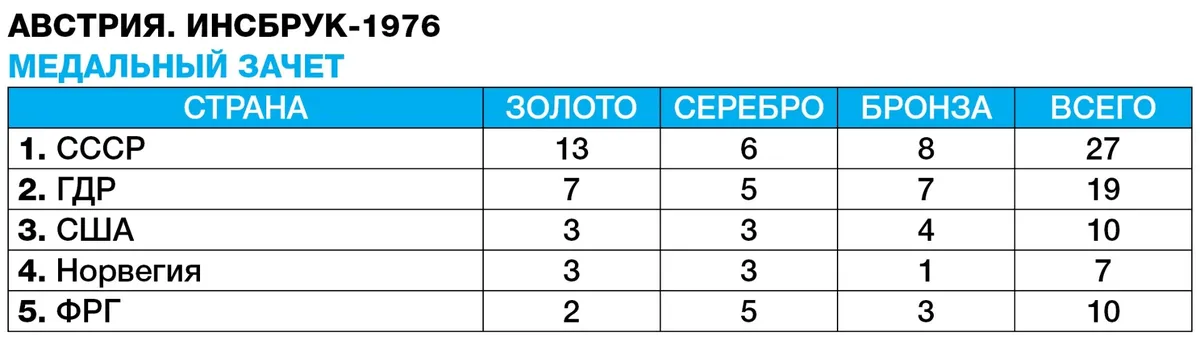
Denver initially intended to host the Olympics, but local residents voted against the “huge expenses,” and state authorities listened to the opinion of the people (the only case in history when a city refused to host the Games it had already received). And therefore the IOC gave the sports keys to Innsbruck, which successfully organized the fair 12 years ago. The second Austrian forum turned out to be the most successful in the history of the USSR national team: 13 gold orders - a result that is unattainable to this day. Skier Raisa Smetanina (10 km race and relay race) and biathlete Nikolai Kruglov (20 km race and relay race) each took home two top awards. Speed skater Tatyana Barabash (Averina) excelled in the 1000 m and 3000 m distances. Lyudmila Pakhomova and Alexander Gorshkov lit up the ice, becoming the first Olympic champions in dancing. Irina Rodnina and her new partner, Alexander Zaitsev, again reached gold. Our skiers Nikolai Bazhukov (15 km race) and Sergei Savelyev (30 km race) were magnificent and incomparable. And the hockey players washed another cup.
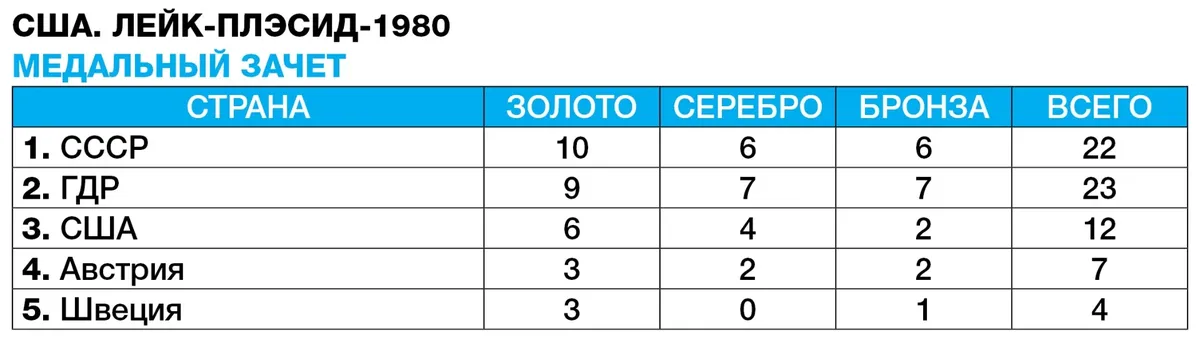
The American starts, to be honest, will be remembered as the “Miracle on Ice.” Almost every resident of the United States knows in detail how the star-striped student squad covered the “Red Car” with Tretyak himself in the finale. By the way, in case of victory in a politically important match, the government intended to award all Soviet hockey players with the Order of Lenin... It should also be noted that the statesman Eric Hayden: the speedster set an eternal record, succeeding at all five distances. But in the overall standings, the USSR was still ahead of everyone. The golden shots of biathlete Anatoly Alyabyev, three victorious races of skier Nikolai Zimyatov (30 km race, 50 km race and relay), the third victory in a row and the tears of the iron Irina Rodnina, as well as the fourth team triumph of Alexander Tikhonov and the great success in the sleigh of Vera Zozulya - this is what we will never forget.
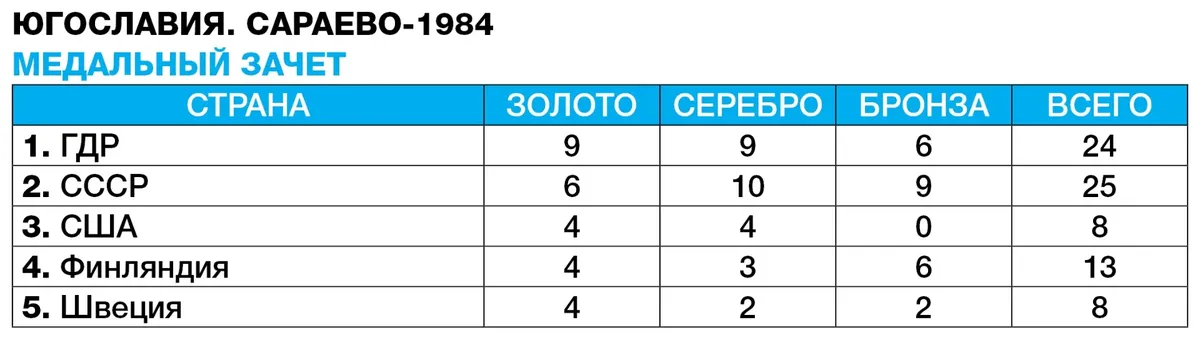
The GDR team lost to the USSR in the overall standings. Although he won one more medal. However, we had something to be happy about. Nikolai Zimyatov got his fourth Olympic gold. Biathletes - Sergei Bulygin, Dmitry Vasiliev, Yuri Kashkarov, Algimantas Shalna - outwitted everyone in the relay. The hockey players rehabilitated themselves for Lake Placid, and Vladislav Tretyak became a three-time champion. In pair skating, Elena Valova and Oleg Vasiliev soared to the top. In speed skating, Sergei Fokichev gilded the “knives” at 500 meters, and his colleague Igor Malkov inimitably buzzed at 10,000 meters. And racers Zintis Ekmanis and Vladimir Alexandrov caught the first Soviet medal (bronze) in bobsleigh.
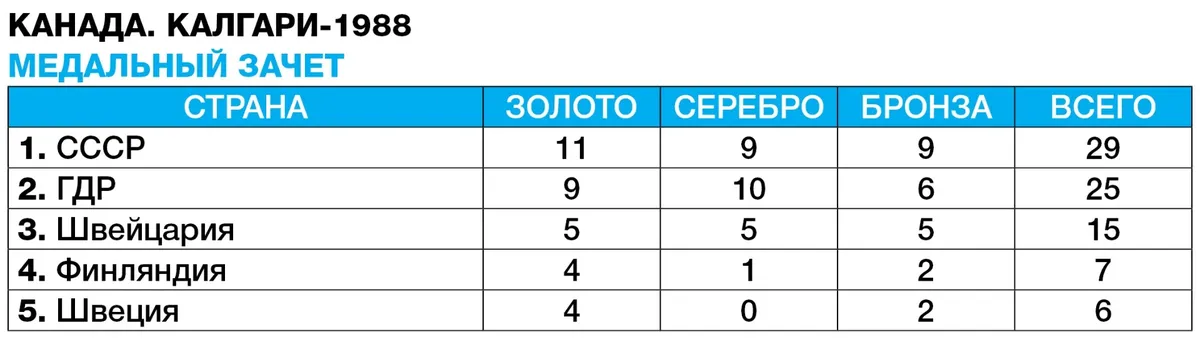
The Games took place on Canadian soil on an unprecedented scale. The Olympic stadium was expanded to 60 thousand spectators, and 20 thousand fans could watch the matches of the hockey tournament, which was marked by the seventh victory of the USSR. It is noteworthy that Vyacheslav Fetisov was supposed to carry the Soviet flag at the opening, but Viktor Tikhonov forbade him to participate in the ceremony. And the standard-bearer was figure skater Andrei Bukin, whose extra workload did not prevent him from winning the dance with Natalya Bestemyanova. In the couples competition, Ekaterina Gordeeva and Sergey Grinkov hit the jackpot. In total, the skating virtuosos won 5 medals. 5 medals (and gold ones) were brought by amazing skiers and skiers. 24 years later, the national team won an award for Nordic combined (Allar Levandi won bronze, and in 1964 Nikolai Kiselev won silver). Well, Janis Kipurs and Vladimir Kozlov literally flew into the history of domestic bobsleigh, making the long-awaited golden run. And one more important point: this Olympics was the last for the national teams of the USSR and the GDR.
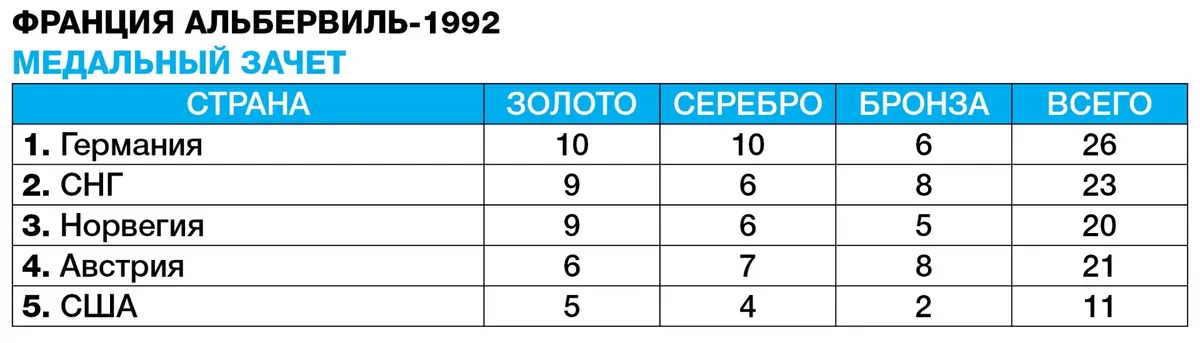
Short track, freestyle and women's biathlon made their debut in the Games program. And in all these events, representatives of the United Team (CIS) received medals. Moreover, Anfisa Reztsova not only won historical gold in the sprint on the French border, but also became the first athlete in the world to become an Olympic champion in biathlon and skiing (in Calgary ’88 she took gold in the relay). A sensational victory was won by 22-year-old biathlete Evgeniy Redkin, who did not make a single mistake at the shooting range of the 20 km distance. The snowy slopes in Albertville were captured by Lyubov Egorova, who climbed to the podium 5 times (three gold and two silver). One yellow and four bronze awards belong to Elena Vyalbe, the current president of the FLGR. Raisa Smetanina, a few days before her fortieth birthday (!), helped her friends - Egorova, Lazutina and Vyalba - get rich in the relay race. Figure skaters Marina Klimova and Sergei Ponomarenko (dances), Natalya Mishkutenok and Artur Dmitriev (pairs), and Sergei Petrenko traveled around all competitors. The “commonwealth of independent hockey players” did not disappoint either, which, under the leadership of Viktor Tikhonov, Vladimir Yurzinov and Igor Dmitriev, defeated the Americans in the semi-finals (5:2), and the Canadians in the final (3:1). The country will wait a quarter of a century for the next “red” stick trophy...
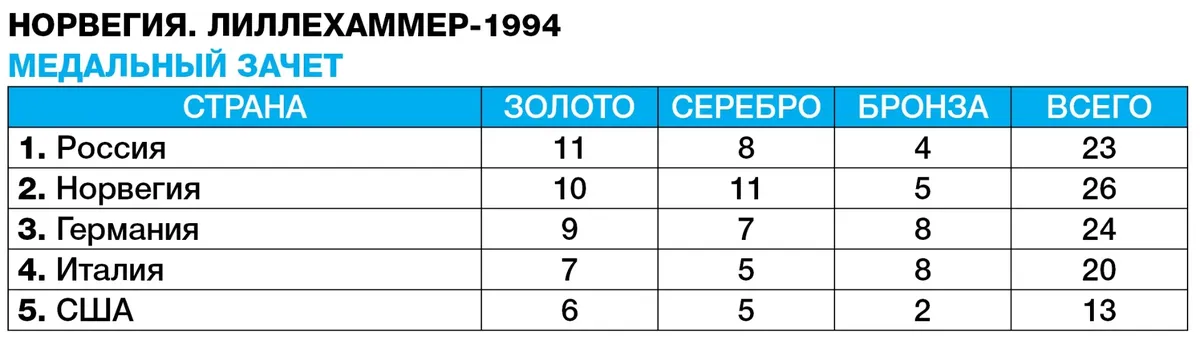
We had to wait only 24 months for new “cold” battles, since the IOC in 1988 decided to separate the summer and winter Games. For the first time, the former Soviet republics participated in the White Olympics as separate teams. And 16-year-old Ukrainian Oksana Baiul jumped over all her competitors in figure skating. Five “figure” awards went to independent Russians: Ekaterina Gordeeva and Sergey Grinkov repeated their Canadian success, ahead of Albertville-92 winners Natalya Mishkutenok and Artur Dmitriev. Oksana Grischuk and Evgeny Platov danced Maya Usova and Alexander Zhulin, and Alexey Urmanov beat Elvis Stoiko and Philip Candeloro. Skier Lyubov Egorova won three more golds in Norway and equaled the number of coolest medals (6) with the great speed skater Lydia Skoblikova. The biathletes (Sergei Chepikov, Sergei Tarasov and the women's relay team) hit three winning targets. The title of the first Russian champion of the Winter Games was given to speed skater Alexander Golubev, who was the fastest to overcome 500 meters (and since then, domestic male speed skaters have not struck gold at the Olympics). But the tricolor debut of the hockey players did not go well: Andrei Nikolishin and his partners did not even find bronze...
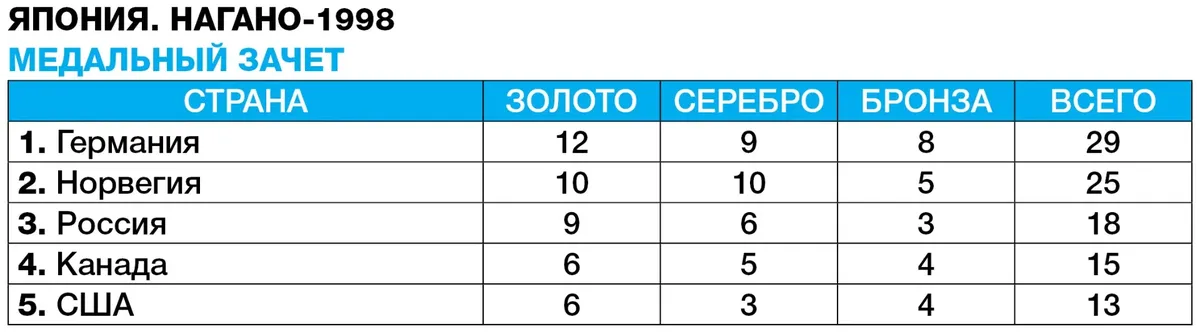
The IOC expanded again, bringing curling back into the program and giving the green light to snowboarding. As a result, almost 2,200 athletes competed for 68 sets of awards. It would not be an exaggeration to say that for Russia the Olympics were saved by skiers led by Larisa Lazutina, who brought 8 medals (5 of them were gold), as well as figure skaters who again won in pair skating (Oksana Kazakova and Artur Dmitriev) and dancing (Oksana Grischuk and Evgeny Platov). Well, the fantastic Ilya Kulik again left Elvis Stojko and Philip Candeloro with silver and bronze. Biathlete Galina Kukleva gave the fans another reason to be proud. The hockey tournament turned out to be extremely interesting, since for the first time in history the strongest players from the NHL came to it. Russia with Pavel Bure lost in the main battle to the Czechs (0:1) with the impenetrable Dominik Hasek...
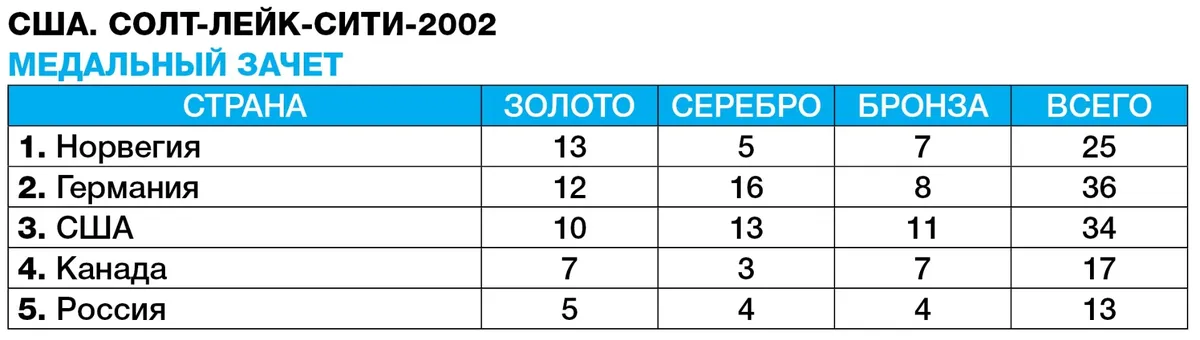
Perhaps the most scandalous Olympics in history. It all started with the fact that several African IOC members who voted for the American application were convicted of bribery. Then followed the doping passions with the participation of our skiers - Larisa Lazutina and Olga Danilova, whose gold and silver medals were taken away for the use of darbepoetin. And for starters, an unprecedented incident occurred in figure skating: in pair competitions, two top awards were awarded at once due to the fact that the referees were suspected of foul play. As a result, Elena Berezhnaya and Anton Sikharulidze stood on the podium along with Canadians Zhami Sale and David Pelletier. Plus, silver Irina Slutskaya still curses the judges for giving the victory to American Sarah Hughes. However, there were also joyful moments. For example, the fight between Alexei Yagudin and Evgeni Plushenko, which ended in the triumph of Tatyana Tarasova’s ward. And also the beautiful finishes of skier Yulia Chepalova (gold–silver–bronze) and the coronation of Olga Medvedtseva (Pyleva) in biathlon. The hockey players (the team was led by Vyacheslav Fetisov), having blundered in the USA semi-finals, “stripped” the Belarusians in the bronze medal match (7:2).
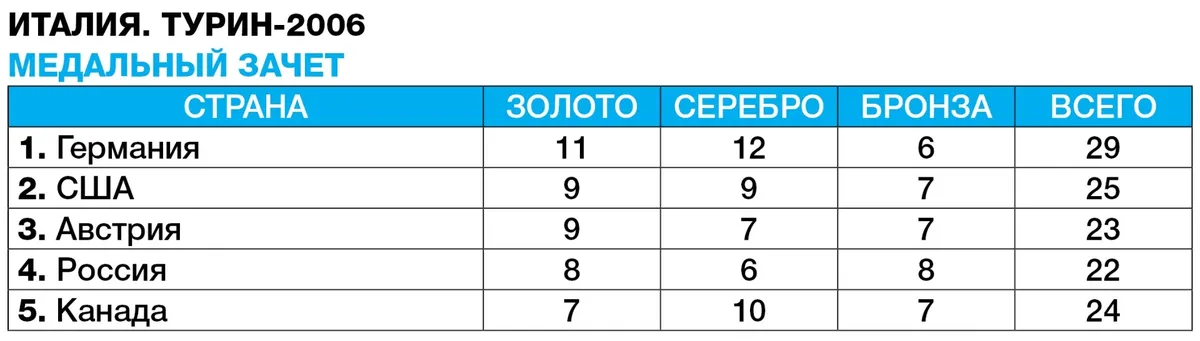
It was the Olympics of our tears. Biathlete Olga Medvedtseva (Pyleva) cried after she was caught doping (carphedon) after finishing silver (the medal was taken away). Svetlana Ishmuratova won the 15 km individual race. And speed skater Svetlana Zhurova, a current State Duma deputy, cried with happiness after finishing the 500-meter race. Like skier Evgeny Dementyev, who made everyone in skiathlon. Three golds remained for Russia in figure skating (Evgeni Plushenko, Tatyana Totmyanina and Maxim Marinin, Tatyana Navka and Roman Kostomarov). And Irina Slutskaya won bronze. The hockey players were extremely upset: 0:4 in the semi-finals from the Finns and 0:3 from the Czechs in the match for third place. But two women's relay races - in skiing and biathlon - ended in triumph for the Russians. Here are the names of the snow champions: Natalya Baranova-Masalkina, Larisa Kurkina, Evgenia Medvedeva-Arbuzova, Yulia Chepalova; Svetlana Ishmuratova, Albina Akhatova, Anna Bogaliy-Titovets, Olga Zaitseva.
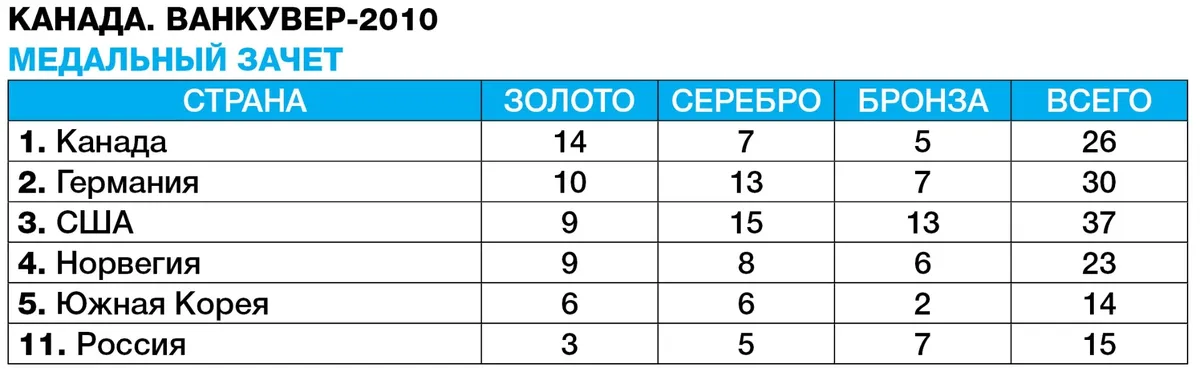
At that time, the worst Games for Russia. No gold in figure skating and only two medals. It’s good that Evgeni Plushenko, as in 2002, got silver, and dancers Oksana Domnina and Maxim Shabalin danced for bronze. The stick makers, led by Vyacheslav Bykov, received 3:7 from the Canadians in the quarterfinals. The country was saved from complete failure by skiers Nikita Kryukov (victory in the sprint), Evgeny Ustyugov (gold in the mass start), as well as a friendly quartet of women biathletes (Svetlana Sleptsova, Anna Bogaliy-Titovets, Olga Zaitseva, Olga Medvedtseva (Pyleva), who were ahead of the French and Germans. It’s funny that the relatives officials promised one million dollars to the one who won two gold medals at the Olympics. And, as you understand, the money remained in the bank. But after this result, the president of the ROC, Leonid Tyagachev, resigned.
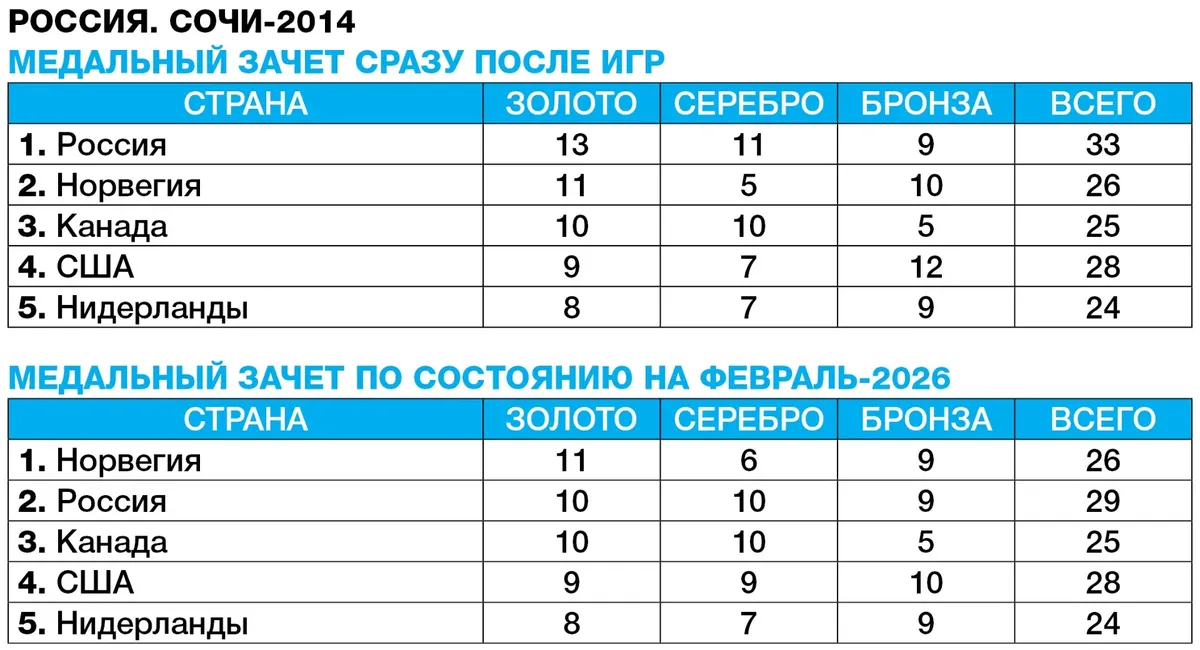
For the impeccable organization of the Olympics in the subtropics, Russia received praise from all countries, and immediately after the end of the Sochi holiday, journalists dubbed the Minister of Sports Vitaly Leontyevich Mutko Vitaly Medalevich. Why? Yes, because the national team created and created. With an American-Korean accent. Three golds in short track speed skating for newly minted Russian Viktor Ahn, two triumphs in snowboarding for White Salmon native and Double Eagle passport holder Victor Wild.
The natives did not disappoint either. Skiers - Alexander Legkov, Maxim Vylegzhanin and Ilya Chernousov - occupied the entire podium in the marathon. The biathlon quartet led by Anton Shipulin shot brilliantly. Adelina Sotnikova broke the ice and became the first Russian champion in women's singles skating. Evgeni Plushenko, who miraculously made it into the national team, won gold in the team tournament, which was included in the Games program for the first time. Tatyana Volosozhar and Maxim Trankov again made everyone respect our pairs skating. We also watched Alexander Zubkov’s golden double in bobsleigh and the legendary race of his namesake Tretyakov in skeleton. And even the hockey players, having lost to the Finns in the quarterfinals, did not spoil the mood.
As a result, in terms of the total number of medals (33), they gave the best result in the entire history of performances (there were also 13 gold awards in Innsbruck-76). And three years later, in November 2017, there were already different results: the testimony of Rodchenkov, the reports of McLaren and Denis Oswald, trials and sentences, after which the conquered roundels began to be taken away from Russia. Then the athletes disqualified for violating anti-doping rules filed appeals, and many of them (28 out of 39) were granted. In particular, marathon champion Alexander Legkov and biathlete Olga Vilukhina were acquitted, returning her silver medal in the sprint. And only two golds from Alexander Zubkov and his bobsleigh partners will most likely be confiscated forever. As well as silver for the women's biathlon team (Olga Zaitseva let her friends down - a high level of salt was detected in one of her samples). In May 2025, the appeal of biathlete Evgeniy Ustyugov, who was caught using oxandrolone, was not satisfied. Therefore, the gold in the relay went to the German team. In short, in 12 years the medal standings have changed 12 times... And, perhaps, they will change again...
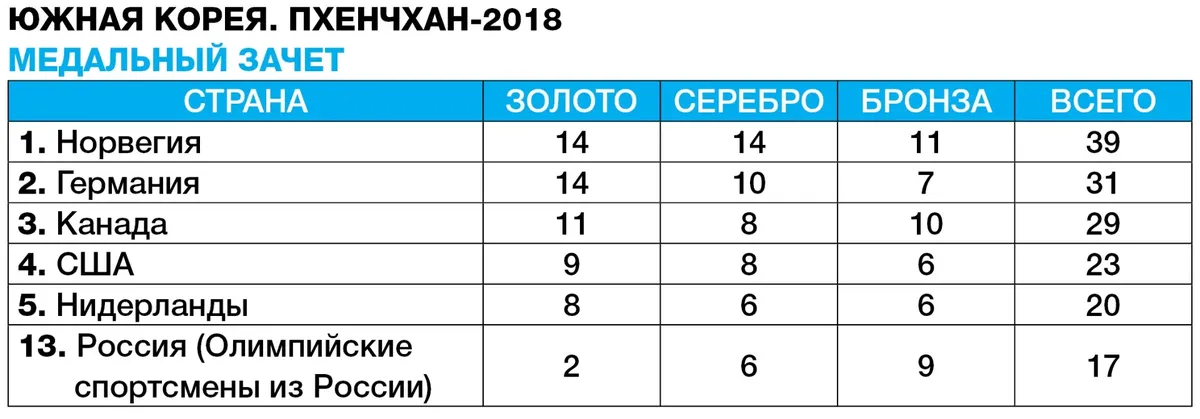
Doping scandals and harsh verdicts of the IOC turned everything upside down, causing most foreign heroes to have a persistent hostility towards the Russian squad, which for the first time was forced to fight in a semi-neutral status - without a flag, an anthem and in a faded uniform with the abbreviation OAR on the chest. It was deciphered as follows: “Olympic athlete from Russia.” In short, after all the screenings and disqualifications, our application turned out to be the smallest since 2006 - only 169 athletes received accreditation. In such an atmosphere, any medal was considered lucky. And the two main achievements, as everyone dreamed, happened on the ice: Alina Zagitova was ahead of Evgenia Medvedeva and repeated the Sochi success of Adelina Sotnikova, and the neutral “Red Machine”, under the strict leadership of Oleg Znarok, started up as in its best years, and 25 years later rushed to the finish line first, beating the German national team in the validating final (4:3). The jubilant fans immediately remembered the saying: “whoever won hockey at the Olympics won all the Games.” That's how they consoled themselves.
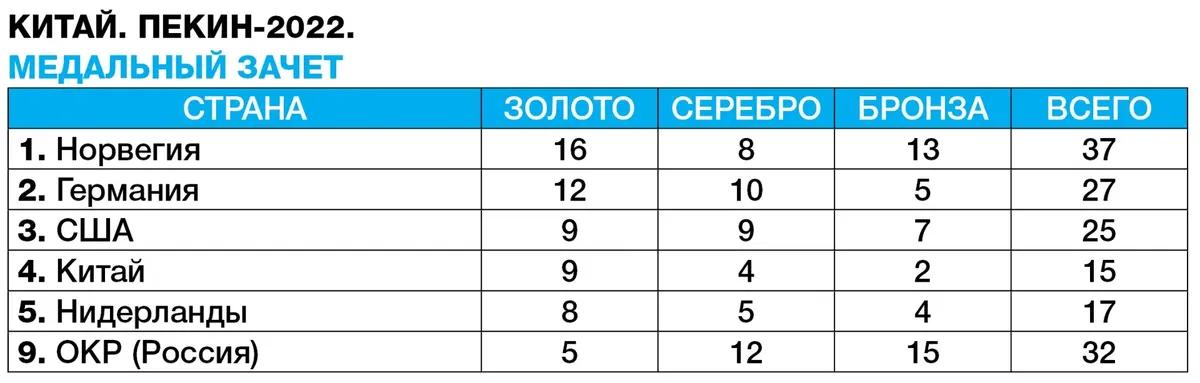
Those February battles were dubbed the Winter Covid Games, the Omicron Olympics and the Survival Lottery. Everyone joked: whoever gets sick last is the champion. The IOC's 70-page Games playbook was devoted almost entirely to medical rules and restrictions. ...Russia was once again an invisible participant at that rally. ...For our tricolor squad, which had been wandering around the athletic fields for many months without a flag or anthem, Beijing 2022 was supposed to be the final major round dance in which it was necessary to circle under the sanctions imposed for the well-known doping scandal. But, as life has shown, everything only got worse over time...
And then the so-called ROC team (Russian Olympic Committee) did not lose face, of course. Although, by and large, only skier Alexander Bolshunov, who won three gold, one silver and one bronze medal, could sleep peacefully after that Olympics. In addition, he won his second gold in a relay race co-authored with Alexei Chervotkin, Denis Spitsov and Sergei Ustyugov (not to be confused with Evgeniy Ustyugov). We haven't seen such a furore since 1980. Of course, the country also drank heavily to the women's relay team (Yulia Stupak, Natalya Nepryaeva, Tatyana Sorina, Veronika Stepanova).
It should be noted that we managed such a golden double only once - in 1972, in Sapporo. The singles skaters also performed a double fairytale trick: Anna Shcherbakova became first, and Alexandra Trusova became second. In pair skating, our plenipotentiaries won silver (Evgenia Tarasova - Vladimir Morozov) and bronze (Anastasia Mishina - Alexander Gallyamov). And Victoria Sinitsina and Nikita Katsalapov won bronze in dancing. But the sparkling and slippery tournament will be remembered for the doping scandal named after Kamila Valieva. Having been caught on trimetazidine, she not only missed the podium in the individual tournament, but also deprived the entire “gang” of the gold medal they had already won in the “team competition”.
The results of the joint competition were revised on January 30, 2024: the gold was taken from Russia and given to the Americans, and the silver sailed to the Japanese. Thus, the innocent guys - Mark Kondratyuk, Anastasia Mishina and Alexander Gallyamov, Victoria Sinitsina and Nikita Katsalapov - lost their Olympic title because of Valieva and were content with bronze (Kamila’s points were subtracted from the total).
...In the third period of the final match, all dreams of a second Olympic title in a row disappeared from the hockey players, who ultimately lost to the Finns (1:2). However, the Chinese forum will also be remembered for three sensations with a plus sign in disciplines specific to us. Thus, in ski jumping in the team competition, Irma Makhinya, Irina Avvakumova, Danil Sadreev and Evgeniy Klimov unexpectedly achieved silver. In freestyle, Anastasia Smirnova, Sergey Ridzik and Ilya Burov collected three bronze medals. And Tatyana Ivanova raced to bronze on a sled...
And thanks to the large number of silver and bronze roundels, obtained, among other things, by speed skaters and skiers, “invisible” Russia in the total number of medals was second only to the Norwegians in Beijing 2022.
The overall result of the performances of the USSR, CIS and Russian national teams at the Winter Games: 386 medals (140-120-126). Only Germany is ahead - 435 awards (163-154-118) and Norway - 405 (148-134-123).