
Translated material
Alternative for the Kremlin
How Telegram became an important tool of Russian influence in Germany. Investigation by Novaya Gazeta Europe and The Insider
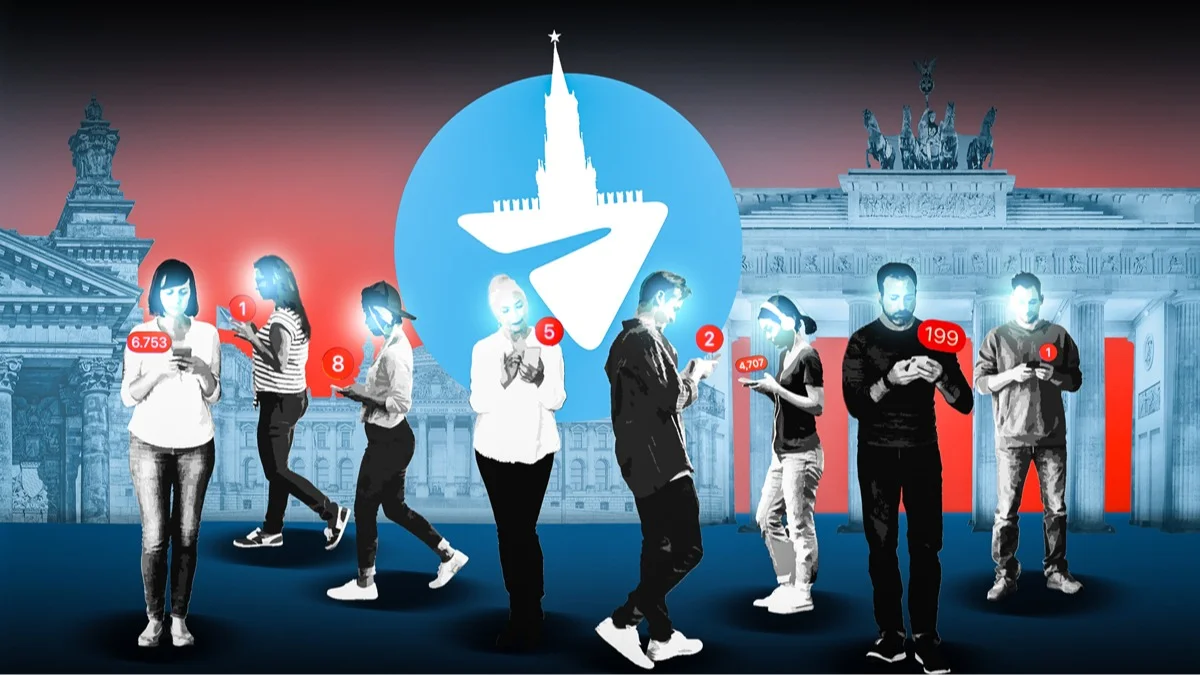
Illustration: “New Newspaper Europe”
Half of the German Telegram audience comes from pro-Russian channels, Novaya Gazeta Europe and The Insider found out. Their reach has grown sharply since the outbreak of a full-scale war in Ukraine: today there are millions of people on whom the Kremlin’s key talking points are broadcast every day. Some channels are associated with Russian intelligence services and RT.
Russia did not start a war against Ukraine—it was a forced response to Western provocations. Weapons supplies to Ukraine must be stopped. The increase in defense budgets by European countries is, in fact, an escalation of the conflict - Russia can give a tough response to this, although in principle it never attacks anyone. All these stories, familiar to the Russian-speaking audience, have taken root well in Germany.
Novaya Gazeta Europe and The Insider studied more than 330 Telegram channels aimed at residents of Germany and disseminating pro-Russian narratives. These are not only political and news resources - part of this sample consists of channels about conspiracy theories, about the dangers of vaccinations, as well as other alternative communities that regularly include pro-Russian rhetoric in their agenda.
According to our calculations, the total audience of pro-Russian telegram channels aimed at residents of Germany exceeds 8.3 million subscribers.
(Hereinafter, the coverage estimate is based on the total number of subscriptions to channels and does not take into account possible audience overlaps. It is technically impossible to identify unique subscribers in Telegram).
For comparison: according to statistics aggregator Telemetr.io , the total reach of the German Telegram segment in the News and Media and Politics categories is about 12.9 million subscribers (including possible overlaps). Of these, pro-Russian channels account for 6.3 million subscribers, that is, almost half.
At the same time, the share of channels with pro-Russian content is disproportionately high among the most influential telegram resources. If among channels with an average audience of less than five thousand views per post they make up a small part, then in groups with tens of thousands of views their share increases noticeably.
In addition, another two million subscribers come from pro-Russian channels that are not included in the News and Media and Politics categories, such as channels about health, finance or history, where war and foreign policy appear as subplots.
Only seven channels are in Russian and are aimed at the diaspora; another five publish content in parallel in Russian and German. The vast majority - 320 accounts - are entirely German-language channels, aimed at residents of Germany and embedded in the local political and media context.
These channels differ markedly in the nature of their content. Some rely on emotional presentation, others repackage the same narratives as “analytics,” while others bring the main theses to a mass German audience. The connections between them can be traced through reposts, citations, and common themes.
For analysis, we divided all detected pro-Russian telegram channels into three groups according to the nature of their self-identification and the degree of involvement in covering events in Russia, Ukraine and the West in the context of the current war (hereinafter referred to as “relevant content”).
The first group—the “combat wing”—included channels that were clearly associated with Russia through the language of publications, symbols, or stated identity.
The second is “propaganda for those who think” - resources that position themselves as independent German-language analytical platforms, focused primarily on the Russian-Ukrainian war and related topics.
The third group - “reaching the masses” - consisted of channels with a broad news or other agenda, for which war is not the main topic, but within which pro-Russian interpretations of events are regularly disseminated.
Some channel owners are associated with Russian structures. Thus, among them we were able to find many RT employees, former employees of the GRU-linked news agency Inforos and Prigozhin’s Federal News Agency. You can find out more about the people behind pro-Kremlin telegram channels in Germany in The Insider .
What we thought
Channel selection
Using the Telegram API, we uploaded the content of several dozen channels, whose participation in the dissemination of pro-Russian propaganda in the German segment of this platform has already been recorded in other studies.
We then expanded the original list by adding channels that were regularly featured in reposts and citations (more than 12 mentions per year) and demonstrated consistent involvement in the dissemination of pro-Russian narratives.
We assessed the pro-Russian orientation of the publications of new channels as follows. We uploaded their content for two months: August and September 2025. From publications during this period, using keywords and expressions, messages relating to the Russian-Ukrainian war, as well as political leaders of Russia and Ukraine, were selected - such messages in this case are the most informative. For each channel, no more than 50 such messages were analyzed.
The selected messages were assessed using the OpenAI-4.1 artificial intelligence model according to their tone and content position: whether they express direct or indirect support for Russia, support for Ukraine, or whether the messages are neutral in nature.
Channels in which 30% or more of the messages from this sample were classified as pro-Russian were considered to be consistently involved in the dissemination of pro-Russian narratives. Channels with a smaller share of such messages were additionally checked manually. No pro-Ukrainian positions were identified in the selected publications: the remaining messages were neutral or informational statements.
The procedure for expanding the sample through reposts and subsequent verification was repeated several times, which made it possible to form a final corpus of Telegram channels selected on the basis of content and relationships through reposts and citations.
Channels with signs of an artificially inflated audience were excluded from the analysis. In particular, channels that, even with tens of thousands of subscribers, averaged less than 50 post views were not included in the calculations because such metrics indicate a lack of real influence.
For channels with more than 50 views per post, an additional adjustment was applied: if the reported number of subscribers was more than ten times the average number of views, the number of subscribers was adjusted to a realistic estimate based on the actual reach of the posts. This made it possible to reduce the influence of the “abnormal” audience and make the comparison of channels more correct.
Highlighting topics and channel groupsThe channels were divided into groups according to two parameters: the nature of self-identification and the degree of involvement in covering the Russian-Ukrainian war.
At the first stage, we identified channels that openly demonstrate connections with Russia into a separate group. These included resources that used obvious identity markers: an indication of Russia in the name (for example, the Neues aus Russland channel), Russian symbols in the design, or the Russian language of publications when targeting a German audience (for example, the Voice of Germany channel). The average share of relevant messages in this group, that is, publications devoted to Russia, Ukraine and the West in the context of the war, was 55.6%.
The remaining channels were divided into groups depending on the proportion of content related to Russia, Ukraine and the West in the context of the current war:
- a group with a high share of relevant content - channels in which such messages make up more than 40% of the total volume of publications; the average share of relevant messages in this group is 59.5%;
- group with an average share of relevant content - channels in which the share of relevant content exceeds 5%, but does not reach 40%; on average, relevant content in this group was 18.9%;
— a group with a low share of relevant content—less than 5% of the total volume of messages—was excluded from the analysis due to the lack of a stable focus on a relevant topic.
As a result, the study included 332 pro-Russian Telegram channels targeted at the German audience and with a high or medium share of relevant content. For analysis, all posts published in them for the period from November 20, 2024 to November 19, 2025 were collected.
Relevant content was highlighted using a mixed approach. At the first stage, messages were divided into topics using topic modeling (BERTopic) - this allowed us to identify stable clusters of messages.
At the second stage, the sample was supplemented with a set of keywords and expressions related to the relevant topic. This made it possible to ensure completeness of coverage and include messages that are not always correctly grouped by topic modeling algorithms, in particular short posts or leads to reposts.
Z-sourcesWe included well-known Russian propaganda channels that take an active pro-war position and support the actions of the Russian authorities in the war against Ukraine into the category of Z-resources. In particular, the channels of Vladimir Solovyov, Margarita Simonyan, Zakhar Prilepin, as well as “Two Majors”, “Voice of Mordor” and others. Also included in this category are popular Russian military correspondents and authors who sympathize with them, in accordance with published collections of similar resources. In total, about 500 channels fall into this category.
NarrativesIn this study, we distinguish between themes and narratives. Topics reflect the main content of messages - what the publication is clearly dedicated to. Narratives, in turn, fix stable interpretative frameworks that can be present in a message regardless of its main topic, including in the form of remarks, assessments or rhetorical insertions. Therefore, the same narrative can appear regularly in messages on different topics without becoming their main subject.
For example, the delegitimation of Vladimir Zelensky often appears in messages dedicated to negotiations or military assistance to Ukraine, although it is not itself the central theme of these publications.
Working with narratives was built as an iterative process. After studying real messages from the collected telegram channels, we recorded repeating theses and semantic structures. Then the sample was marked according to the generated list of narratives. Messages that did not fall into any of the categories were analyzed separately, which made it possible to identify additional persistent motives and adjust the initial list.
In total, about 20 narratives were identified, but further inspection showed that only half of them occur with noticeable frequency.
To assess the prevalence of narratives, we analyzed messages from all studied groups of channels. At the first stage, posts relating to Russia, Ukraine and the West as parties involved in the conflict were selected from the general array. We then excluded messages that were strictly news in nature—without evaluation, position, or conclusion (for example, meeting announcements or neutral reports that were not accompanied by authorial commentary).
From the remaining array, an analytical sample of 900 messages was formed - 300 randomly selected posts for each of the three groups of channels.
We determined the presence of one or another narrative in posts using artificial intelligence, OpenAI-4.1 model. Several dozen posts from each group were additionally reviewed manually to ensure that the model was tagging posts correctly.
Identifying Hate Speech and Analytical Framework
To analyze stylistic differences between channel groups, we separately assessed the use of hate speech and the analytical frame.
The analytical frame was determined using key words and expressions: vocabulary and syntactic structures characteristic of analytical texts.
Hate speech is much more variable and contextual. In addition to direct insults, derogatory names, and dehumanizing language, it often manifests itself in less obvious forms: mockery, devaluation, sarcasm, and innuendo that cannot be detected using a predetermined vocabulary.
In this regard, a combined approach was used to identify hate speech. At the first stage, a set of key words and expressions was used that captured the most common forms of insult, demonization, dehumanization and justification of violence. At the second stage, the remaining messages were further analyzed using the OpenAI-4.1 artificial intelligence model, which made it possible to take into account contextual, non-formalized variants of hate speech.
Three levels of propaganda
Each group of channels with pro-Russian content has its own role in disseminating pro-Russian narratives. Together, they form an environment within which the same theses travel from Russian Z-resources to a mass German audience.
The first group disperses the emotional intensity and acts as a “supplier of raw materials,” relying mainly on internal Russian Z-sources.
The second group disguises propaganda content as analytics. This group refers to Russian Z-channels relatively rarely, citing the first group much more often. The second group includes a smaller number of channels, and the audience coverage is almost two times lower than that of the first, but it does the most important work adapting pro-Russian content for the German news and political publics of the third group.
The third group brings the pro-Russian narratives already prepared by the second group into the German context and conveys it to a wide audience. In total, the channels of the third group quoted or reposted pro-Russian content at least 43.9 thousand times over the past year - an average of 120 times a day.
The differences in the nature of the content are clearly manifested, in particular, in the use of hate speech towards Ukraine. If in the channels of the first group, on average, every fourth message on the topic contains signs of demonization, dehumanization, insult, humiliation or justification of violence towards Ukraine, Ukrainians or Vladimir Zelensky personally (“Ukronazis”, “Khokhlyat Fuhrer”, “Saloreich”, “country 404”, etc.), then in the second group such vocabulary is found almost half as often, and in the third - in only 4% of cases.
The second group, in turn, is noticeably distinguished by its attempt to speak the language of logic, creating the appearance of a critical understanding of events. Here we are not talking about the quality of analytics or the validity of conclusions, but solely about the use of words and formulations that appeal to rationality and common sense.
Such markers include, for example, references to expert opinion, attempts to consider the situation from the positions of different parties to the conflict, forecasts of further developments, and the use of vocabulary characteristic of analytical texts.
Despite the noticeable stylistic differences between the groups, they operate with the same set of key narratives: Western responsibility for the start and escalation of the war, the failure of the Ukrainian state, calls to stop military aid, and so on.
More details
— Responsibility of the West for the start and escalation of Russia’s war against Ukraine
In this framework, Russia’s own responsibility for an unprovoked invasion of the territory of a sovereign state is completely excluded and shifted to the West. It was the actions of Western countries—the “aggressive expansion of NATO to the East,” inattention to “Moscow’s red lines,” hostile anti-Russian rhetoric—that created a situation in which Russia had no alternatives: war became a forced measure.
— Delegitimation of UkraineUkraine is described as a “Nazi” and “ukro-fascist” entity, and power in the country is described as illegally seized by the “Kyiv junta.”
— Calls to stop aid to Ukraine, primarily militaryThe arguments range from humanitarian (supplying weapons only prolongs the war and increases the number of victims) to pragmatic (it is too expensive) and intimidating (helping Ukraine is a hostile act towards Russia, with which it is dangerous to quarrel).
— Delegitimation, demonization and caricaturization of Vladimir Zelensky personallyCaricatured and derogatory designations (“overdue dictator” and the like) are found even in posts that are purely news in content.
— A potential threat from Russia to Europe if confrontation is not abandoned and relations are not improved— The opposite narrative is about the absence of a threat from Russia. In this case, the fears of European politicians are declared paranoia, and the increase in defense spending, rearmament and increase in the size of the army is a senseless and harmful undertaking.
— Russia as a “liberator” of Ukrainian territories that supposedly belong to it by right, or as a defender of the local population from the “criminal Kyiv regime”In addition, there are persistent narratives about the lack of sovereignty of Ukraine, which is completely dependent on its “Western masters,” and the European Union, which has “masters” in Washington. It is also alleged that the mainstream media systematically and deliberately hides or distorts the whole truth about the war and related events.
There are also some differences between the groups. Thus, the narrative that Russia is “liberating” Ukrainian territories, actively disseminated by the first two groups, did not reach the channels of the third group, aimed at a wide German audience, at all. And the narrative about the “Nazi” character of the Ukrainian state, very popular in the channels of the first group, is much less common in the second and third.
First Group: Combat Wing
The first group of channels—the “combat wing”—includes 53 Telegram channels with a total audience of about 1 million people (partial overlap of subscribers is possible). These channels are either in Russian or clearly indicate their Russian roots without trying to disguise themselves.
The average share of relevant content, that is, publications devoted to Russia, Ukraine and the West in the context of the war, in this group is 55.6%.
The graph shows the most common topics for a given group of channels; in total they cover about 70% of the content. A similar share accounts for the top 20 topics in the groups discussed below, although the set of topics differs.
These include, for example, the channels Neues aus Russland and DruschbaFM ; a public page with a neutral name, but with telling Soviet symbols on the avatar - Analytik_News ; the Anti-Spiegel channel, which is run by the so-called “foreign military correspondent” - a German who moved to Russia and transmits news literally from the front line; as well as German-language versions of Russian state media - RT, RIA Novosti and others .
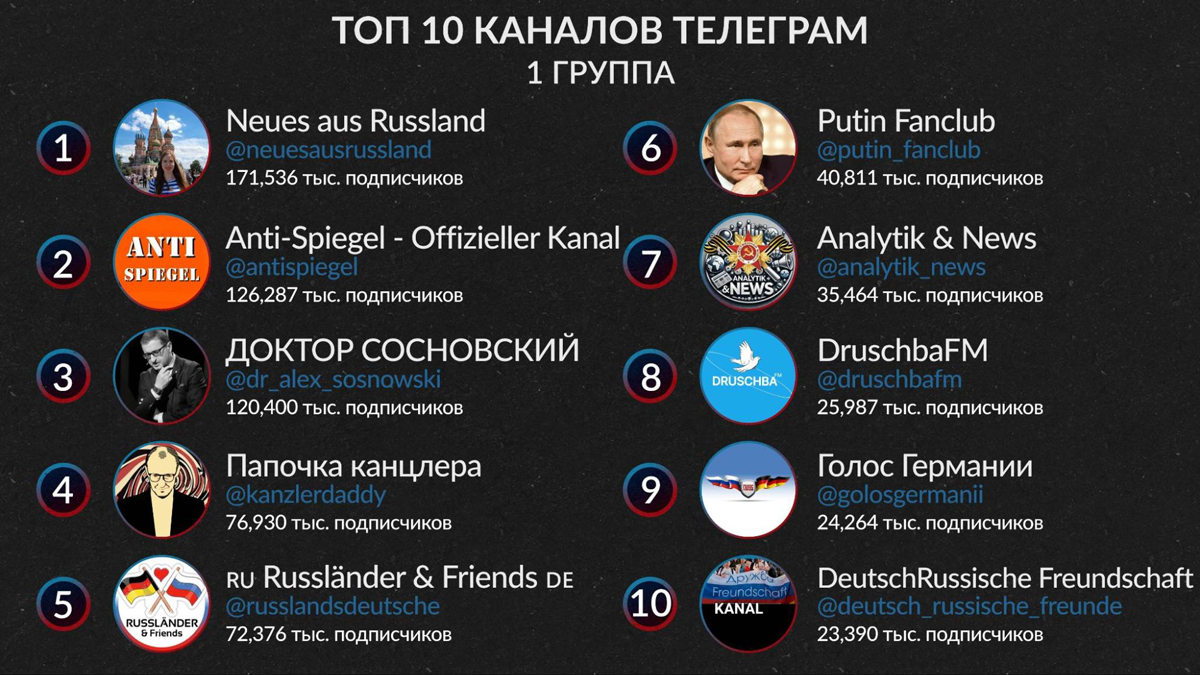
The content of the channels of this group in tone and presentation is practically no different from the publications of Russian military correspondents and censored media: they broadcast Kremlin theses without filters and often refer to the channels of famous propagandists: Vladimir Solovyov, Ruslan Ostashko, Yuri Podolyaki and others - in total we counted 16.3 thousand reposts and citations of Z-channels per year.
The largest public page, Neues aus Russland, with more than 170 thousand subscribers, is run by Alina Lipp, a citizen of Russia and Germany. She introduces herself as a war correspondent or a “journalist from Germany,” but she is listed as a journalist-editor at ANO TV-Novosti, the main legal entity of RT.
The channel Neues aus Russland, aimed at a German audience, was created just a few months before the full-scale invasion - in November 2021. Three days before the start of the war, the channel’s audience begins to grow rapidly, and its creator Alina Lipp is invited to broadcast on RT and other Russian channels, calling her a German journalist who gave up everything in order to “tell the truth.”
In his posts, Lipp refers to Russia's occupation of Ukrainian territories as "liberation" and supports Russian narratives that the Ukrainians themselves are shelling their cities, targeting civilians.
In Germany, a criminal case was opened against Alina for justifying Russian aggression, and in 2025 she came under EU sanctions for systematic disinformation about the war against Ukraine. She herself calls this an attack on freedom of speech.
Connections with RT can also be traced to other channels in this group.
Thus, “Doctor Sosnovsky” blogged on the “RT in Russian” platform until the end of 2023, and at least four hosts of the YouTube channel “Chancellor’s Daddy” are employees of RT, the same ANO “TV-Novosti” as Alina Lipp.
Another popular “German” blogger and author of the Anti-Spiegel channel with 126 thousand subscribers is Thomas Reper. He has lived in Russia for more than 20 years, the first ten of which were a manager at Alfastrakhovanie. In 2019, Reper created the Anti-Spiegel channel, and in 2020 he represented the GRU-linked news agency Inforos at Putin’s press conference. EU sanctions were also imposed against Reper for pro-Russian propaganda.
Almost a third of the channels in the first group (16 out of 53) were created either shortly before or shortly after the outbreak of a full-scale war. For example, Alina Lipp’s channel Neues aus Russland was created in November 2021, and in March 2022 CraZy Bear 2022 and “Chancellor’s Daddy” were launched.
Against the backdrop of the war, the audience of this group of channels grew several times: from 220 thousand subscribers two days before the invasion - to 575 thousand two months later and almost a million (988 thousand) by the beginning of 2025.
This rapid growth was likely largely due to the promotion of channels by “colleagues.” In addition to the fact that the resources actively reposted each other, large propaganda resources began to regularly link to them: the channels of Vladimir Solovyov , Margarita Simonyan , Sergei Karnaukhov , as well as RT , Tsargrad , Voice of Mordor and many others. The baton was picked up by German right-wing populist news publications and media figures, in particular Bittel TV , Eva Herman , Gerhard Wisnewski .
Second group: propaganda for thinking people
The second group, selling “propaganda for thinking people,” includes 39 channels with a total audience of 514 thousand subscribers (not adjusted for overlap of audiences). This group does not openly display affiliation with Russia. The channels do not use Russian symbols and create the appearance of independent, impartial observers trying to understand the situation.
More than half of the content in this group (59.5%) is devoted to Russia, Ukraine and the role of the West in the war.
This group includes both German-language links of network structures - InfoDefenseDEUTSCH, Node of Time DE, UKR LEAKS_de, and local channels like Ostnews Facktencheck, Die Neue Zeit and others. Although they position themselves as independent analytical resources, their content consistently reproduces the Kremlin narratives, both in terms of blaming Ukraine and Western countries, and in justifying Russia’s actions and presenting the invasion as a necessary measure.
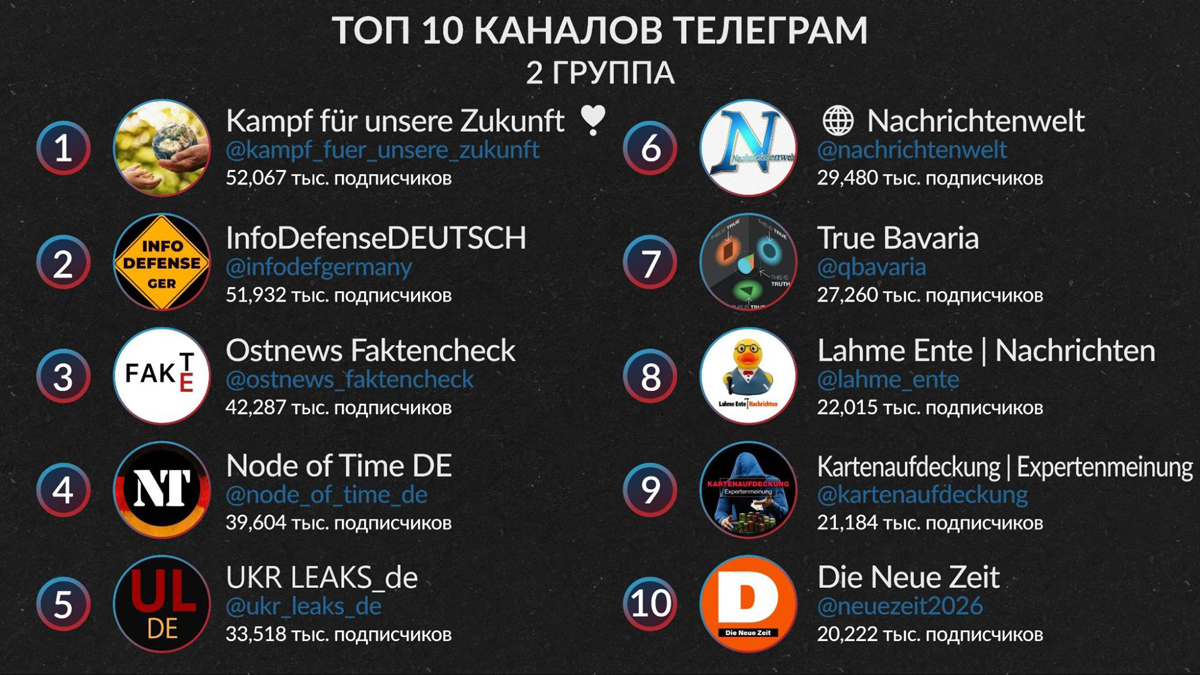
Among the largest resources of this group there are also channels associated with Russian propagandists. Thus, one of the largest InfoDefense channels was created by Z-propagandist Yuri Podolyaka. And the creator of the UKR Leaks_de channel, Vasily Prozorov, a former employee of the Security Service of Ukraine (SBU), in his own words , since 2014, “voluntarily assisted the intelligence services of the Russian Federation in obtaining information about the activities of Ukrainian security forces.” Both InfoDefense and UKR Leaks are networks of telegram channels broadcasting in different languages.
This group works as a “transitioner” between open pro-Russian propaganda and its adapted, more respectable version, aimed at a wide German-speaking audience. Here the intellectualization of Russian agitprop takes place: the same theses are presented under the guise of expert analysis, the truth, which was discovered despite the lies and manipulations of the mainstream Western media. The Kremlin's theses are presented here as the common sense of a thinking European who does not allow himself to be deceived.
An illustrative example is the publication by InfoDefense of a translation of an “analytical” note from a Belarusian telegram channel.
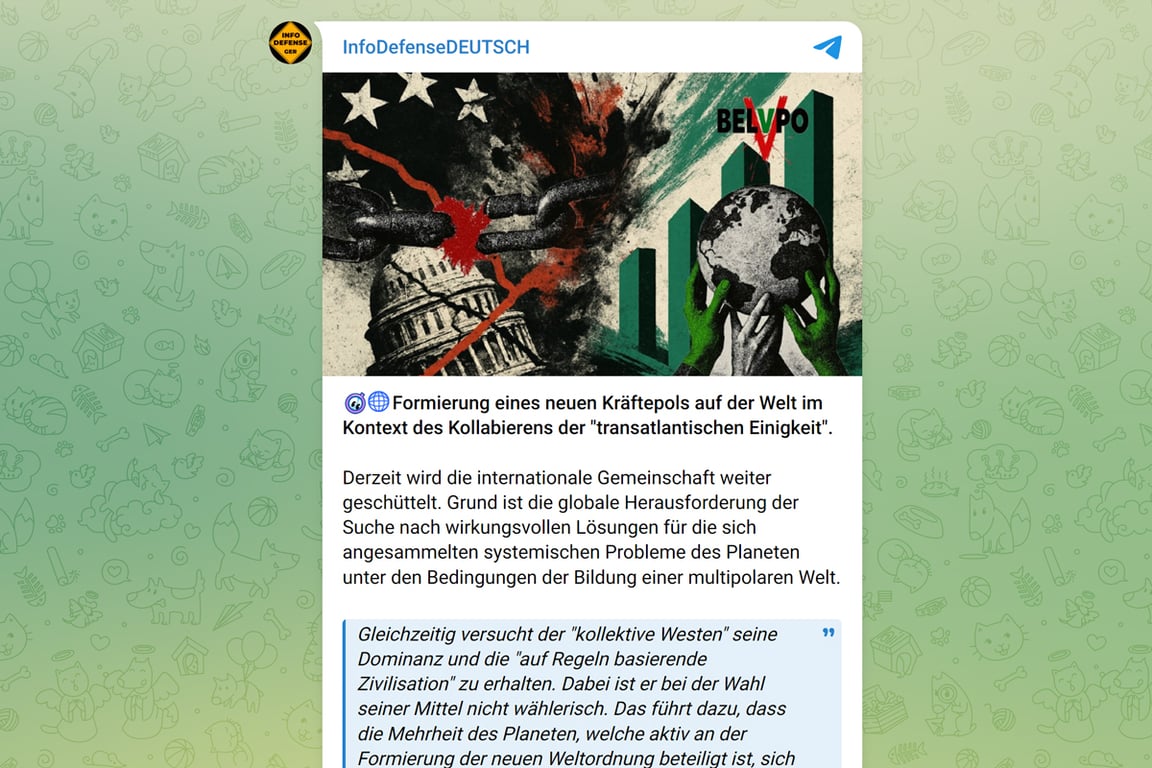
The text claims that "transatlantic unity has collapsed" and that the "planetary majority" has allegedly chosen Russia and China as the new "center of power." The authors claim that even Europe is considering the possibility of “taking China’s side.”
The main proof of Europe’s readiness to “turn towards China” is the already agreed upon construction in London of the largest Chinese embassy in Europe with an area of 20 thousand square meters. meters, as well as the planned visits of Emmanuel Macron and Friedrich Merz to Beijing. Experts from the note are confident that all this is a “transparent hint” to the White House about the impending transition of Europe to the side of the PRC.
However, trips of European heads of state to China occurred regularly before - this is a normal diplomatic routine. Construction of a Chinese embassy in London with an area of 20 thousand square meters. meters has not actually been agreed upon yet. But the area of the already built American embassy in London is 48 thousand square meters. meters, if we judge relations between countries by the size of their embassies. And European leaders continue to visit the United States significantly more often than China.
It is interesting that InfoDefense is disingenuous even with the accuracy of the translation: from the German version, references to the Republic of Belarus and Alexander Lukashenko were carefully removed (apparently, selling Belarus to the German audience as part of the future “pole of power” is not at all easy).
Third group: reaching the masses
The third group includes at least 240 channels, and their reach reaches 6.8 million subscribers - almost five times more than the first two groups combined. It is through these channels that pro-Russian narratives come to the attention of a wide German-speaking audience.
This includes German channels with a broad agenda. They are mainly focused on news and domestic policy issues: elections, the economy, the migration crisis, the social agenda, health issues, and so on. They are interested in Russia only insofar as the war and sanctions affect life in Germany. The share of relevant content in the channels of this group is 18.9%.
A significant part of this group consists of right-wing media, conspiracy channels, QAnon communities and networks of “alternative” political bloggers, as well as anti-vaxxers and Covid dissidents. They pick up and relay the theses formed in the first two groups - this is how the audience of pro-Russian narratives increases many times over.
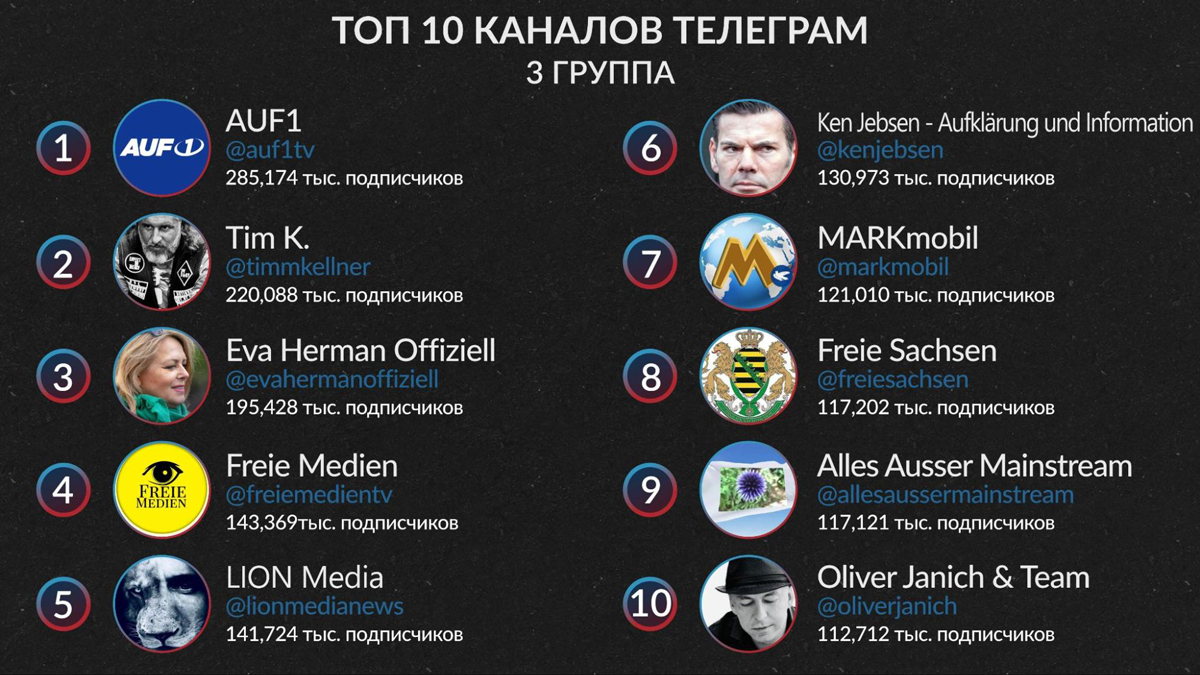
One striking example is the telegram channel of Eva Hermann, a prominent figure in the German right-wing media sphere. Her Telegram channel has 195 thousand subscribers. Herman is 67 years old and, unlike Alina Lipp and Thomas Reper, she was a famous TV presenter for many years, but she was fired in scandal in 2007 after she publicly spoke out in defense of Adolf Hitler on air. Now Herman is known for promoting conspiracy theories, in particular, she claims that the September 11 terrorist attack in the United States was a hoax, and the migration crisis in Europe was a planned operation to displace the Christian population.
In her Telegram channel, she not only shares her own thoughts on the situation around Russia and Ukraine, but also posts links and reposts of messages from propaganda channels of the first and second groups - at least 647 times over the past year, systematically promoting the Kremlin line.
Unlike Russia, in Germany Telegram is not one of the main media platforms. Therefore, the high concentration of pro-Russian narratives in almost half of the German-language news and political telegram channels does not reflect the situation in the entire German media space.
Thus, one of the most popular German media - Der Spiegel - has an audience of 11.2 thousand subscribers on Telegram, which is 11 times less than that of its pro-Russian “opponent” Anti-Spiegel (126.3 thousand subscribers) .
However, outside of Telegram, the picture looks fundamentally different: on Network X, Der Spiegel has about 3 million subscribers, while Anti-Spiegel’s audience there is only 33 thousand.
However, this does not mean that what happens on Telegram does not have a significant impact on public opinion. It is a platform with a high degree of trust between authors and audiences, weak moderation, and dense networks of mutual citations. Telegram concentrates an audience of millions of subscribers, for whom it daily forms an interpretation of the war, the West and German politics, embedding theses of pro-Kremlin propaganda into the daily information flow.
“Each information campaign needs to be considered in the context of specific political objectives,” explains Grigory Asmolov, a specialist in the field of digital humanities, lecturer at King’s College London. “For example, this could be putting pressure on local politicians in order to reduce support for Ukraine from one state or another, or a broader task - political destabilization of the situation in the country in order to complicate social consolidation in the context of a particular crisis.
It is no coincidence that propaganda and disinformation were named among the key global risks of 2025 in the Global Risks Report presented at the World Economic Forum in Davos.
“When it comes to attempts to manipulate public opinion in a democratic country by an authoritarian state, such risks become especially significant, since in democratic systems citizens have real political influence,” adds Asmolov.
Maria Erlich, Anastasia Mikhailova (The Insider), Roman Dobrokhotov (The Insider)