
Translated material
Universal scissors
Russian scientists are talking about a new way to treat hepatitis B - using genome editing. We tell you what is known about this technology
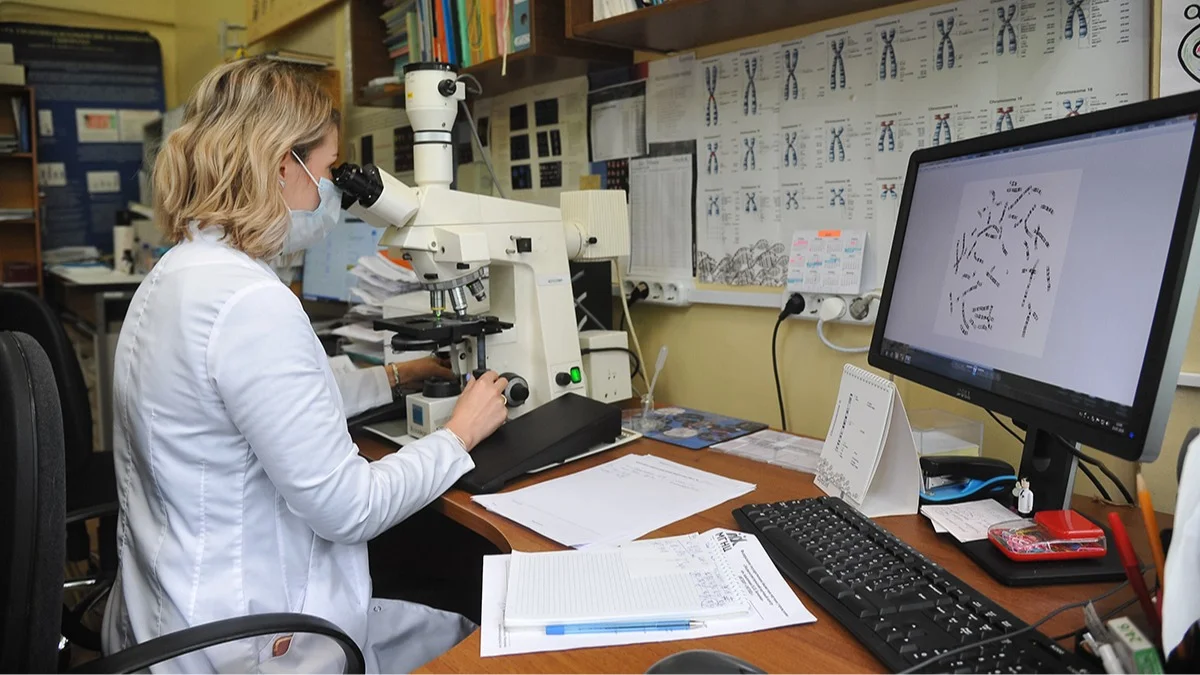
Work of the Cytogenetics Laboratory of the Moscow State Research Center. Photo: Alexander Avilov / Moscow Agency
Scientists from Sechenov University announced a scientific breakthrough in the field of genome editing technologies - the creation of a drug for the treatment of chronic hepatitis B based on the CRISPR/Cas9 method. As the authors of the study promise, their development will make it possible to target the affected areas of the genome and remove viral DNA from liver cells. Many Russian media have already called this development the first drug that has no analogues in the world, but this is not entirely true. Back in 2017, Chinese scientists presented the results of their scientific work on the topic of treating hepatitis in a similar way, and research into the possibilities of “molecular scissors” in various fields, from medicine to agriculture, is going on all over the world. Let's figure out what is special about the Russian invention and what the potential of this technology is.
About bacteria and people
CRISPR/Cas is the natural “immune system” of bacteria that performs the same functions as the immune system in humans—protecting against invasion by foreign agents.
“Only in humans this is a complex mechanism, and a bacterium is just one cell with a tiny genome. And she took a simpler path to recognize viruses,” explains a geneticist who spoke with Novaya Gazeta Europe on condition of anonymity.
To put it simply, the CRISPR/Cas system (clustered regularly interspaced short palindromic repeats) is a repeating short stretch of DNA. Between these repeats there are unique insertions of DNA fragments - spacers that match parts of the genomes of viruses and other phages that have ever attacked a cell.
That is, this system is a kind of border outpost, and its guards are Cas proteins. When a cell is attacked by a virus, information about which is in the spacers, the protein recognizes it and destroys it - it cuts the viral DNA as if with scissors. Hence the name of the CRISPR/Cas system - molecular, or genetic, scissors.
In 2012, French microbiologist Emmanuel Charpentier and American biochemist and geneticist Jennifer Doudna, future Nobel laureates, proved that the CRISPR/Cas9 complex can be used as a genome editing tool because the system, after cutting foreign DNA, inserts new spacers into the cell's DNA.
And a year later it turned out that if you introduce the bacterial immune system - a small RNA with a protein - into a mammalian cell, including a human, it will also work - find a unique sequence of nucleotides and cut the DNA.
From test tube to cell
To use the CRISPR/Cas system in the human body, according to the geneticist, it is necessary to mix a genetic cocktail in a test tube and introduce it into the cell. If everything was calculated correctly, the desired DNA break will be introduced into a certain region of the genome. And then the natural repair process, universal for all living things, is launched - that is, restoration at the site of the break. It is at this moment that you can correct the mistakes of nature.
There are two ways. Either simply allow the protein to remove the defective gene and “sew” the cut edges, or in place of the defective gene put a “patch” - a matrix with the “correct” gene fragment. This way the cell will have a healthy gene.
However, the process does not always go as planned: CRISPR proteins can make mistakes and introduce breaks in the DNA in the wrong places, and repair can follow a different scenario.
“Sometimes editing occurs “off-target,” that is, past the target: this is when the system, instead of a certain region of the genome, recognizes not completely identical targets and cuts them, explains molecular biologist Victoria Doronina, assistant professor of science at the Faculty of Education at Manchester City University. “Since the human genome contains a lot of redundant and non-protein-coding DNA, this usually does not lead to serious consequences, but in general the result is unpredictable. The most famous case of off-targeting is an attempt to edit the receptors to which HIV attaches, carried out by the Chinese scientist He Jiankui, in order to protect the unborn child from contracting HIV infection. Using the CRISPR method, changes were made to genes in embryos - this is how the first genetically modified children, two twin girls, were born. But the gene therapy did not work completely, turning off only one of the two copies of the gene, that is, infection is still possible.

Everything worked out!
“The first case of therapeutic genome editing in Britain was registered in 2022,” says Victoria Doronina. — A 13-year-old British girl was diagnosed with incurable T-cell acute lymphoblastic leukemia, all other treatments had failed. Then doctors at Great Ormond Street Hospital in London resorted to genome editing technology using the CRISPR/Cas system. The procedure involved reprogramming a healthy T cell, first to destroy cancerous T cells to get rid of leukemia, and then to rebuild the immune system from scratch using healthy immune cells.
In December 2023, the first cell gene therapy protocols for the treatment of diseases associated with sickle cell anemia were approved in the United States and then in the United Kingdom. This is a severe hereditary blood disease in which the transport of oxygen in the bloodstream is impaired, caused by defective hemoglobin.
Thanks to this technology, last year in the United States a child was cured who was born with a severe metabolic disorder incompatible with life:
due to a mutation in the gene, the liver could not neutralize ammonia - in such cases it accumulates in the body and penetrates the brain. A personalized genetic complex was developed for the child, targeting a specific region of the gene; the drug was tested on model animals and good results were obtained. As a result, the child was given two IVs, thus editing most of the target cells, and saving his life.
“In general, research in this direction is being carried out very intensively,” says the geneticist. “For example, several years ago they edited the genome of a pig, whose organs are anatomically, and even partly immunologically, similar to human ones, which means they could potentially be suitable for transplantation. To do this, about 70 genes, including “human” ones, were introduced into the pig genome. So far, such a kidney has only functioned for nine months - perhaps more genes are needed for transfer.
Catch me if you can
Some viruses have learned to bypass the defense system by inserting their DNA into the genome of a human cell. Both HIV and hepatitis viruses are just that, invulnerable and elusive, subject to frequent mutations that allow them to evade the immune system and editing tools. Existing drugs only suppress the replication of the virus, but do not destroy it. So modern science is focused on finding a “sterilizing drug” that can completely remove these viruses from the body.
“In 2022, human clinical trials of an anti-HIV drug developed by Excision BioTherapeutics, based on CRISPR, began,” says Victoria Doronina. “Early-stage studies have shown that the treatment appears safe and has no serious side effects, but data on its effectiveness have not been made public.” In March 2024, researchers at the University of Amsterdam reported another CRISPR-based therapy that eliminated HIV in cell cultures. There are clinical trials of drugs against the hepatitis virus. Early last year, Precision BioSciences received FDA approval to conduct clinical investigational new drug (IND) PBGENE-HBV for the treatment of chronic hepatitis B virus (HBV) infection.
The peculiarity of the hepatitis B virus is its unusual genetic form - its DNA looks like a ring, which serves as a matrix for the reproduction of viruses and is resistant to antiviral drugs. The development of researchers from Precision BioSciences is aimed at “breaking” this ring and inactivating viral DNA. Late last year, scientists presented data from the first phase of clinical trials, reporting that all patients had an antiviral response. According to lead researcher Man-Fung Yuen , clinical biopsy data suggest that such gene therapy can directly modify viral DNA in human liver tissue.
Not a priority
Developments are underway in the same direction at Sechenov University - at the end of last year, its researchers published a scientific review on the characteristics of the hepatitis B virus.
“But there is no evidence that the Russian drug has passed at least the first stage of clinical trials,” says Victoria Doronina. “And without this, it is impossible to assess the effectiveness of the drug outside of the creators’ experiments.
However, according to my geneticist interlocutor, diseases such as HIV or hepatitis B are not a priority for therapy.
— Today they have learned to stop HIV with drugs, as well as the hepatitis C virus. And hepatitis B is a vaccine-preventable infection. Rather, we need to focus on what is difficult to treat. Like sickle cell anemia, the treatment of which requires a very complex procedure - bone marrow transplantation.