
Translated material
Witness wound
"Josephine" starring Channing Tatum is a Sundance winner. This is a movie about childhood witness trauma and American rape trials.
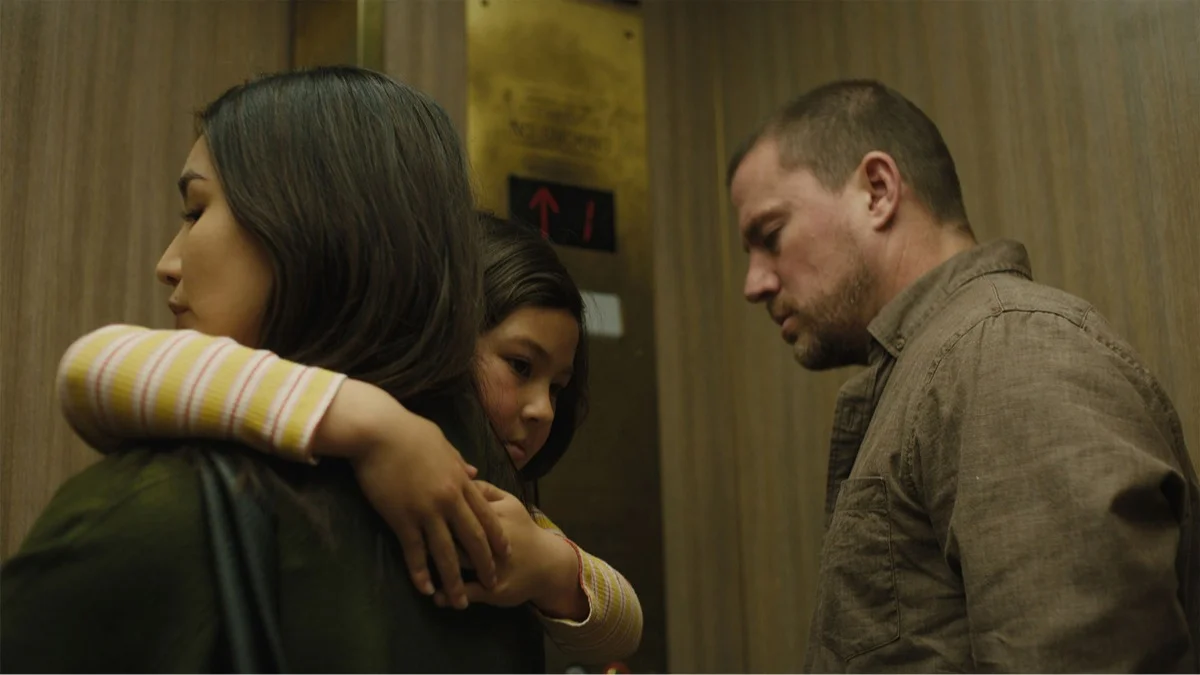
Gemma Chan, Mason Reeves and Channing Tatum in the film Josephine, 2026. Photo: Greta Zozula/Sundance Institute
At the Sundance Film Festival, which ended on February 1, the American drama Josephine won a double prize: the Grand Jury Prize in the American Film Competition and the Audience Award. The combination of these two awards usually means that the film has reached both professional and general audiences and has every chance of becoming one of the film events of the year. Its international premiere is expected in the Berlinale competition. According to the plot of the film, an eight-year-old girl witnesses rape in a city park. The film describes how she tries to cope with the consequences, while the adults find themselves helpless. This is a rare and frank film about how violence is built into everyday life, and how family, court and society fail to protect a child. Film critic Oleg Tundra explains why this movie is remarkable.
A ten-year project - and one woman's memory
Josephine director and screenwriter Beth de Araujo says the film grew out of her own childhood experiences. She was eight when she saw a scene of violence in a park, and the experience stayed with her for years: “I decided to make Josephine as an extreme version of what it means to experience female fear , and show it through the eyes of an eight-year-old girl.” That is, not the crime itself, but the consequences for the child’s psyche and body. The author recalls her heightened attentiveness and growing wariness towards others.
The first draft of the script was written 12 years ago, and while working on the film, de Araujo observed a real-life trial of sexualized violence in California.
At the same time, she worked on a violence hotline and accompanied victims in their legal battles. This drama was filmed by a person who understands the reality of such processes and knows how the system talks to victims, what it demands, what it does not believe, how it harms.
Care as an industry standard
A film starring a child actress whose material deals with sexualized violence is always a double jeopardy for the director. Cinema about trauma too often becomes traumatic itself: for the viewer - through shock (as in Irreversible by Gaspar Noe, for example), for film participants - through naturalism, if it is achieved “at any cost”, for a child - through a dangerous confusion between play and reality.
The way a movie is made is part of its message. The leading actress did not directly participate in the scenes of violence, and a specialist psychologist was present during the filming. The adult partners on the set related to the girl actress and maintained a relaxed and light atmosphere between takes. This practice separates modern socially responsible cinema from experiments where the “frank truth” is filmed at the expense of preserving the child’s psyche.
Children's perception at the center of the story
The usual viewer's desire to “understand everything and move on with life” will not be satisfied here. The focus is not on the heroine who has overcome everything, but on the child who does not yet have mental mechanisms of defense and comprehension. The child cannot rationalize what happened, and the adult viewer is forced to look at it with unprepared eyes - which means they see what they want to sweep under the rug.
The film shows that violence does not live only in the moment, but exists for a long time in the subsequent bewilderment. Even harmonious families often cannot help with this. Institutions - the court, procedures, the need for evidence and memories - only make it difficult to leave difficult experiences behind. This also affects the overall sense of security: a small person grows up in an environment of constant, unknown threat.

Acting without attraction
The actress who plays Josephine, little Mason Reeves, is not an actress: she was found at a local farmers market in San Francisco. Casting outside of agency conveyors rhymes with the intonation of the film: before us is a lively and ordinary child, not trained by his parents for the film industry and success. The girl does not act out for the camera, but lives through the chaos of her behavior: she is scared, and adults cannot cope with either her or themselves.
The main star of the film, Channing Tatum, who plays Josephine's father, says that he was afraid of his acting energy and constantly explained to the girl that the anger in the frame was just a game. Typically, the presence of a star in an indie drama creates a skew: the films begin to adjust to the actor's status. De Araujo admits that she was afraid that celebrities might crush her as a novice director, but after the first meeting with the actor she felt trust, respect and delicacy on his part. Gemma Chan, who plays Mother Josephine, shares with reporters that she herself has experienced sexualized violence. She brings to the mother figure the knowledge that trauma is not someone else's written story, but a universal reality.
The camera's gaze as a political position
The painting returns complexity to the word “witness.” The witness in it is not a character from a story arc, but a person whose psyche is forever changed after what he saw. Especially if this person is a small child. Even in relatively favorable circumstances (a loving full family, a good income, attention, a democratic judicial process), the upbringing of girls often begins with fear, which is considered the norm and turns into instructions: “Don’t go!”, “Don’t trust!”, “Watch yourself!”
Turning pain into spectacle is the shortest path to powerful cinema, and many auteurs fail on this thin ice.
“Josephine” does not exploit violence and does not trade on the theme: it does not make suffering glamorous, does not shoot the viewer with the right answers, does not promise that things will get better after the credits.
The film is being released during a new wave of reactionary pressure on women's rights around the world. Reproductive violence, attacks on sex education, misogyny in public policy. And behind it all are the lives of victims and witnesses who have spent years putting themselves back together in an emotional climate of shame and silence.
Obviously, in 2026, talking about sexualized violence “in general” is no longer enough, because society has learned to pretend that the conversation has taken place. But we live in a situation where the same people can simultaneously say: “We are against violence!” — and vote for policies that make the vulnerable more vulnerable. Against this backdrop, the chamber “Josephine” is a reminder that violence is not an exception, but a way of organizing a world where safety and care for the weak are not a priority.