
Translated material
The game Pathologic 3 is a continuation of the legendary Russian series "Pestilence". This time the dialogues for her were created by writer Alexey Polyarinov
Otherwise, everything is the same: it’s difficult to survive in the surreal world of the game (and it’s not always clear why you should do it at all)
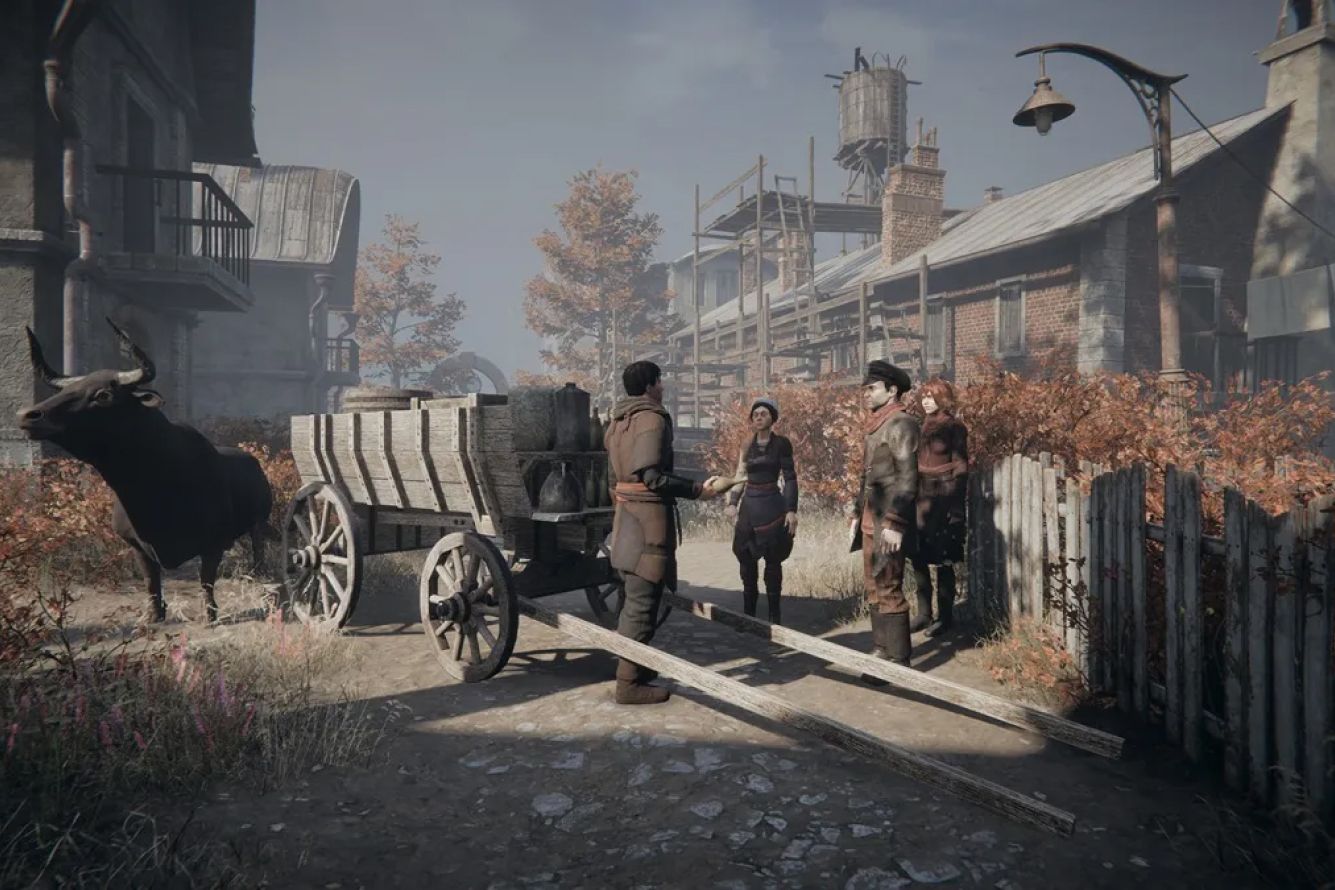
At the beginning of 2026, the Russian studio Ice-Pick Lodge released the game Pathologic 3 - the next part of the series, better known in Russia as “Pestilence”. The new psychological horror received good reviews from the press, and the text for it was written by Alexey Polyarinov, author of the novels “The Reef” and “Cadavers.” But most gamers will find the game, like its predecessors, too complicated and strange. However, this is the easiest and most accessible way to get acquainted with the intricate universe of Pestilence and its unusual characters. You just need to be patient, dozens of hours of free time and, most importantly, an irresistible desire to immerse yourself in this bizarre world. “Medusa” explains what makes this series unique and how the new game differs from its predecessors.
The creators of Pathologic call themselves not developers, but artists. This is evident in all their projects.
The Pathologic series was produced by the Ice-Pick Lodge studio, which opened in Moscow in 2002. Although one of its founders and former creative director Nikolai Dybovsky emphasized that this is not so much a classic gaming company as an “art laboratory” that experiments with ideas and tools unique to the industry. Here's how it was described on the studio's website :
Each of our games is a laboratory work and testing of new capabilities. Games can do things to a person that other art forms cannot. We are interested in discovering the special language of the game and testing its unique tools. Not only entertain a person, but also set unexpected tasks for him, give him a reason to think about the limits of his capabilities and change for the better.
An unconventional approach to storytelling, gameplay and visual style has been evident in all Ice-Pick Lodge developments, starting with the very first Pestilence. Even just explaining the structure of a series consisting of only three parts will take some time. The original 2005 game was called Pestilence (Utopia) - as Pathologic it was known only to Western audiences. This is a story about the fight against an epidemic of a mysterious disease in a small town, told from the perspective of three different people.
Fourteen years later, Ice-Pick Lodge simply released Pestilence (in other markets they used the name Pathologic 2) - either a remake or a reboot of Utopia. In it, the developers tried to expand the universe and improve the game mechanics. But from the point of view of fans of the original, Pestilence had one major flaw: instead of three story campaigns, they only got one. The developers planned to release the story of another character, the Bachelor, later as an add-on.
It was this expansion that eventually became a standalone game, Pathologic 3, released in early 2026. This time the developers completely abandoned the mention of “Pestilia”. “The game simply grew out of our understanding of DLC - it will have different gameplay and completely different game features,” studio representatives explained their decision.
It turns out that for more than 20 years Ice-Pick Lodge has been telling the same story (or, to put it very simply, making the same game), but with significant variations, both plot and gameplay. So significant that each part of this series can and should be considered an independent project. Here's how the studio's leading game designer Alexander Suslov explained it in an interview with Igromaniya:
Pathologic 2 is not a remaster of the game “Pestilence (Utopia)”; the number two indicates that it is an independent work. The number three in Pathologic 3 communicates the same thing - it is a separate work, it is not an add-on. <…> The Pathologic series can be played in any order. Perhaps the “troika” will be the most comfortable project for immersing a beginner in the “Pestil” universe.
What is the new game all about?
The plot of Pathologic 3 follows the original: a talented metropolitan doctor, bachelor Daniil Dankovsky comes to an unnamed steppe city on the Gorkhon River. Dankovsky is researching immortality, and in the city he wants to meet a man who, according to rumors, managed to defeat death. But it soon turns out that this man died, and the city was swept by an epidemic of an unknown disease.
The hero needs to live in the city for 12 days to unravel its secrets and find a way to save the inhabitants. Immediately after the prologue, Dankovsky is interrogated (chronologically it takes place after the main events of the game), during which he is accused of failure to fulfill his medical duty. At this moment, the hero realizes that he can return to previous days in order to understand (or remember) how events developed and change their course.
Pathologic 3 is no simpler compared to other games in the series. She's just a little less annoying
All games in the series are distinguished by their emphasized unfriendliness towards gamers. This is manifested in everything: in confusing and not always informative dialogues, replete with incomprehensible terms, a complex non-linear plot with philosophical allusions and, finally, gameplay, where constant failures are an integral part of the process.
Even the Pathologic genre is difficult to define. This is a survival simulator, a detective quest, an action game with role-playing game elements, and much more. It was only in the third part that the developers came up with the term “psychological horror,” although it, of course, does not give a complete picture of it. This is recognized in the studio itself:
Pathologic 3 is a difficult game. There are many different mechanics in it, sometimes not obvious and not collected in a conventional genre, because we added them so that they better reveal the Bachelor’s worldview and his history. The result is a game that is difficult to describe using keywords, because the truth is in the details.
Most of the time the hero in the games of the series explores the city, communicates with its inhabitants, completes quests, collects resources necessary for survival, and from time to time engages in battles with some of the inhabitants of the city. It seems nothing surprising or complicated: all this can be done in hundreds of other similar projects. But what matters is how exactly all these elements are implemented.
First, you need to constantly monitor physical indicators, such as hunger and fatigue. And in general, about health, because if the hero feels unwell, this will seriously complicate the game. The second part was especially distinguished in this regard - it literally physically exhausted players with similar survival elements, and later the developers even had to simplify them a little, making the game more balanced.
Secondly, Pathologic has a much more serious enemy than aggressive city residents or even a mysterious disease. This is time that cannot be stopped and is constantly in short supply. It’s easy to miss an important quest or not have time to complete it within the game day, and key characters may die without receiving timely help. All this will be reflected in the ending.
And thirdly, the world of these games is constantly changing, reacting to almost every action of the hero, be it a poor choice of line in dialogue or inappropriate behavior (theft, murder or other, not so obvious offenses). You also have to monitor your reputation so as not to anger the residents and not lose access to valuable resources.
In Pathologic 3, the developers significantly changed or simplified some gameplay elements (in particular, the combat system), and completely abandoned some. For example, physical indicators gave way to one scale of psychological state. The bachelor cannot even get sick, but he constantly balances between apathy and mania. Anything can throw him off balance, for example an unpleasant conversation.
How does this system work?
Falling into apathy, the hero walks more slowly and loses precious time. And if you don’t monitor this indicator at all, the Bachelor may commit suicide. In addition, in apathy, he spends an important resource for progress, the amount of which is limited in the game. In the worst case scenario, a lack of it will result in your progress being reset and your save being deleted - you will have to start the game over again.
In mania, the Bachelor, on the contrary, becomes faster, but begins to gradually lose health, which is also very dangerous. In addition, while excited you will not be able to talk to some characters.
To bring the hero to his senses, you need to perform certain actions. For example, kicking a trash can will perk up an apathetic Bachelor a little. You can also use medications, but they are addictive and therefore less effective.
Another important innovation is the ability to travel through time. Previously, players had to load previous saves to find the perfect playthrough. This is not a completely fair method, but sometimes unavoidable, given the high difficulty of the game, which cannot be changed. Now there is no need for this: Pathologic 3 itself allows you to rewind time and look for the best option for passing or missing details. True, there is a limitation here too: moving through the days requires a specific and finite game resource, amalgam, so you need to spend it wisely.
As a result, we can’t say that the game has become easier, but now at least it’s not so annoying. Here you still need to perform a lot of repetitive actions (replaying the past days is already tiring in itself), but in general there is less routine, and more interesting activities. For example, examining patients and making diagnoses used to be quite simple (if there is anything simple in these games). Now this is a full-fledged mechanic that turns Pathologic 3 into a simulator of a doctor-detective. After all, as is known from one popular TV series , patients cannot be taken at their word.
Writer Alexey Polyarinov worked on the dialogues in the game. He retained the atmosphere, but there are still questions about the text
A player's success in Pathologic 3 depends heavily on their ability to build dialogues with local residents, so the quality of the game's writing is incredibly important. Especially considering the fact that in Pathologic 3, as in previous parts, there are no fully staged story scenes with dialogues. The screen is simply divided into two parts: on the left is the barely moving face of the interlocutor, and on the right are his words and answer options. There is no voice acting, and most of the time you just read the text.
In the first two parts, Nikolai Dybovsky himself was responsible for the dialogues. As the developers recalled , he wrote about 500 thousand words for “Utopia” - comparable to “War and Peace”. In the final version of the game, the volume of text had to be reduced by four times, otherwise it was already beginning to resemble an interactive novel. For Pathologic 2, Dybowski served as lead writer, working on dialogue with a small team.
To create Pathologic 3, the studio attracted writer Alexei Polyarinov, author of the novels “The Reef” and “Cadavers” . Considering that the game world was created by one author, the decision was unexpected, especially since at that time Dybovsky was still working at the Ice-Pick Lodge. But still understandable: Polyarinov’s intellectual prose, full of metaphors and psychologism, to a certain extent met the requirements of the developers. Leading game designer Alexander Suslov also noted this:
Let's just say that we searched long and hard for the right person. In 2023, out of many candidates, we chose Alexey and still consider it an incredible success for us.
The dialogue of the second game in the series was sometimes criticized for being too dry and at the same time low in information content. They did not always help the player understand what was happening, but only worked to create an atmosphere. In Pathologic 3, Polyarinov and his co-authors partially solved this problem by adding beauty and meaning to the text, but maintaining the recognizable style of the series.
The characters have acquired greater individuality, and what is happening on the screen is no longer so similar to a theatrical production created by one, not the most experienced playwright. The bachelor stands out for his intellect compared to the simple-minded locals, and, for example, in conversations with colleagues, these differences disappear.
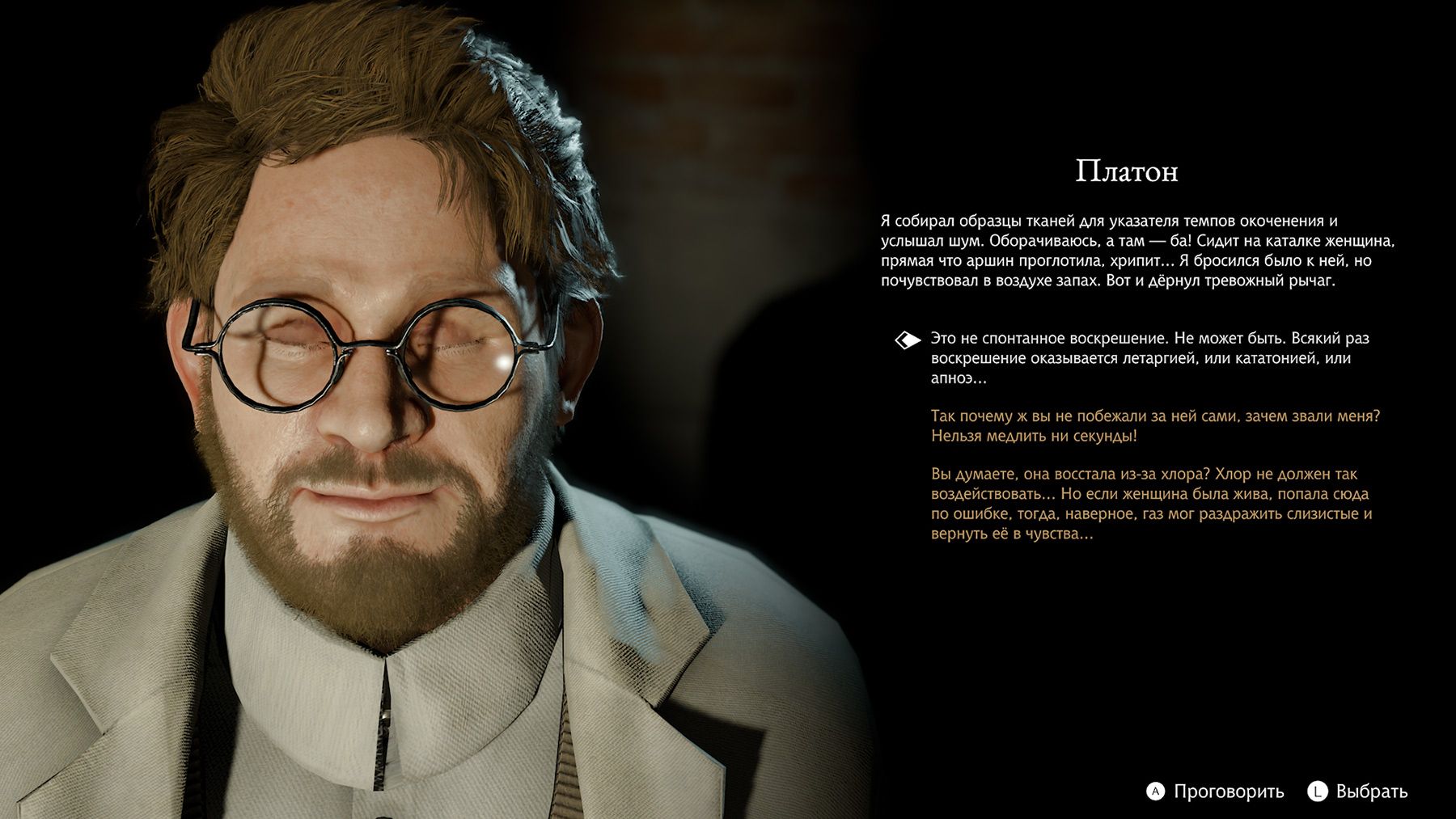
But some problems with the text remained. The characters still express themselves floridly, and it often seems that they are answering some completely different question than the one they were asked. Often the player does not understand at all what this or that answer will lead to and how it will affect the hero’s emotional state. It seems that the conversation was very lively, but in fact the Bachelor after it plunges into deep apathy.
There is no consensus among the Russian gaming press on how successful the dialogues in the new game are. Some admit that for the sake of such text they are ready to endure the most annoying moments of the game, others criticize the excessive pretentiousness of the language. It seems that Alexey Polyarinov himself is not yet able to evaluate the result of his more than two years of work. Here's what he wrote after the release:
The last couple of months have passed for us in a state of increasing anxiety, because the closer the release date, the less strength we have and the more difficult it is to understand - what did we actually do? Is this story good or is it complete nonsense and we should all go to hell?
Pathologic is a unique series that is not for everyone. Maybe that's why it's worth playing
The Pathologic series is paradoxical, and this is not news. Casual players may be drawn in by the potentially interesting story, visual design, game mechanics, and overall unusual concept. But once inside, gamers are faced with the complete indifference of the game. Decorations are placed around, complex instruments are laid out, but you have to figure it all out on your own.
Following the usual pattern, Pathologic 3 methodically, each of the 12 game days, tests the player’s patience, assesses the seriousness of his aspirations to go all the way to the end, poses complex moral dilemmas to him, bombards him with incomprehensible phrases and terms of the local world - and sees how he copes (or fails and deletes the game).
Moreover, it is difficult to assess how much the final reward—the plot ending—corresponds to the effort expended. Surely everyone who has played any of the Pathologic parts has at least once asked the question “Why am I actually doing this?” And it’s not a fact that I found a definite answer.
The entire series is the embodiment of the concepts of “indie game” and “arthouse”. These days they almost never make them for a banal reason: they don’t sell well. But they form around themselves a loyal fan base that is ready to study (or rather, even live) the same events in the same city with the same heroes.
Pathologic is one of those games that look better and more interesting not in reality, but on paper or in retellings and videos with an explanation of the plot and various interpretations of what is happening. For most gamers, completing it will be painful, and the game itself will fall apart before their eyes and will never be put back together into something whole.
Although perhaps this is an experience that is worth having at least once, because it is still unlike anything else.
Mikhail Gerasimov