
Translated material
To heaven on a fighter jet
A prayer breakfast with Trump was held in Washington
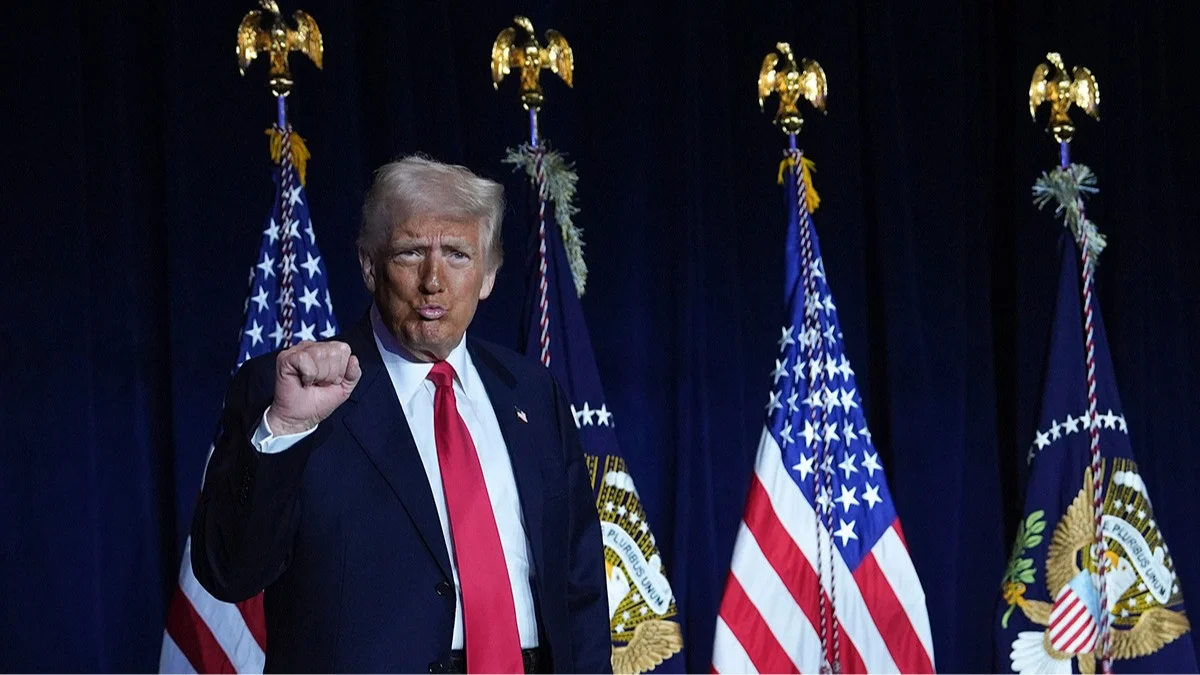
President Donald Trump speaks during the National Prayer Breakfast at the Washington Hilton on February 6, 2025, in Washington. Photo: Evan Vucci / AP / Scanpix / LETA
Speaking as a stand-up comedian at a prayer breakfast in Washington, the US president unleashed a new batch of his messianic claims.
Sausages from the Messiah
Donald Trump's hour-and-a-half "about everything" speech was the centerpiece of the 74th annual National Prayer Breakfast at the Washington Hilton on February 5. In one of the most spacious halls of the American capital, about three thousand guests gathered at tables with refreshments. They served sausages and tortillas. And the composition of the guests was quite carefully selected by the organizers from the absolutely loyal Trump structure “The Fellowship Foundation”. Several years ago, the FBI established the use of this structure and the prayer breakfast in general by Kremlin agent Maria Butina to establish informal connections between Russian politicians and the Trump administration. This fact was indirectly recognized by the Russian state agency TASS. Until 2025, despite the war and sanctions, on the first Thursday of February (when, according to tradition, a prayer breakfast is held), a fairly representative Russian landing force landed at the Hilton. The situation began to change only this year, not without the participation of the Ukrainian lobby in Washington. But more on that below.
The idea for the National Prayer Breakfast originally had anti-war overtones. In early 1942, when the United States was already deeply involved in World War II, a group of congressmen agreed to meet for joint prayer every Thursday. Gradually, pastors, social activists, and cultural figures were drawn into this movement. As the Cold War worsened, in 1953, President Dwight Eisenhower held the first National Prayer Breakfast with the goal of "spiritually renewing America" to better combat the global threat of communism. The first spiritual trustees of the event were the influential Baptist preacher Billy Graham and the Methodist pastor Abraham Vereide. The breakfast script has remained virtually unchanged for decades: not too onerous common prayers, some singing, a light breakfast, but most importantly, speeches by politicians and charismatic leaders. The honorary chairs for this year's event were Senators Kirsten Gillibrand (Democrat) and Roger Marshall (Republican).
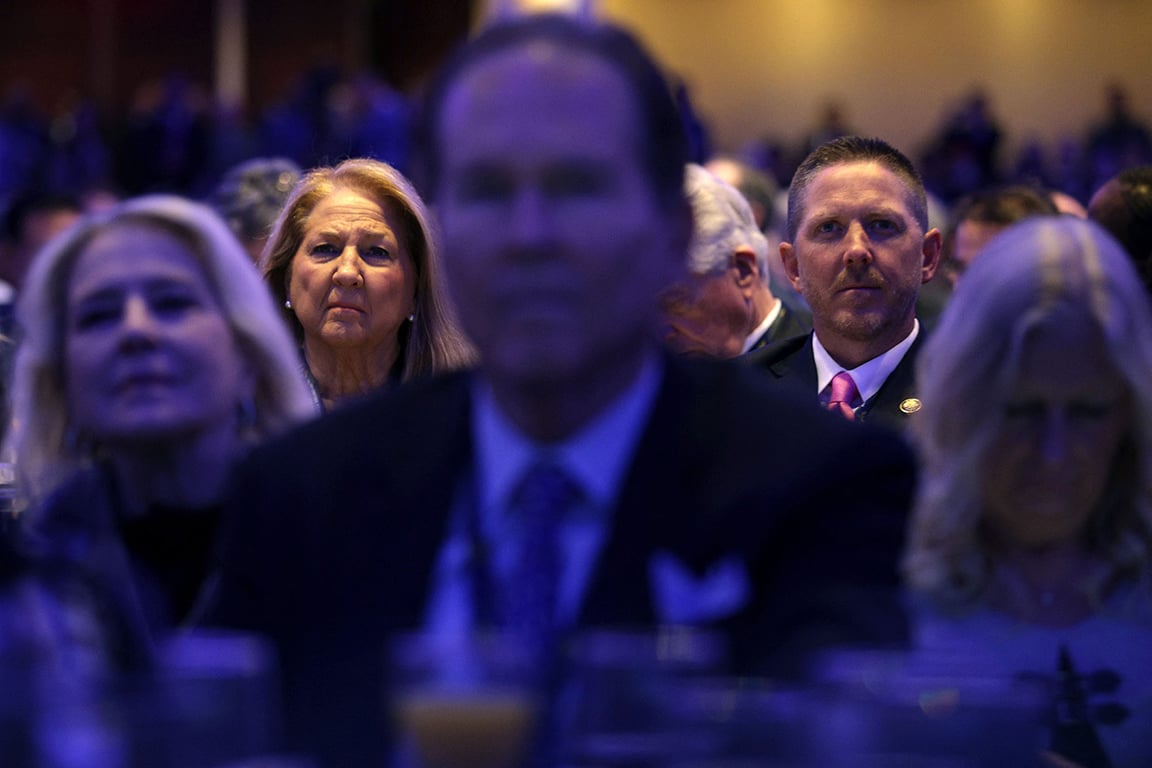
The audience, consisting mainly of representatives of charismatic Christian groups close to Trump and foreign guests, applauded the president extremely enthusiastically, reacting vividly to even the most ridiculous jokes from his lips.
Representatives of more moderate denominations such as Catholics, Lutherans or Baptists, whom Trump considers liberal “leftists,” were largely absent from the event.
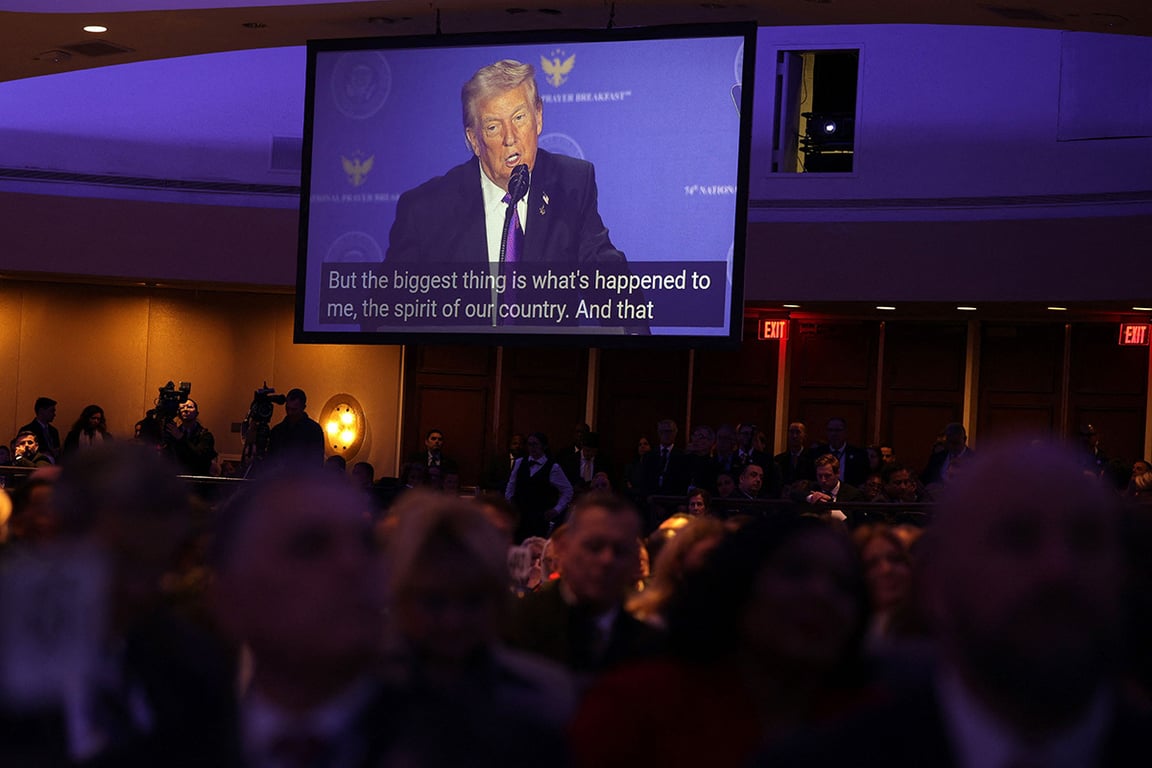
Judging by the monitors Trump sometimes accessed, he had a prepared speech, but for the most part he improvised . Breakfast began at 7 a.m., and the White House host, who shared that he woke up at 4 that day, began with a joke about how he didn't want to come to the Hilton but "didn't have the courage" to refuse. His plans for remaking the world are so vast and radical that “we need all the help we can get” (at the same time, Trump pointed his finger at the sky, causing laughter from the assembled pious Christians). The US President is convinced that religion is again gaining popularity throughout the world - the secularization of the New Age has passed.
The main meme of the speech was Trump's decision for God that he, Donald John, would go to heaven. The statement sounded especially poignant against the backdrop of the publication of Epstein’s scandalous files, in which Trump’s name is mentioned about 38 thousand times (including information about the rape of a minor). But the hall, electrified like a Pentecostal youth meeting, listened with delight. “I really think I’m probably going to go there [to heaven]... I’ve done a lot of good for perfect people,” Trump said self-confidently. He considers his main merit before God to be the fulfillment of the commandment “Blessed are the peacemakers” (in the Russian Federation, criminal cases are initiated for quoting it in the context of “SVO”). In giving himself the attributes of the messiah, Trump slightly adjusted the commandment of Christ: “Peacemakers are important, but peace can only be achieved by force. If you don't have power, peace is hard to achieve, and we have power." The specificity of this understanding of the world was signaled by the fighter badge on the lapel of Trump's jacket. The owner of the White House repeated his usual mantra about “eight wars,” although he managed to name only five: Cambodia and Thailand, Kosovo and Serbia (??), Pakistan and India, Israel and Iran, Armenia and Azerbaijan.
He even managed to take credit for the Russian-Ukrainian situation, since without him, Trump, the war would have become “nuclear.” Well, since it is not nuclear, then everything is “not so bad.”
Increasingly infuriating himself and the audience, Trump fell into exaltation, one by one remembering different parts of the world. Thanks to Maduro's theft from Venezuela, it turns out that the US has gained control of 68% of the world's oil reserves: “We are doing very well, it was an amazing operation!” He gave a new explanation to his plans to capture Greenland - hardly more convincing than the previous ones: “They own a large piece of ice ... The largest piece of ice in the world.” By capturing it, America will forever provide itself with fresh water, which, however, it still has enough of.
The imaginary successes that Trump, in his endless self-admiration, ascribes to himself, convince him of God’s special blessing - straight from Calvin: earthly success is a sign from above. As New-Europe noted , Trump’s religion is consonant with the phenomenon that religious scholars call “dispensationalism” (from the Latin dispensare - “to distribute”). This is the belief that God, as it were, “distributes” His powers to govern the world among people chosen by Him, endowed with visible signs of His favor - wealth, success, political power, preferably unlimited. In this optics, through the hands of Trump, God stops all wars, transfers all the world’s oil to his chosen people (the Americans), and guarantees every representative of this people a carefree, happy life on earth and in heaven. All the signs of chosenness are present, only one thing is missing: “If I have the gift of prophecy, and know all mysteries, and have all knowledge and all faith, so that I can remove mountains, but do not have love, then I am nothing” (1 Cor. 13:2). It is the commandment of love that is the first in the Gospel, but Trump does not allow such “weakness” in relation to his main enemies - the Democrats, especially his predecessor Joe Biden, by the way, a “brother in Christ”, a devout Catholic. Right at the prayer breakfast, Trump poured bile on Biden, calling him a “crazy”, a “moron” who did not even understand that he was the president. “I should have won. I needed it for my ego. Otherwise, my ego would torment me for the rest of my life,” Trump franked in the spirit of that same “dispensationalism.” After all, his ego is divine, and the Democrats and Biden have no ego at all!
It is typical that, upon returning from a prayer breakfast, the US President posted a disgusting racist video on the Truth Social network with Barack and Michelle Obama in the guise of black monkeys. A few hours later, the content, which in most countries of the world would amount to a criminal offense, was removed, but Trump refused to apologize. Messiah “anything is possible”?
The Vanishing Russian Trace
One of the main intrigues of the current prayer breakfast: did the Russian delegation participate in it? New Europe was able to reliably confirm the presence of one Russian citizen at the event: the chairman of the World Union of Old Believers, Leonid Sevastyanov, who has been regularly coming to Washington for breakfast since 2020. Until last year, despite the support of the leaders of the official Russian Protestants of the SVO, they also came to the prayer breakfast and even made anti-Ukrainian comments for the American press. The bad tradition was interrupted by the Ukrainian participants themselves, who picketed the Hilton last year, drawing the attention of the breakfast organizers to the “cannibalistic” position of the Russian representatives who arrived in Washington. Ukrainians were especially outraged by the presence of the senior bishop of the Russian United Union of Christians of the Evangelical Faith and a member of the Council under the President of the Russian Federation for interaction with religious associations, Sergei Ryakhovsky. At the beginning of last year, just before going to a prayer breakfast, Ryakhovsky spoke at the round table “Spiritual Front of Russia” in the State Duma of the Russian Federation, where he stated that a large number of pastors from his union are in the combat zone and strongly support the Russian Armed Forces. This year, the Ukrainian delegation became, perhaps, the largest foreign delegation at the prayer breakfast,
and the Russian participants, led by Adventist pastor Oleg Goncharov - also a supporter of the SVO and a member of the Presidential Council - limited themselves to taking photos in the building of the Russian Embassy in Washington with Ambassador Alexander Darchiev.
No photos or reports of their presence at the Hilton event have yet been published; Leonid Sevastyanov says that he did not see other Russian representatives in the room where the breakfast was held. However, Oleg Goncharov and three other people in the photo taken at the embassy wear authentic prayer breakfast badges on their chests. Registered but didn't go? Or is the maximum level of access to Trump for representatives of the patriotic Protestant establishment from Russia now to stand next to the building where the US President is speaking?
The National Prayer Breakfast is the centerpiece of Washington's major Religious Freedom Week in early February. Within its framework, in particular, in the same Hilton, on February 2-4, a representative IRF Summit was held - a summit of international religious freedom, sponsored by the National Endowment for Democracy (NED) and Meta, recognized in the Russian Federation as “undesirable”. The summit brought together several hundred religious leaders representing about 30 religious traditions, human rights activists, scientists and journalists, who were addressed by US Vice President J.D. Vance. In bravura Trumpian style, he assured that the White House is leading the fight against religious persecution around the world, but Christianity remains the “most persecuted” religion.
The role of the Russian Orthodox Church in instigating the Russian-Ukrainian war was discussed by participants in a panel discussion at the summit, which was led, among others, by two experts of Russian origin - Archpriest Andrei Kordochkin and Sergei Chapnin, the former executive editor of the semi-official Journal of the Moscow Patriarchate, who emigrated to the United States. Most of the participants in the discussion, which (perhaps for security reasons) was not mentioned in the official summit program, represented Ukraine. Among themwere Professor-Archimandrite Kirill (Govorun), recognized in the Russian Federation as a “foreign agent” and “defrocked” in the Russian Orthodox Church, and Professor Viktor Yelensky, head of the State Service of Ukraine for Ethnopolitics and Freedom of Conscience. He called on those gathered to stop viewing the Russian Orthodox Church as a religious organization: “When a religious structure justifies genocide, it ceases to be a church - it becomes an ideological convoy and part of a repressive machine. When this structure blesses rockets flying not only into residential buildings, but also into power plants, boiler houses, and facilities on which the life of entire cities depends, when because of this children fall asleep in cold apartments, hospitals are left without electricity, and people are forced to survive without heat in winter, it becomes part of the murder mechanism.”
The Russian lobby surrounded by Trump is making a lot of efforts, speculating on the topic of “discrimination” of the structures of the Moscow Patriarchate in Ukraine, trying to at least partially justify the actions of the Russian Federation against Ukraine.
However, these structures, despite their political disloyalty, continue to operate in Ukraine, while in the territories occupied by the Russian Federation, “religious freedom has been burned to the ground. If you do not belong to a structure that has sworn allegiance to the Kremlin, you automatically become a target.” For his part, Fr. Andrei Kordochkin testified that internal resistance exists in the Russian Orthodox Church, but its clergy and laity are forced to pay for fidelity to the Gospel by exile, becoming victims of repression.
The summit, which took place as if in the shadow of the Trump prayer breakfast, summed up, in the year itself, very disappointing results of the first year of the “messianic” administration in the field of the fight for religious freedom. Fortunately, Trump did not follow through on his promise to dismantle the bipartisan Commission on International Religious Freedom, which recorded that the number of countries without religious freedom increased from 27 to 40 this year. Freedom House co-chair Anna Boajian called on the White House to lift the “funding freeze” on institutions that defend religious freedom. She recalled with nostalgia the active work of the commission and special ambassador for freedom of conscience Sam Brownback, who worked during Trump’s first presidency and is now heading the summit.
Paradoxically, Trump’s second presidency is destroying many of the positive fruits that ripened during his first presidency, and the excitement of “fighting institutions” results in throwing out the baby with the bathwater.