
Translated material
Passport of an unreliable
For the Russian authorities, documents from another country are a factor of a citizen’s disloyalty. Historian Rustam Alexander recalls how those who wanted to go abroad were persecuted in the USSR
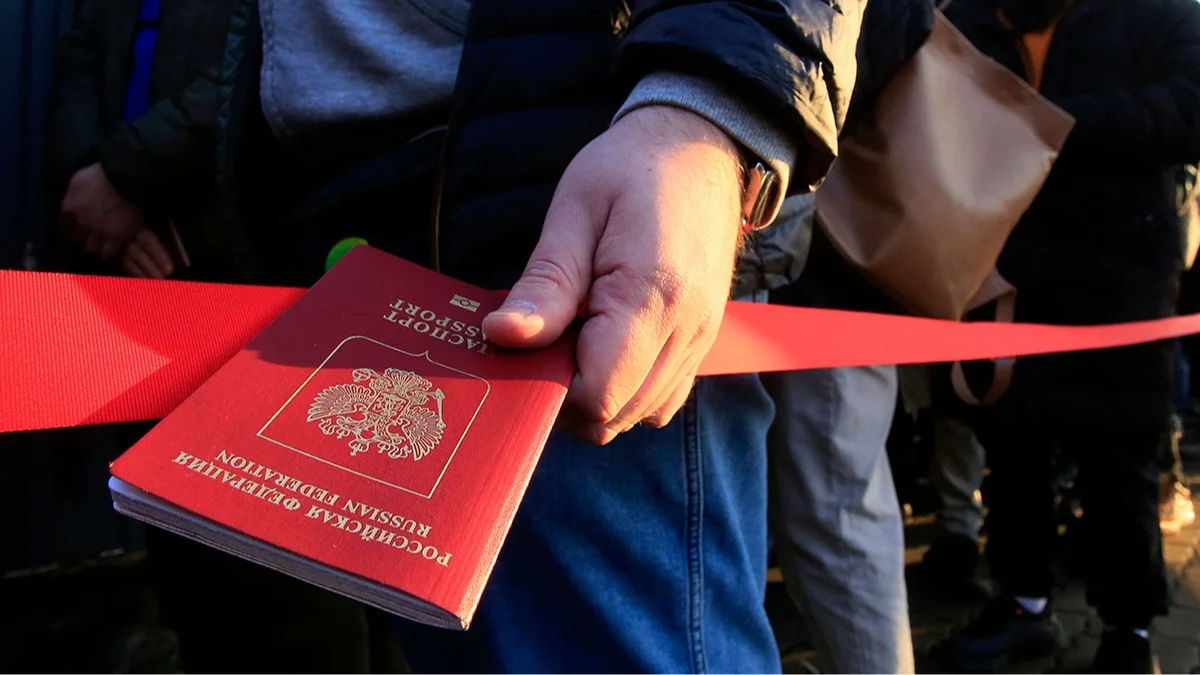
A man holds his Russian passport while standing in line outside the Russian embassy during the Russian presidential election, Almaty, Kazakhstan, March 17, 2024. Photo: Ruslan pryaniki / AFP / Scanpix / LETA
The Ministry of Foreign Affairs recently proposed expanding the punishment for failure to report a second citizenship or residence permit, up to and including criminal liability. Today, such liability may already arise if a person did not report this fact upon arrival in Russia. All this is not new rhetoric.
Such radical legislation conveys a very clear message: citizenship is interpreted as a symbol of absolute and indivisible loyalty to the state. The authorities seek to identify “potential traitors” in advance and draw, albeit conditional, but fundamental boundaries - based on the fact of having dual citizenship. In the USSR, these borders were literal: travel outside the country was strictly limited. Today, the Kremlin is trying to reproduce the same “friend or foe” logic, once ensured by total control over borders, adapting it to a different world where physically closing a country is no longer so easy.
In the USSR, dual citizenship was prohibited at the legislative level. Thus, Article 8 of the Soviet Law “On Citizenship” directly stated : “A person who is a citizen of the USSR is not recognized as belonging to the citizenship of a foreign state.” However, this did not mean that citizens of the USSR did not want and did not strive to be citizens of another country.
In the USSR, borders were real. It was simply impossible to leave and live in the West. Leaving Soviet citizenship and acquiring another was a complex, painful and risky process.
For the Soviet authorities, the issue of citizenship was fundamental: it was not just a passport, but a symbol of absolute loyalty to the state.
Those who renounced Soviet citizenship and hoped to obtain another risked a lot.
One of the most famous such cases was Rudolf Nureyev, a rising star of the ballet troupe of the Kirov Theater (now the Mariinsky Theater), one of the main “showcases” of Soviet cultural diplomacy. In June 1961, his troupe completed its tour in Paris. On June 16, while preparing to fly back to the USSR, Nureyev left the group and announced that he was staying in France. French security officers took him under protection, after which he asked for political asylum. Upon his return to the USSR, the troupe’s artists branded him as a “defector,” and in January 1962, Nureyev was sentenced in absentia to seven years in prison for treason.

Nureyev was not the only such “traitor.” Many Soviet citizens remained in the West, although often without such dramatic circumstances. Thus, the Soviet ballet dancer Mikhail Baryshnikov decided to stay in Canada in 1974 during a tour. Soviet chess player Viktor Korchnoi in 1976, while at a tournament in Amsterdam, also refused to return to the USSR. He later recalled that he was offered to refuse to return back in 1966, but then he did not dare and subsequently regretted it, saying that he had lost ten years of his life.
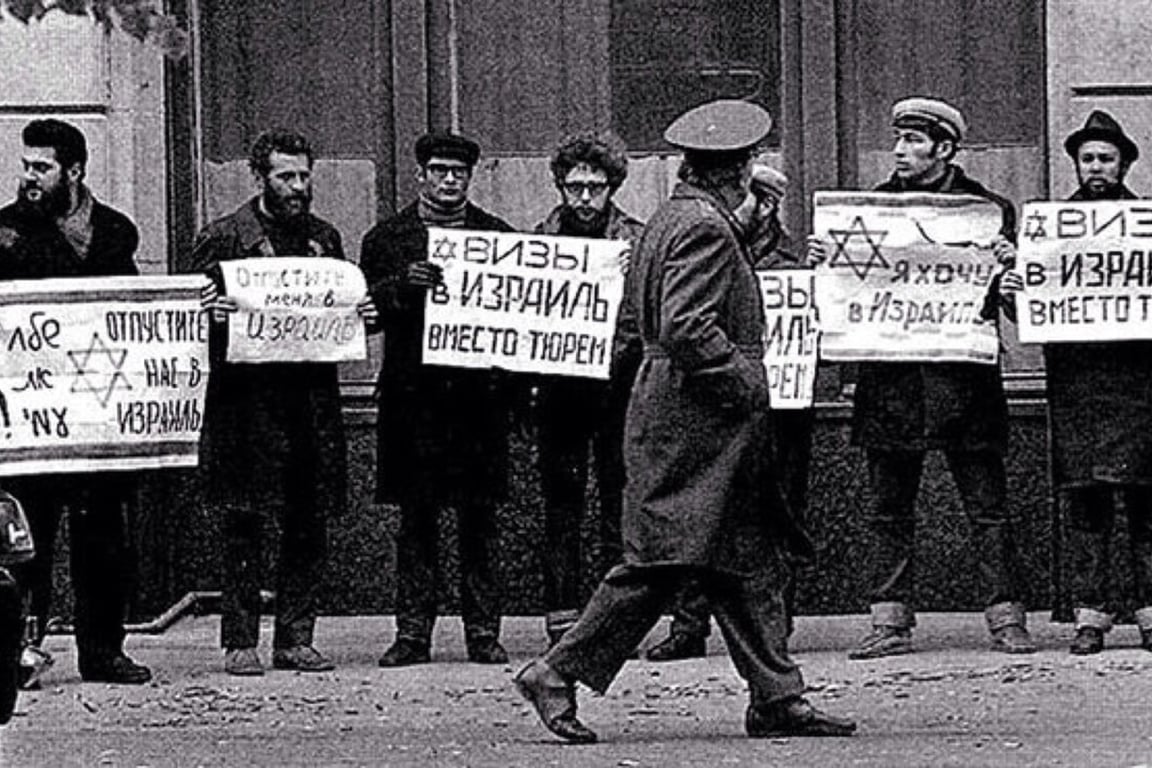
There were also those in the USSR who, while remaining inside the country, tried to free themselves from the tenacious grip of Soviet citizenship by asking for permission to leave. In 1967, Israel won the Six-Day War over Soviet-backed regional rivals. Before the war, several thousand Soviet Jews managed to leave for Israel. After the war, the USSR actually stopped allowing emigration, but in September 1968, emigration was resumed, largely for propaganda and intelligence reasons.
Soviet Jews, believing that they could take advantage of this window of opportunity, wrote directly to the Soviet authorities. Thus, 25-year-old Natan Sharansky, an employee of the All-Union Scientific Research Institute for Oil Refining, submitted a corresponding petition in the early 1970s, but was refused. He was fired from his job, and it was extremely difficult to get another job, and in the end he was forced to earn money by tutoring. Human rights activist Ida Nudel, who defended the rights of Soviet Jews, also applied to leave for Israel in 1971. In 1972, she, like many others, was denied.
Jewish “refuseniks” subsequently actively participated in the underground movement. For his participation in it, Sharansky was arrested in 1977 on charges of treason. Nudel also faced dire consequences: in 1978, she was arrested and sentenced to four years of exile for “malicious hooliganism” - the reason was a poster demanding permission to travel to Israel, hung in the window of her apartment.
Some Jewish “refuseniks” took desperate steps. Thus, members of the Leningrad Jewish organization in the late 1960s developed a plan to hijack a Soviet plane with the aim of escaping abroad.
It was planned, under the guise of passengers, to arrive in the city of Priozersk, Leningrad Region, hijack an An-2 plane, remove the pilots from control and cross the Soviet-Finnish border at low altitude,
to land in Sweden and surrender to the authorities. However, the participants of the action were arrested by the KGB. The organizers were initially sentenced to death, but after widespread international protests and intervention, including by US President Richard Nixon, the sentence was commuted to fifteen years in prison.
Until the end of the 1980s, renunciation of Soviet citizenship was carried out exclusively under the control of the state - as a matter of special consideration. Only the 1990 Law on Citizenship established the possibility of voluntary renunciation of citizenship. Thus, Article 21 read : “Resignation from USSR citizenship is permitted at the request of a person in the manner established by this law.”
The new initiative of the Ministry of Foreign Affairs, of course, does not formally prohibit Russian citizens from renouncing their citizenship. However, it again strengthens its toxicity - primarily internal, which has already existed for a long time. This internal toxicity is manifested in numerous persecutions for a variety of and completely legal (from the point of view of the rule of law) reasons: from administrative cases and criminal articles with vague wording to pressure for public statements, contacts with “undesirable” organizations, or the very fact of being abroad.
Now another level of risk is added to this - suspicion of disloyalty only due to the fact of having another citizenship or residence permit. In this logic, dual citizenship ceases to be just a legal status and begins to be perceived as potential evidence of adultery. At the same time, many apolitical people inevitably fall under the influence of this logic, who have already learned to accept Russia “as it is,” until this deprives them of the opportunity to enjoy the benefits of Western life: freely travel, study, work or even live abroad, relying on foreign documents.