Date
Author
Ikorzhtir2
Preserved copy
Translated material
IVK-2025: Russia repeated the worst result in history
Corruption Perceptions Index 2025: Russia repeats worst result in history
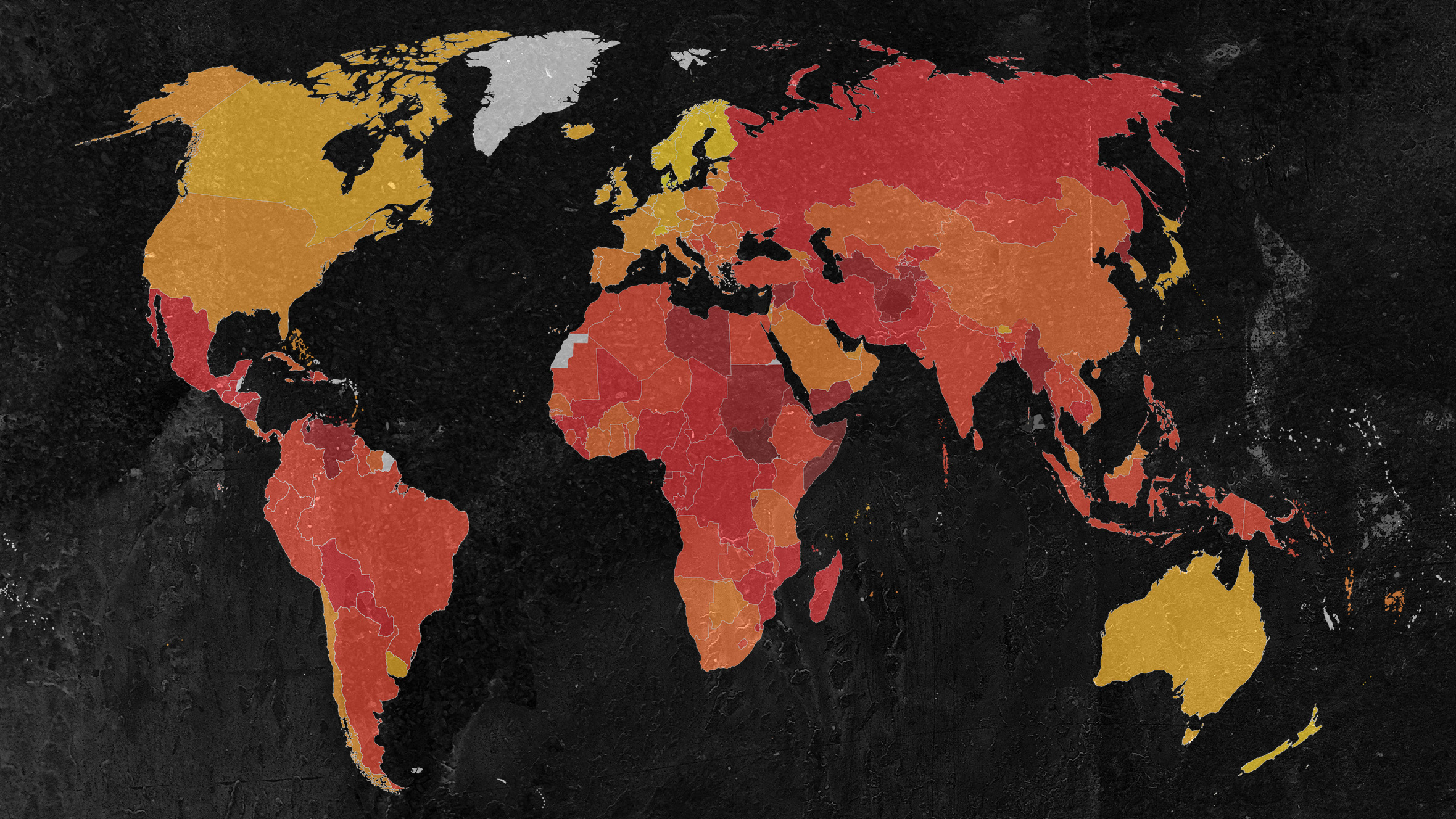
Transparency International has published the Corruption Perceptions Index (CPI) for 2025. This time, Russia scored 22 points out of 100 and took 157th place out of 182. Honduras, Zimbabwe and Chad received the same results. In terms of scores, our country repeated its worst result in the history of Indek, while losing three positions in the overall ranking of states - this is how far Russia has fallen.
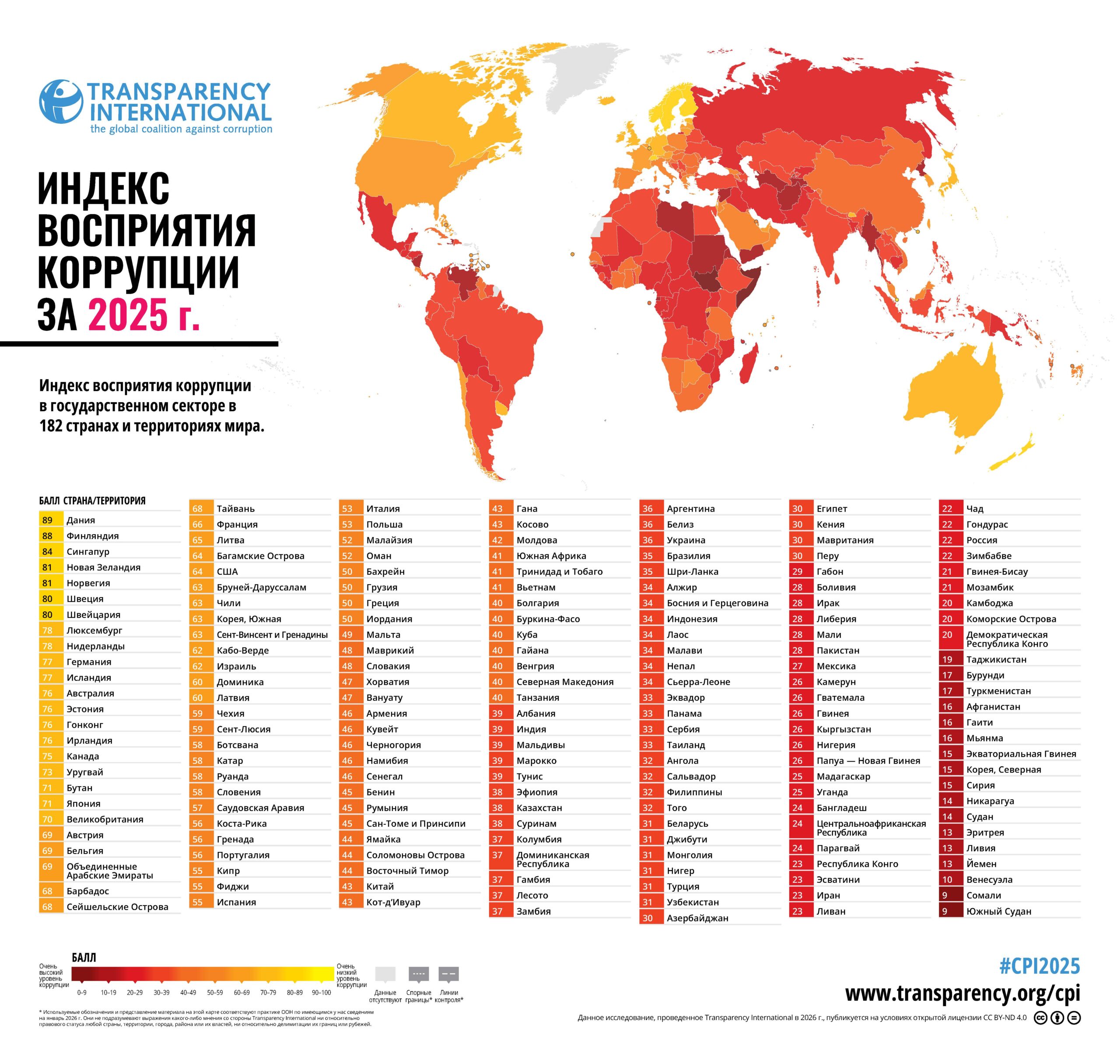
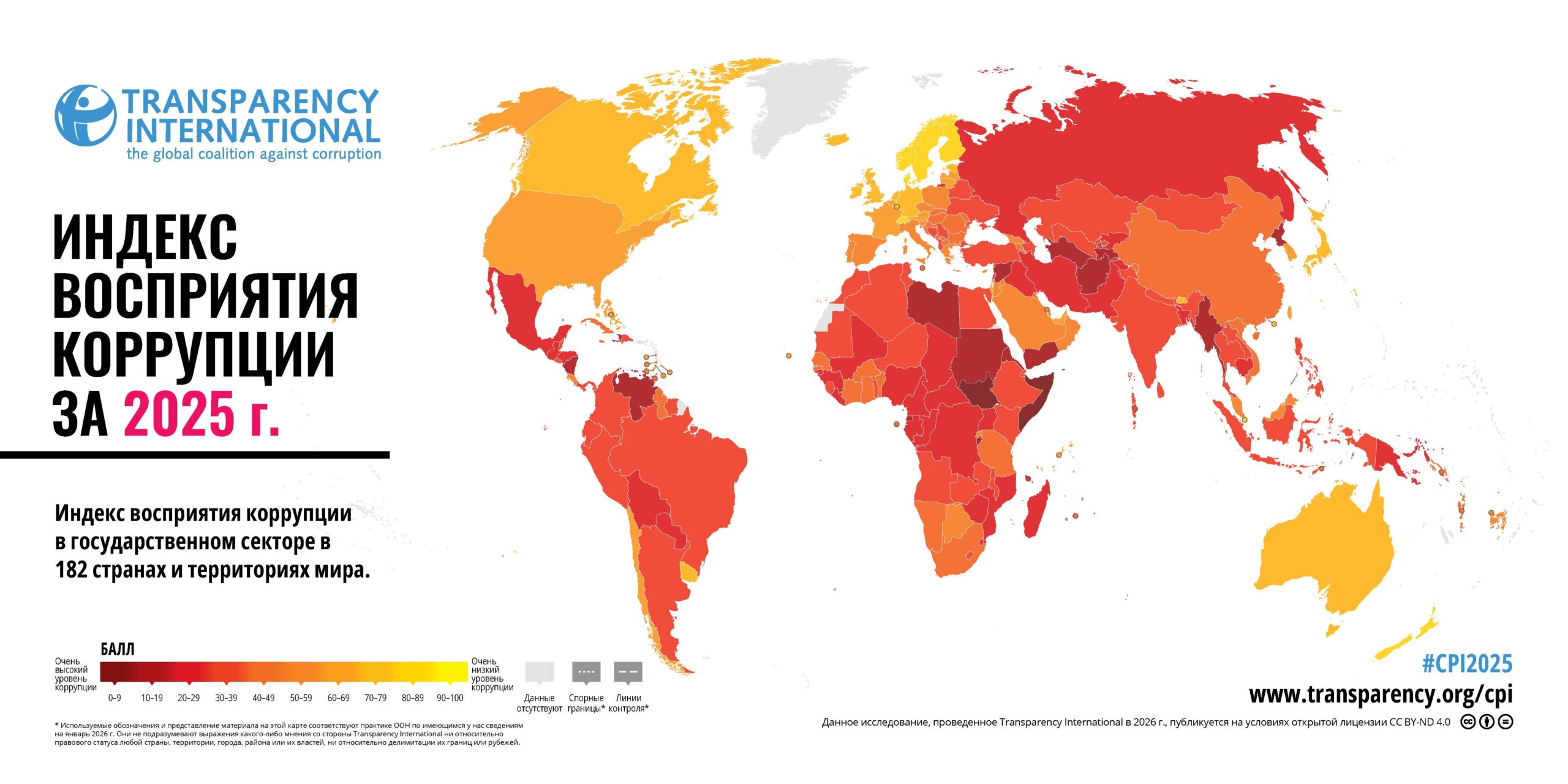
The Corruption Perceptions Index (CPI) is a ranking of 182 countries that reflects perceptions of corruption in the public sector. It is calculated based on data obtained from 13 expert sources, including the World Bank, Freedom House, private consulting firms and rating agencies, think tanks and other organizations. The CPI scores countries from 100—perceived as free of corruption—to 0—perceived as the most corrupt.
In 2024, Russia scored 22 points and took 154th place. Then Azerbaijan took the same number of points, which in 2025 improved its result by 8 points and rose by 24 positions. Even against the backdrop of countries with traditionally high levels of corruption, Russia continues to worsen its position.
Political degradation and destruction of institutions
Russia has recorded a steady degradation of key democratic institutions. The full-scale war against Ukraine that has been going on since 2022, repression of civil society, attacks on independent journalism, refusal of transparency in public procurement and budget management - all this creates conditions under which corruption becomes the norm, not the exception.
“The 2025 Corruption Perceptions Index shows that corruption in Russia remains a persistent problem amid closed government, pressure on independent institutions, and a lack of independent oversight. This means that the public sector continues to work in the interests of a narrow circle of people, rather than in the interests of citizens. What is a corrupt public sector? This is the insecurity of patients in hospitals, rising prices for medicines due to conspiracies, fear of facing police brutality and lack of rights in the courts, deforestation and polluted air. Every year we sum up the results, and for Russia they are again disappointing. We believe it can be different. But for this we need to stop the war and repression against civil society, restore access to socially significant information and support free media. Only decision makers can do this. But we never tire of reminding you of this through investigations and analytics,” comments Alena Vandysheva, director of Transparency International - Russia .
Weakening leadership in the fight against corruption
In many European countries, progress in the fight against corruption has virtually stalled over the past decade. Since 2012, the performance of 13 countries in Western Europe and the European Union has deteriorated significantly, with only seven countries showing measurable improvement.
The United States (64 points) continued its decline, reaching its lowest score on record. While the full extent of the events of 2025 are not yet reflected, actions targeting independent voices and undermining the independence of the judiciary raise serious concerns. Beyond the CPI numbers, the suspension of the Foreign Corrupt Practices Act signaled tolerance for corrupt business practices, and cuts in U.S. aid to civil society organizations weakened global anti-corruption efforts. Political leaders in other countries took this as a sign that the activities of NGOs, journalists and other independent individuals could be further restricted.
A high score in the CPI does not guarantee the complete absence of corruption, since some countries with the highest scores contribute to corruption in other countries by facilitating laundering and cross-border movement of corruption proceeds, which is not taken into account in the CPI. For example, Switzerland (80 points) and Singapore (84 points) are among the leaders, but have been criticized for promoting the legalization of dirty money.
Global dynamics: weak institutions and stagnation
The average global CPI score is 42 out of 100. This is the worst result since 2012. More than two thirds of countries scored less than 50 points. The vast majority of countries fail to control corruption: more than two thirds – 122 out of 180 – score below 50 points.
Leaders of IVK-2024:
- Denmark (89 points) – remains in first place since 2018.
- Finland (88 points) and Singapore (84 points) are in the top 3 “cleanest” countries.
Outsiders of the rating:
- South Sudan (9 points), Somalia (9 points), Venezuela (10 points), Yemen (13 points), Libya (13 points).
“Corruption is not inevitable. Our research and experience of the global anti-corruption movement shows that there is a clear plan to hold power accountable for the common good: from democratic processes and independent oversight to a free and open civil society. At a time when we see a dangerous disregard for international norms on the part of some states, we call on governments and leaders to act with integrity and fulfill their obligations to ensure a better future for people around the world,” said François Valerian, Chairman of Transparency International.
The average for Eastern Europe and Central Asia remained at 34, making our region one of the least transparent in the world.
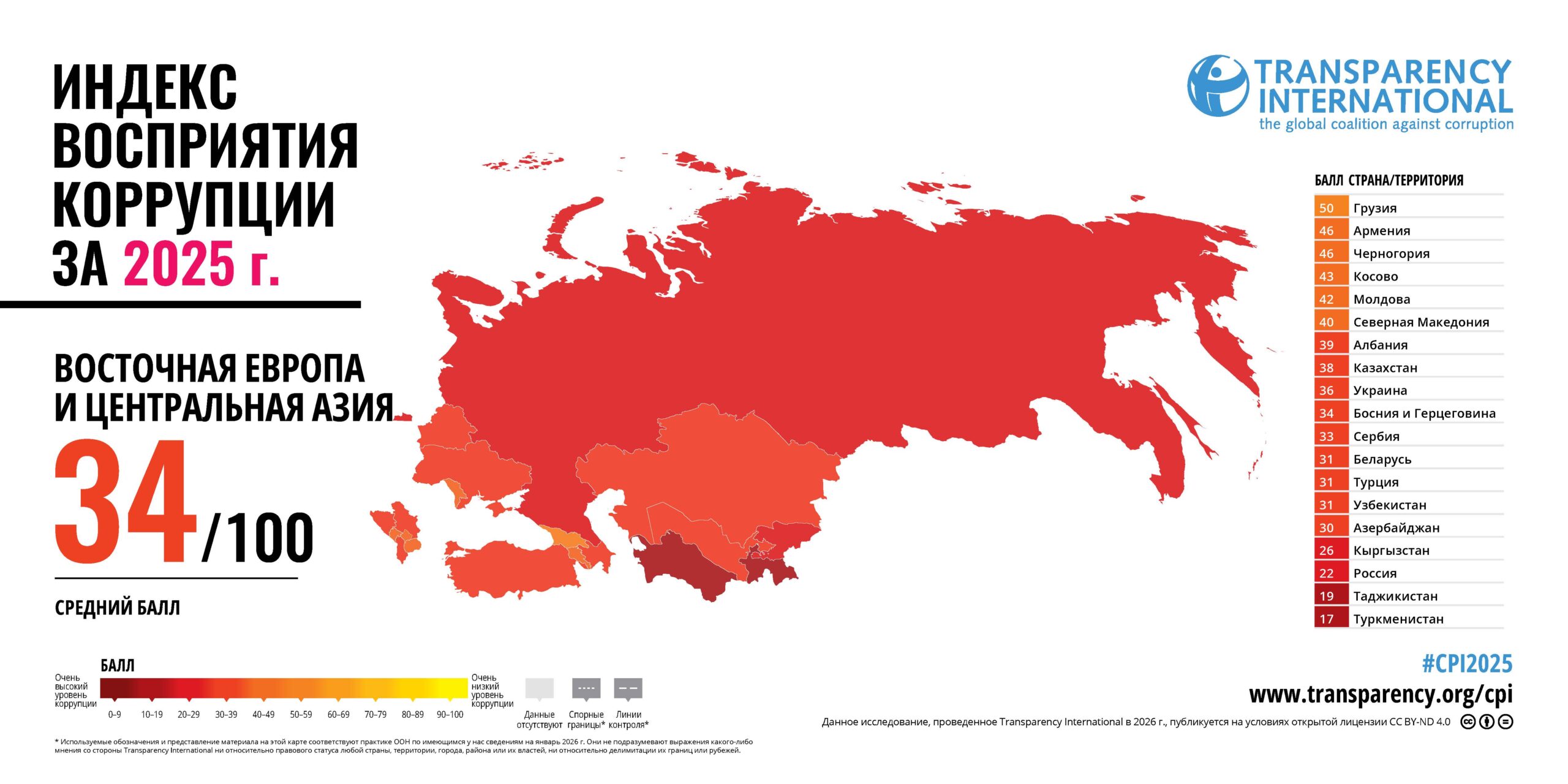
Countries that improved their positions (important: statistically significant improvement - at least 4 points):
- Ukraine (36 points, +1)
- Bosnia and Herzegovina (34 points, +1)
- Azerbaijan (30 points, +8)
- Kyrgyzstan (26 points, +1)
Countries that lost ground (important: statistically significant deterioration - at least 4 points):
- Georgia (50 points, -3)
- Armenia (46 points, -1)
- Moldova (42 points, -1)
- Kazakhstan (38 points, -2)
- Serbia (33 points, -2)
- Türkiye (31 points, -3)
- Belarus (31 points, -2)
- Uzbekistan (31 points, -1)
Countries whose positions remained unchanged:
- Tajikistan (19 points)
- Turkmenistan (17 points)
Recommendations
Despite numerous corruption scandals in Russia and cases against high-ranking officials, there is no talk of significant progress in anti-corruption policy. The practice of concealing data on government procurement, income and assets of officials, which appeared in 2018, by the beginning of 2026 had finally become established as a state norm.
Since internal control mechanisms in Russia are paralyzed, the main recommendations of Transparency International - Russia are now addressed to European and international regulators, whose contribution to the fight against cross-border corruption is decisive:
- We call for the introduction of more careful controls over cryptocurrency hubs associated with Russian financial flows. It is necessary to introduce automatic data exchange between exchanges to block money laundering schemes.
- In the context of the closedness of Russian databases (USRN and Unified State Register of Legal Entities), EU institutions must ensure full transparency of their registers of beneficiaries in order to exclude the possibility of concealing corrupt assets of politically exposed persons from Russia in Western jurisdictions.
- The practice of applying universal jurisdiction and mechanisms for confiscation of assets obtained as a result of illicit enrichment (in accordance with Article 20 of the UN Convention) should be expanded if their legalization occurs outside the Russian Federation.
- It is critical to strengthen direct support for independent anti-corruption centers and investigative media working under the pressure of repressive legislation on foreign agents, extremists and undesirable organizations. Without external protection, the voices of those who expose corruption risk being completely suppressed. When national institutions of accountability are deliberately undermined, the responsibility for curbing corruption falls on the shoulders of the international community—not only out of solidarity, but also in its own self-interest. Corruption is increasingly cross-border: illicit financial flows, money laundering and sanctions evasion directly affect other countries and their economic and political security.
Transparency International Russia calls on the international community to support independent NGOs and media that resist corruption, expose government crimes and continue to inform society despite repression and censorship.
For additional information, as well as questions about organizing interviews and comments, you can contact the organization’s PR specialist Ivan Korzh by mail: [email protected]