
Translated material
Hello, weapons? New arms race
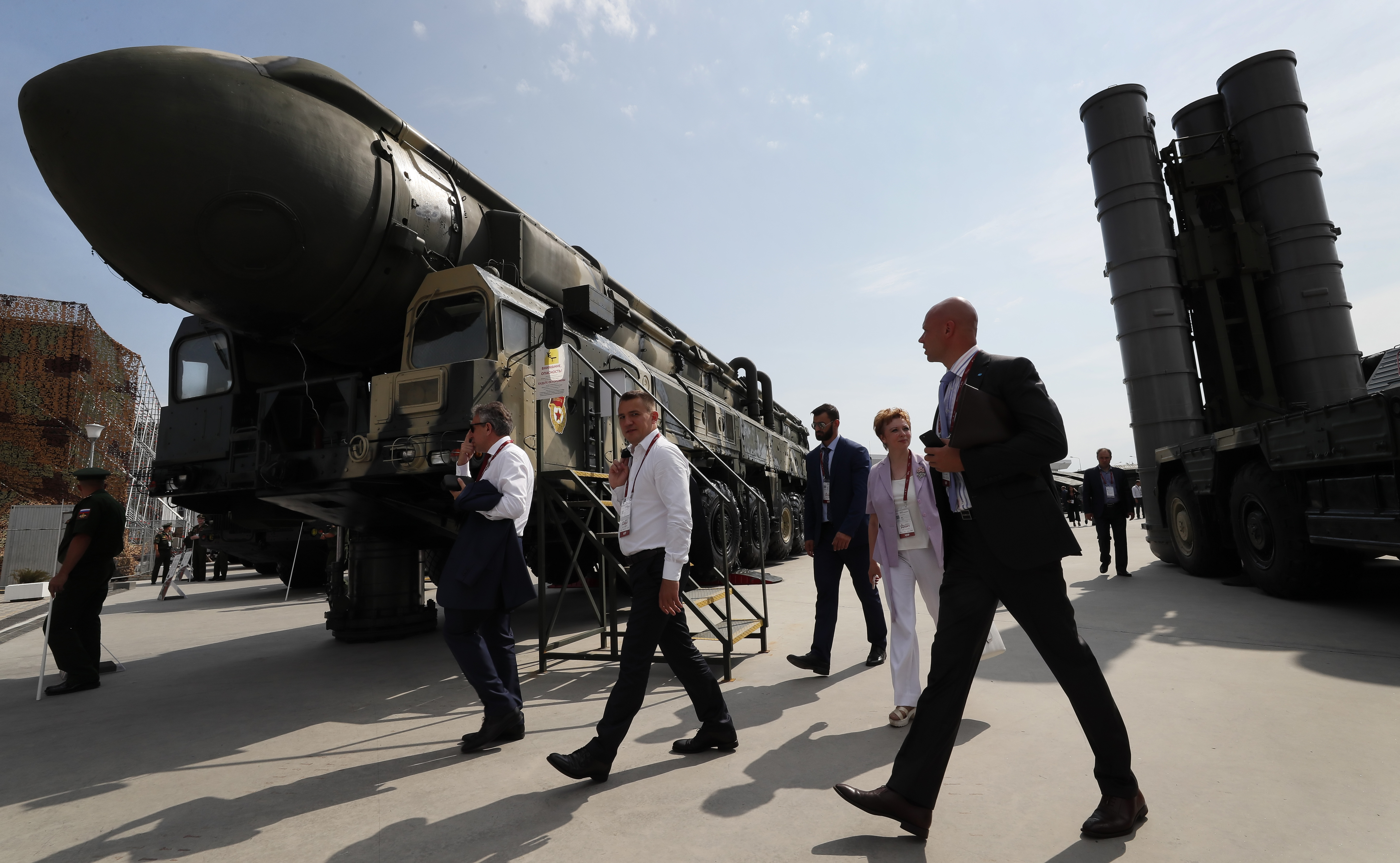
A new arms race has unfolded in the world. Europe, China, and the countries of the Global South are arming themselves. The arms control and missile defense regimes collapsed. There is a drone revolution taking place on the battlefield, an artificial intelligence revolution. Will Russia be able to compete in the new arms race? How will this affect the outcome of the war in Ukraine? The program includes Pavel Baev , professor at the Oslo Peace Research Institute, Air Force military observer Pavel Aksyonov , military expert Yuri Fedorov , and Ukrainian military expert Ivan Stupak.
Sergei Medvedev: On February 5, the extended term of the START-3 treaty, these are strategic and offensive weapons, ended. Are there no restrictions on nuclear weapons now? Is it time to dig a nuclear bunker?
Pavel Baev: Because the treaty has expired, it is not necessary to dig a nuclear bunker. The risks of nuclear war have not increased much, if at all, since last week. By and large, the agreement has outlived its usefulness. He recorded the realities of another era, initially the era of the reset between Russia and the United States, then during the extension, an era when the United States and Europe expected that Russian behavior would be predictable and stable. This era is over. And the agreement remained, in general, a symbol of the past.
the agreement has become obsolete
He did not impose any real meaning, any real restrictions on anyone. The modernization of Russia's nuclear arsenal has been going on and will continue to do so. It started quite a long time ago. The agreement limited it to a very small extent. Huge amounts of money were invested in the modernization of the nuclear arsenal, against the backdrop of the fact that the pause in this modernization continued in the United States, and is now ongoing. They decided that there was no point in investing money now. Systems that work reliably enough will last for some time. Russia was the initiator and pioneer of this race, and continues to be.
Sergei Medvedev : Is it possible to assess who is now ahead in the race, or is there some kind of parity? What does the new Russian modernization mean? We can hear threats from Putin about Burevestnik and Sarmat. But as I understand it, all tests so far have ended in failure?
Pavel Baev: No, not all. The main, most advanced direction of modernization was the construction of a new generation of strategic submarines, the Borei class. This program is ongoing, and at first there were also some hiccups and disruptions, especially with regard to the Bulava missile. But now the program is moving according to plan, it is insanely expensive, this is the most expensive moment in the entire weapons program.
the program continues
And even though the war in Ukraine dictates other priorities, it was clear that the money needed to be directed to something else, this program continues. And the boats are being built and introduced into the fleet. It can be noted that the last boat was put into operation last year, the Prince Pozharsky, without testing the Bulava missile, which is somewhat strange. But overall the program is progressing.
Sergei Medvedev: If you look at the entire nuclear triad: submarines, strategic bombers and launch vehicles. Firstly, bombers. As I understand it, Russia relies on outdated aircraft, which cannot compete with American stealth technology. How modern are Russian delivery vehicles? Will the rockets take off? Do we know that the missiles will not explode, as happened with the Sarmat in the silos?
Pavel Baev : Well, “Sarmat” is a test. And this is a serious failure in the nuclear modernization program. Those rockets that went into production and continue to be produced are the Topol-M family and its modernization, the Yars rocket , they continue to be produced, tested every year, and take off stably. But with the Sarmat, of course, there is a serious mistake, because this missile is heavy, it was necessary to replace the previous generation of heavy missiles built in Ukraine. But, nevertheless, the situation with this part of the strategic triad is not emergency. And as far as strategic aviation, long-range aviation is concerned, of course, there is a problem.
Against the backdrop of Chinese successes, everything is quite sad
Not only because Tu-95 aircraft are seriously outdated, they are not even jets. And the fact that it turned out to be technically impossible to launch the newer Tu-160 bomber into production. And the new generation project, called PAK DA , does not even have a working name yet; it has been postponed for an indefinite future. Against the backdrop of Chinese successes in this area, everything is quite sad. So the strategic triad may soon turn out to be not a triad, but a dyad. But this does not mean that critical capabilities will be lost, because even on two legs it can be more than enough to deter potential opponents.
Sergei Medvedev : Does Russia now have the same guaranteed potential for destroying the enemy as it had at the peak of the Cold War? Relatively speaking, Russia can legitimately threaten to destroy the world. Can we say that this is not a bluff?
Pavel Baev: There are fewer warheads, but there are enough of them to cause irreparable damage to our fragile planet, the destruction of not only individual cities, but the overall destruction of life on Earth. Fifteen hundred warheads are enough for this. How does this potential compare with the American and Chinese? Is there a need for quantitative parity, which is considered absolutely necessary in Russian doctrine? Or can we move on to the criteria of reasonable sufficiency? During Gorbachev’s time, we were still calculating this at the Institute of Europe.
How does this potential compare with the American and Chinese?
Russia is actively testing weapons systems that are not covered by any agreements and have no strategic meaning, such as the Burevestnik nuclear-powered cruise missile, the Poseidon nuclear torpedo, and even the Oreshnik missile, which was tested twice against Ukraine. It was clear that equipping it with non-nuclear warheads made no sense; it did not cause much damage. As with any intercontinental missile, nuclear warheads make sense. And this missile is a consequence of the fact that the Intermediate-Range Nuclear Forces Treaty, which Trump tore up during his first administration, has lost force. This treaty was much more important for European security than the one that expired last week.
Sergei Medvedev: Will Russia conduct nuclear tests? How ready is Russia for them?
Pavel Baev: I think that Russia’s readiness is much higher than the readiness of the United States. The test site on Novaya Zemlya is not like the test site in Nevada, no one will protest. It is difficult to say how much engineering work went in this direction; apparently, tests of the Burevestnik, a nuclear-powered missile, were carried out there, and mainly on the ground.
Russia's readiness is much higher than that of the United States
Testing nuclear weapons requires tunnels, deep and expensive. Unless, of course, you test it the way they tested the Tsar Bomba , exploding it in the air over Novaya Zemlya. I think that such excesses are hardly in the plans now.
Sergei Medvedev: Russia, despite all the restrictions and sanctions, is still capable of developing new nuclear weapons and threatening the United States, the whole world, and Europe? Has Russia retained its destructive potential?
Pavel Baev: The potential has not only been preserved, it has been modernized, and large resources have been invested in it. In a changing world, Russia will have to increasingly rely on its nuclear potential, because Russia is running out of other components of state power, including economics, technology, and demography.
Sergei Medvedev : What is happening in the missile defense system? To what extent can the West and the United States protect themselves from a possible Russian nuclear strike?
Pavel Baev: They can’t. No Golden Dome, this is President Trump’s dream for now. The missile defense system, which was deployed long ago and is being modernized around Moscow, also does not provide any guarantee. New Russian developments such as the S-500, from what we see in Ukraine, where the chain of these missiles is, are performing very averagely. Neither Russia, nor the United States, nor Europe have any protection against a nuclear attack, and cannot have it today.
Sergei Medvedev: Is it possible to raise the question of the emergence of new nuclear powers if Europe begins nuclear rearmament? To what extent can we talk about the renuclearization of Ukraine?
Pavel Baev: I don’t think that for Ukraine this issue can be on a practical level. The country has too many other concerns and no free funds.
They clearly don't do this
In three months there will be a conference related to the non-proliferation treaty, where the problem will be stated bluntly: countries that own nuclear weapons, the nuclear five, do not fulfill their obligations under the treaty. And it is written there that they will move towards the reduction and complete destruction of nuclear weapons. They clearly don't do this. To what extent can this violation of the treaty be exploited by other countries? I think that South Korea will raise this issue seriously. After that, most likely, Japan. These countries have the technology and means to quickly create nuclear weapons.
Sergei Medvedev: India, Pakistan. We have just seen a war between two nuclear powers that is far from over.
Pavel Baev: The history of these clashes suggests that both countries strive to leave their nuclear potentials as a last reserve, that they are not ready to play nuclear games in a situation of armed conflict. In this sense, they are much more restrained than Putin, who constantly puts forward various threats and demonstrations during the conflict with Ukraine, where all sorts of nuclear cards are played.
Sergei Medvedev: How realistic is the European 5 percent of the defense budget? To what extent will Europe be able to rearm and present itself as a serious military force in the next 5-7 years?
Yuriy Fedorov: It must be borne in mind that of this 5 percent, approximately 1.5 percent is expected to be allocated for the construction of military infrastructure, or infrastructure that can be used for military purposes. For example, highways that can not deteriorate after heavy trailers with tanks and other equipment drive along them. Strengthening bridges. Everything that is of fundamental importance. In order to transfer a significant number of troops to a zone of potential or actual conflict, this is primarily the Baltic region, it is necessary to transfer troops and equipment along a fairly dense, but very different quality network of roads.
Everything that matters
Therefore, probably 3-3.5 percent will be spent on weapons as such. It's still a lot. But look at 3.5% of the European Union's gross domestic product. The EU plus the UK - in 2024 their combined GDP was almost $23 trillion. In the same year, Russia's GDP was approximately 2.5 trillion. 9 times more GDP, economic volume and other economic indicators, more than Russia.
Sergei Medvedev: But the numbers are not automatically converted into combat effectiveness. Russia has the political will to fight, to break the unity of Europe, to blackmail. Will European interest be able to be converted into reliable defense?
Yuriy Fedorov: Firstly, everything is changing. European elites have not fully, but to a large extent, already realized the threat that Russia poses. Accordingly, there is a need to make serious political decisions that will allow this threat to be compensated or neutralized. This means that Europe must militarize and arm itself. Undoubtedly, this is difficult not only from a technical, but also from a political point of view. If resources are transferred to the military-economic area, less money is spent on social programs.
In addition to NATO, another structure may emerge in Europe
This is difficult for political forces whose prospects are connected with the expansion of the social sphere, the sphere of social insurance. This is a serious political problem. Now, at least in theory, an understanding is emerging that, in addition to NATO, another military-political structure can emerge in Europe, based on what is now called a “coalition of the willing.” These are Germany, Poland, the Baltic countries, Scandinavia, apparently Great Britain, it’s hard to say about France. This is an embryonic structure, but it is taking shape, action plans are being developed within the framework of this coalition of the willing. And this can be very important. NATO is a powerful organization in a military sense, meaning planning, logistics and so on, but it is unwieldy in a political sense. The interests of European states are completely different.
Sergei Medvedev: How competitive can Russia be in the new arms race?
Yuriy Fedorov: If we look at it in 5-7 years, what is the modern arms race? This is not only and not so much a quantitative increase in tanks, guns, and so on. This is a qualitative arms race. This is the creation of new types of weapons and the use of the latest achievements of scientific and technological progress.
Results depend on how much money is invested
The situation here in Russia, in my opinion, is extremely sad. A high-quality arms race and its prospects ultimately depend on the scale of investment and the effectiveness of the scientific complex. That is, on the effectiveness of what in Russia is called R&D , research and development. In the West it is called R&D, Research and Development. The results of research work depend on how much money is invested. The EU invests approximately 2.2% of its domestic product. In Russia, 1% is invested, sometimes a little more, sometimes less. But differences in scale and in GDP volumes suggest the following. Europeans invest approximately $500 billion in R&D, both through the state and private businesses, universities, and so on. Russia invests 1%, which is 25 billion dollars. The difference is 20 times.
Sergei Medvedev: Now on the battlefield in Ukraine you cannot bring European percentages of GDP to Ukraine. I’m trying to understand how competitive the Russian arsenal is in its current state. Entering the war in Ukraine, Russia had a huge advantage in tanks, but how adequate is heavy equipment now? Tanks, artillery?
Yuriy Fedorov: Absolutely adequate. If you look at the scenarios of possible wars in the Baltic region, it is impossible to do without heavy armored vehicles and heavy weapons, ground forces. If we talk about modern war scenarios, then I would say this: the one who strikes the first blow will win, if we talk about a big war. About one in which the Russian side can use approximately half of the troops that are deployed in Ukraine, from 300 to 350 thousand. The personnel of the coalition that can resist this army is probably one and a half times smaller. With weapons, the ratio is approximately the same.
the one who strikes first wins
But no one has canceled the basic characteristic of modern warfare, namely, the effectiveness of delivering the first air missile strike against the enemy, and not only against the forces that are directly involved in hostilities, but also against the so-called second echelon. During the Cold War, this was one of the key points of NATO strategy, the so-called follow-on force attack, a strike on the second strategic echelon. If the Western coalition is able to launch the first massive air missile strike against the second echelon of the invading forces, then the invasion is doomed to failure.
Sergei Medvedev: Can you theoretically imagine a Russian military strike on Europe? What if there is, say, a Russian invasion against Europe, against the Baltic countries, against Poland?
Yuriy Fedorov: Let’s return to the fact that since about the middle of the last decade, war games have been played out in the West, both closed and open, which are dedicated to developing scenarios for this conflict. Yes, it is considered possible, it is always better to assume the worst case scenario. It is still possible, and if it is neglected, then the party that may be attacked is unprepared. The same thing that happened to Ukraine in February 2022, it was unprepared. This means that everything depends on how prepared the political leadership of European states is psychologically and politically.