
Translated material
“Your memory cannot be killed”
Two years after Navalny's murder. In Russia, mourning rallies are held despite the arrests. Yulia Navalnaya intends to achieve justice
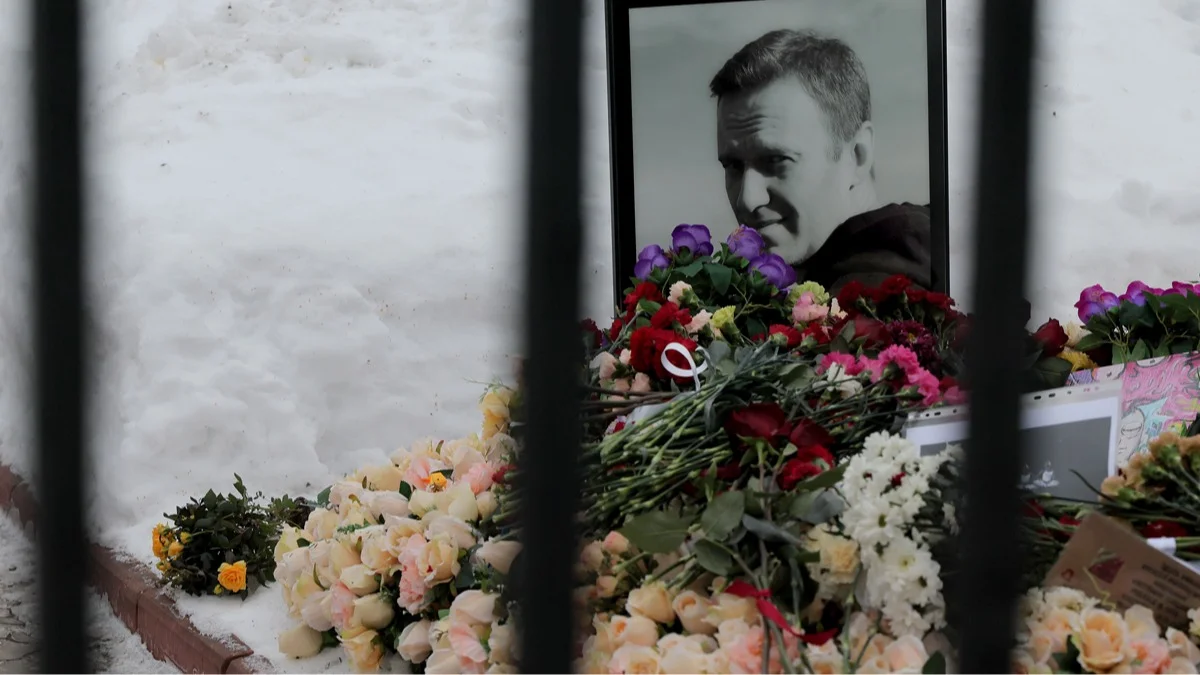
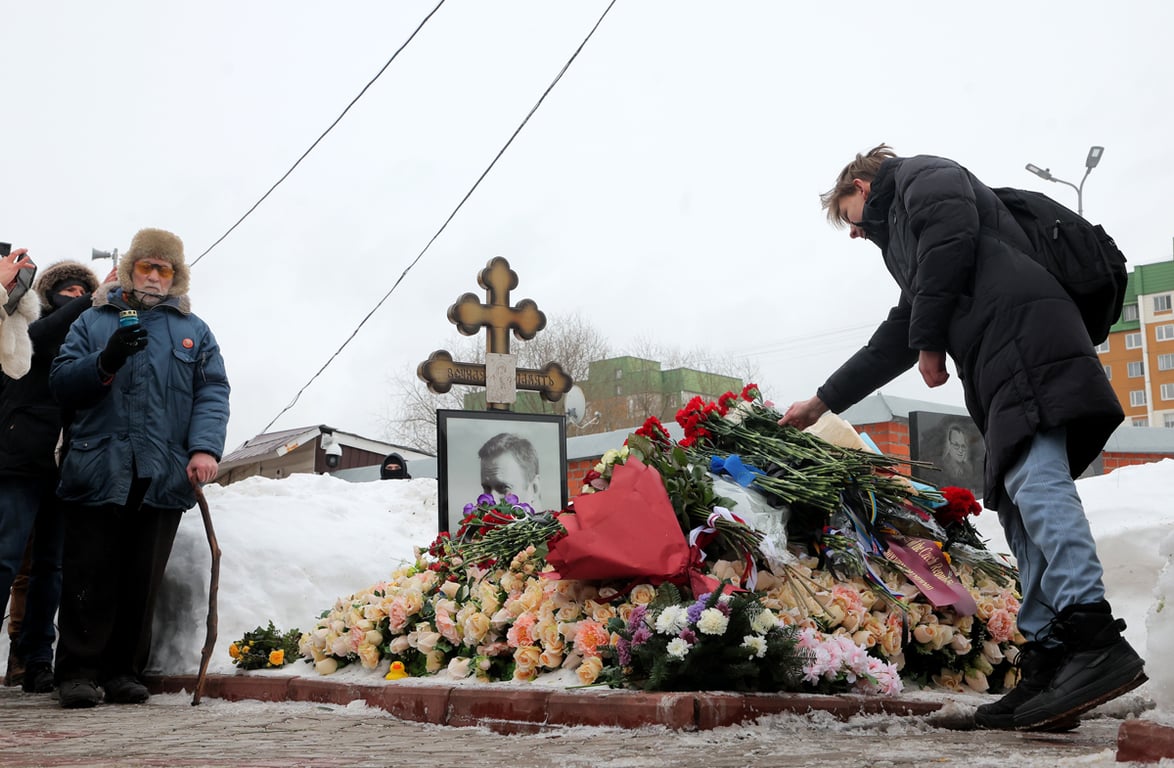
The grave of Alexei Navalny at the Borisov Cemetery, Moscow, February 16, 2026. Photo: Maxim Shipenkov / EPA
Two years ago, Alexei Navalny was killed in a colony beyond the Arctic Circle. The Russian authorities are still afraid of the politician and forbid even remembering him, Memorial noted. Despite the risks, on February 16, Russians in Moscow, St. Petersburg and other cities came out to commemorate events and laid flowers at memorials to victims of political repression. Protests took place in many other countries. “We have achieved the truth, we will also achieve justice one day,” Yulia Navalnaya wrote today. Companions of the murdered politician emphasize: Navalny has become the personification of strength, goodness and courage, and it is precisely such people who are missing today. How Navalny is remembered in Russia and the world today - in the material of “New Europe”.
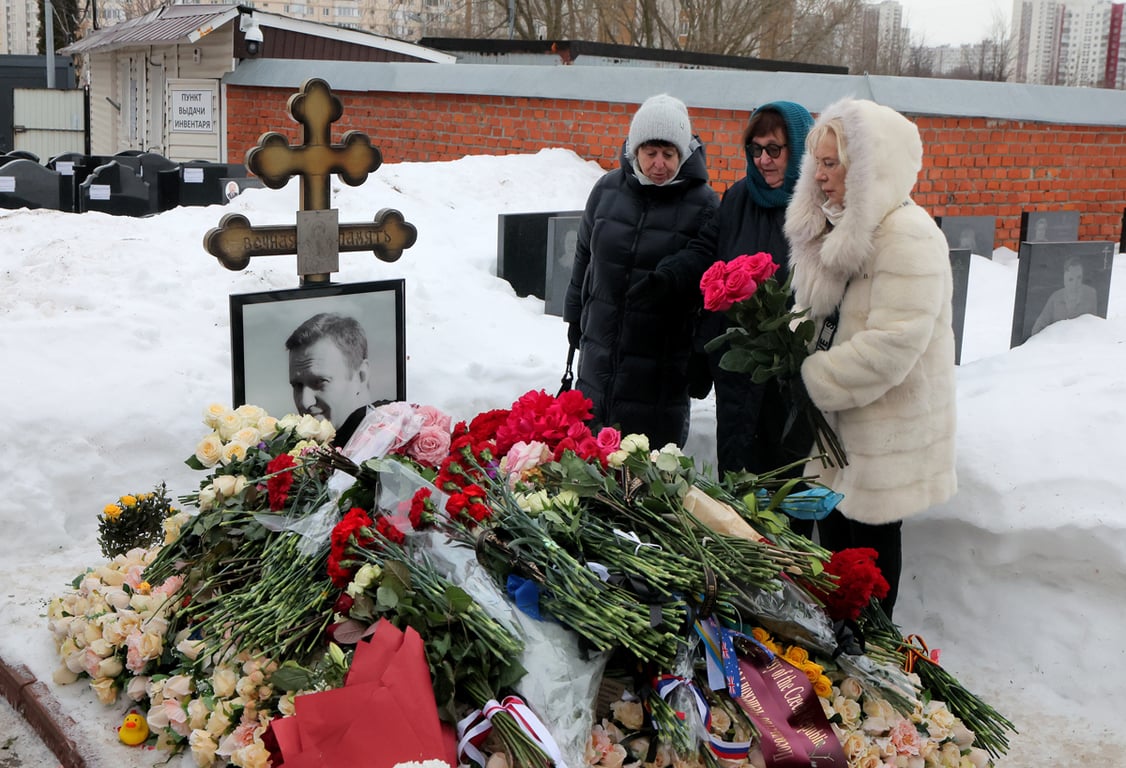
Borisov Cemetery is still the main place of mourning events
On the second anniversary of the death of politician Alexei Navalny, dozens of people gathered at the Borisovsky cemetery in Moscow even before its opening. The memory of the politician was honored by representatives of several European diplomatic missions: Germany, Italy, Spain, Poland and Latvia.
The politician's mother Lyudmila Navalnaya, as well as Yulia Navalnaya's mother Alla Abrosimova, laid flowers on the grave. “The whole world knows our customers. And we want to know everyone who took part in this,” said Lyudmila.
According to a SOTAvision correspondent,
Near the cemetery there were several Russian Guard cars with the letter “Z” on the hood, and employees of the “E” center were also on duty in masks.
People leave flowers at Navalny's grave. In addition, many remember what the politician said and leave various messages, for example, asking for forgiveness and saying that his memory lives on. So, someone brought a photo with a quote from Navalny: “I am not going to give them my country and I believe that the darkness will disappear. But as long as it persists, I will do what I can, try to do the right thing and encourage everyone not to give in to despondency.”
In Moscow, flowers and a note appeared near the house where the politician lived. As Sirena reports , handwritten on a piece of paper: “A. Navalny lived here. Born: 06/04/1976. Died in a special regime colony: 02/16/2024.”
Protests in Russia take place even under the threat of reprisals
Memorial events are also held in other Russian cities. Mostly people come to monuments to victims of political repression. So, in Vladivostok, in the Faith and Nadezhda Square, a local resident laid red carnations and two candles at the monument. In Novosibirsk, flowers were brought to the monument by ex-city council deputy Anton Kartavin, who was declared a “foreign agent.” In Barnaul, people also leave flowers.
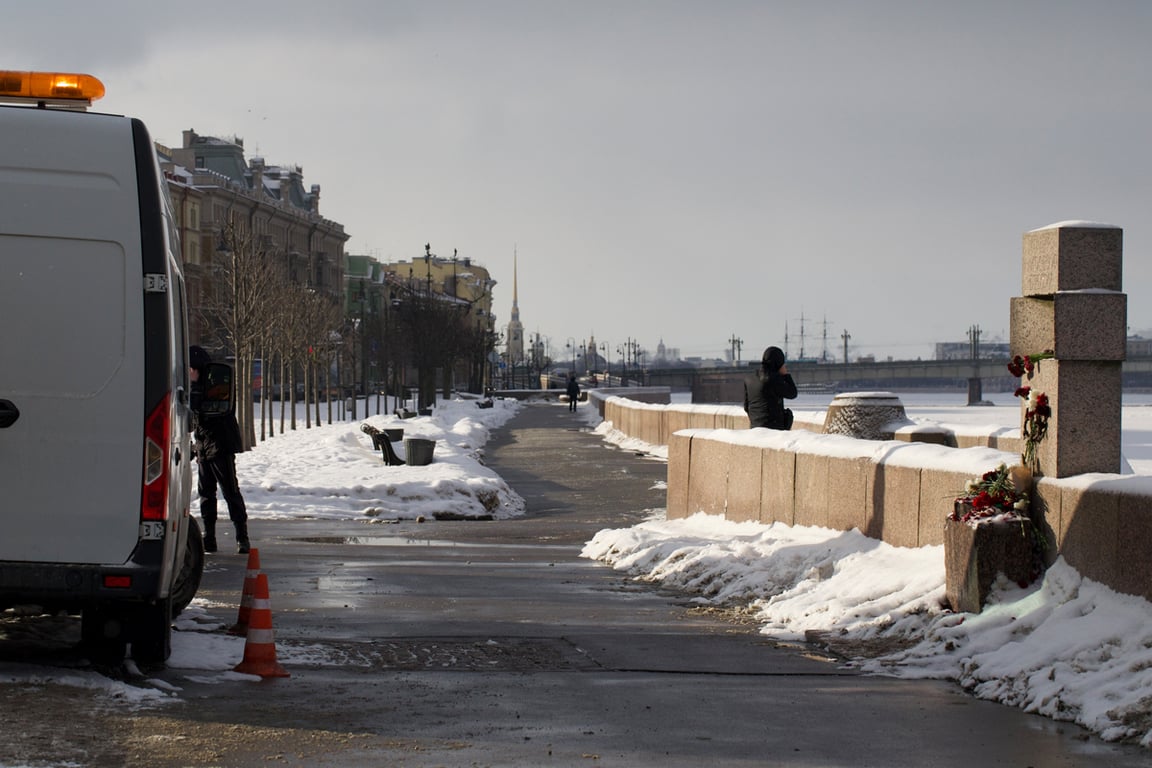
In St. Petersburg, flowers were laid at the Solovetsky Stone; as an eyewitness told Bamaga, the security forces “are standing behind the trees, watching.” At the same time, the memorial to the victims of political repression on Voskresenskaya embankment was surrounded by a mesh fence and a crane was placed nearby. “The monument is blocked with a fence, supposedly work is underway. In fact, everyone already understands why this was done. Three police officers are standing nearby, just in case, in case someone wants to lay flowers,” an eyewitness told RusNews. The man who took a photograph of the fenced memorial was detained by security forces. As eyewitnesses told Novaya-Europa, at 15:00 the fence on the embankment was no longer there.
There were also arrests in Volgograd: there, security forces took to the police department a local resident who had come to the monument to the victims of political repression.
In Ufa, near the memorial in the park of the 50th anniversary of the Victory, security forces have been on duty since the very morning, a New Europe correspondent reports from the scene. The area is patrolled by cars and people in uniform and civilian clothes. Entry into the park is prohibited for everyone - exceptions are made only for special equipment and law enforcement vehicles without identification marks.
There are no flowers at the monument itself or nearby, but most likely they are thrown away, as has happened before. The only untouched flowers stand in the snow at the entrance to the park - they were left by a 12-year-old boy.
Passers-by, who watched him adjust the carnations several times, thanked him and waved their hands in greeting, the Novaya-Europa correspondent reports.
And in Gorno-Altaisk a note appeared at the memorial. The message, according to RusNews, says: “Alexey, we remember you! Now your name is forever. You were a leader, but you became a banner! Now in our hearts you are the same Petrel from Gorky’s poem! And the memory of you cannot be killed! PS: There is no more courageous and patient person than you!”
At mourning rallies around the world, people are reminded to “don’t give up”
Around the world, memorial events, as announced by Navalny's team, were planned in more than 80 cities outside of Russia. Thus, a memorial evening with the participation of Yulia Navalnaya will be held in Paris today; in Prague, as part of the mourning event, a concert by the Stoptime group will be held with the participation of singer Naoko.
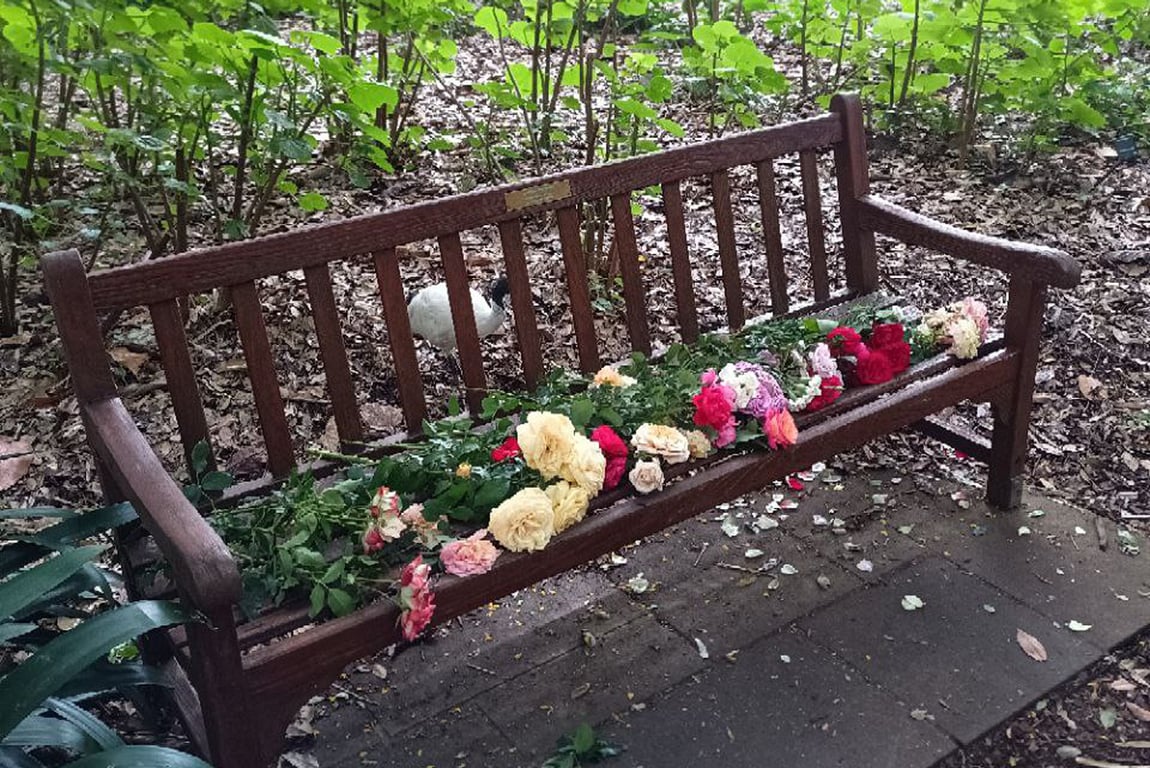
The geography of actions in memory of Navalny is traditionally wide. So, in San Diego (United States) people held a large poster with a photo of a politician and the words “Don’t give up!”, In Miami (USA) - banners with the inscriptions “Heroes do not die”, “Don’t forget, don’t be silent.” Readers of “New-Europe” sent photos from an event in Sydney (Australia): city residents gathered in the Royal Botanic Garden at a park bench dedicated to Alexey.
In Tbilisi, the police did not allow a rally in memory of the politician near the Pushkin monument. The organizers moved the event to another location. “New-Europe” spoke in more detail about promotions around the world in a separate article.
Companions and politicians write about Navalny's legacy
Yulia Navalnaya, who is not in Russia due to the criminal case brought against her and her status as an “extremist,” published a photo of Navalny on social networks, accompanying the post with the words: “Two years. We have achieved the truth and one day we will also achieve justice.”
Leonid Volkov, one of Navalny's associates, said in a memorial post that, in his opinion, Navalny was the complete opposite of Putin: lively, brave, curious and cheerful. That is why, according to Volkov, Putin was so jealous of Alexei and hated him. “By killing Alexei, Putin wanted to kill hope. Kill the idea. Kill faith. Looking back at these two years, I must honestly say: in some ways this plan worked.
Here and there someone gives up. Nerves are gone. Faith ends. This is fine. This is human. Let's help each other stay hopeful and move forward."
- he wrote.
Volkov expressed confidence that sooner or later other times will come and new opportunities will appear. The main monument to Navalny, according to Volkov, is the future free, peaceful, democratic and prosperous Russia, which Alexey dreamed of and for which he gave his life.
On the anniversary of Navalny’s death, Ilya Yashin called the incident “the vile murder of a friend.” Putin, according to him, always acts vilely, his weapons are lies and manipulations: he denied the presence of his soldiers, the bombing of civilians, and denied the very fact of Navalny’s poisoning. Navalny, on the contrary, always acted openly, Yashin emphasized: he directly called a spade a spade, was not afraid of riot police, elections, debates, or even death.
“And another difference is that Putin is an evil and weak person. Navalny has become the personification of calm strength, goodness and courage. These are the kind of people that Russian politics lacks today: strong, kind and brave. I really hope that we have enough strength and will to be worthy of the memory of Alexei. And I really miss my friend,” Yashin wrote.
On this day, French President Emmanuel Macron remembered the Russian politician killed in a colony: “Two years ago the world learned of the death of Alexei Navalny, whose memory I honor. Then I said my conviction that his death is obvious evidence of the Kremlin’s weakness and its fear of any opponent. Today it is clear that it was deliberate. The truth always triumphs in the end, waiting for justice to prevail,” he wrote in X in Russian and English.
Russian authorities and propagandists deny accusations of Navalny's poisoning - now supported by evidence
On February 14, the foreign ministers of Germany, France, the Netherlands, Sweden and Great Britain published a joint statement on the murder of Navalny, saying that the politician was killed in a colony using the poisonous substance epibatidine. This poison is extracted from the skin of the South American dart frog. The statement was made after laboratories in these countries analyzed samples of biomaterials exported from Russia.
Putin's press secretary Dmitry Peskov today called the accusations of Navalny's poisoning "biased and not based on anything." Russian Foreign Ministry spokeswoman Maria Zakharova claims that the news about the poisoning was published allegedly with the aim of distracting from discussions of the Jeffrey Epstein case. In her opinion, the statement of European countries is a “stuffing of information.”
“Doctor” Alexander Sosnovsky, a permanent expert of Vladimir Solovyov’s propaganda program on the state channel “Russia 1”, tried to refute the statement about Navalny’s poisoning, the Agency noted . He said the synthesized epibatidine "cannot be used as a military weapon."
Platform at PACE: “Navalny gave his life for a free Russia”
Russian democratic forces under PACE issued a statement on the second anniversary of Navalny's death.
“The statement [of European foreign ministers] confirms what we knew and talked about from the very beginning: responsibility for the death of Alexei Navalny lies with the regime of Vladimir Putin,” emphasized the participants in the platform of Russian democratic forces at PACE.
They divided their further statement into three points. The first of them emphasizes that Navalny’s murder is not an isolated incident, but part of a long-term policy of terror, including poisonings, assassinations and murders of oppositionists and journalists. Since Navalny was in full power of the state, in the Polar Wolf penal colony, Putin personally bears responsibility for his death, the authors of the statement added.
The second paragraph notes that the Kremlin systematically violates the Chemical Weapons Convention by using poisons against opponents, and the international community is obliged to give a legal assessment of this.
In the third point, the platform members call on the PACE delegations to support the statement of the European ministers and seek the creation of an international tribunal. He must investigate the crimes of the regime, the statement said, from the murder of Navalny to war crimes in Ukraine and on Russian territory.
“Alexey Navalny gave his life for a free Russia. He returned to the country knowing that prison or death awaited him, because he believed that Russia could be different. We must ensure that his death was not in vain. The memory of Navalny is not only grief. It's a commitment. An obligation to the peoples of modern Russia, to its citizens and to everyone who believes in justice,” summed up the Russian democratic forces at PACE.
15 countries of the world speak about the need to release political prisoners
15 countries of the world - Australia, Great Britain, Germany, the Czech Republic, Denmark, Canada, Latvia, Lithuania, the Netherlands, Norway, Sweden, New Zealand, Poland, Finland and Estonia - issued a joint statement on the second anniversary of Navalny's death. The text was published on the website of the German Foreign Ministry.
The signatory countries expressed condolences to Navalny's family, placed sole responsibility for the death of the politician on the Russian authorities and demanded a transparent investigation.
“The legacy of Alexei Navalny lives on, and we continue to support the courageous Russian human rights defenders and representatives of independent civil society who do not stop working even in the face of growing personal risks,”
- the statement says.
The authors refer to data from the OVD-Info project about more than 1,700 political prisoners, including Ukrainians: they are tortured and deprived of medical care. “In Ukraine, the Russian state is increasing violence and aggression against the Ukrainian population. At the same time, internal repression in Russia allows it to carry out external aggression. Our position is unshakable: the Russian authorities must fully comply with all their international obligations and release all political prisoners,” the countries emphasize.