
Translated material
The wind of change in a wild field. Dmitry Bykov* - about why there is no alternative to Navalny
Two years after the death of Alexei Navalny in the Polar Wolf colony, the Russian opposition still has no consensus leader. Writer Dmitry Bykov, in his column dedicated to the anniversary of the death of Russian opposition leader No. 1, explains why Alexei Navalny was Vladimir Putin’s only chance for a civilized exit and why any ruler of Russia who follows Putin—whoever he is—is obviously doomed.
I recently conducted a poll among readers on Facebook**: does anyone admit that the next head of Russia, no matter what the position is called after Putin, will sit in the chair? According to my feelings, no matter what he does - tighten the already screwed nuts, carry out a liberal coup from above, shoot all the corrupt officials, all the waiters or everyone in general - pretty soon they will be shot out of a cannon. The long-term leader - and even then, if you're lucky - may become not n+1, but only n+2, and it will be unsafe to go to Russia immediately after the change of power: the most likely outcome of Putin's rule will be turmoil for a year or two, if not longer.
Most readers in my bubble agreed with this conclusion, and only a few pessimistic optimists (indeed, it is difficult to determine whether such a prospect is better for the country) suggested that Putin would rule for another 10-12 years, after which he would place a son on the throne, who, over another 30 years, would very gradually restore trade with the West. The option of decolonization, that is, territorial disintegration, was also voiced, but personally I do not see any prerequisites for it. True, before the Pretender, no matter what his name was this time (Prigozhin is possible, forgive the rhyme), some also suggested Godunov-2 - Kiriyenko or Mishustin, but they were given no more than six months.
We have to admit that the traditional Russian version of self-renewal of the system through revolution or liberalization has broken down irrevocably.
As a result of thirty years of radical stupidity of Russian citizens, there is no demand for perestroika, just as there is no mass loyalty sufficient to continue Putin’s line. The protest leaders are either driven out of the country or killed, like Nemtsov and Navalny. None of the currently seated Russian politicians - nor any of the moderate oppositionists who remain at large - are looking to become either a successor or a leader of unrest, with all due respect to them.
It is, of course, possible that a new political star will rapidly rise from among some deeply secret coastal partisans or sudden protest governors, but these are unpredictable things - as Heydar Dzhemal predicted, at the first sign of unrest, new leaders will “weave out of the fog.” Another question is that for Minin and Pozharsky, the Polish intervention is missing - and the chances of it are low. And most importantly, there is a great shortage of princes and citizens, that is, an elite that is not completely rotten and activists that are not completely duped. In Russia over the past five years - however, only? — everything has radically degraded: institutions, the press (essentially abolished), the Internet (virtually shut down), the army (never brilliant in intelligence) and even the intelligence services (autoimmunely devouring each other). The saddest thing is happening: the country is not going to evolve and launch a new cycle of its development - the last circle is already being carried out by hellraisers who have adopted long-outdated ideas and purely repressive methods.
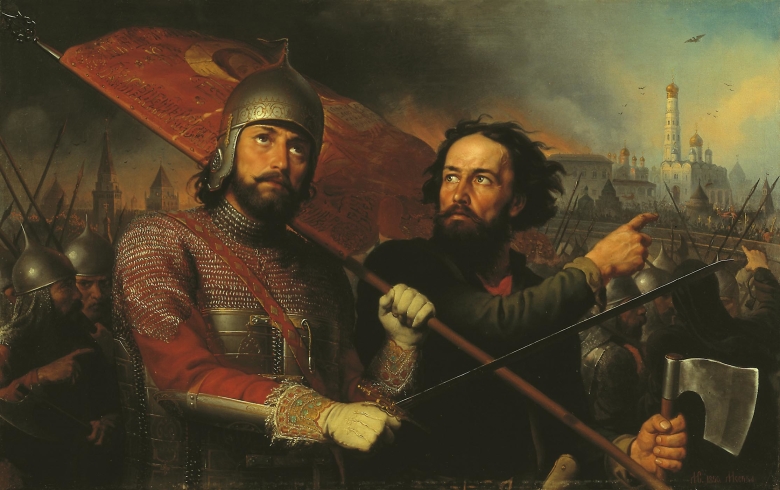
Mikhail Scotti. Minin and Pozharsky
In such cases, the structure collapses under its own weight, due to growing uncontrollability and various black swans in the form of man-made disasters or illiterate decisions. This could last five, or maybe ten years, but it’s unlikely to last longer, because events started to happen like an avalanche. I don’t really believe in turning off the “cart” - here the authorities seem ready to win back, as in the case of Konstantin Bogomolov. In matters of tertiary importance, a willingness to meet halfway will be demonstrated - with the liberal permission of the telegram it is easy to carry out even mobilization, even public executions of corrupt officials or “foreign agents”. But in matters of primary importance - war, complete control over public policy, periodic persecution of friends or foes - the regime entered a stage of complete rigidity, and this did not happen yesterday, but at least in 2012, before any Crimea. Such structures do not bend, but break, fall deep into themselves, which we will see throughout the life of one generation.
The death of Alexei Navalny is an undoubted milestone here, because Navalny, paradoxical as it may sound, was the consensus leader of the protest.
Subscribe to read in full
Subscribe to Redefine.Media to read Republic
Subscribe [You can pay with a Russian or foreign card. The subscription is renewed automatically. You can unsubscribe at any time.]
Where does the subscribers' money go?