
Translated material
Returning the name
Reflections at the entrance of a house on Lesnaya

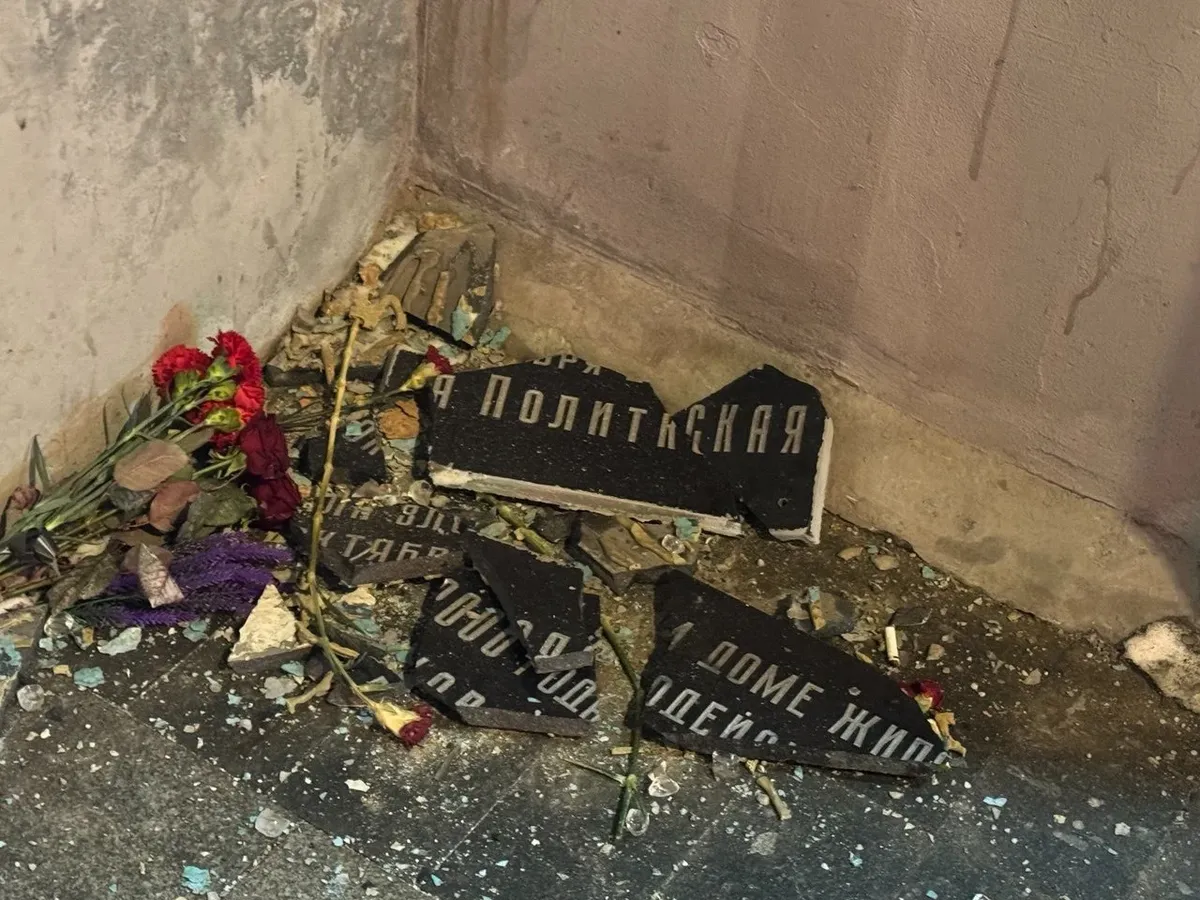
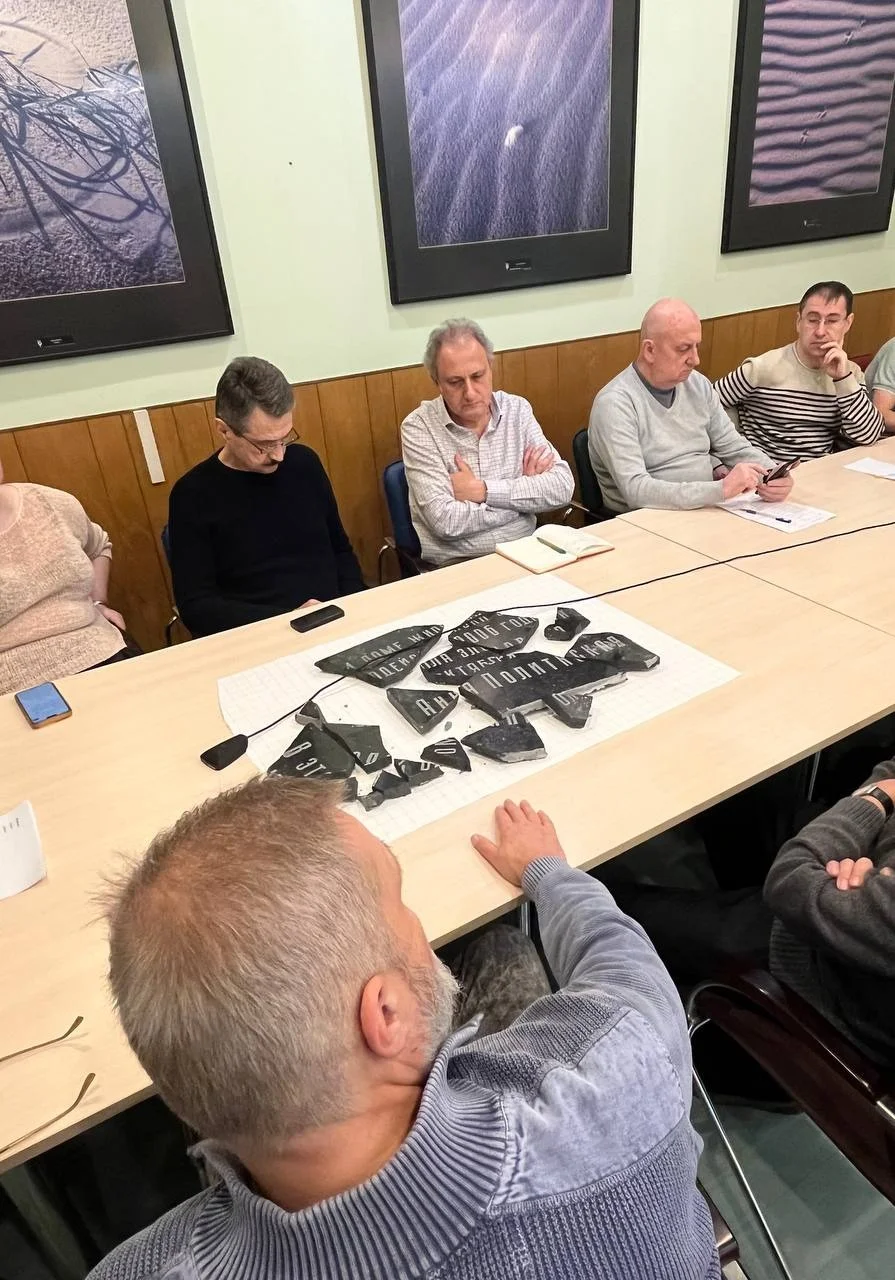
Fragments of a memorial plaque on Lesnaya Street. Photo: Victoria Artemyeva / Novaya Gazeta
“I was always amazed by these things with paintings. They hang there for years, then, for no reason, out of the blue, I say, bam, they fall down. They hang there, on a nail, and at some point, boom, they fall down like a stone. In absolute silence, everything around is motionless, not even a fly flies by, but they bang. For no reason. Why at this moment? Unknown. Bums."
Alessandro Baricco. "One thousand nine hundred"
“7”, “killed”, “Politkovs” - on the first evening, the fragments of what had recently been a memorial plaque, lying near the tattered wall of the house, looked like either a bad puzzle, or like pieces of ice from which Kai had to put together the word “eternity” in “The Snow Queen”. The board, torn down by neo-Nazis and clearly carefully crushed, was immediately compared to the tattered “Last Addresses.” And because the address really was the last one, and because a couple of meters away, on the facade of the same house, there was already a smaller white spot - from a torn sign with the names of the repressed. And although the very next day the same war for memory that has long been going on around the “Address” began around the entrance,
the struggle to return the name of Anna Politkovskaya is clearly out of the question of these wars. Because, at least, the main claim to this name, apparently, is not that its bearer was killed, but that she was.
After almost a month of this war, one of the flower shops closest to the hot spot has already begun to get used to the fighting taking place nearby. When, despite minus twenty, you ask for roses without wrapper, they clarify: “Are you going to the sign, or what? Oh, well, I see.” And they even know the artist: they say that although neo-Nazis took responsibility for the first broken granite, throughout this month, every day and tirelessly, temporary signs and bouquets of flowers are torn off and carried into the nearest trash can by Galina Shustova - the same 69-year-old fan of Kadyrov and the housing comrade bureaucracy, whom one of the activists found and filmed.
20 years later, she suddenly decided to challenge the formula “in the entrance of her own home” that had been heard all these years in all the media: “This is my home! - the pensioner screams in the video. “I’m the owner, and I didn’t allow it!” And in general, the memorial tablet, it turns out, always bothered her, from the very day it appeared here. And when she says this in the video, you get the full feeling that she is, in general, not far from the phrase “thanks to our boys.”
The war for memory on Lesnaya, 8, began with the fact that in response to the breaking of the sign, Muscovites brought flowers and lamps to the entrance, then hung up a plastic temporary copy, and when all this disappeared, they brought flowers again and hung up a temporary sign again. Then again. And again. And then they changed the inscription - instead of “killed here,” they wrote “the memorial plaque was destroyed here by neo-Nazis.” Eventually, a graffiti stencil appeared on the wall instead of a sign.
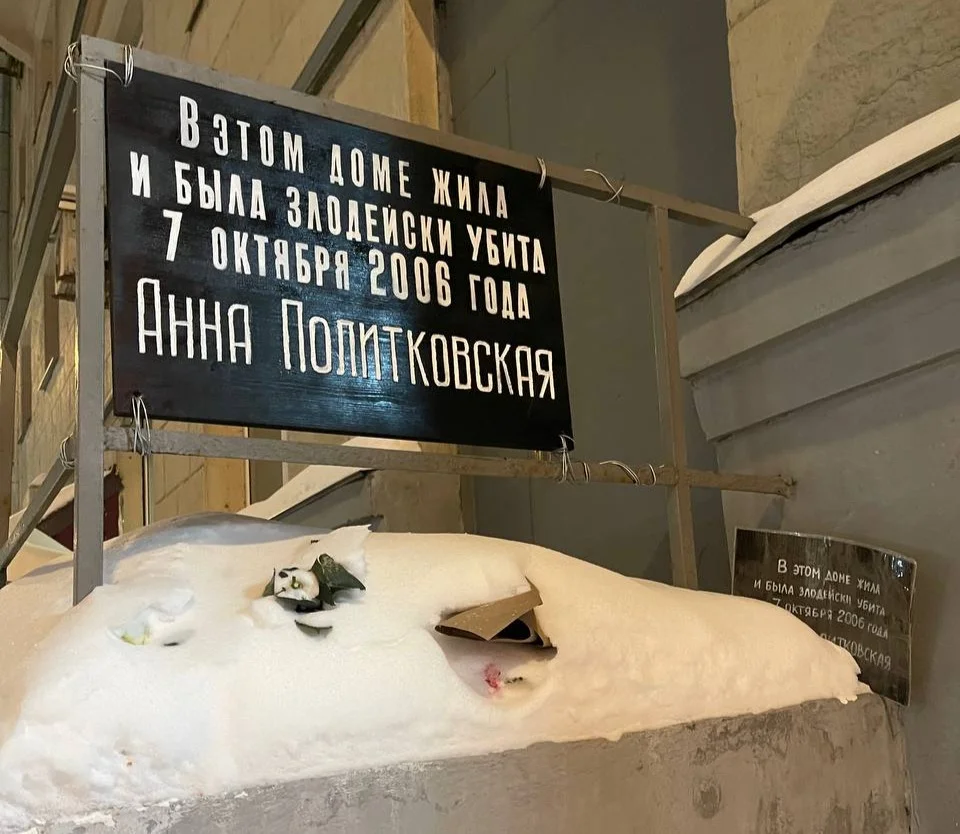
The Nazis, we must give them their due, respond quickly, and they clearly cannot do without the speed and observation of a local resident. This touching volunteering probably made the work of the NS/WP* participants much easier - after all, it’s cold for skinheads in the cold. Every day the graffiti becomes cloudier - either from the weather, or from attempts to wash it off, but the Moscow pensioner’s capabilities and means are clearly not enough to finally defeat the text.
So the composition of the performers - at least socially - was no big secret already on the third day. It was much more interesting to look for an answer to another question: why now?
Fatalists will say that the return of Politkovskaya's name to the news was inevitable under the current circumstances. Those who have an idea about the neo-Nazi crowd will explain this by the recent release of Evgenia Khasis (many, however, will doubt that this name is still a significant symbol for neo-Nazis).
Numerologists will explain this by the anniversary year - in 2026 it will be 20 years since the murder. Writers will explain by the logic of the plot: when else should this name be returned, if not now, when the country, completely mired in totalitarianism, is again fighting.
And not in one of her remote regions, but with a country to which Politkovskaya also had a family relationship (her maiden name, as you know, is Mazepa).
When should we return, if not now, when every day the whole country is trying to return somewhere, when meetings and conferences discussing plans for the future are called “Forward to the Past!” When, if not now, when all Politkovskaya’s topics have returned - from war crimes, terrorist attacks, torture of prisoners to the problems of refugees, the complete lack of rights of political prisoners and all possible emergencies. The only difference, however, is that all of Russia has now become Chechnya.
In addition to the sign that is constantly returned to its place, in addition to the indelible inscription on the shabby wall of the entrance, recently stickers with a flower and the inscription in a circle began to appear here and there, on drainpipes, and on subway doors: “Remember Politkovskaya.” And here’s the paradox: those who print these stickers cannot remember Politkovskaya purely physically. Nikolai Rybakov (chairman of the Yabloko party) can keep a real memory of it, one of the first to notice that the sign was broken and hung up one of the temporary boards. But those who regularly monitor the safety of the memorial cannot remember Politkovskaya. Simply because they were born either after or shortly before her murder. By 2006, they were at most six, seven, 10 years old, and yet they are confident in the terminology used: they remember it.
At the same time, when you start asking what exactly they mean and what this name means to them, it turns out that their memory is rather fragmentary: Chechnya, Nord-Ost, interviews with Kadyrov, refugees - they list the key stages of what in memory studies is called the memorial canon. In this sense, the change in the text on the temporary plaque is very characteristic: if earlier it was fundamentally important to remind people that Politkovskaya was killed, now that the murder, the undetected customer, and the expired statute of limitations for the crime have become an integral part of the memorial canon (everyone who knows Politkovskaya’s name knows this), it has become fundamentally important to record in people’s memory the fact that her name haunts her enemies even 20 years after her death.
In other words, everything that those who care about the memorial remember about her is, of course, not personal memory, it is veneration of the symbol, albeit very ardently and absolutely sincerely. This is a reproduction of the winning narrative about a person: although during her life she was reproached for being too emotional and for being too focused on the war and the pain of others, 20 years later it became clear that it was not the claims to her work that won, but what she, despite them, was actually able to do.
After 20 years, it became clear that her concentration was absolutely justified: what Putin started with, against whose policies she so protested, has not only not ended in 20 years, but has increased many times over. Where he started, that’s where he returned, and that’s where he ends, and with him ends the country that Politkovskaya called Putin’s Russia in the title of one of her books.
And it was precisely because of this clear proof that she was right that over time the image of Politkovskaya as a top-class professional, as a moral tuning fork and as a person for whom nothing was more important than another person prevailed.
This is also why, by the way, the return of her name to the daily agenda turned out to be so logical: during times of big data and global catastrophes, when everything merges into a mass, a crowd, statistics, categorization, classification into friends and foes, those who left and those who stayed, those imprisoned and imprisoned, the living and the dead - during a total taxonomy, it is Politkovskaya’s approach, individual, deeply personal, implying eye-to-eye conversation, that seems truly alive and the only one that works.
Against the backdrop of all this, it is natural that an unnecessary reminder of it looks very inconvenient. It looks even more inconvenient against the backdrop of the general state desire for new territories, against the backdrop of the mass naming of streets, schools and desks, even church bell towers after the names of their partners, against the backdrop of the installation of monuments to them. Perhaps the upper echelons of power do not have an image of the future either for themselves or for the country, but they know perfectly well how to stake out the memory of the present: all this placing of flags and names is nothing more than a concern for how they themselves will be remembered. In this sense, the Politkovskaya memorial, which is not even related to 2022, is too noticeable a stain on future memory.
But here’s the problem: trying to erase the memory of it leads to the opposite effect - the memory is not erased, it is updated. The vandals tried so actively to forget Politkovskaya that instead of an oblivion campaign they carried out something like a memorial** “Return of Names”: they forced even those who were physically unable to remember Politkovskaya, they drew a direct analogy between the 2000s and the 20s - and now she is a full participant and a sign not only of everything that was connected with the second Chechen war, but also of everything that is connected with what was happening.
Moreover: the torn sign and everything that began and continues after that turned out to have two more important functions for today. The first was indirectly described in one of the articles by Alexey Semenov-Troyat, who publishes a large series in Novaya, entirely devoted to memory studies. He writes: “Imagine: you throw a magnet into a box of iron filings. They instantly line up along invisible lines of force. It would seem chaos. But as soon as the force appears, a structure arises. The memory field works in exactly the same way.”
The situation around the torn sign formed just such a field of memory, where, like a magnet, those who have something to remember, those who want to adopt these memories, and those who want to completely erase these memories were attracted and united into polar camps.
And the second function of this event is that tearing down and returning the sign became another new form of protest. In February Russia, where the usual - street, rally - protest was completely blocked, stunningly creative new forms immediately began to quickly take shape. And if, for example, dressing in the colors of the Ukrainian flag or sticking price tags in a store turned out to be no less or even more dangerous than a single picket, then the consequences of singing protest songs in passages or writing quotes from anti-war poems on the walls of houses, or applauding in the right places in the theater, or painting nails black in mourning, or attending Navalny’s funeral and much, much more - the consequences of all this are unpredictable, but still tolerant. The method of protest became something that was usually unsuitable for these purposes, including the fight for the Politkovskaya memorial.
And if you chat with florists from stores nearby, they will say that even those who found out about what happened quite by accident come to them and buy flowers from them. And when you buy a couple of roses from them and ask them not to wrap them, because they will immediately throw them away anyway, they will answer: “Wait. Everything will fall into place, time will pass, and your heroes will return. They will return there, where they are supposed to be.”
Someday, of course, they will return, but for now, every day, even the coldest day, flowers appear here: they are taken away - they appear, they are thrown away - they end up here again. Flowers became a sign of protest against death when the entire sidewalk in front of these doors was first covered with bouquets, and when a garden appeared under the windows of the Novaya Gazeta editorial office. Now flowers have become a sign of protest against oblivion, a protest against the death of memory.