
Translated material
Memoirs of the Constitution
Professor Tamara Morshchakova presented a book about her work in the Constitutional Court

Tamara Morshchakova’s book “Judge Regardless”
Chairs kept being dragged and dragged from somewhere in the next room, and people kept walking and walking, so that the young people had to stand in the back row for two hours. Full house. It was not the movie star who was greeted standing by the audience, but the lawyer, professor Tamara Georgievna Morshchakova, who presented B.N. at the Moscow branch of the Presidential Center. Yeltsin’s book “A Judge Regardless” (it was published by the same center in the series “90s: Personalities in History”).
What is so attractive about this wizened lady, always wearing the same glasses, who will soon turn ninety? Not only with her scientific works, not only with the lectures that she gave to HSE students until recently. Even in the crowd of people who want to get an autograph surrounding her, she looks like an independent loner. A knight ready to fight wickedness in all its forms. And there is a lot of this in the courts.
The book “Judge Regardless” is a memoir on a given topic. It fits into the trend of rethinking the 90s, which began two years ago with the 10-episode documentary “Non-Past Tense” and the highly controversial film by Maria Pevchikh* “Traitors.” Work on Morshchakova’s book together with her literary editor Tatyana Skorobogatko was underway at the same time. As Lyudmila Telen, deputy director of the center, said when opening the presentation, Tamara Georgievna was not immediately persuaded - at first she considered the idea of a book “immodest.”
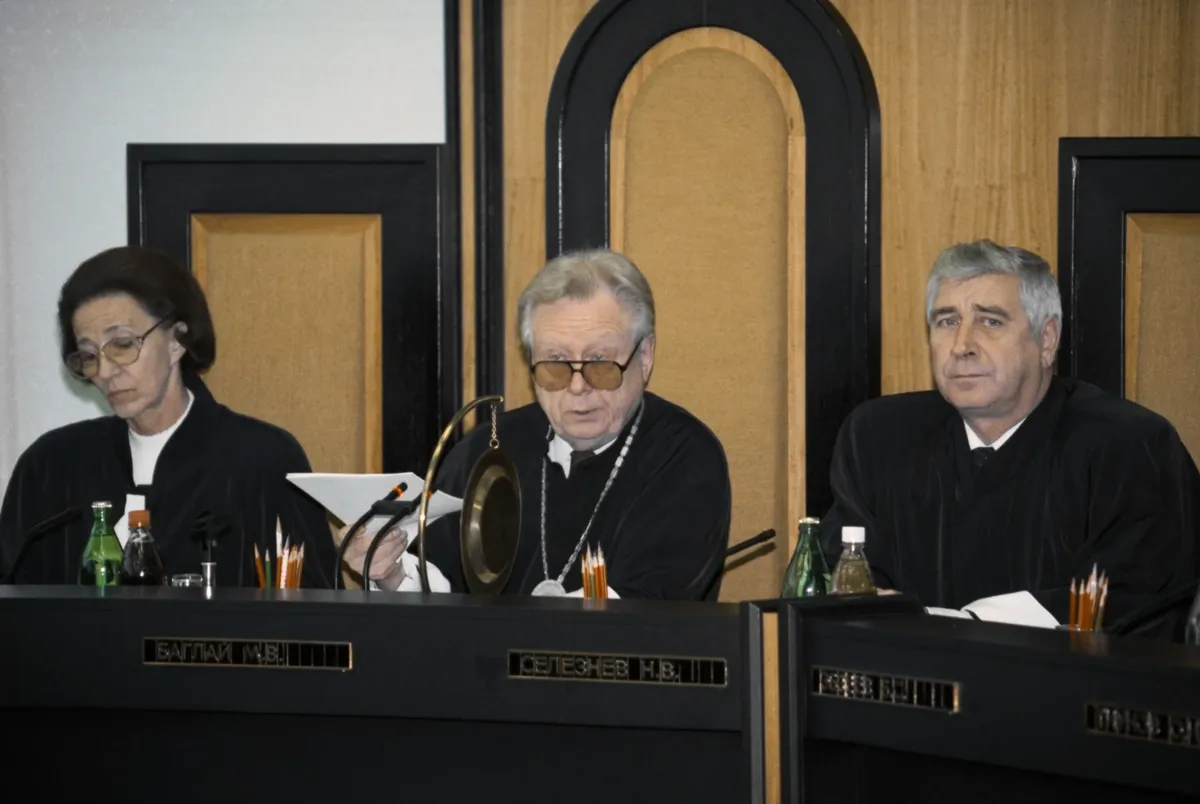
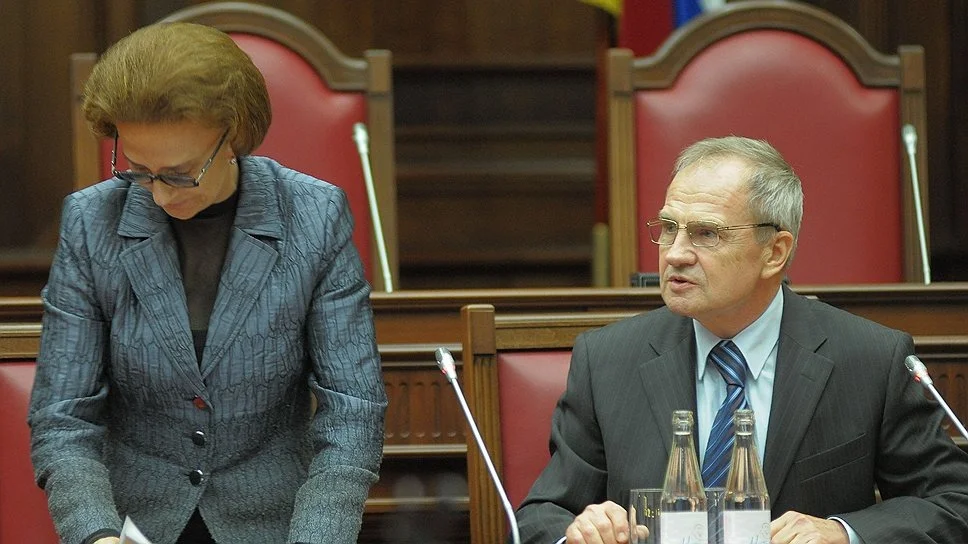
Meanwhile, her story about the events of 1991–2002 (when she resigned from the Constitutional Court due to age) allows us to look at this and subsequent periods of Russian history through the prism of one, but important institution of separation of powers - the Constitutional Court. The Constitutional Court, which was created in 1991, has, perhaps, only one thing in common with its current “namesake” - the full name of the chairman. But Valery Zorkin also seems to have been replaced - he is no longer the same as he was in the early 90s.
At what point did they both—the court and its chairman—stop being themselves? Professor Morshchakova, who managed to remain herself, even going through “copper pipes,” answers this question with her very being.
* * *
In the spring of 1991, Sergei Pashin, who worked in the State Legal Administration of the President, prepared two draft laws on the Constitutional Court, and on July 12, the V Congress of People's Deputies of the RSFSR approved the one that provided for the possibility of ordinary citizens filing complaints with the Constitutional Court. On October 29, the Congress elected 13 judges from the list submitted by the Chairman of the Supreme Council Ruslan Khasbulatov, including Zorkin, Morshchakova and others.
Tamara Georgievna describes the meeting of the newly elected judges with Boris Yeltsin, who congratulated them so that they would not in any way think that they were going to be put under pressure. This promise will not be fulfilled, but later, often finding myself next to Tamara Georgievna, I became convinced that she spoke equally evenly with the president and with an ordinary and annoying “complainer.” Boris Pasternak called this a noble feeling of equality with all living things.
The very first decision of the Constitutional Court, dated January 14, 1992, declared unconstitutional the presidential decree on the merger of the Ministry of Security (the future FSB) and the Ministry of Internal Affairs.
The judges pointed out that although the configuration of government bodies is the responsibility of the president, such an order cannot be extended to the power ministries. Boris Yeltsin immediately complied with the decision of the Constitutional Court and canceled the decree.
The “CPSU case,” with which the Constitutional Court was mainly occupied in 1992 (52 meetings), ended with the recognition as constitutional of Yeltsin’s August 1991 decrees regarding the dissolution of the highest bodies of the CPSU, which replaced the state, but unconstitutional in terms of the dissolution of the grassroots cells of the CPSU. This decision did not satisfy any of the parties, but during the meetings, unique historical documents were made public, which today can only be found in six volumes of the “Materials of the CPSU Case,” which were published shortly after the trial.
The “CPSU case” was initiated by a request from communist deputies; there was no possibility (or even desire) to evade its consideration, but it immediately revealed the fundamental vulnerability of the court’s position. No matter how hard the judges tried to avoid assessing the facts in order to talk only about the constitutionality of the norms, in this kind of cases this turned out to be impossible. And no matter how hard they tried to stay “out of politics,” politics itself captured them.
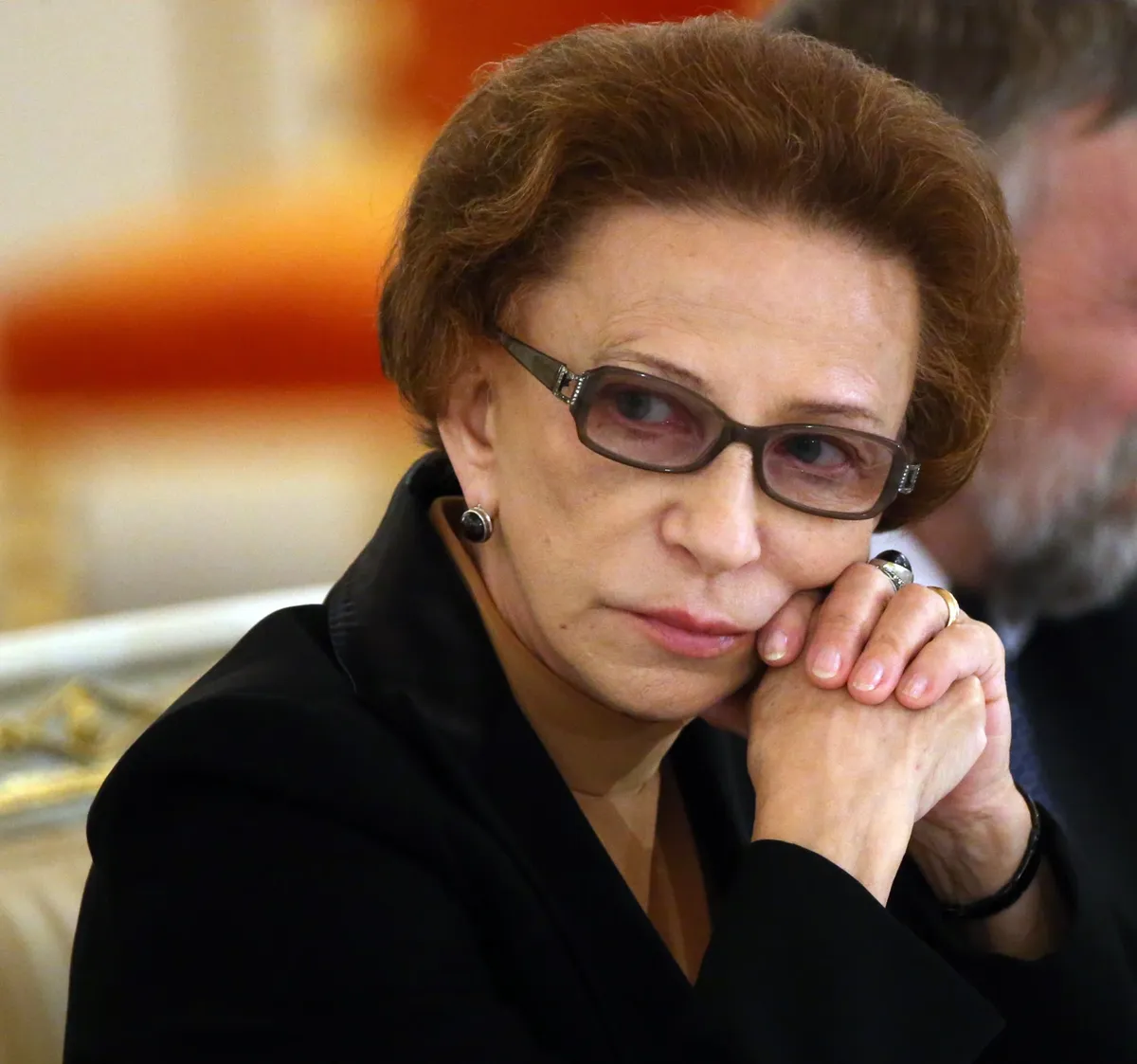
Today, reading yet another rejected ruling by the Constitutional Court (for example, about the refusal to consider the complaint of Lev Shlosberg* and Boris Vishnevsky* about declaring them “foreign agents”), we ask: is it good that the Constitutional Court so shuns “politics”, and isn’t such self-removal from the political scene deceit and cowardice?
And in 1991–1993, the Constitutional Court was formed and made decisions in an atmosphere of fierce confrontation between President Yeltsin and his administration and the majority of deputies of the Congress and the Supreme Council of the RSFSR. It was also difficult to rely on the current Constitution of the RSFSR of 1978, to which the Congress of People's Deputies introduced about 400 amendments.
* * *
There is little personal in Morshchakova’s memoirs, but the personal factor also played a role in the evolution of the CS. Tamara Georgievna, not for the sake of sorting things out, but for the sake of history, talks about the role of Valery Zorkin in it during his first chairmanship of the Constitutional Court from 1991 to 1993. He played politics, claiming to be an arbiter in the confrontation between the president and the Supreme Council, and made public statements that were not agreed upon with other judges of the Constitutional Court. According to Morshchakova,
the chairman sought to take upon himself the resolution of all issues, including the choice of complaints accepted for consideration, and also established all contacts with other branches of government.
The political confrontation reached its extreme stage on September 21, 1993, when Yeltsin issued decree No. 1400 on the dissolution of the Congress of People's Deputies and the Supreme Council of the RSFSR and on submitting a new Constitution to an all-Russian referendum. On the same night - from September 21 to 22 - the Constitutional Court, which urgently met, ruled on the unconstitutionality of Decree No. 1400 with four votes against, including Tamara Georgievna.
Morshchakova’s argumentation, set out in her book, boils down mainly to procedural issues: the meeting, which was a step towards the impeachment of the president, was convened not at the request of the Supreme Council, but on the court’s own initiative; it was not prepared, did not take place according to regulations, and the opinions of the parties were not heard.
Morshchakova is a person of procedure, which is very important for a judge and for perseverance in general. But in terms of content, Decree No. 1400, as well as the forceful suppression of parliament that followed it, were indeed unconstitutional. It was a revolution: political action interrupted the previous legal continuity; legally, the state of the “RF” began anew in 1993, “from scratch.” From a substantive point of view, according to Morshchakova, Yeltsin’s actions were justified by extreme necessity: this is what lawyers call causing less harm to prevent more.
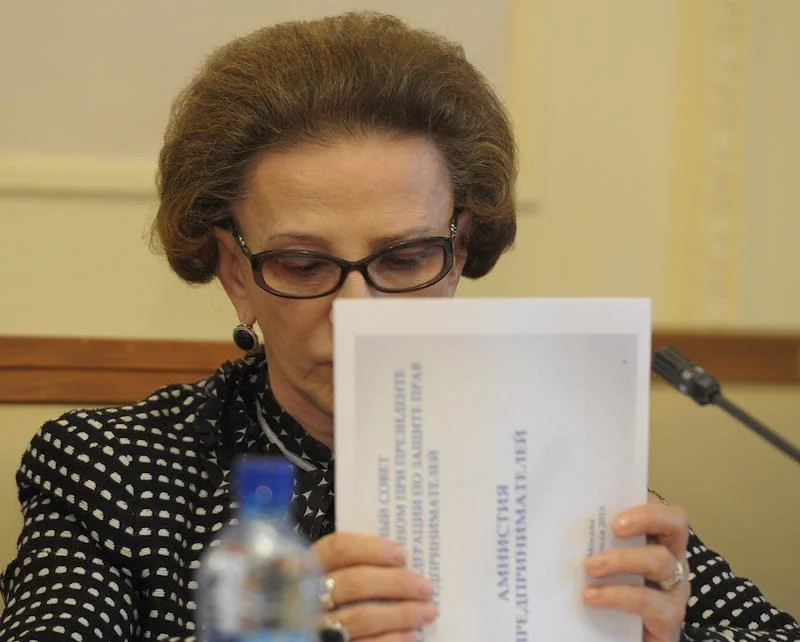
In the framework of understanding the decade of the 90s, this can and even should be discussed, and Tamara Georgievna in no way avoids such a discussion. Rethinking is always rethinking. But today this is already a historical experience, and nothing more.
The judges of that Constitutional Court not only learned, but also used part of this experience: while the court was inactive in 1994, they rewrote the draft of a new law on the Constitutional Court and drew up internal regulations that did not allow the chairman to usurp the apparatus power and speak on behalf of the court without its special decision. This order was observed until Zorkin’s second coming to the post of chairman in 2003.
* * *
On October 4, 1993, I found myself in the Constitutional Court, where I walked around the offices and talked with judges I knew. Each of them had a TV on and there was a live CNN broadcast from the White House, at which tanks were firing blanks, surrounded by a crowd of revelers on the Novoarbatsky Bridge. Along with the Supreme Council, every shot seemed to reach here, to Ilyinka (the court’s move to St. Petersburg would happen another 15 years later), where the judges two weeks earlier “put on the wrong ones.”
Yeltsin was rashly ready to get rid of the Constitutional Court altogether, partially transferring its functions to the Supreme Court, but he was convinced to retain the Constitutional Court, depriving it of the ability to accept cases on its own initiative and agreeing with the judges to replace the chairman, which was not difficult.
In July 1994, a new federal law was adopted, which is still in force today, but with significant changes made to it in 2020, and Professor Vladimir Tumanov became the new chairman of the Constitutional Court.
In 1995, the Constitutional Court received a request from the Federation Council to verify the constitutionality of Yeltsin’s decrees on conducting an armed operation in Chechnya. The Federation Council indicated, in particular, that the use of troops is its prerogative and this requires the introduction of martial law or a state of emergency in the country (in my opinion, this is relevant). Then the Constitutional Court made a rather ambiguous decision, which, however, did not give the Federation Council a reason to impeach Yeltsin.
Along with issues of this magnitude, the Constitutional Court also considered applications from individual citizens, making principled and understandable decisions on them. For this purpose, an ingenious legal mechanism was invented. The transitional provisions of the 1993 Constitution state that the laws of the Russian Federation adopted before it can be applied only if they do not contradict this Basic Law. On the other hand, in accordance with Art. 17 of the Constitution, “in the Russian Federation the rights and freedoms of man and citizen are recognized and guaranteed in accordance with the generally recognized principles and norms of international law.” This allowed the Constitutional Court of the 90s to recognize as unconstitutional any acts that contradict international standards. On this basis, for example, a number of decisions were made on the unconstitutionality of the institution of registration.
On February 2, 1999, at the request of the Moscow City Court and a number of citizens, the Constitutional Court decided that the use of the death penalty on the territory of the Russian Federation was inadmissible. This penalty can only be applied on the basis of a jury verdict, and such a court at that time had not yet been created in most subjects of the Federation. In 2009, the Constitutional Court confirmed its position on the death penalty, however, it remains in the form of punishment under a number of articles in the Criminal Code, and the moratorium can be terminated.
* * *
Morshchakova, as a matter of principle, does not publicly comment on the decisions of the Constitutional Court that were adopted after her resignation in 2002. Although her position, which does not coincide with her former colleagues, as a member of the Human Rights Council (2004–2019) - in particular, regarding the “law on foreign agents” - is well known. But in general, it’s difficult for Tamara Georgievna to talk about the current legislation and practices of recent years: hysteria or buffoonery are not her genres.
Morshchakova only allowed herself to criticize in the book the amendments made to the law on the Constitutional Court in 2020. First of all, the one that prohibited judges from publishing their dissenting opinions and generally commenting on decisions made by the court in any way. The path traversed by the Constitutional Court over 35 years can thus be described as a movement from complete openness to complete closure from civil society.
Today, the Constitutional Court responds to most incoming complaints in writing - with so-called refusal rulings, and we do not know who draws them up, how they are discussed (and whether they are discussed), what opinions are expressed by individual judges.
And we often don’t know the judges themselves either: in the legal world they are not the most prominent figures.
The only frontman of the Constitutional Court, as in the first years of its existence, is Chairman Zorkin, who, within the framework of the legal forum regularly held in St. Petersburg, speaks with reflections that are historically interesting, but strange for his position.
Let us return, however, to the hall of the Moscow branch of the Yeltsin Center, where, at almost ninety, the ex-judge answers questions from fans. The conversation concerns not so much the Constitutional Court, which now seems to exist, but the judicial system as a whole and, in particular, the independence of judges. No official record is kept just in case.
The audience in the hall was clearly divided in half: on the one hand, people of the 90s, including members of the then government, and on the other, young lawyers, for whom Tamara Georgievna is a living legend, and her book probably reads like a fairy tale. And when we talked about it, we tried to keep the comparison in mind: this is how it was, and this is how it became.
The very fact that Morshchakova agreed to work on this book for five years and publish it is evidence of Tamara Georgievna’s optimism. It is based on the fact that young people come and ask questions. The Constitutional Court today is a “sleeping institution,” but under some circumstances it may wake up.
* The Ministry of Justice of the Russian Federation included in the register of foreign agents
Tamara Morshchakova’s book can be purchased at the Yeltsin Center store.