
Translated material
Basin
Lev Shlosberg* - about his life in prison. Continuation of the diaries of a political prisoner from Pskov Castle

Illustration: Petr Sarukhanov / Novaya Gazeta
18+. THIS MATERIAL (INFORMATION) IS PRODUCED, DISTRIBUTED AND (OR) SENT BY FOREIGN AGENT SHLOSBERG LEV MARKOVITCH OR CONCERNES THE ACTIVITIES OF FOREIGN AGENT SHLOSBERG LEV MARKOVITCH.
Prison is a mechanism for standardizing a person’s life down to the details. A person who finds himself in prison finds himself in a system that has been well-functioning for years, in which almost every step is foreseen, planned and calculated.
A person in prison may not show any initiative, not take any action, and life inside the prison mechanism will go on as usual, as a clock wound up for a long time goes, ticking regularly.
Life in prison is designed for a person to have no ideas about the content and rhythm of life. You don't have to think. You don't have to ask questions. You don’t have to organize your own life in any way - it is organized for everyone in prison. There is no need to show will, to make your own decisions.
In such a situation, especially if it becomes prolonged, a person’s most important qualities and personality traits may atrophy - will, motivation, independence, responsibility.
It is impossible to turn them off temporarily using some button and then turn them on again. Failure to use oneself as a person, even if this happens for a limited time, turns a person from a subject into an object that has become the subject of the actions of other people and forces.
In order not to lose yourself, you need to create your own way of life in prison, which, without violating the general routine and without coming into conflict with it, will be the result of your own efforts, your own decisions, your own actions. Figuratively speaking, this is like including your own cog in the overall large mechanism, which does not affect the course of this mechanism, but organizes your life in such a way that you can say to yourself: “This is happening because I myself decided and did it.”
Yes, the vast majority of these decisions and actions are related to the routine of life in prison. From things that are possible, but not necessary, you form your own way of life, and no one can create it except you.
The motto of this way of life can be put in the words: “I may not do it, but I do.” Because that’s what I want, that’s what I decided and that’s what I did.
Charging is recommended but not required. You do it yourself and it opens up your day. Simple gymnastics. Squats, push-ups. Press. Plank. After 15 minutes the body is ready for life. Bath - only once a week, but every morning - washing your hair, drying your body, and every evening before bed - a warm foot bath. You must always be clean. Feeling clean is part of self-esteem. After washing, tea or milk with oatmeal cookies from the prison store. This is my first breakfast.
Washing your clothes is up to you. The feeling of clean clothes is part of the feeling of a clean body. I can't remember the last time I washed by hand. We - consumers of modern civilization - are faced with washing by pressing two buttons of the washing machine: on. and off In prison I learned to wash light and dark in the same water: first the light, then the dark. Thanks to my friends - a wonderful little kettle provides me with hot water for washing and washing. And I bought the immortal “AIST station wagon” in the prison store.
Yes, it's long. But the process and the result bring satisfaction. Soak. Main wash. Three rinses in warm water, two in cool water. Ready. The horizontal heating pipe is my great dryer. Everything dries out in a few hours, including the terry towel and trousers.
Washing by hand, as you know, is one of the types of tactile psychotherapy. After a long hearing of the Pskov Regional Court on December 12, which upheld the decision on my detention, I returned to the cell and felt that I needed some kind of physical action to release the negative emotion from myself. And I started washing my underwear.
Your way of life in prison is made up of details that are important only to the person himself.
If you are used to shaving, you should shave. You should see your face in a piece of mirror embedded in the tiles above the washbasin, the way you are used to seeing yourself. Nobody needs this but you. You need to respect your face, your habits and traditions.
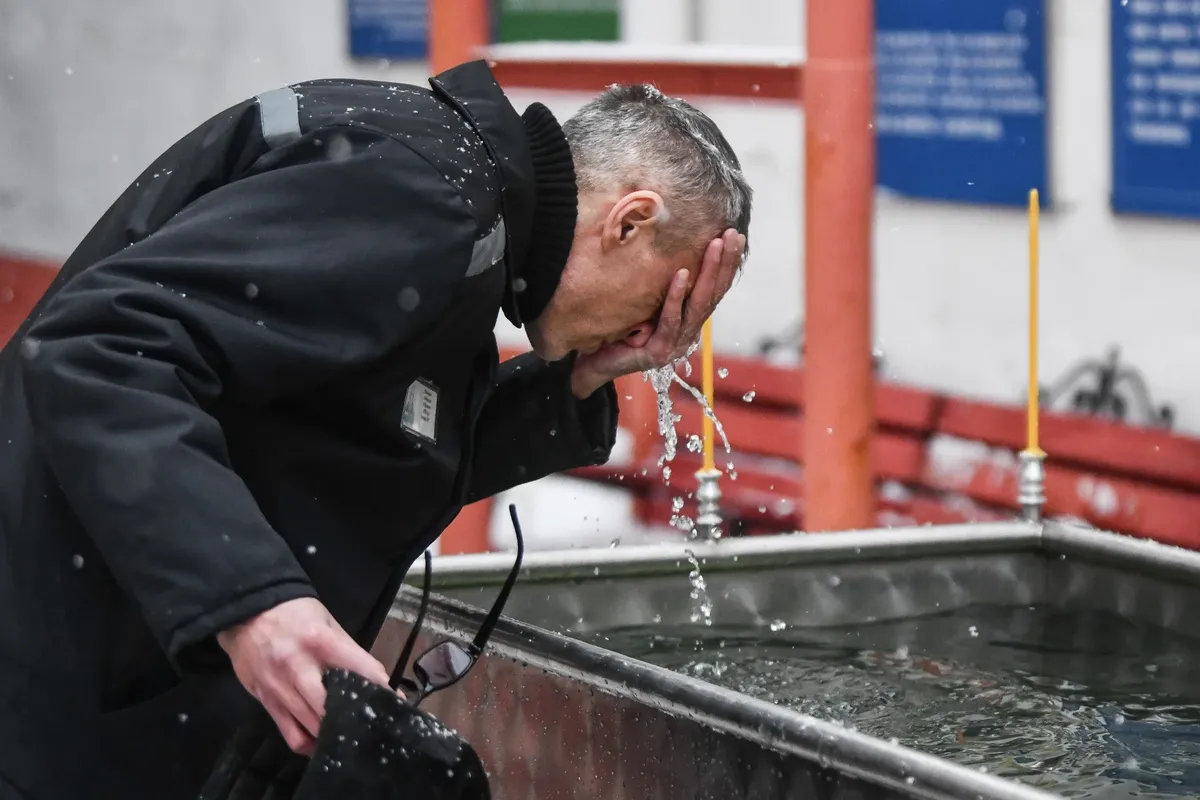
Prisoners are provided with official utensils: aluminum bowls three times a day and, upon signature, an aluminum spoon and a plastic mug. There is no problem in using a spoon that has been eaten by thousands of mouths. Laundered and everything was in order. But your own table is your own table. Friends gave me a set of plastic utensils, and I bought a new aluminum spoon and a new mug from the prison store. Because my table is my joy.
There are clothes for the camera, and there are clothes for walking. In the cell, you wear trousers at home; you wear trousers for walks, although you don’t need to go outside - the walking “glasses” are adjacent to the dormitory building. Just the habit of keeping in shape is part of your way of life: at home - in the home, on the street - in the street.
Walking in prison is a rather peculiar thing. The exercise yard is a stone “glass” approximately 3 x 5 m, on which instead of a ceiling there is a reinforced wall made of thick rods, on the reinforcement there is a chain-link mesh, above all this there is a roof, between the roof and the outer wall of the “glass” there is a lattice and a barbed wire-web. It is through them that you can see that very “strip of sky” that Eva Merkacheva wrote about the right to. Unless, of course, the place of the strip of sky is occupied by the wall of a neighboring building.
Many prisoners do not like walks in such an environment and refuse them. I always walk. Walking is movement. A walk is fresh air, which, unlike the “strip of sky,” is always present in the walking “glass.” “Glass” can be wider (almost up to 4 m), or narrower (a little wider than 2 m). You “cut” ellipses into a “glass”; the internal regulations of pre-trial detention centers or some FM station are heard in the background.
Often an employee looks in before the end of the walk (an hour) and asks: “Are you going home or are you still walking?” - “How much is left?” - “10 minutes.” - “Let’s take another walk.” And again “ellipses” clockwise.
The subject of special concern for cleanliness is the cell in which you live. In correspondence with family and friends, I began to call the cell a room. Yes, if someone says that a cell is not a room, let him be the first to throw a stone at me. But the point is not the intersection of concepts. The camera is a place to be. A room is a place of life.
The first thing I did in my room (first quarantine, then permanent) was to wash all the items in it. In quarantine - with a rag for washing the sink, which I inherited from my predecessor, in the permanent room - with a household sponge bought in the prison store. The bed, including the second tier, on which you do not sleep, but which you touch. Table. Bench. Shelf with four sections. Sink. There are 12 white tiles above it, one of which has a mirror embedded in it. A utility shelf-corner above the sink. Stand for drinking water tank. The hanger is a metal corner with four welded hooks. Battery. Heating pipes. "Feeder" in the door.
Already while I was in the permanent room, friends gave me a large soft cloth for washing the floor, and wet cleaning became simple. You need to go through all objects with your own hand, literally - wash your inner space with your own hands. This is part of that very feeling of cleanliness that helps you feel okay.
There are funny things associated with maintaining cleanliness. In the new room there was no plastic basin necessary for washing and washing. I was surprised because he was in the quarantine chamber - brand new, clean, recently purchased. At the first morning check, I told the employees about this. “No basin?” - They were surprised and promised to find him. The next morning I repeated the request. Finally they brought me a basin. Undoubtedly, he was once the identical twin of the handsome man I got in quarantine. But life treated him cruelly.
It is impossible to guess what was done to it, but in three places from the outside its red walls were pressed inward, as if it had been placed on a crooked red-hot tripod. Maybe the poor guy was used for other purposes than just that. Decorative inserts in the handles were knocked out. From the outside, the unfortunate man looked as if he had spent some time at a construction site. It was impossible to imagine that I would wash my hair (and even my feet) and wash clothes in this product. Maximum for cleaning the floor.
Meanwhile, time passed. I ordered a basin from the prison store (it was on the price list). But it was not available. I asked my friends to make a transfer. But they refused to let the basin into the prison as an English spy - the basin was not on the list of items allowed for transfer. It’s a paradox, of course, that a basin is on the list of things that must be provided to a prisoner in prison, but if it is not in the cell, it cannot be transferred to the prisoner from outside to captivity - this is not provided for in the instructions of the Ministry of Justice.
During the rounds of the prisoners by the deputy head of the pre-trial detention center, I showed him a basin with all the traces of the trials I had endured. “What a good basin! - said the deputy head of the pre-trial detention center. “There are no holes!”
There were actually no holes in the basin. I talked about the results of my efforts to find the basin. The deputy chief confirmed that the basin would not pass through the transmission. “What if you make a property donation to the pre-trial detention center and transfer the basin here?” - I suggested a wonderful, as it seemed to me, way out. The deputy chief understood me instantly: “So I need to assemble a commission, take it to the balance sheet, appoint someone financially responsible...” - sincere sadness ran across the deputy chief’s face. “This is an MBP - a low-value and wearable item that can be written off at the time of commissioning,” I carefully showed my knowledge of the balance sheet. But the deputy chief did not react to this display of accounting literacy by me and looked at the basin with undisguised confidence that he would work with me. The basin modestly stood on the floor and with all its appearance showed that if I want to maintain cleanliness, then we cannot escape each other.
That same day I accepted reality, the basin was washed in several hot waters using dishwashing gel and took its place in my household. Because cleanliness is the key to order.
But I stubbornly included a basin in every application to the prison store. And on January 20, my perseverance was rewarded - they brought me a shiny, ultramarine-colored plastic basin.
Work became an important part of my lifestyle in prison. My main job here is writing letters. There will be a separate story about the letters. Almost every day from 6.30 in the morning I work - I write letters to friends and complete strangers who wrote to me themselves after my imprisonment.
Daily intellectual work shapes my way of thinking in prison. I constantly have something to think about, find words and write - and this makes my whole way of life in prison meaningful and reasonable.