
Translated material
Freedom game
How video games help resist totalitarianism

Photo: dpa/picture-alliance
Quite a lot of time has passed since then, when the academic community talked about the end of history, the end of ideology and solemnly buried totalitarianism - so much that all these theories and terms managed to come full circle and again be applicable to today. In parallel, video games have gradually transformed from marginal entertainment into a mass cultural phenomenon that is rapidly penetrating into all areas, including politics. At the intersection of these two vectors—the resurgence of totalitarianism and the spread of video games—an understandable question arises: how does the gaming experience change our perception of power and control?
To begin with, let us clarify what exactly we mean by totalitarianism. This is a political system that purposefully destroys the agency of the individual. Agency - in the sense of a person’s ability to perform meaningful actions, influence his life and the surrounding reality. Hannah Arendt in The Origins of Totalitarianism shows that the key mechanism in such destruction is the atomization of society, that is, the disintegration of social bonds and the transformation of people into isolated individuals.

This process begins with the collapse of the class structure of society: classes, despite their inequality, provided the individual with a certain place in the social system and a sense of belonging, and their collapse gives rise to chaos, that is, the “masses”. Arendt writes:
“The main characteristic of the mass man is not cruelty and backwardness, but his isolation and lack of normal social relationships.”
It is important here to clarify the distinction that Arendt makes between isolation and loneliness. Isolation is an objective situation in which a person cannot act together with others, and loneliness is a subjective feeling of abandonment that can occur even among people. So, totalitarian regimes rely on isolation - and at the same time they bring loneliness to the state of everyday norm for large groups of the population. Loneliness, as Arendt notes, has become an everyday experience of the masses in our century.
The next stage in the formation of a totalitarian regime is the use of total terror. In contrast to terror as a means of suppressing opposition, total terror becomes a principle of control: its victims are not for specific actions, but arbitrarily, in accordance with the logic of ideology. This destroys the very idea of a meaningful act: if punishment is not associated with an action, then any action becomes meaningless. As a result, a person turns into a passive, will-less element of the system, who cannot logically explain the world in which he lives, although he can justify it in hindsight.
Video games are structurally the opposite of the passivity described. Their main property is interactivity, the need for active participation in the process, because this is why we love games. Their researcher Janet Murray defines agency in digital environments as “the ability to take meaningful action and see the results of one’s decisions and choices.” So the player initially takes the position not of an observer, but of an active agent whose decisions really matter - albeit within the framework of the game world. Moreover, without these actions the game world itself cannot be realized. If in a totalitarian system the actions of an individual are meaningless and do not affect the result, then in a video game the player’s influence is the central condition for the functioning of the system. And so, for example, researchers Murel and Crawford see video games as a form of modern political agency, where the very act of interacting with rules can be an act of resistance to strict control.

A specific manifestation of agency in games is a meaningful choice. We are talking about game decisions that have a noticeable and often irreversible impact on the development of the plot, the state of the game world, or relationships with characters. For example, in the role-playing game Disco Elysium, the player not only makes story decisions, but also constantly chooses which personality traits and skills his character will develop. The internal dialogue of the hero with his various character traits allows the player to experiment with identity in a safe space.
But agency in video games is not absolute and is often criticized. Researchers point to its limited and predetermined nature: for example, Sarah Stang notes that video games do not offer infinitely variable scenarios, their capabilities are limited by the rules and plot branches pre-written by the developers. A striking example of this illusion is mocked by the game BioShock: at the climax, the character who manipulated the hero reveals that all his seemingly independent actions were programmed using the code phrase “Would you kindly.” This works as an indication that the player's freedom of choice was previously a fiction.
This line of criticism is generally quite popular: for example, the scientist Alec Charles calls video games “faux-scriptible texts” that create the illusion of meaning, power and active participation, and Dominique Arsenault and Bernard Perron coin the term “interreactivity” to describe the process in which the player does not so much influence events as react to stimuli prepared in advance by the system.
But even limited agency has value.
In conditions where totalitarian practices seek to completely deprive a person of the experience of meaningful action, video games provide a structured space for its simulation and practice.
The illusion of choice in a game differs from the absence of choice in reality in that it is based on the voluntary consent of the player and provides him with a certain, albeit limited, set of options, and this contrasts with a situation where opportunities are not provided at all, and even the understanding of the world around him is tightly regulated.
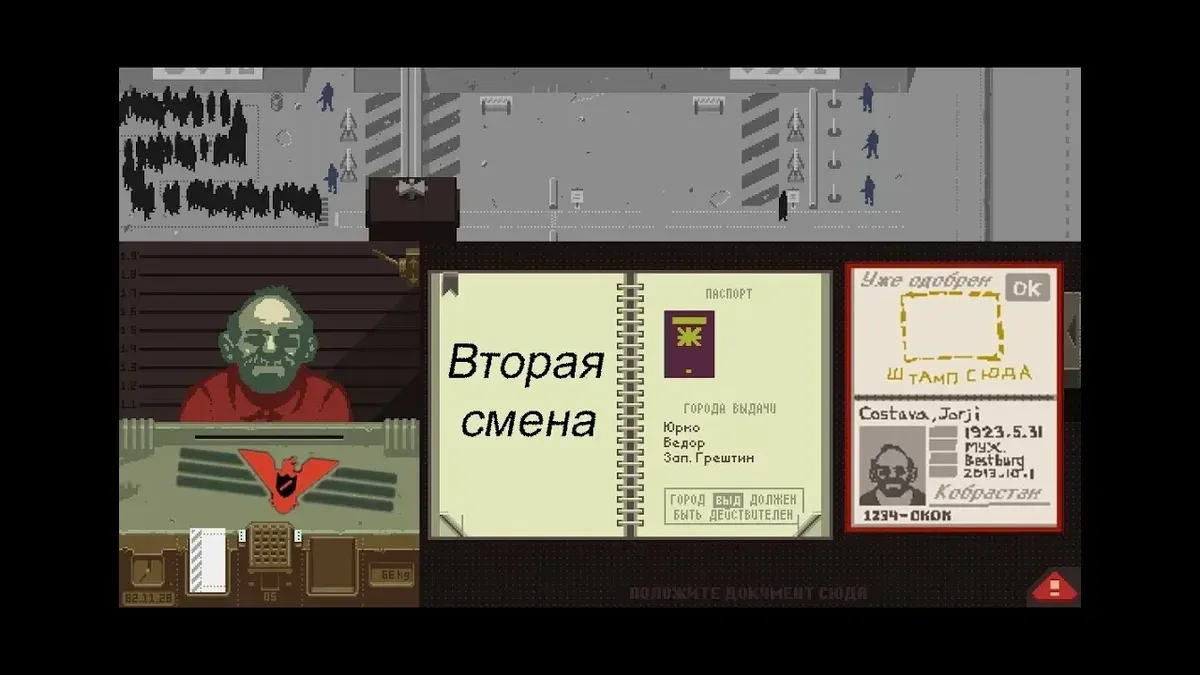
In an effort to realize player autonomy, game developers resort to various game mechanics. One of the most significant concepts in this sense is “procedural rhetoric”, proposed by Ian Bogost. It describes the ability of game processes (rules, mechanics) to express certain arguments and ideas (that is, the game convinces not through text or image, but through action). As an example, we can recall the game Papers, Please - in which the player plays the role of an inspector on the border of the fictional totalitarian country of Arstotzka. The mechanics involve checking migrants' documents according to an increasingly complex set of rules. In this case, procedural rhetoric conveys the absurdity and pressure of a bureaucratic system, but within these strict rules the player is regularly faced with a moral choice: follow instructions and turn away the person with incomplete documents, or be sympathetic and let him through, risking a fine and worsening the situation of his virtual family. Thus, the game does not just talk about totalitarianism, but models the situation of pressure from the system and the possibility of personal, albeit risky, ethical choice within it.
Virtual worlds often become platforms for collective action, and there are historical cases of players using game mechanics to express protest. For example, in 2005, in the Chinese online game Fantasy Westward Journey, about 100 thousand players organized a virtual riot, protesting against the blocking of the account of one of the participants. They attacked in-game objects en masse and disrupted the normal flow of the game. And in World of Warcraft, players in China, in protest of government restrictions on gaming sessions, organized actions in which many characters simultaneously performed actions leading to their death in the game. So, as we see, gaming communities are able to coordinate and use the tools provided by the system for collective protest.
Related to this quality of games is that in countries with authoritarian regimes, video games often serve double duty. On the one hand, they serve as a legal and controlled channel for escapism, escape from the complexities of real life into the virtual world, and on the other hand, they can turn into instruments of indirect political expression and even resistance. Thus, during mass protests in Hong Kong in 2019, activists created several modifications and independent games: Liberate Hong Kong, a VR simulator that allows you to find yourself on the street among protesters, or Revolution in Our Times, where you need to make decisions in a political crisis. GTA V players coordinated online to launch virtual attacks on servers associated with mainland Chinese players, using game mechanics as a form of symbolic protest. Another significant case is the scandal surrounding e-sports player Chun Ng Wai, known as Blitzchung: during a post-match interview as part of an official Hearthstone tournament, he put on a mask and shouted a slogan in support of Hong Kong. Blizzard Entertainment promptly suspended him from competition and stripped him of his prize money in what was seen as an act of censorship and bowing to pressure from China, sparking a wave of criticism and boycotts from the international gaming community, demonstrating how political issues permeate the video game industry and how the community can react to it.
In a situation where totalitarian regimes are again occupying more and more space on the world map, seeking to destroy human independence, the very possibility of collective action, and simply our entire lives, video games offer an alternative space.
This space allows one to practice, albeit perhaps in a conditional and limited form, the skills of decision-making, ethical choice, collaboration and resistance to external pressure, providing an experience of freedom. So, despite internal contradictions and criticism, the interactivity of video games is an important cultural and social phenomenon. Of course, we shouldn’t rely on video games as the only salvation from totalitarianism - but still, with video games, life becomes a little easier for us.
Evgeniy Gavrilin