
Translated material
Lieutenant Colonel Satyukov and the stolen cryptobillions
How, under the guise of protection from a greedy “roof,” a policeman from Tyumen milked the creators of a large crypto platform for billions

Georgy Satyukov
At the end of January, the Zyuzinsky Court of Moscow satisfied the claim of the Prosecutor General's Office of Russia and seized 14 apartments in Moscow and St. Petersburg, 11 non-residential properties in several cities and regions of Russia, a mansion in the UAE, Porsche and BMW X5 cars, a collection of Patek Philippe watches and other valuables worth 3.5 billion rubles from retired Lieutenant Colonel of the Ministry of Internal Affairs Georgiy Satyukov for state income. In addition, about one billion rubles kept in bank accounts were confiscated from Satyukov and persons associated with him.
This news went virtually unnoticed; no details emerged from the courtroom: at the request of the Prosecutor General's Office, the supervisory agency's claim was considered behind closed doors. However, Novaya managed to find out the details of the case about the fabulous enrichment of the lieutenant colonel, which went beyond the scope of the official press release.
Vinnik and Bilyuchenko
A criminal case against Satyukov, the former head of the 3rd department of the 4th department of the Department for Combating Crimes in the Sphere of Information and Telecommunication Technologies of the Ministry of Internal Affairs of Russia (the so-called “K” Directorate of the Ministry of Internal Affairs), was initiated on August 1, 2023. At the same time, it became known about his recent dismissal from service, which, most likely, could have been issued retroactively.
By the time the criminal case was initiated, Satyukov had already left Russia. On August 21, 2023, he was put on the federal wanted list, and two months later, on October 20, 2023, he was put on the international wanted list. However, the plot of the criminal case against the lieutenant colonel became known at the end of 2019, when an investigation by journalist Alexey Zakharov* about the circumstances of the collapse of the BTC-e and WEX crypto exchanges was published.
Novaya also wrote about this story, let me remind you briefly.
On June 7, 2023, documents from the court of the Northern District of California, which issued a warrant for the arrest of Russian Alexander Vinnik, were published in the United States. The documents showed that Russian citizens Alexander Vinnik and Alexey Bilyuchenko created the BTC-e crypto exchange in 2011, which soon became one of the TOP 20 crypto exchanges in the world. There you could buy and sell cryptocurrency anonymously, without providing information about your real personal data.
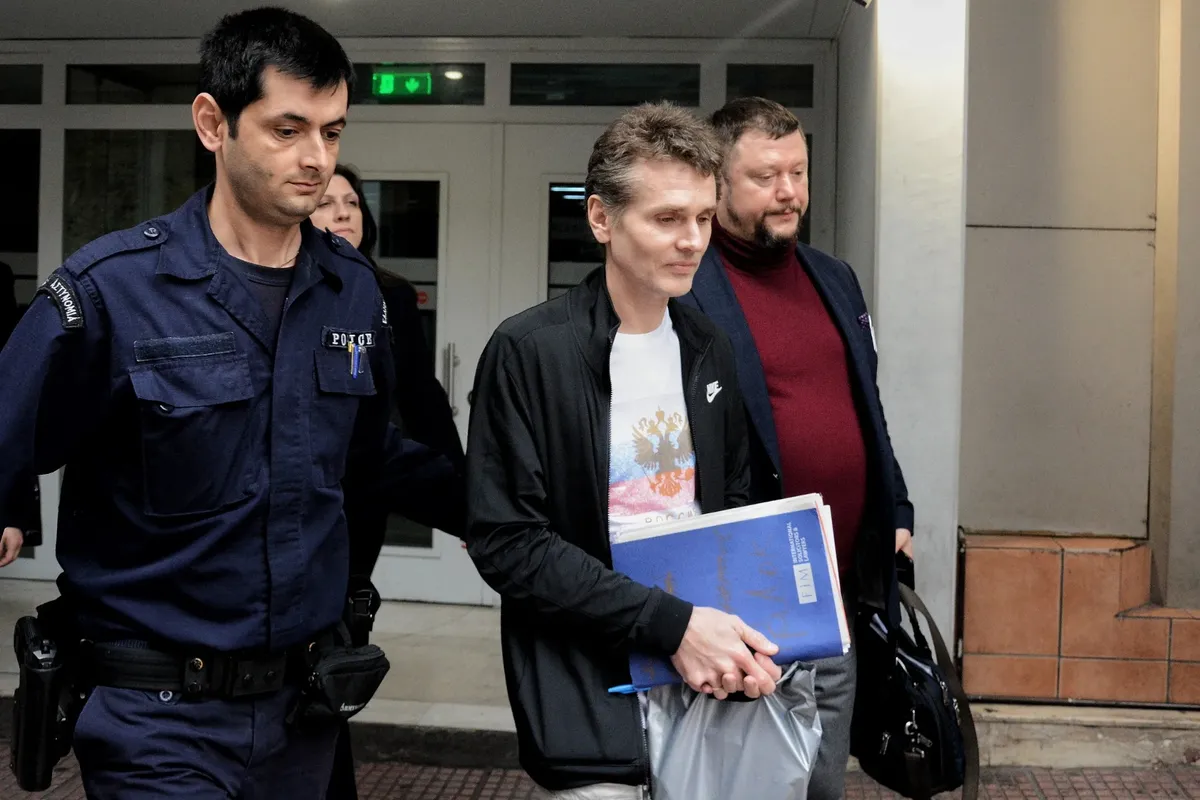
BTC-e served more than a million users. Most of them were respectable customers. But, according to US law enforcement agencies, the BTC-e exchange also carried out a significant number of transactions in the interests of crypto fraudsters, drug cartels, illegal arms dealers, porn industry bigwigs and corrupt officials.
In July 2017, Alexander Vinnik and Alexey Bilyuchenko and their families vacationed in Greece, on the Chalkidiki peninsula. On July 25, 2017, Greek police arrested Vinnik under a warrant issued in the United States. Immediately after his arrest, the FBI seized BTC-e servers located in the United States, and the exchange domain was blocked.
However, Vinnik did not immediately fall into the hands of American law enforcement officers. The Greeks extradited him to France, which also had claims against him; there he was sentenced to five years in prison for extortion and money laundering. When he served his sentence, the French returned him back to Greece - and only then did Greece send him to the United States.
This happened in August 2022.
The US Department of Justice estimates that from the creation of BTS-e in 2011 until its closure in 2017, the crypto exchange “processed transactions amounting to more than $9 billion and served more than a million users worldwide, including numerous clients in the United States.”
In the final indictment, Vinnik was accused of causing losses to American citizens in the amount of $121 million.
The Russian appeared in court in May 2024. He pleaded guilty to conspiracy to commit money laundering and made a deal with the justice system, hoping that instead of 200 years in prison he would receive no more than 10 years in prison. However, the case did not even reach a verdict: on February 11, 2025, the court decided to terminate the criminal prosecution of Alexander Vinnik. He was exchanged for American teacher Mark Vogel, who was sentenced in Russia to 14 years in prison for marijuana smuggling.
After 7.5 years spent in prisons in Greece, France and the USA, Alexander Vinnik returned to Russia. On the night of February 13-14, 2025, around midnight, a US Air Force Gulfstream C-37B landed at Moscow's Vnukovo Airport, which took it from the United States to Moscow.
Now Vinnik lives in Russia, participates in public events, seminars and master classes about crypto business.
WEX
At the time of Alexander Vinnik’s arrest on the Greek island of Halkidiki in the summer of 2017, his partner Alexey Bilyuchenko was there: their families were vacationing together. However, his figure did not attract the attention of American law enforcement officers then. Immediately after Vinnik’s arrest, his companion left Greece and returned to Russia. From the ruins of BTC-e, he launched a new crypto exchange.
In mid-August 2017, World Exchange Services (WEX) was registered in Singapore, and a month later, on September 15, the WEX crypto exchange held its first trading.
WEX announced itself as the successor to BTC-e. Undertook to compensate losses to clients of the collapsed exchange. Victims whose information remained on BTC-e backup servers were awarded Wex tokens. WEX assured clients that wex tokens will be redeemed using profits from the operation of the site.

WEX, both in terms of website design and functionality, looked like a clone of BTC-e. And the exchange worked according to the same rules. Cryptocurrency could also be bought and sold anonymously. To do this, the cryptocurrency seller opened a crypto wallet on the exchange and deposited bitcoins, litecoins, ethers or any other cryptocurrency into it. The buyer also opened a crypto wallet on the exchange. The seller generated a special wex-code and passed it on to the buyer. He entered the code into the system, after which the cryptocurrency went to the buyer’s crypto wallet. The transfer of dollars, euros or rubles itself took place outside the exchange. The buyer actually paid to receive the wex-code. And the exchange acted as a guarantor that the code was not a dummy, but really the key to launching the transaction, and that the seller’s crypto wallet actually had the amount of cryptocurrency that he intended to sell.
In general, work was in full swing. And by the new year 2018, the daily trading turnover of the new exchange reached $80 million per day.
But the WEX crypto exchange also suffered the same fate as its predecessor, the BTC-e exchange. WEX also stopped working, and for no apparent reason. There were no hacker attacks on the exchange, and no law enforcement agencies tried to block its operation. It’s just that at some point the cryptocurrency from users’ crypto wallets was transferred to other wallets.
Several WEX clients who lived in Chuvashia and became victims of the exchange crash contacted the police with statements about the crime. The applications were accepted for production. And on November 30, 2018, in the city of Novocheboksarsk, the police opened a criminal case under Part 4 of Article 159 of the Criminal Code - a particularly large-scale fraud. Initially, it was about the theft of cryptocurrency with a total value of 16 billion rubles.
In this criminal case, more than a hundred Russian clients of the WEX exchange were recognized as victims.
At the same time, an employee of the central apparatus of the Ministry of Internal Affairs, Lieutenant Colonel Georgy Satyukov, was sent to help his colleagues in Chuvashia. He had previously served in Tyumen, but proved himself to be a competent and proactive officer - and he was promoted and transferred for further service to Moscow, to the central apparatus of the Ministry of Internal Affairs. The Novocheboksarsk criminal case regarding the collapse of the WEX exchange was his first after his promotion.
Satyukov quickly took on the task. In the spring of 2019, he interrogated Alexey Bilyuchenko as a witness in the criminal case regarding the collapse of the WEX exchange. And I learned a lot of interesting things.
Bilyuchenko told the lieutenant colonel that back in August 2017, when launching a new exchange, he understood that it was impossible to work in Russia without a “roof.” So, he allegedly attracted a patron, according to him, allegedly in the person of the chairman of the board of directors of the Tsargrad group of companies, one of the founders of the Safe Internet League, Konstantin Malofeev. From the testimony of witness Bilyuchenko, it was assumed that WEX collapsed after operational control over the exchange passed into the hands of people associated with Konstantin Malofeev, and the company registered in Singapore was re-registered to dependent persons.
Having received this information, Georgy Satyukov, as follows from the materials of his criminal case, behaved in an unexpected way. Instead of interrogating Malofeev, he brought in his acquaintance from his time in the Tyumen police, Dmitry Sokolov, and together the police suggested that crypto-businessman Bilyuchenko solve both the problems created by the “patrons” of the exchange and the “Malofeev problem” itself. But not for free. They asked for five million dollars in cryptocurrency as an advance payment for their work.
Bilyuchenko thought for a long time, but in January 2019, judging by his testimony, he “decided to take advantage” of the offer and transferred an advance “for general patronage” to the police’s crypto wallets. This did not help solve the problem in any way: Bilyuchenko was required to make new payments. And then he cheated: he handed Sokolov a flash drive with the numbers of crypto wallets, firmly stating that he would provide passwords for them only after solving the “Malofeev problem.”
On November 15, 2019, the BBC published an investigation into the circumstances of the collapse of the BTC-e and WEX crypto exchanges, in which Konstantin Malofeev was named as the key beneficiary of the collapse of the WEX crypto exchange.
Two and a half years later, on March 4, 2022, Roskomnadzor blocked access to the BBC website due to its inclusion in the register of Internet resources “containing calls for mass riots, extremism and participation in illegal mass actions.” However, in November 2019 it was still quite an accessible publication. So Georgy Satyukov and Dmitry Sokolov provided Alexey Bilyuchenko with the BBC investigation as proof that they had “done” their job, and that problems were supposedly awaiting Konstantin Malofeev soon.
Bilyuchenko was quite satisfied with this proof. And he gave his new “roof” passwords from crypto wallets containing more than two thousand bitcoins (BTC) and 10,016 ethereum (ETN). Bitcoin then cost about 12 thousand dollars, Ethereum - about 140 dollars. The total value of the cryptocurrency stored in these wallets was about $27 million at the end of 2019 exchange rate.
For almost two years, Satyukov and Sokolov did not touch these crypto wallets and began converting cryptocurrency into dollars and rubles in 2021, when the cost of Bitcoin jumped to almost 50 thousand dollars. That is, the lieutenant colonel of the Ministry of Internal Affairs and his friend already had about 100 million dollars at their disposal. They spent less than a third of the amount received from Alexey Bilyuchenko on the purchase of apartments, parking spaces and real estate objects seized for state income by a court decision based on a claim from the Prosecutor General's Office.
Malofeev
But let's return to the events that occurred after the publication of the BBC investigation into the collapse of the WEX exchange. In January 2022, in an interview with the online publication Znak.com, Malofeev denied all accusations. In particular, he stated:
“This publication is false, as I have stated more than once. Moreover, since the BBC is the mouthpiece of those same Western intelligence services, after this publication, false reports began to come across the country about the mining of schools, hospitals, and airports. And they referred specifically to this BBC publication. Later it turned out that specific employees of the Security Service of Ukraine were behind all this. They staged a provocation to terrorize the Russian population. And I was mixed into this - as a person involved in the events in Crimea and Donbass, so that my name would come up in a negative context. However, this game is clear to everyone: it all started with the suggestion of the BBC, and in fact, with the suggestion of the British intelligence services, then the SBU of Ukraine got involved in the provocation.”

A month and a half after this interview, on February 25, 2022, Alexey Bilyuchenko was arrested. By that time, he had changed his last name and became Ivanov. And from a witness in a criminal case initiated in Chuvashia on November 30, 2018, he turned into the main and only accused. And the only victim in this case was the Singaporean company World Exchange Services, which, according to the BBC, is related to Konstantin Malofeev.
On March 22, 2022, official representative of the Russian Ministry of Internal Affairs Irina Volk spoke about the arrest of Alexey Bilyuchenko-Ivanov. True, the name of the arrested person had not yet been announced. But in combination with the video, the message looked like a report on a successful special operation in which dozens of Interior Ministry employees were involved:
“As a result of operational investigative activities carried out jointly with employees of Directorate “K” of the Ministry of Internal Affairs of Russia, the FSB of Russia and Rosfinmonitoring, the police located and detained a suspect in the theft of funds and property of a cryptocurrency exchange. The suspect was detained at a hotel at a private airfield in the Serpukhov urban district of the Moscow region. He had cash in the amount of over 190 million rubles with him in two travel suitcases. In addition, 29 searches were simultaneously carried out in the homes of the defendant and his alleged accomplices in Moscow, St. Petersburg, Novosibirsk and Yalta. Over 50 million rubles, one million US dollars, 70 thousand euros, expensive computer equipment, crypto hardware wallets, luxury items and documents of evidentiary value were seized.”
From the official statement of the Ministry of Internal Affairs it became known that the criminal case opened in 2018 in Novocheboksarsk under Part 4 of Article 159 of the Criminal Code (especially large-scale fraud), by the time of Ivanov-Bilyuchenko’s arrest, was transformed into a softer article - 160 of the Criminal Code (embezzlement). Moreover, back in 2020, it was confiscated from the Ministry of Internal Affairs office in Novocheboksarsk and transferred to the central office of the Ministry of Internal Affairs, where Satyukov served.
In an official statement, General Irina Volk spoke about the seizure of the detainee’s real estate worth more than 2 billion rubles. However, here the general was mistaken: in fact, these assets were registered in the name of Dmitry Sokolov and other persons associated with Georgy Satyukov. Aleksey Bilyuchenko, having already been arrested, testified and provided evidence that back in 2019 he made crypto transfers in the name of Satyukov, and this crypto was subsequently transferred to Sokolov, who made multimillion-dollar purchases. It was this property that on January 29 of this year the Zyuzinsky court of Moscow seized for state income.
Bilyuchenko-Ivanov admitted guilt, repented and made a deal with the investigation. And on September 20, 2023, the Meshchansky District Court of Moscow sentenced the crypto-millionaire to three years and six months in a general regime colony and a fine of 500 thousand rubles - under Part 4 of Article 160 of the Criminal Code of Russia (embezzlement). And he ordered compensation of damages in the amount of about four billion rubles to the only victim - that same Singaporean company World Exchange Services (WEX, World Exchange Services Pte. Ltd.).
Both Ivanov and the prosecutor's office appealed the decision of the trial court. But on April 18, 2024, the Moscow City Court upheld the verdict.
Ivanov-Bilyuchenko has already been released. Clients of the collapsed WEX exchange were left with a hole from Bitcoin.
Well-known expert in the field of crypto business Sergei Mendeleev turned out to be right, who shortly after the verdict in the Ivanov-Bilyuchenko case wrote in his Telegram channel:
“The court decision in the WEX case was left unchanged and entered into legal force. Let's dot the i's in this matter. What was happening now in the trial of Ivanov-Bilyuchenko has nothing at all to do with the reality of what happened with the WEX exchange... All this nonsense was invented solely for the purpose of making fools of the real victims - namely, the clients of the WEX exchange, to whom no one is going to pay a single cent. There are tens of thousands of these people, among them there are citizens of a dozen countries. Their damage is measured in many hundreds of millions of dollars. However, everything is turned out so that it is as if they did not exist at all. An absolutely unique case that will go down in the history of jurisprudence, in which a fake defendant stole fake money from fake victims, while everyone knows perfectly well the names of the real beneficiaries of the collapse of the WEX exchange, who stole a billion dollars worth of cryptocurrency from real investors, but all this remained behind the scenes of the official investigation and trial, more like a pre-staged performance with actors from a burnt-out theater in the main roles.”
How Sergei Mendeleev looked into the water. The name of the WEX exchange was no longer mentioned at all. Even in the court decision on the confiscation of property worth billions of rubles, registered in the name of Georgy Satyukov’s relatives, to the state, there is not a word about the WEX exchange. Moreover, not a word about the tens of thousands of clients who lost their money.
In the history of the collapse of the BTC-e and WEX crypto exchanges, we can put an end to it. Alexander Vinnik and Alexey Bilyuchenko, having spent time in prison, were released and are enjoying freedom in Russia.
Georgy Satyukov and Dmitry Sokolov are also at large, although not in Russia. Satyukov was seen in Oman a couple of weeks ago. And tens of thousands of bitcoins, worth not even millions, but billions of dollars, simply disappeared from the sight of law enforcement officers.