
Translated material
Little morning secret
At the end of the Berlin festival, the public was shown Josephine, the main film of the Sundance festival, awarded the Grand Jury Prize and the Audience Award.

Still from the film “Josephine”
The Berlin Festival ends today and the Wim Wenders jury will announce the winners. The general feeling is that the competition is significantly inferior to previous years, although several good films were shown towards the finals (including “Josephine” by the Sundance winner). But it seems that for all the assurances of festival director Tricia Tuttle that the current Berlinale focuses on cinema and not on politics, it turned out exactly the opposite. With all the dominance of the “agenda” (brave women of the East with open faces, childhood traumas, creators in totalitarian systems, films from developing countries), scandals unfolded precisely because of insufficient attention - as it seems to the current star pro-Palestinian activists - to today's conflicts and a clear position (we are talking about the boycott of Israel).
Although Perspectives included “Chronicles of the Siege” by the Palestinian Abdallah al-Khatib. The lives of ordinary Palestinians are in ruins under siege. It seems unrelated to current events, but the final credits are dedicated to the genocide of the Palestinian people, which has been ongoing since 1948. The film is predicted to win this section.
The public is dissatisfied with the absence of major stars at the festival, and photographers are clearly bored on the current snowy red carpet.
It seems to me that the festival, which in recent years has been noticeably inferior to both Cannes and Venice, trying to please political trends and European trends, picking up the “crumbs” of other film shows, needs an overload, a clear independent artistic idea. And even scandals suit strong competition.
And at the end of the competition they showed “Josephine” by Beth De Araujo , the main film of Sundance, awarded the Grand Jury Prize and the Audience Award.
Early on a gray morning, eight-year-old Josephine (Mason Reeves) races her dad (Channing Tatum) to the park, overtakes him and... finds herself witnessing a sexualized abuse: a rapist attacks a girl who went for a jog in the park. And little Josephine, frozen, stares at this monstrous act. She is scared, and curious, and incomprehensible, but no, still very scared. Dad, who called the police, is at a loss, not knowing how to answer the question: “What did uncle do?”
Josephine is seriously interested in what rape and sex are and is looking for answers on Google.
The adults are trying to calm the girl down, and at first it seems that she is not very worried, as if she is falling into prostration. But neither the father, nor the mother, nor the child psychologist have enough words to explain to the child what happened. Fear creeps into her. He takes on the specific appearance of a rapist - a completely ordinary, even charming young male with blond hair and an aquamarine polo. This man, who was immediately arrested, is “stalking” the girl. He walks around the apartment like a businessman - invisible to adults, sits next to her bed at night, looks out the window from the street. And even eats her favorite cookies.
From that moment on, little Josephine seems to lose her thread. She tries to take out the fear with aggression, which pulsates and beats inside, trying to break out. Aggression seems to be defending against an incomprehensible creeping danger emanating from all men. She chooses a machine gun instead of a doll at a toy store, and at home she arms herself with a knife and scissors. In retaliation for his classmate’s rudeness, he puts a bag over his head and tries to choke him. She is completely inadequate and does not know how to formulate her psychological problems.
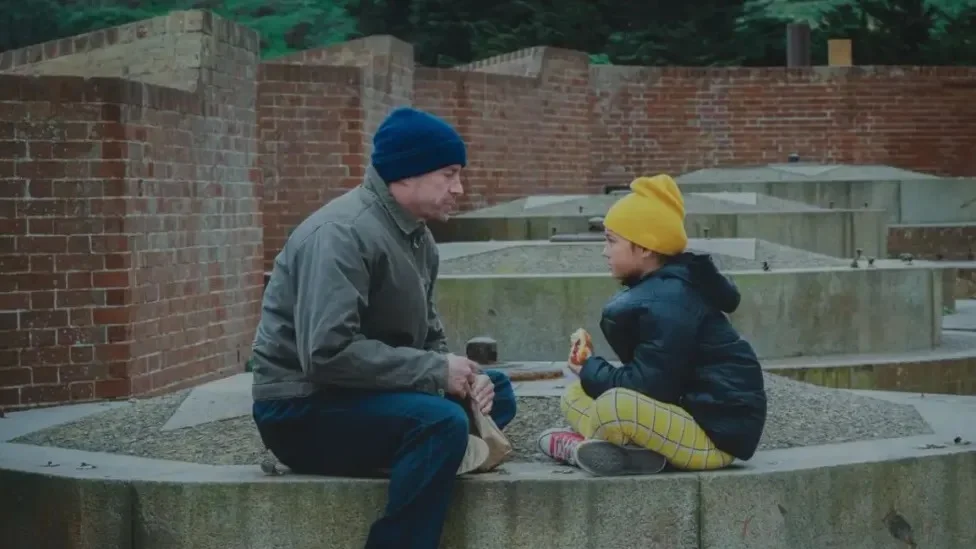
There are wonderful actors out there. Tactile, gentle Gemma Chan, trying to share the child’s pain and not understanding how to do it. Channing Tatum’s somewhat straightforward, brutal, but caring dad solves problems in his own, masculine way: he assigns Josephine to the self-defense section, shows how to properly hit his counterpart in the stomach who frightens her.
Adults console: “Don’t worry, this will never happen to you.” But Josephine turns from an object, from a witness of abuse, into a victim, then into a threat... And how can one maintain tenderness and patience with a child who is completely out of control?
The main thing in a movie is the atmosphere created by fragmentary, uneven sounds instead of music, a camera (amazing cinematography by Greta Zozula), precise editing that sets a tight but ragged rhythm (at a meeting with the audience, the director said that she initially shot the film in one shot, but the timing stretched to four hours, and she re-edited it). But the main magnet is the amazing sincerity of the existence of the young actress Mason Reeves.
A movie about how violence corrodes everything around: the psyche, family relationships. How difficult it is to regain the trust of the adults of your child, who yesterday was selflessly devoted, and today he felt that the adults had betrayed him.
While watching this not outstanding, but really strong picture, I remembered Natasha Meshchaninova’s wonderful quiet film “A Little Night Secret,” which raises an even more terrible topic - domestic abuse, from which a child has no way out at all. During the discussion of the “secret” in “Illusion,” the audience talked about how important it is to talk about such problems in cinema. Both films are united by the theme of the insurmountable distance between children and adults. The unbearable difficulty of dialogue.
There was a serious fight to buy the film at the film market. Sumerian Pictures won. She acquired the rights to distribute Josephine in the United States. The deal is valued at seven figures and includes a commitment to a wide theatrical release and a full Oscar campaign.
Alas, “Little Night Secret” was never given a distribution certificate.
MORE ABOUT CINEMA
Larisa Malyukova runs a telegram channel about cinema and more. Subscribe here .