
Translated material
“Lord, burn!” Dmitry Bykov* is delighted with Gore Verbinski
Gore Verbinski's first film in eight years, Good Luck, Have Fun, Don't Die, dedicated to humanity's struggle with artificial intelligence, has been released in America. Writer Dmitry Bykov, a longtime admirer of the work of the director who gave us “Pirates of the Caribbean” and the American “Ring,” believes that Verbinski made a very relevant movie, the audience of which should quickly unite, like his heroes, in order to defeat the future.
Gore Verbinski's new film is extremely vulnerable to unkind snobbish criticism, and I would recommend it to only two categories of the population: some love Verbinski and feel a special kind of almost mystical closeness with him, others feel that the world is going to hell, and not into the usual ass into which it always goes, but into some new, final and irreparable one. However, I do not rule out that these two categories of viewers completely coincide.
That same connection struck me once again when, at the beginning of the new film, its hero turned out to be a schoolteacher who is trying to get his class to read Anna Karenina. The fact is that the course “Anna Karenina. Slow reading” I read at my university, in the spring semester. And the main argument in favor of choosing this particular course was my homemade invitation poster with Keira Knightley (Verbinski’s schoolchildren mention her). It is extremely difficult to believe in such coincidences. It’s just that “Anna Karenina” is the most complex and perfect of psychological novels, a text on the verge of realism and symbolism, and it is the loss of complexity and the crisis of symbolist philosophy that this film by Verbinski is dedicated to, with all its apparent pop appeal.
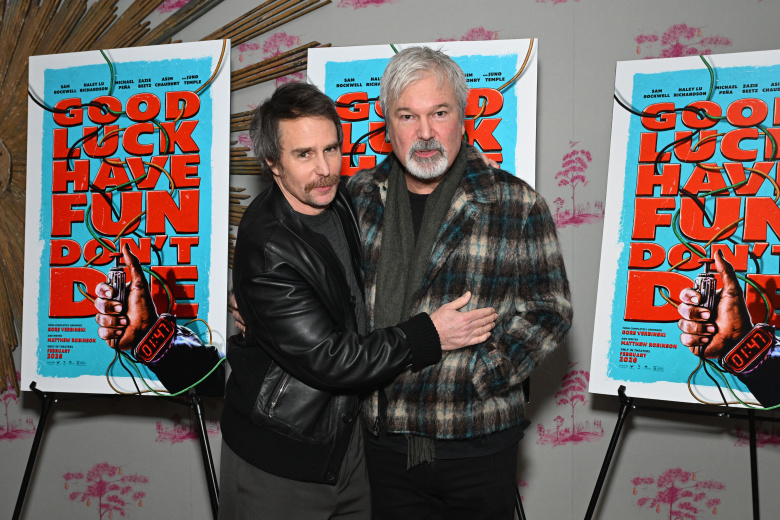
Sam Rockwell and Gore Verbinski at a special screening of the film "Good Luck, Have Fun, Don't Die", January 27, 2026
Slaven Vlasic / GETTY IMAGES NORTH AMERICA / Getty Images via AFP
In an interview that the director gave me in 2013, when he brought his “Lone Ranger” to Moscow, he almost verbatim pronounced the monologue of the alien from the future from the film: progress, like the train from “Ranger”, uncontrollably tears up space, lays its straight paths along the complex terrain of the earth, but sometimes it can be stopped by the so-called Noble Savage (who doesn’t believe, you can see : just try to compare viewing time).
That is, Verbinski already had the idea for this picture back then, in 2013. And in all his other films, there was an alarm about total slavery, those same three morning minutes of “what-are-they-writing-on-Facebook,” which then stretch for a full day. In "The Ring" (2002) - in my opinion, much superior to Hideo Nakata's Japanese original - the creepiest sequence was a panorama through the windows of a skyscraper, where in every apartment there is a TV, and in every TV there is a monster.
In a sense, Verbinski’s entire cinema is a desperate and hopeless protest against the mechanization of life and, most importantly, the creative process (it is not for nothing that he repeatedly admitted that he would not like to understand the mechanism for generating his own ideas, to put the subconscious under control, which was the dream of all modernists, starting with Freud). He continues to tell children's, at times extremely naive, fairy tales, the standard example of which was the “pirate” franchise.
After Verbinski, she instantly lost her shine, although she retained her scope: “expensive and rich,” or something else.
Verbinski loves and knows how to combine the most cynical black humor - look at the flashback with the cloning of victims of school jokes, which in the future became daily - with frank pressure on the tear glands. He is sentimental, but this does not prevent him from seeing the main danger precisely in children, in the infantile teenage consciousness. It’s not for nothing that zombified schoolchildren, receiving signals for aggression from their mobile phones, almost ruin the entire mission for the heroes. And God himself - the artificial intelligence of the future, which finally replaces reality with its high-quality imitation - appears in the image of a bald-shaven autistic child, the Creepy Boy. By the way, the only truly scary episode in “Good Luck, Have Fun, Don’t Die” is when he starts screaming; this is not what you expect.
Subscribe to read in full
Subscribe to Redefine.Media to read Republic
Subscribe [You can pay with a Russian or foreign card. The subscription is renewed automatically. You can unsubscribe at any time.]
Where does the subscribers' money go?