
Translated material
"The whole world to Frida! I love you!" The life and death of the artist Alexander Dotsenko in the colony
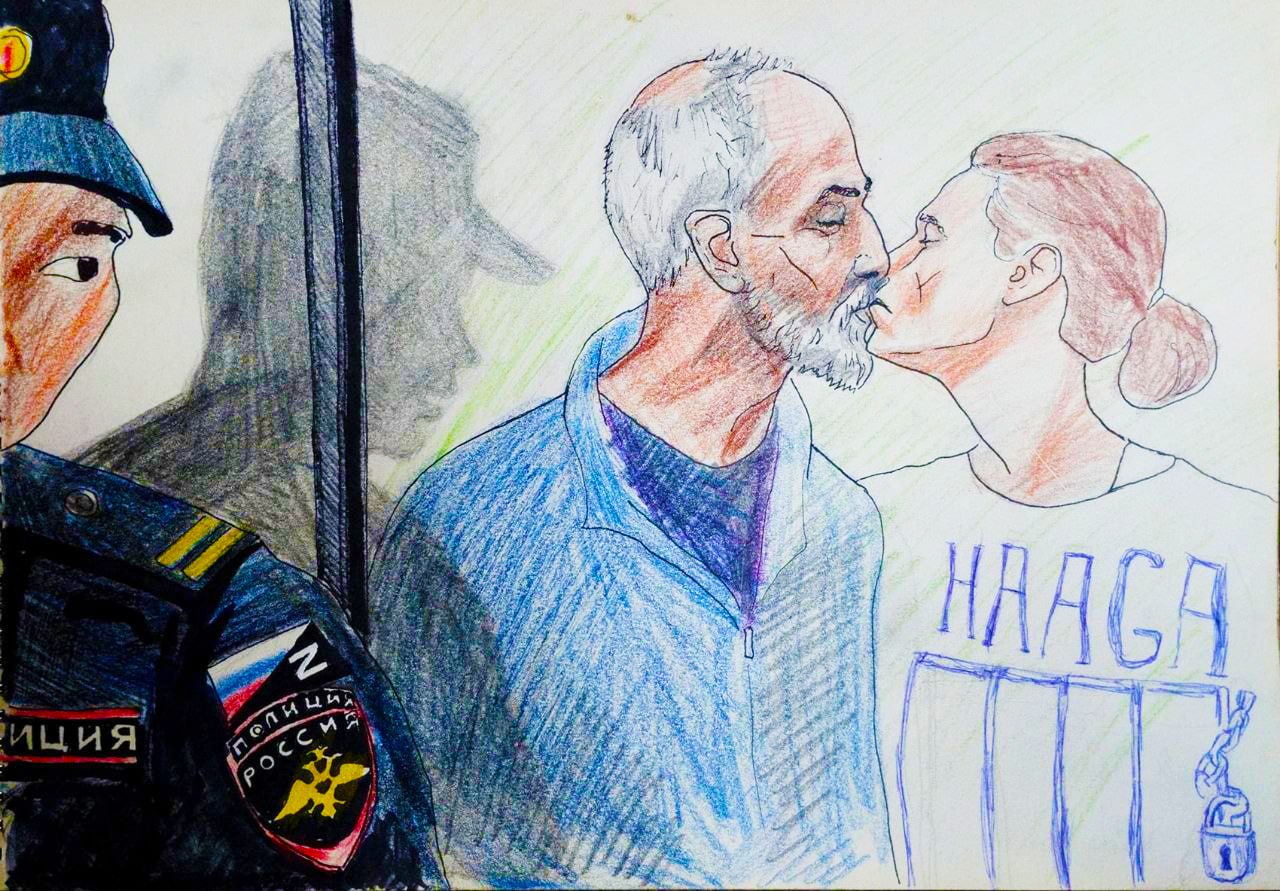
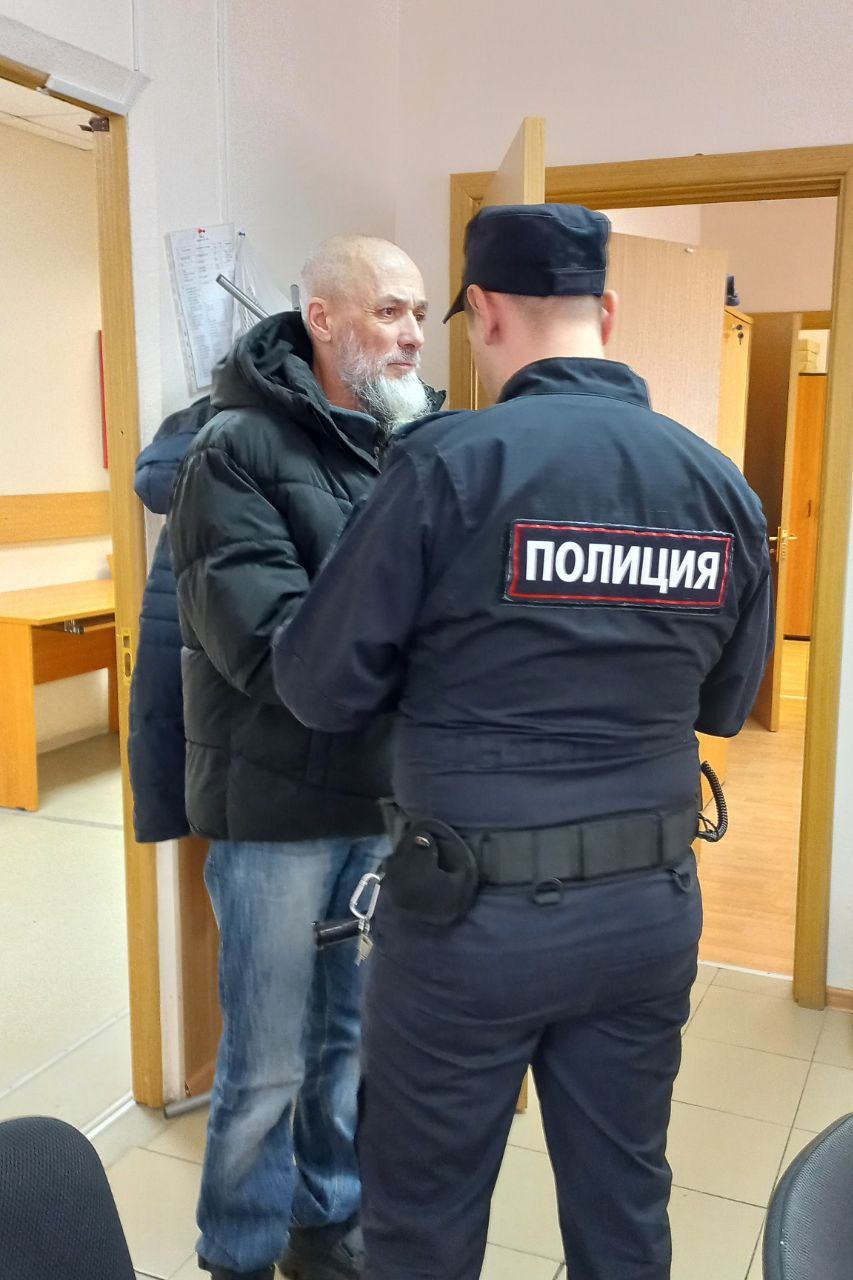
On Thursday, February 26, in the village of Taitsy, Leningrad Region, they said goodbye to the artist Alexander Dotsenko. He was 65 years old. On February 12, he was taken from the colony to the hospital with a massive heart attack, and on February 19, he died. Spouses Alexander Dotsenko and Anastasia Dyudyaeva from Gatchina were sentenced in 2024, respectively, to three and three and a half years of imprisonment in a penal colony, accused of “calls for terrorism.” A case was brought against them because of pro-Ukrainian leaflets in the Lenta supermarket. One of them had the phrase “putinyaku na gilyaku” (“Putin to the gallows”). Dotsenko and Dyudyaev were not found guilty; a handwriting expert from the prosecution in court doubted that they were the authors of the inscriptions on the leaflets. Alexander was serving his sentence in a colony settlement in St. Petersburg, his wife Asya is in KP-4 in Karelia, she was not allowed to say goodbye to her husband.
From the last letter of Asya (Anastasia) Dyudyaeva, wife of Alexander Dotsenko:
“My dear husband Sasha! You gave me 11 years of love. Every day, every minute I felt and knew that I was loved very much! I love you very much, Sasha! You are a special person. It’s hard for me to realize that you are no longer there, because I really want you to be near... And you are close, because you live in my heart in my soul.
I was strong because I had you. I felt whole. Your love saved me even when we were far from each other...
I re-read your letters to me many, many times, drowning in your love.
All these years I have felt your support and care. And even in prison I was not alone, knowing that we were going through this together... You promised to come to see me in Karelia in a year..."
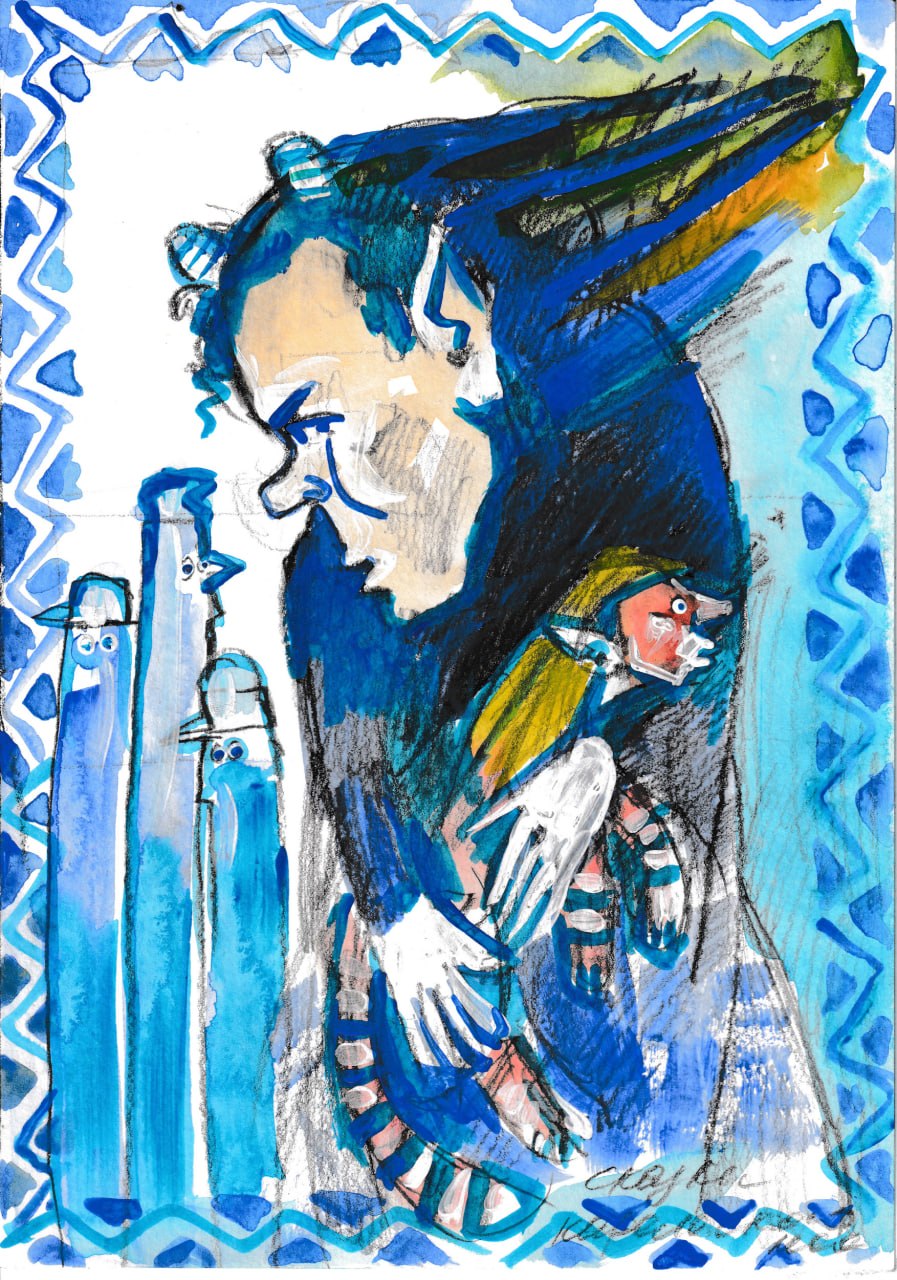
And he sent her this drawing in one of his last letters. “This is you and me in the north of the bay, looking at the sunset,” Alexander wrote.
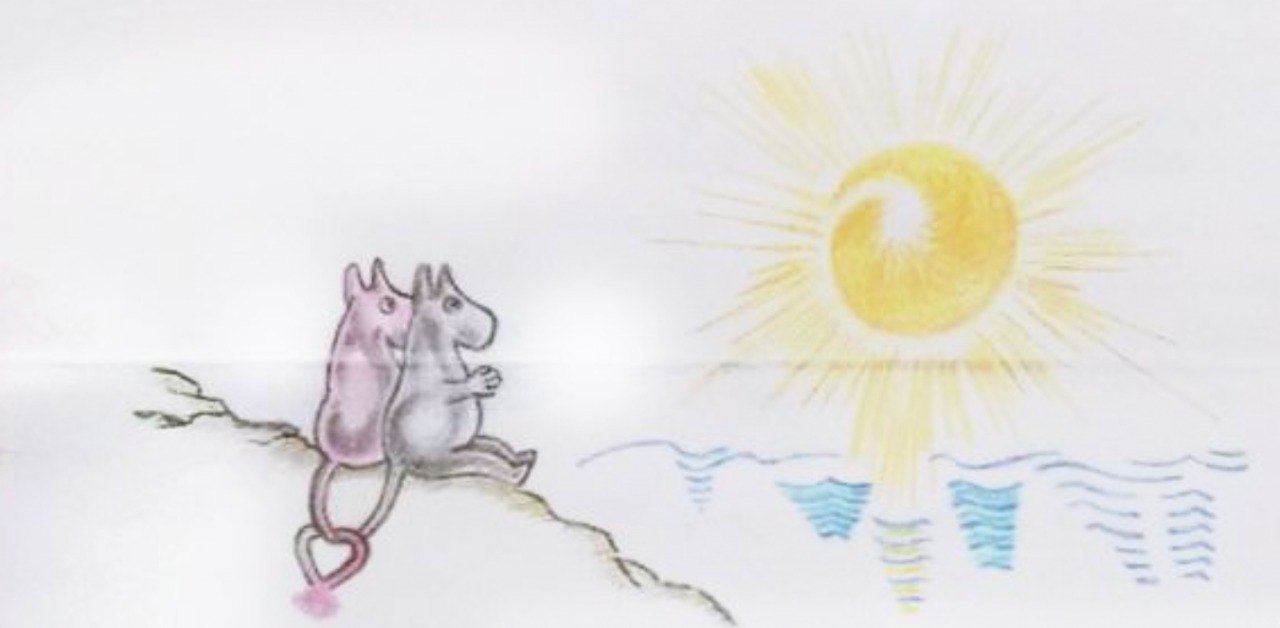
– For me, this is, first of all, a love story. Pierre Abelard and Heloise, Amedeo Modigliani and Jeanne Hebuterne, Frida and Picasso (Frida Kahlo and Picasso were not lovers, they were friends and admired each other’s work - SR) , Asya and Alexander. Frida is Asya’s pet nickname, as Alexander called her, in honor of Frida Kahlo. And the cellmates in the Gorelovo pre-trial detention center nicknamed Alexander himself “Picasso,” and that’s how he signed his letters: “Picasso,” says Natalya , who communicated with Alexander.
From a letter from Alexander Dotsenko to one of the volunteers, 07/06/2024:
“One of the housemates called me Picasso in my first “hut.” I condescended and drew a portrait of his sister from a photo. It’s of little interest to me in every sense, but there are two employees whom I would gladly draw, even though I’m not a portrait painter. There’s such a texture, such types, in general, nature didn’t offend them. I offered to one, but he refused, which is a pity! Yes, Picasso is great, without any buts! But my attitude towards him is divided, or something... Some of him phrases are interesting and shocking, if they are not attributed to him, and even scandalous. But, on the other hand, do I have the right, excuse me, to “crush the loaf” on Picasso himself? As a layman (viewer), if closer to the point, yes! “Everything I spit will be art,” this is his phrase, after Macel Duchamp with his object “Fountain” everything is even very harmonious and correct.”
Court and case
Alexander Dotsenko and Anastasia Dyudyaeva were detained at the end of January 2024. Before the initiation of a criminal case, 46-year-old Dyudyaeva worked as a graphic designer. Alexander is originally from Ukraine, he is also an artist, was a children's athletics coach, made jewelry, was a multiple participant in the World of Stone and Junwex jewelry exhibitions, and a member of the Union of Artists of St. Petersburg. He loved jazz and collected a whole collection of vinyl with music of different genres, he adored poetry, and most of all he appreciated Byron. Both Alexander and Anastasia participated in various art exhibitions.
The prosecution's evidence was based on recordings from a video camera in the Lenta store in St. Petersburg on Tallinskoe Highway, which captured store visitors. At the same time, even experts from the prosecution could not accurately determine whether Dotsenko and Dyudyaev were in these frames, but “came to presumptive conclusions that Dotsenko did something and stuck something on certain goods.”
“There were already two offended citizens, they were witnesses at the trial,” says Konstantin , a friend of Alexander who went to all the hearings. – Oleg Gennadyevich Kalenchuk came to court in a medical mask, said that his neighbor had brought a “bad” postcard with offensive content from work, and it was allegedly given to him by a supermarket visitor who found it there. The second witness, Lidiya Aleksandrovna Egorenko, an employee of the metro clinic, is a downtrodden, shabby, although quite young woman, who also showed consciousness. Egorenko told the court that she found the postcard in a purchased box of imported chocolates. According to her, the box was sealed and not damaged; it would have been impossible to put a postcard in it on the sales floor.
One of the postcards, which the investigation studied, depicted a New Year’s tree and a hanged man; there was written a Happy New Year greeting and the inscription “Putinyaku on the Gilyak,” the literal translation of which is “Putinyaku on the branch.” The translator, who participated in the criminal case, translated the phrase not literally, but by adding or removing some words and punctuation marks from it - “Putinyak, hang him on a branch,” although neither the word “him” nor the word “hang” was in the original text of the postcard.
Specialist Ilya Mikhailov, who examined the drawings for calls for terrorism, said during interrogations at the FSB that “the meaning of the phrase is a call to hang a certain Putinyak from a branch.”
In court, Mikhailov said that the translators “transformed” the phrase so that the expression became clear to “the person who reads the case materials” and to “convey the exact meaning.” Mikhailov decided that they were going to hang the Putinyak, based on the picture on which a tree was drawn and an appeal to the slogan “hang communists.” “This is not an addition, but a translation transformation. I believe that it is necessary, since in the phrase “Putinyak on a branch” it is not entirely clear what needs to be done, it appeals to the well-known slogan “hang communists”. The word “hang” has been added here to make it clearer. You can put someone on a branch, but here we are talking about hanging,” Mikhailov said at the trial.
The artists' lawyers asked the court to summon translator Stebleva, who translated the text of the postcard, and linguist expert Irina Marinina, who conducted a linguistic examination of the text, for questioning. Marinina’s conclusion states that “in the case of another translation, the meaning of the conclusion may change.” The court refused to question witnesses.
In her last word, Anastasia said that she was being tried for being an artist; Alexander said that the entire accusation was based on “fictions and riddles.”
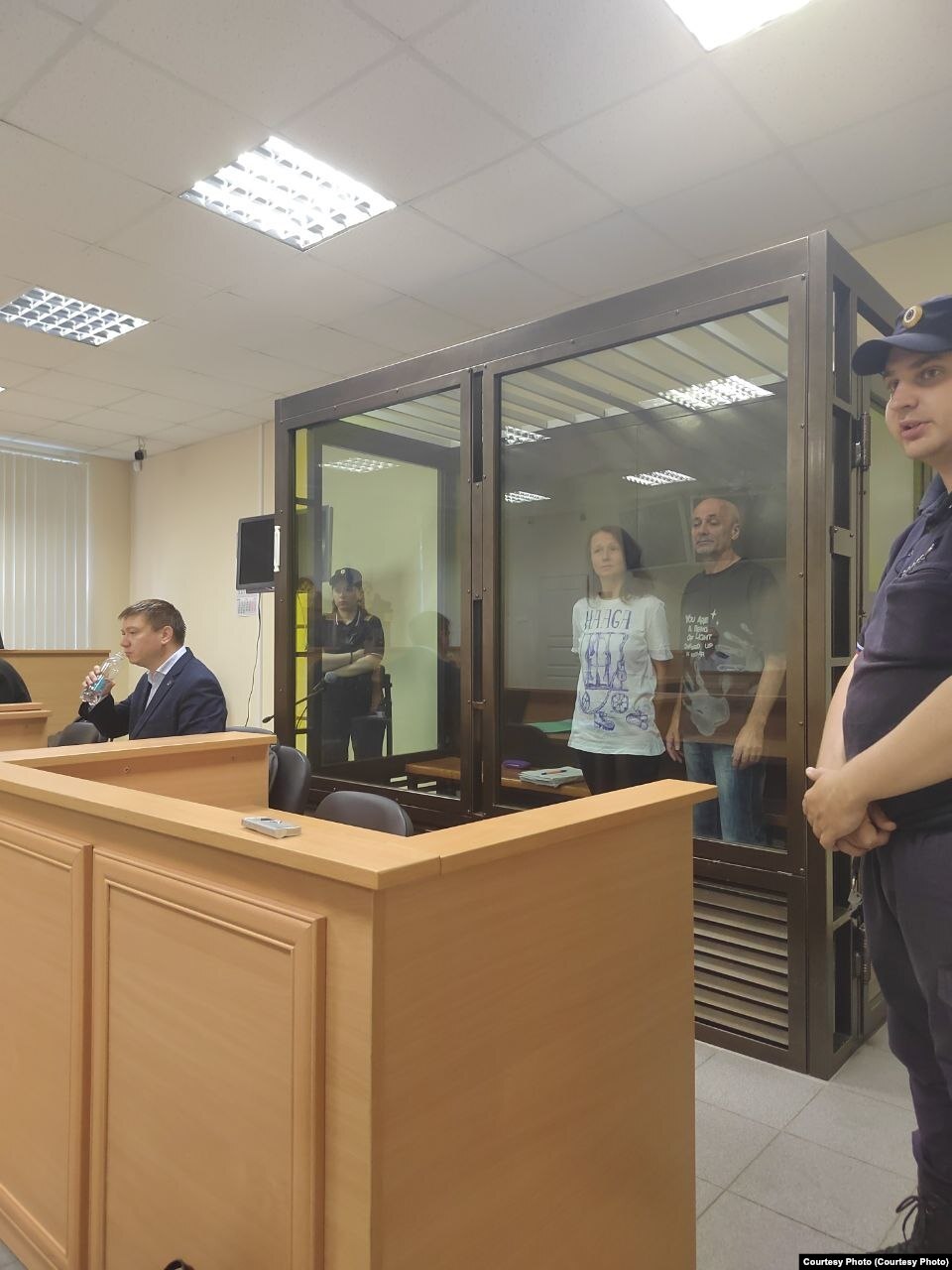
“The prosecutor, bringing charges and based only on fabrications, conjectures, riddles, fabrications, is in fact wiping his feet on the judicial system of the Russian Federation. This does not do honor to our high court and negatively affects, to put it mildly, a not very good portrait of our system. Therefore, I believe that an acquittal will raise the Russian flag to new heights and countries unfriendly to us will not point a finger at us that there (in Russia) they are just imprisoning everyone in a row. This will be an honor for the court, and for you personally, your honor, and for our entire society as a whole. It is in your power to prove that Russia is a real democratic and European state. This is only in your hands. And this [an acquittal] will be regarded as another victory for Russia over its Anglo-Saxon opponents and all of Europe,” said Alexander Dotsenko in his last word.
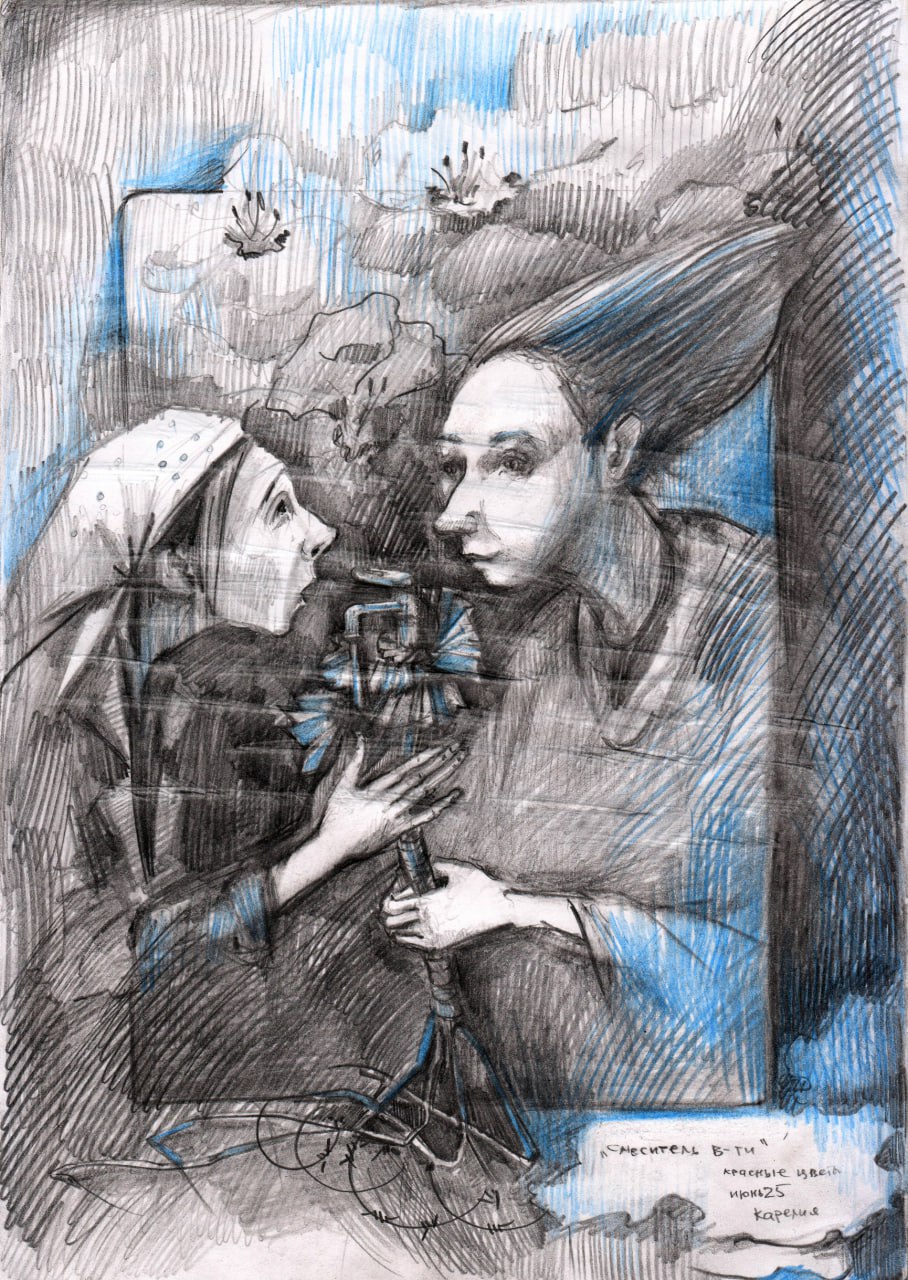
"I am an artist. What does an artist do? He draws, paints pictures. I draw what I see, I paint what I feel. Whether I am a bad artist or a good one, what kind of artist I am - maybe this will be judged later. I believe that I reflect reality with my works. I would like to talk about one case under Stalin, when about 10 artists were shot. Someone didn’t like that they put shadows on the leader incorrectly, somewhere, I don’t I remember. All these people were shot. I believe that today I am being judged for the fact that I am an artist, for my creativity. If someone sees something in my works, this does not mean that it actually exists and that I specifically wanted to put something into it. It may seem to someone that I did something wrong,” Dyudyaeva told the court.
At the announcement of the verdict, they were together for the last time - in the same “cage”. Alexander was given three years, Anastasia - 3.5 years in a penal colony. He was left in St. Petersburg, she was sent to Karelia.
From a letter from Alexander Dotsenko to one of the volunteers, 06/30/2024:
“Let me return to the appeal. According to Asya’s and my article, there is no option for a day in two or even a day and a half. There is no option for parole (parole - SR). But there is also no substantiated violation of the law. If you follow the letter of the law, the Criminal Code, the Code of Criminal Procedure, the Constitution of the Russian Federation, then everything that the soul desired has been violated. If guilty, the punishment is lenient, if innocent - harsh.. All my hope is for a fair decision of the court of appeal for me and Asya. And then maybe it will follow the plots of oriental fairy tales, inhabited by genies, padishahs, little guys and animals who transport cargo of paramount importance.”
The appeal court upheld the verdict in February 2024.
"He was a big kid"
Konstantin worked in the theater with Asya’s mother, he knew her when she was a 12-year-old girl. When Alexander appeared in her life, he became friends with him.
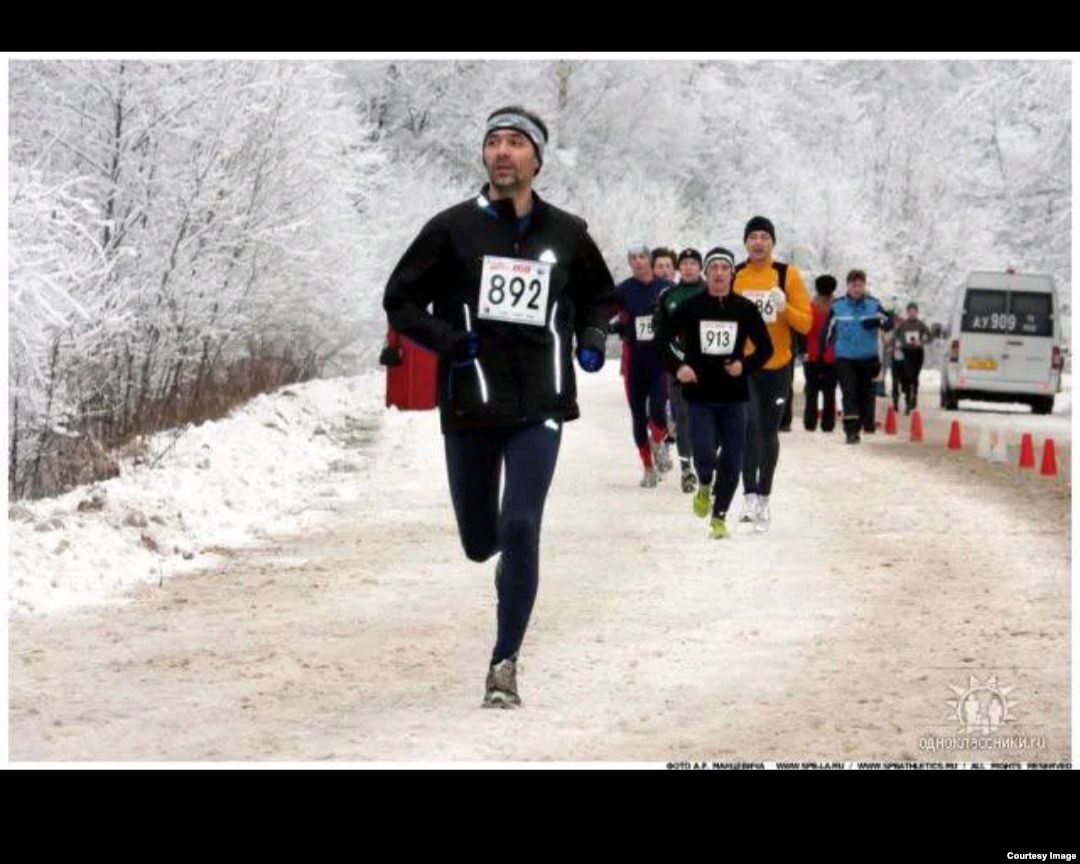
“He was a kind, good person, such a big child.” Asya, despite the fact that she is much younger than him, is more mature or something, she is more collected, more disciplined, she has a masculine character. She works a lot in the colony, draws every day... I was involved in a theater studio, Asya made scenery for performances, was engaged in interior design, Sasha not only drew, but also designed rings, and was always with a soldering iron. He also knew how to light people up. He himself is very athletic, such a social activist, a truly passionate person, he loved running and encouraged many people to take part in marathons - he himself participated in them, organized them, and was a pacemaker. I was very worried that while he was in prison, various competitions were being held, but he did not participate in them.
From a letter from Alexander Dotsenko to one of the volunteers, 07/21/2024:
“The week turned out to be difficult and difficult mentally, two moves and a long trial in one week, it’s not easy. I didn’t eat very well, there was no appetite, it’s always like that when moving, I ran, strength training (training - SR), I emasculated myself physically and psychologically, and the heat was humid and humid.”
From a letter from Alexander Dotsenko to one of the volunteers, 08/10/2024:
“The cold is slowly receding, I’m glad about that! There is one more joy - the sneakers arrived, I tried it once! 30 minutes - the flight was successful.”
– Alexander opened the world of ultramarathons for me. I know that he and Asya met in the athletics section, where he himself ran and trained marathon runners. He talked a lot about the philosophy and strategy of running, about famous marathon runners (he even remembered their records by heart!). On his recommendation, I read the book by the famous runner Dean Karnazes, “The Runner's High: Older, Wiser, Slower, Stronger.” And I realized that ultramarathons are not only about numbers, they are not only about running. This is about all of us,” says Natalya, who communicated a lot with Dotsenko and corresponds with other political prisoners. – Our recipients, political prisoners – they run their ultramarathons for days, months, years. At the moral-volitional level and at the limit of strength. This is not an elastic stadium track, these are mountains, rivers, deserts. But sometimes, already losing strength and sense of orientation in space, they are able to stop for a moment and see the sky, admire the sunset. And there we are, volunteers, we, too, in the sun or in the rain, stand at the food stations with our letters, parcels, parcels, ready to give them something to drink, feed, rub their sore legs, just rejoice at the runner, exchange a few words, and wait for everyone at the finish line, every single one of them. I really hope that Asya will finish this marathon, for herself and for Alexander.
When you start volunteer correspondence with a new person, you don’t know what will hook you this time, Natalya continues, in the case of Alexander it turned out to be handwriting.
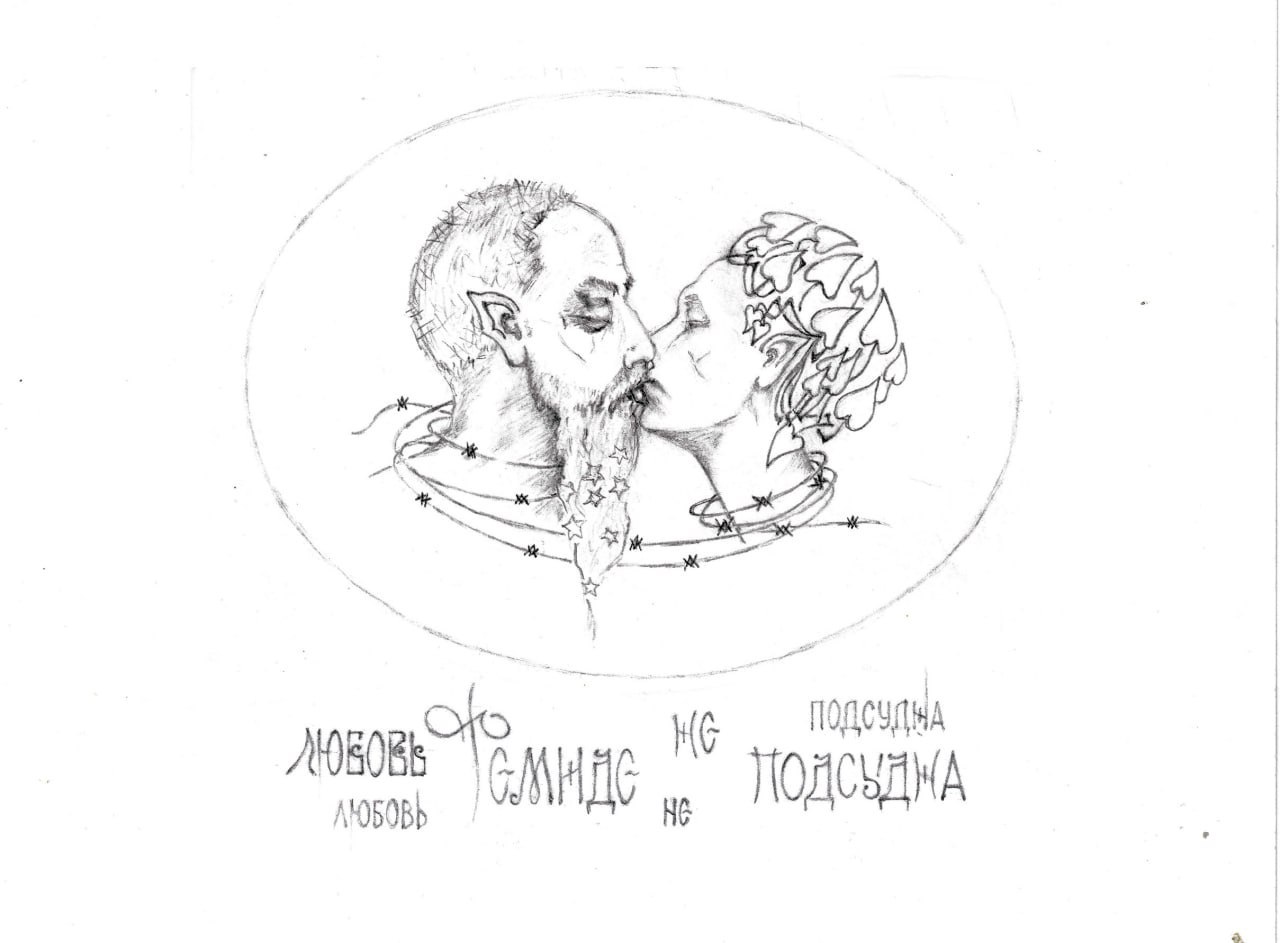
“You rarely see such beautiful handwriting these days, especially among men.” He fascinated me, as did his manner of writing, and then his speech. Soft, delicate style, imagery, ability to listen, maintain a conversation on many topics, erudition, erudition, the list goes on. He ended each letter with greetings and words of love to his Frida, and this was a special volunteer joy for me - to convey a few lines to two loving hearts,” she notes. – Maybe you’ve seen his work “Love is beyond the jurisdiction of Themis”? He sent it to me from Gorelovo, and it was already exhibited. Very precise and subtle image. Alexander's works and drawings remained in the colony. There is a portrait of Asya in the style of Modigliani. I really hope we see this portrait. After all, so much love was put into it.
When Alexander was sent to the colony, he was able to make calls from there.
“He called often, tried to find a time when I was at the computer, and immediately bombarded me with questions. Such a reference and verification bureau, but it was not a burden to me, because Alexander could ask a question on the most unexpected topic, from personalities to terms, from news to historical facts. And it was so interesting! We immediately discussed everything, sometimes even debated, it was wonderful communication, lively, free,” recalls Natalya. – The last time he called me was on February 11, in the afternoon. He was somehow actively excited. On this day, he received two letters from Asya at once, and a lawyer came to see him. Alexander spoke about how Asya in her letter describes her impressions of the colors of the North and Karelia. He agreed with her opinion that the colors in the north are brighter, clearer, and compared them with his feelings of southern colors - soft, velvety. They made plans with him for parole.
He was very worried about Asya, what would happen to her legal support, he was wondering how to find financing, he was thinking about selling his paintings that were left at home. Alexander often told me his projects related to Asya, for example, how, having been released, he would go to Asya on the same day without any approval, right under the gates of her colony. Then we just chatted, discussed magazine subscriptions, remembered what we subscribed to in childhood, youth, how we collected binders, what we collected from glossy magazines. In the end, we settled on “Around the World” and “Model Designer”. It seems to me that in addition to drawing, Alexander really wanted to do something with his hands, to make things. If not jewelry, then at least some such models. He couldn't sit idle. I still can’t believe that this was the last conversation.
From a letter from Alexander Dotsenko to one of the volunteers, 06/30/2024:
"Northern colors in the palette of colors are an incomparable brightness of colors. These do not exist in the south. The south is rather velvety. I once worked in Murmansk, visited the outskirts of the city, I really liked the places, the hills and the city. The Kola Bay “smoking” in the cold, the influence of the Gulf Stream. In the summer - the never-setting sun, in the winter - the polar night. The most amazing thing is that Nastasya and I also planned to get to Teriberka this summer. But life decided otherwise.
From a letter from Alexander Dotsenko to one of the volunteers, 09/21/2024:
“In Severomorsk, at the turn of the 1960s, my late father served on the nuclear submarine “Leninsky Komsomol” in Severomorsk. From Murmansk I went to sea, was a sailor-developer of international level. We were given English commands, I passed them perfectly. At that time I could perform the work of the deck crew when mooring foreign ships at sea. Mostly the fishing was in the CEA (Central-Eastern Atlantic). We went between Gibraltar, then the Canary Islands to the equator and back, on a floating base, a rather large ship. If you stayed in the Barents Sea, then around the island of Bear to Spitsbergen (Norway), in circles. And Murmansk is a polar fairy tale, where the Northern Lights festival takes place every year.
“It was very difficult for him to sit, it was morally difficult, you could feel it from the correspondence with him, how difficult it was for him not to become despondent,” says another volunteer, Elena . – They are artists with Asya, they flit around a little, or something, they look at the world a little differently. And there had never been such a tough guy before - they probably didn’t imagine what kind of postcards they could put in prison. They are quiet, modest, talented people who simply expressed themselves artistically, and they were swept away for it. Now, of course, no one will do anything like that, going out on a single picket is already heroism, everyone is intimidated.
According to the human rights project “Support for Political Prisoners. Memorial” (as of February 2026), over the past four years, more than 4 thousand people have been prosecuted in politically motivated criminal cases related to the war, while more than 3 thousand people remain in custody. Most of the new cases are related to the anti-war position of those arrested. Most of the persecution was recorded in the Kursk region, in the occupied territories of Ukraine, as well as in Moscow. Human rights activists note that repression is becoming increasingly harsh, including long prison sentences and the use of articles on “terrorism” and “treason.”
From a letter from Alexander Dotsenko to one of the volunteers, 01/31/2025:
“The cold either subsides, then tries to finish me off again. This is a rather unpleasant factor, especially against the backdrop of negative emotions. I suffer due to my not very well tolerated confined space. Or maybe it’s banal claustrophobia? Is it my kind of “dark” humor, a defensive reaction to atypical stimuli, or what? That’s it, I’m not joking anymore. I love Frida the whole world!”
"The whole world to Frida! I love you!" The life and death of the artist Alexander Dotsenko in the colony