
Translated material
Subsidies for our own: who supported their business in the North-West

In 2025, the authorities began to save on assistance to small and medium-sized businesses: there were fewer subsidies, and some regions of the North-West, for example, St. Petersburg and Karelia, completely eliminated them. The main recipients of the remaining funding are agricultural companies whose owners are associated with United Russia or local authorities. “Chronicles.Media” annually calculates the amount of support for small and medium-sized businesses in the North-West of Russia.
Russian authorities allocate billions of rubles every year to support small and medium-sized businesses. True, in 2025 in the northwestern regions of the country these payments decreased significantly.
If in 2024 grants and subsidies amounted to 8.6 billion rubles, then in 2025 - only 5.7 billion. A particularly strong drop was recorded in the Vologda and Kaliningrad regions. In Karelia and St. Petersburg, judging by the Register of small and medium-sized businesses receiving support , the authorities have completely abandoned support for entrepreneurs.
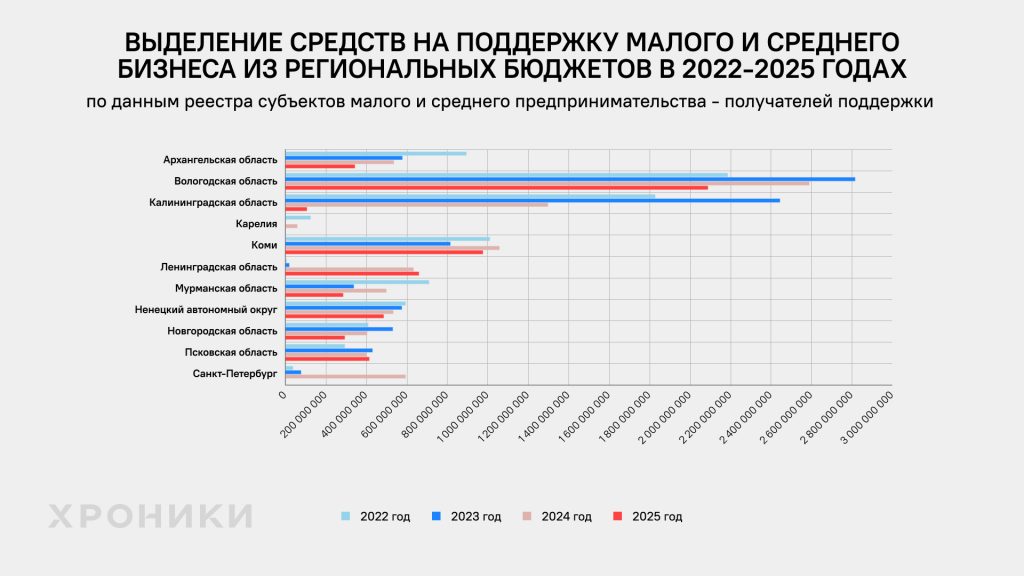
"Chronicles.Media" studied the Register of small and medium-sized businesses - recipients of support . The study took into account support in the form of subsidies and grants allocated in 2025 from the regional budgets of the Northwestern Federal District. Some companies received several subsidies and grants; in this case, the total support was taken into account.
According to the law, three types of enterprises are classified as small and medium-sized businesses:
- Micro - up to 15 people, annual income up to 120 million rubles;
- Small - up to 100 people, annual income up to 800 million rubles;
- Medium - up to 250 people, annual income up to 2 billion rubles.
The reduction in aid is most likely due to growing budget problems in Russia. In 2025, the Ministry of Finance initially projected the federal budget deficit at 1.2 trillion rubles, which grew to 5.7 trillion rubles by the end of the year.
Regions face their own budget problems, which can also affect the amount of business assistance. The authorities of Karelia, for example, initially planned a surplus of almost 2 billion, but, according to preliminary data, the budget was executed with a deficit of more than 3 billion rubles.
Problems with the budget deficit may also be associated with a reduction in payments - regional authorities have begun to save on supporting small and medium-sized businesses. Moreover, such companies, as a rule, are not associated with the defense sector, which, after the outbreak of a full-scale war in Ukraine, receives abundant funding from the budget.
The problem is unlikely to go away in 2026. The federal budget deficit, according to official government plans, should amount to 3.8 trillion rubles. In reality, it could be 2-3 times higher, say Sberbank and Reuters sources, citing calculations for the government. The authorities of St. Petersburg, for example, who reset aid last year, expect a deficit of almost 189 billion rubles in 2026.
The share of small and medium-sized businesses in the Russian economy is 21.7%, the Ministry of Economic Development reported in 2025. Then officials called this a record for the last six years - officials explained the growth with government support. However, Russia still lags behind European countries and the United States in terms of the share of small and medium-sized businesses.
In 2025, as in previous years, the bulk of subsidies in the North-West regions went to agricultural companies. At the same time, the basis of the region’s economy is industrial enterprises, but there are quite a few of them among the recipients of assistance.
Companies that received grants in 2025 in the regions of the Northwestern Federal District were often associated with members of United Russia or representatives of local authorities.
Next are three cases where money is concentrated among people with party and administrative connections: Vologda, Nenets Autonomous Okrug and Arkhangelsk. Then, as an exception, there is the Pskov region, and the “second line” of regions.
Vologda region: grants for one family
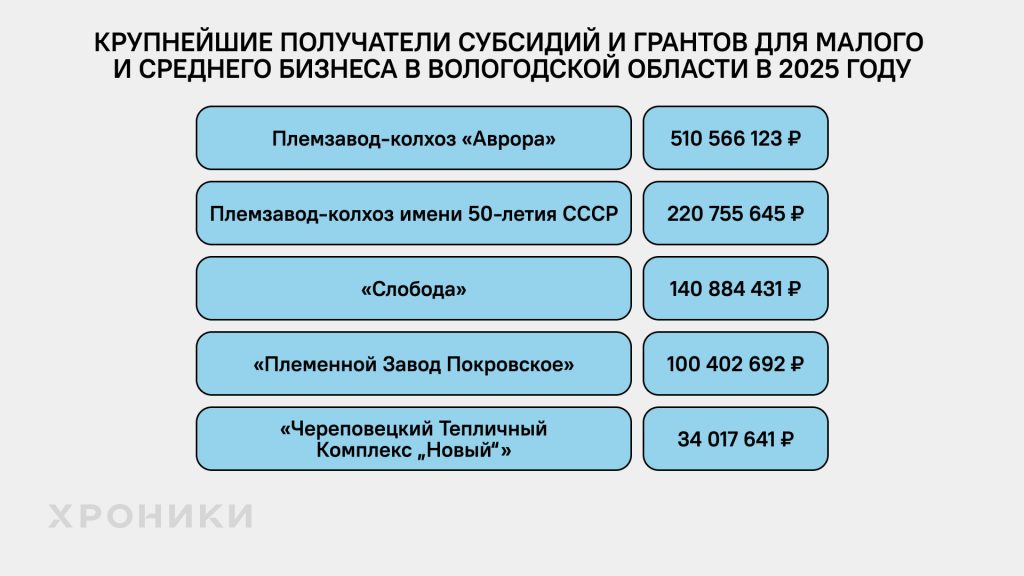
In 2025, the region became the leader in the North-West in terms of assistance to small and medium-sized businesses. Subsidies amounted to 2 billion rubles. In 2024, however, the amount was even greater - almost 2.6 billion rubles.
The largest recipients of grants in the region were breeding plants, that is, enterprises involved in breeding livestock. True, three of the five recipients of the largest subsidies are associated with one family - Vasily Zhiltsov, a former deputy of the legislative assembly of the Vologda region from the Agrarian Party, who then joined United Russia, and his son Vladimir. Zhiltsov Jr. was also elected to the regional legislative assembly from United Russia.
The breeding plant, the Aurora collective farm, received more than 500 million rubles from the budget. On social networks, the collective farm refers to Soviet history: the first mention appeared in the archives in 1931. Now it is a large enterprise with revenue of 1.7 billion rubles and a profit of 408 million. Its chairman is Vladimir Zhiltsov.
He is also the chairman and main owner of another large local enterprise with revenue of 1.6 billion rubles and with a reference to Soviet history - Plemzavod - Collective Farm named after. 50th anniversary of the USSR". “They don’t skimp on the comfort of the animals in this farm,” they assure on the website of companies in the Vologda region. The company received more than 220 million rubles from the state last year.
Zhiltsov Sr.’s company, Pokrovskoye Breeding Plant, received more than 100 million rubles from the state last year.
In 2024, Vladimir Zhiltsov resigned early from his mandate as a deputy of the regional legislative assembly. In October 2023, Georgy Filimonov was appointed acting governor of the region - with his arrival, a massive rotation of officials and deputies began in the region. This did not prevent the Zhiltsovs’ business from continuing to receive grants.
The Sloboda pig-breeding complex received more than 140 million rubles from the Vologda authorities. This company is not associated with the Zhiltsovs. The pig-breeding complex should reach full capacity in 2026 - then, according to RBC , it will produce 5.5 thousand tons of pork. In 2024, the company’s revenue already amounted to 430 million rubles.
Grants for United Russia
The Nenets Autonomous Okrug was also among the leaders in aid issued for a total amount of 487.5 million rubles. In the region, assistance from the state was mainly received by agricultural companies that were in one way or another connected with the state.
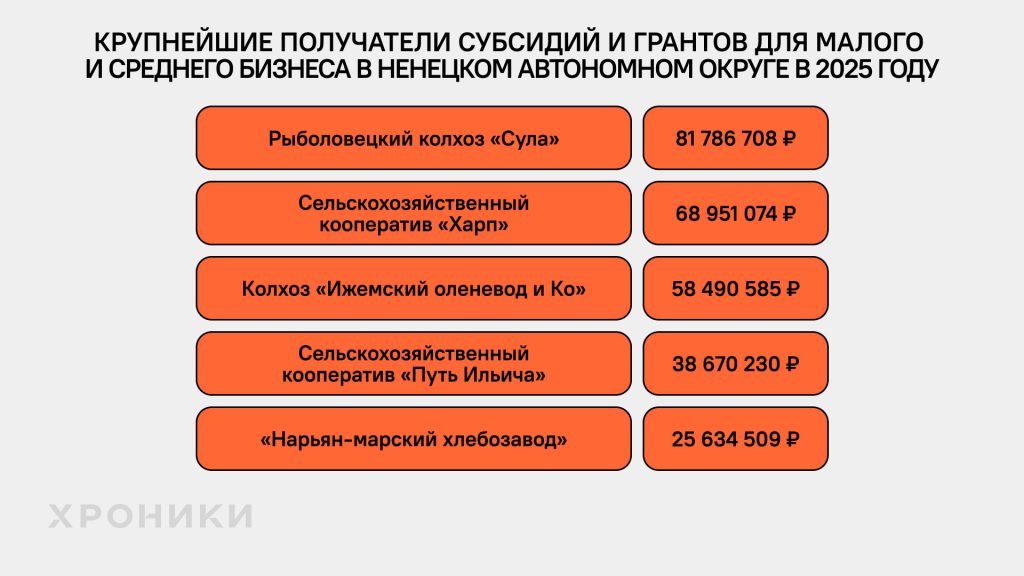
The collective farm "Sula" is listed as a co-owner of the company "Nenets Rybaksoyuz", the director of which is the fishing industry owner Alexey Dityatev - earlier "Chronicles.Media" included him among the "fish owners" of the Northwestern Federal District. In turn, Alexey Dityatev is not only a member of the regional political council of United Russia, but even tried to become a major sponsor of the party: one of his companies transferred 2 million rubles to United Russia, but the donation was returned due to a violation of the legislation on parties.
The Sula collective farm, despite virtually no activity, continues to receive fishing quotas for many years. And apparently, these quotas are redistributed through the Nenets Fisherman's Union of Alexei Dityatev. Among the formal co-founders of Rybaksoyuz there are other fishing collective farms that show modest revenues, but significant profits. They also receive quotas, despite the lack of activity, and, apparently, redistribute them among the co-founders of Rybaksoyuz.
Among the co-founders of the Nenets Fishery Union, there is only one company that, judging by its financial statements, is engaged in real activities - the Andeg Fishing Collective Farm, controlled by the family of Alexei Dityatev. This company receives billions in revenue and millions in income, apparently doing this at the expense of quotas from other cooperatives.
Unlike the Sula collective farm, the Kharp agricultural production cooperative in 2024 suffered losses of 4 million rubles with revenue of 63 million. But it still received almost 70 million rubles from the state. The chairman of the cooperative, Nadezhda Kaneva, is also associated with United Russia: in 2018, she was elected from the party as a deputy of the Primorsko-Kuisky village council, but already in 2019-2024 she was a deputy of the Polar District, nominated by the Communist Party of the Russian Federation.
In the Nenets Autonomous Okrug, aid from the state in the amount of 26 million rubles was received by the Naryan-Mar bakery, the main owner of which was the city of Naryan-Mar. Its general director, Dmitry Zakharov, participated in the elections of deputies to the Nenets parliament from United Russia in 2014. The profitability of the bakery's production is low: the profit was only 933 thousand rubles with revenue of 107 million.
The situation is similar in the Arkhangelsk region: of the five companies that received the most assistance from the state in 2025, at least four are associated with members of United Russia.
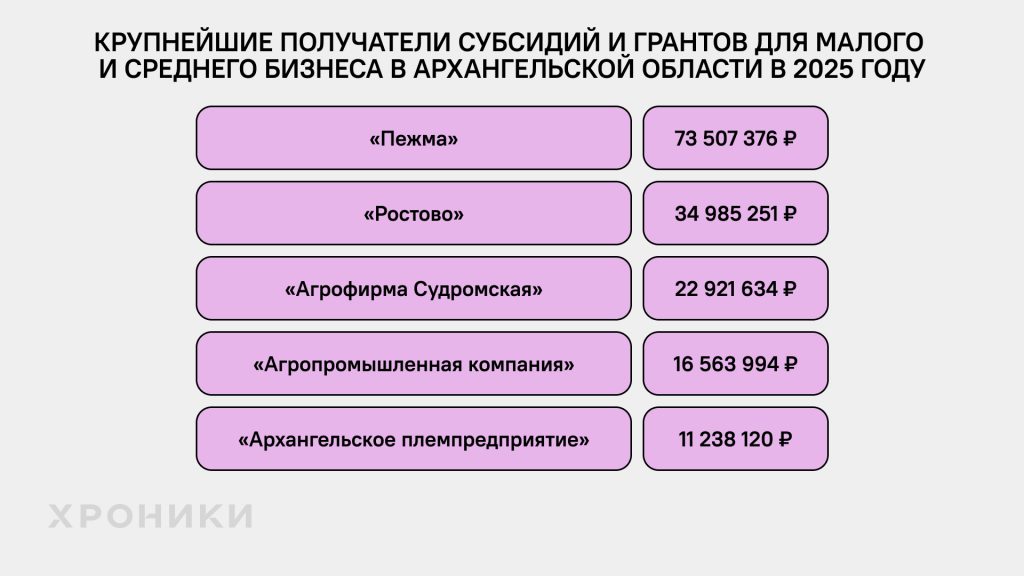
The largest subsidy of more than 73 million rubles was received by the agricultural company Pezhma. Its main owner is Viktor Shorokhov - he has been elected as a deputy of the Velsky district from the “party in power” for 20 years, and works in the commission on land relations, agriculture and entrepreneurship. Given that he heads an agricultural company, this could be considered a conflict of interest. The year before, Pezhma was also among the main recipients of government assistance.
Pezhma is engaged in livestock breeding and milk production. On social networks, companies post videos with the words “Our cows are something! This is someone who definitely won’t let you get bored.” In 2024, it brought its owner a profit of almost 87 million rubles.
Like Pezhma, the owners of the agricultural companies Rostovo, Agrofirma Sudromskaya and Agroindustrial Company are associated with United Russia. All of them are either party members or local deputies from the same party. In total, their companies received about 74 million rubles in support in 2025.
Chronicles was unable to identify the owner of the Arkhangelsk Company, which produces sperm from “high-value stud bulls with unique domestic genetics for agricultural producers.” It sells bull semen to enterprises in the Arkhangelsk region and other regions. But this small enterprise with revenue of 7 million rubles and a profit of less than a million received approximately 10 million rubles from the Arkhangelsk authorities.
The Pskov region allocated 414 million rubles to help small and medium-sized businesses. This is the region that has increased payments compared to 2024. But the recipients of the largest grants here are also associated with United Russia.
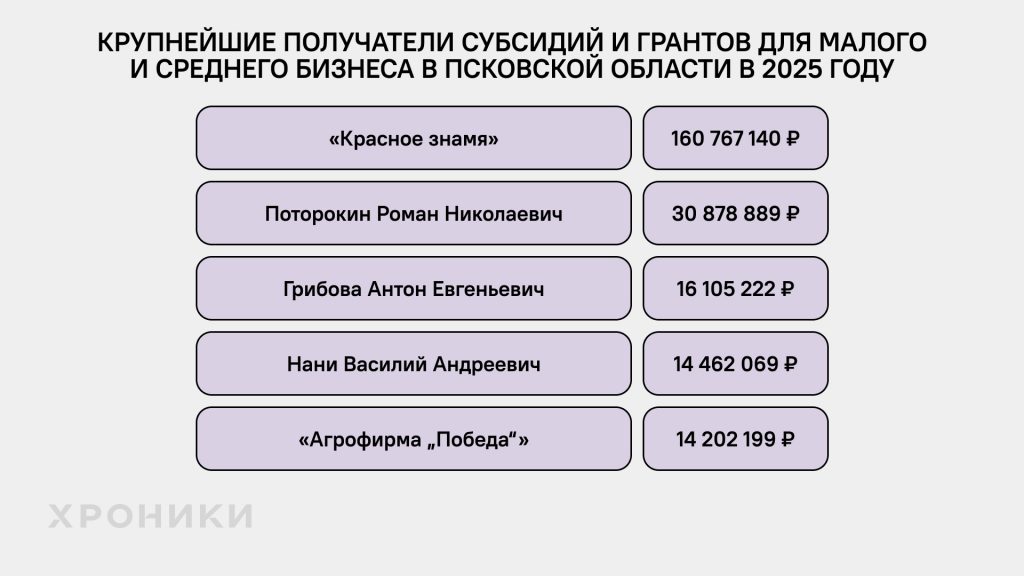
The largest subsidy in the amount of 157 million rubles went to the agricultural company “Krasnoe Znamya” with revenue of 1.1 billion rubles, with a rather small profit of 167 million. The general director of the company, Vladimir Dovgun, was previously elected as a deputy of the Novosokolnichesky district of the region from United Russia. Former general director of Red Banner Andrei Kozlov now heads the committee on economic policy and agro-industrial complex of the Pskov Legislative Assembly. He is also a member of United Russia.
“Red Banner” is part of the assets of the Kozlovsky family clan, influential in the Pskov region. The senior representative of the clan, Nikolai Kozlovsky, has been heading the second largest city in the region, Velikiye Luki, for many years, and his son Alexander works as a State Duma deputy. Both are representatives of United Russia. The family’s main asset is the Velikiye Luki Electrical Equipment Plant, which is not only one of the largest taxpayers in the region, but also a sponsor of United Russia. The family is also engaged in agricultural business, receiving support from the budget of the Pskov region.
Another recipient of the subsidy associated with United Russia was Vasily Nani. He is registered as an individual entrepreneur and is engaged in agriculture. In 2010-2015, he was a deputy from the party in the rural settlement of Veleiskaya volost.
Financing of losses
In other regions the situation is similar: mainly agricultural businesses receive funding. This business as a whole is rarely highly profitable. In Russia, in recent years, agriculture has also been hit by general economic problems - labor shortages and high loan rates.
As a result, there are many companies on the list of aid recipients that suffered losses in 2024. Also among the recipients of subsidies were companies that are part of large industrial holdings.
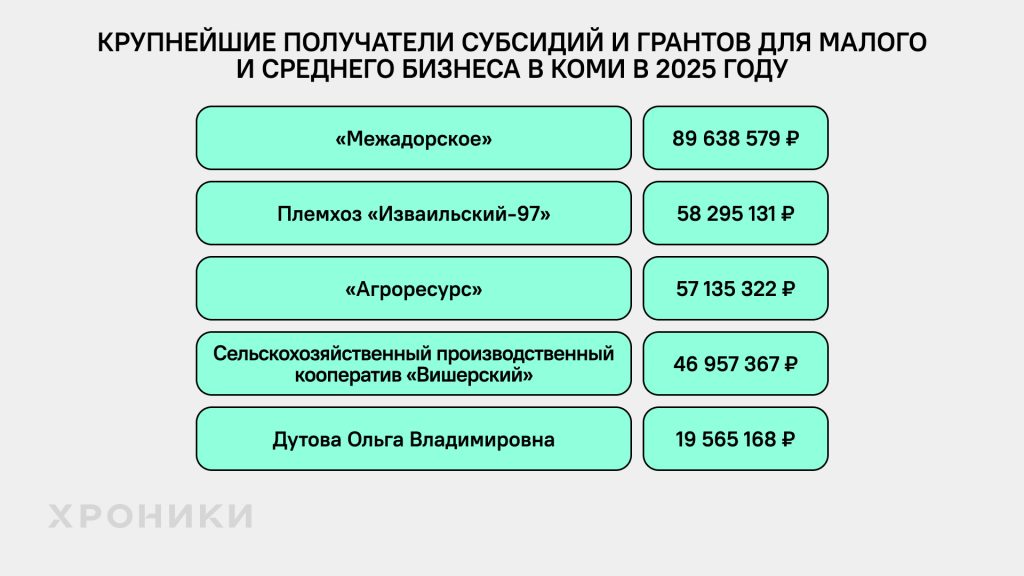
In Komi, mainly agricultural companies received assistance from the state. One of the largest recipients is Plemkhoz Izvailsky-97. This is a company that produces livestock and milk. In 2024, losses amounted to 233 thousand rubles with revenue of 128 million. At the same time, the company received a subsidy in the amount of 58 million rubles.
Fish, farm and unprofitable plant
In the Kaliningrad region, subsidies were mainly received by companies involved in fishing. The largest subsidy - 82 million rubles - went to the Marfish company, which supplies about 5 thousand tons of fish per year for processing. Marfish is part of a large fishing holding, the current owners of which inherited it from their father. The company is profitable: in 2024 it earned 32 million rubles with revenue of 453 million.
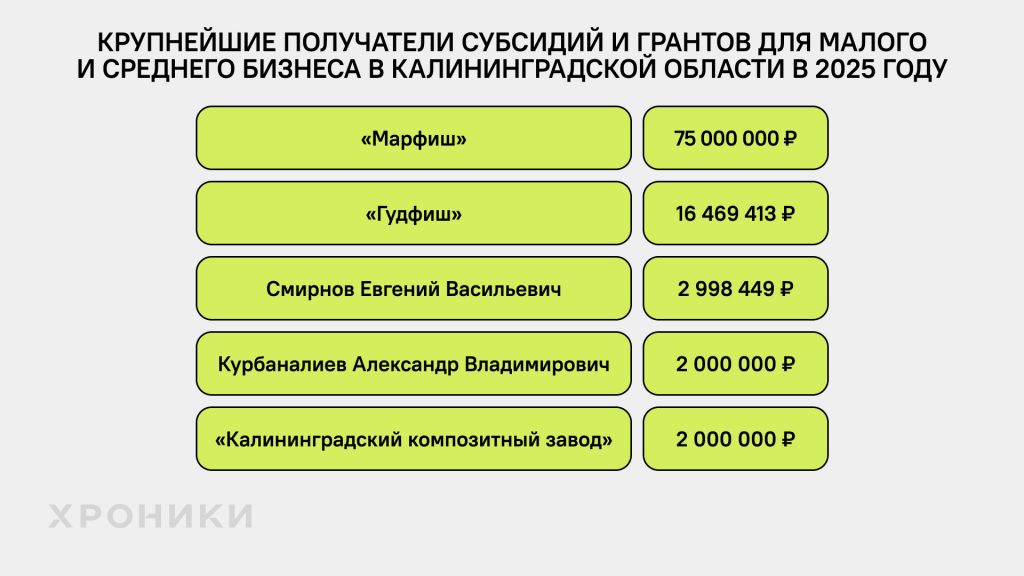
The second largest grant in the region - 16.5 million rubles - was received by the Goodfish company. In 2024, it turned out to be unprofitable - by 50.8 million rubles. But, like Marfish, this company is also part of a fish processing holding.
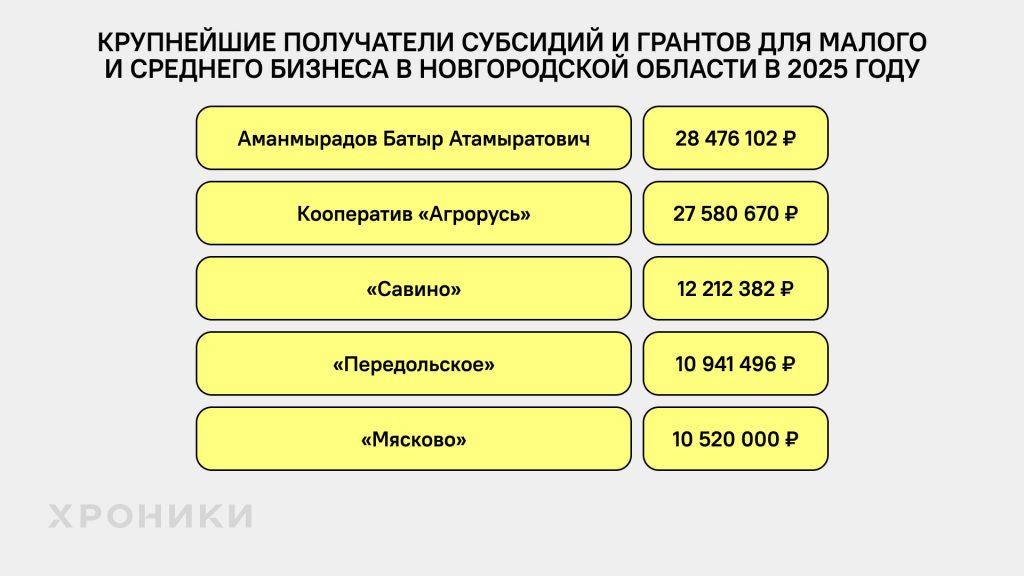
In the Novgorod region, the largest payments - 28.5 and 27.5 million rubles - were received by farmers. The first went to Batyr Amanmyradov, the head of a farm that produces about 200 tons of milk annually. The second grant was received by the Agrorus cooperative, which is launching a dairy farm.
In the Leningrad region, several industrial companies received assistance, but the volume of each grant is relatively small. Alfa Microtech, which produces communications equipment, received almost 12 million rubles. The company's revenue in 2024 amounted to only 4.8 million rubles, having fallen five times compared to the previous period, and profit - 5.1 million. Judging by the financial statements, most of the profit was not received from the main activity, apparently from renting out its property.
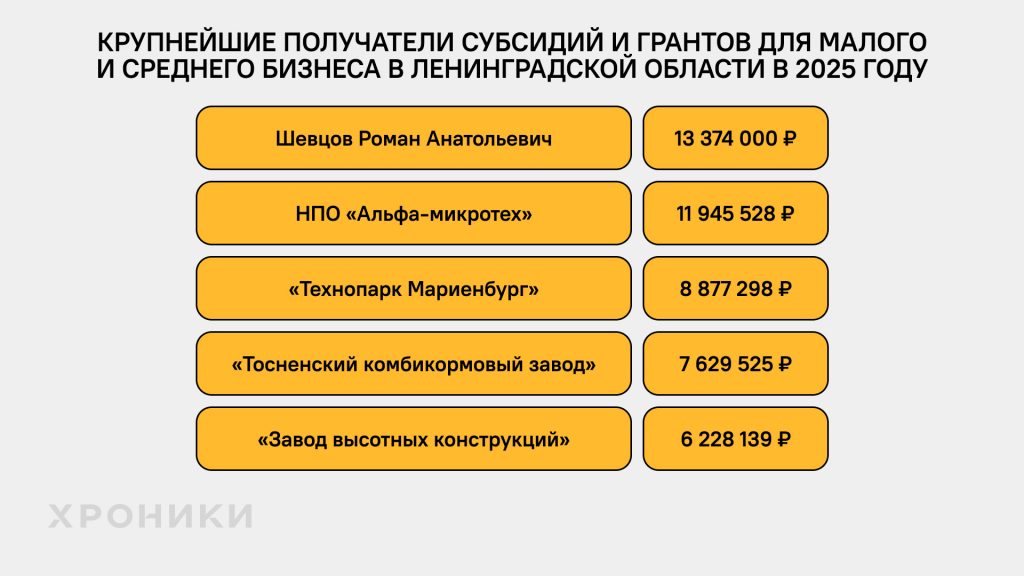
Other payments in the region were less than 10 million rubles.
Murmansk region: social stability through grants
The Murmansk region found itself, as last year, in a special situation. The reform of the budget sector has been ongoing there for several years: the number of government institutions, including those providing services to the population, is being reduced. The authorities explain this by saying that they want to spend the budget more efficiently.
Therefore, support from the authorities was mainly received by companies that provide social services to the population. The authorities have transferred some functions from government agencies to private businesses, but continue to finance these functions through the provision of subsidies.
The experiment does not seem to be successful: of the five companies that received funding in 2025, four were unprofitable even a year earlier, when the authorities were already carrying out this reform.
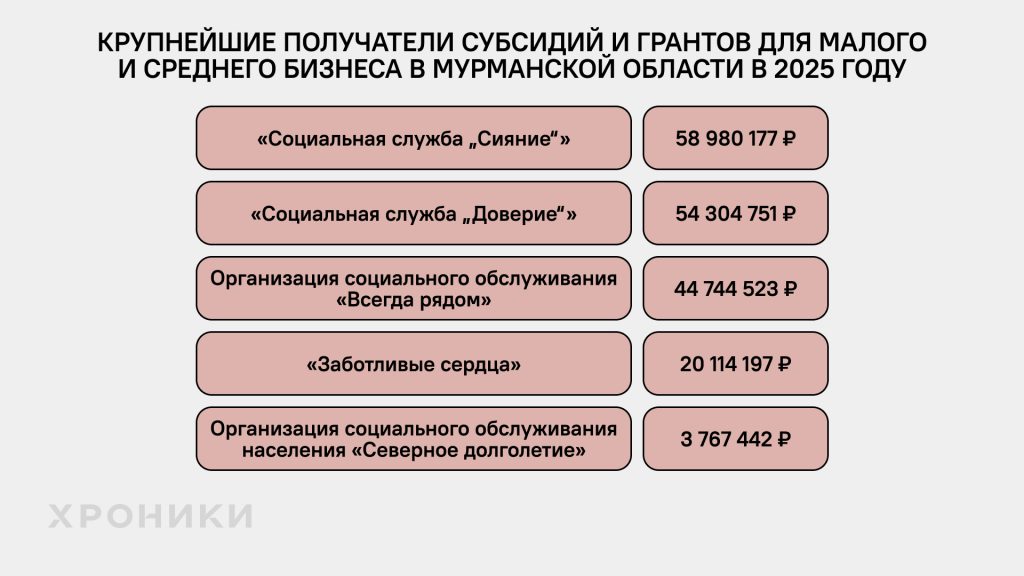
Support in the amount of 59 million rubles was received by the Social Service “Shine” company, which provides assistance to the elderly and disabled. In 2024, its losses amounted to 381 thousand rubles with revenue of 6 million.
Other recipients of government subsidies have the same indicators. For example, the Caring Hearts company suffered a loss of 1.4 million rubles in 2024, and the Northern Longevity Social Services Organization suffered a loss of 1.8 million. At the same time, they received more than 20 million rubles in subsidies to support small and medium-sized businesses.
***
The year 2025 showed that support for small and medium-sized businesses is one of the first items that cut off regions in the event of budgetary problems. In the North-West, the total volume of grants and subsidies dropped by a third, and in some regions, judging by the Register of Support Recipients, such payments were completely abandoned.
At the same time, the remaining money is mainly concentrated in agriculture - and often in companies with strong ties to local authorities and United Russia. As a result, support for small and medium-sized businesses increasingly works not as a tool for entrepreneurship development, but as a mechanism for distributing budget resources in favor of a narrow circle of recipients.
If deficits and tax pressure increase in 2026, the logic of “we save for everyone - we support our own” will become even more noticeable. And the overall economic prospects are murkier.
Mikhail Mikhnevich, Olga Sokolova