
Translated material
Under the ax
The law allowing the deforestation of Lake Baikal has come into force. The damage to the lake and ecosystem may be irreparable
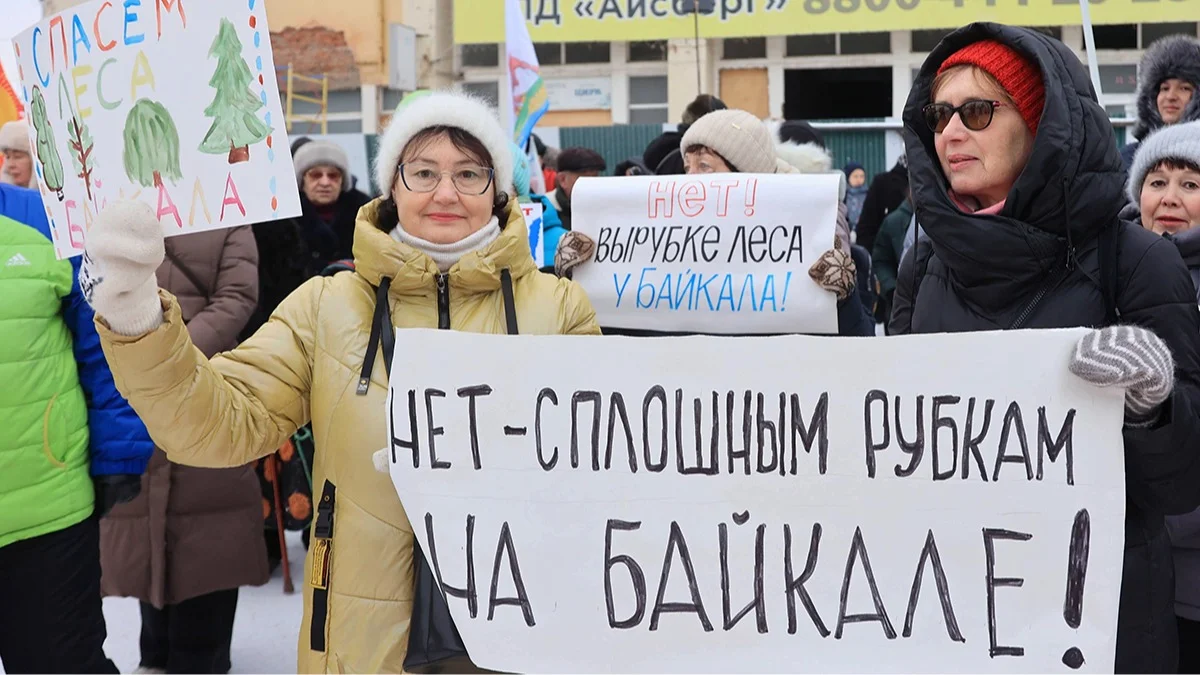
Activists hold placards during a rally against deforestation around Lake Baikal in Irkutsk, Russia, December 27, 2025. Photo: Kirill Shipitsin / IMAGO / SNA / Scanpix / LETA
On March 1, 2026, amendments to the law “On the Protection of Lake Baikal” came into force. The document allows clear cutting of dead forest plantations in the central ecological zone of the Baikal natural territory. The law also allows for the transfer of forest fund lands to other categories for the construction of infrastructure facilities. Decisions on these issues will be made on the basis of a scientific conclusion by a departmental commission. Many critics of the law suggest that the amendments allow the development of the Baikal territory with tourist sites, the protection of the lake is now significantly weakened and Baikal at the next UNESCO meeting may be classified as “endangered sites”. Novaya Gazeta Europe reminds us what is wrong with the law on Lake Baikal.
Unlimited felling
Despite the formal restrictions, experts believe that it will not be difficult to obtain the necessary approvals for logging. This could lead to uncontrolled logging, which would upset the balance of the lake's ecosystem. Scientists and activists fear that the wood may be removed from the territory, although according to the law it should remain on the cutting site. In addition, even small cuttings will lead to fragmentation of forests and reduce the stability of the ecosystem.
The Scientific Council of the Russian Academy of Sciences on Forests opposed the amendments (the text of the council’s comments is at the disposal of the publication). According to experts, they create high risks of unreasonable logging and loss of unique ecosystems of Lake Baikal due to the lack of scientific criteria for assessing the “loss of functions” of the forest.
Legislation takes into account only the recreational value of forests, ignoring their critical role in the formation of water flow (73% of water for Lake Baikal), climate regulation and biodiversity conservation.
Artificial restoration after logging using heavy equipment destroys the soil and pollutes the lake, and permission to expand economic zones and settlements leads to a direct reduction of forest areas. Scientists insist that economic activity on Baikal is permissible only after a comprehensive scientific assessment of all ecosystem functions of the forest.
However, the opinion of other scientists who do not study forests, but are also members of the Russian Academy of Sciences, prevailed. In July 2025, at a hearing in the Public Chamber of the Russian Federation, the head of the Siberian Branch of the Russian Academy of Sciences, academician Valentin Parmon (a specialist in the field of catalysis and photocatalysis), noted that during reforestation it is necessary to use “modern technologies”: for example, planting seedlings in pots. According to the scientist, if you work carefully, there will be no destruction of the ecosystem. And in December, the Russian Academy of Sciences agreed to the approval, which is mandatory when making a decision on logging. There are still no details about this structure.
Why will trees be cut down?
According to two governors who lobbied for the law - Igor Kobzev in the Irkutsk region and Alexander Tsydenov from Buryatia - before the adoption of the amendments, the law did not allow the development of local infrastructure, building roads, repairing bridges, laying new power lines, or implementing territorial development projects.
For example, Igor Kobzev emphasized that the lack of modern infrastructure (berths, roads) is holding back the development of the region. He pointed out problems with existing berths (queues for the ferry to the port of Baikal) and the need to create winter parking for large ships. These difficulties prevent the implementation of the federal tourism development project “Magic Baikal”. According to preliminary estimates, the construction and reconstruction of berths will require 15.5 billion rubles.
In 2025, three new investors received the status of residents of the special economic zone “Gates of Baikal”. They plan to implement hotel projects worth 1.7 billion rubles by 2028. Among the projects: guest houses, restaurants, bath complexes, apart-hotels and spa complexes.
As part of the federal project “Five Seas and Lake Baikal” and the national project “Tourism and Hospitality”, apartment buildings, townhouses and hotels will be built on the former territory of the Baikal Pulp and Paper Mill (BPPM). However, work to clean up the lands of the former enterprise has not yet been completed.
Buryatia also has many plans to develop the lake. In 2025, the new resident of the Special Economic Zone (SEZ) “Baikal Harbor” will invest more than 940 million rubles in the Green Flow Baikal Residence project and 40 billion in the ski resort on Mount Bychaya. A five-star hotel complex with 654 rooms and a multifunctional cluster “Lotos” are being built in Goryachinsk. It will include an ethno-village, a spa center with a thermal area, a sports complex, a training center for athletes and artists, as well as a multifunctional arena for 5 thousand spectators. The volume of investments is 40 billion rubles.
Why the lake is unlikely to escape pollution
Every news about the development of Lake Baikal is accompanied by a mantra about preserving the lake’s ecosystem. The state of Russia's water bodies, comprehensive development plans and ineffective monitoring system casts doubt on these assurances.
Thus, despite UNESCO’s requirements—Baikal is still a World Natural Heritage Site—the Ministry of Natural Resources did not provide the organization with a comprehensive plan for the development of the territory with an environmental impact assessment. According to Mikhail Kreindlin, a specialist in specially protected natural areas, if such a plan is not developed, Baikal could receive the status of “heritage at risk” in 2027, when a UNESCO mission is scheduled to visit the site.
It is also alarming that there is no system for constant and high-quality monitoring of the lake yet. Deputy Minister of Natural Resources of Buryatia Natalya Tumureeva spoke about this in 2019. Later, this was remembered less and less, although no monitoring system for the lake ever appeared.
The “Point No. 1” project is still the flagship for assessing the cleanliness of Lake Baikal. Sampling has been carried out for more than 80 years at one point in the lake, 2.7 km from the village of Bolshiye Koty.
The construction of treatment facilities in several villages on Lake Baikal was not completed in 2024, and a delay in commissioning of 700 days was predicted. After a revealing inspection by the State Duma, which revealed these facts, no reports about the launch of treatment plants could be found . Facts of lake pollution appear on the Internet from time to time. Thus, in 2025, in the village of Turka in Buryatia, the elite AMAR complex was accused of possibly discharging wastewater into the lake.
Experts say the main problem of Baikal pollution is the lack of new and low efficiency of existing sewage treatment facilities: many of them do not meet technical standards. As Andrei Fedotov, director of the Limnological Institute, explained , a common practice is to use septic tanks and filters outside closed containers. Since there is nowhere to remove the waste, the waste seeps through the ground directly into the lake.
Against the backdrop of coastal development and growing tourist flows, the situation is becoming critical. Scientists insist: the development of tourism must be strictly linked to the capacity of sewage treatment plants (STP): “No treatment plants - no tourism, there are treatment plants - tourism to the extent of their capacity.” But at the moment, the law has been adopted, construction has begun, but there are no treatment facilities. The lack of treatment facilities contributes to the pollution of shallow waters and the growth of algae along the shore.
Meanwhile, in general, there are no special places in the country where wastewater treatment could be established. Back in 2017, the Ministry of Natural Resources noted that 80% of Russian rivers are polluted to one degree or another. The main reason is insufficiently treated wastewater. Judging by the fact that the large-scale reconstruction of treatment plants on the Volga did not bring results, there have been no improvements since then.
According to Roshydromet, in 2023, 162 rivers and lakes with extremely high levels of pollution were recorded in the country, which is 33% more than in 2022 (122 objects).
306 reservoirs with high levels of pollution were also identified. According to information as of February 2025, according to the Greenium information and analytical platform, in 2024 the number of cases of water pollution in Russia increased by 12% compared to 2023. The largest number of pollution cases was recorded in the Sverdlovsk, Murmansk and Smolensk regions, the Krasnoyarsk Territory and the Moscow region - that is, in the most populated regions.
Baikal is so far saved from severe pollution by its remoteness and relative desolation. But the same thing can happen here that happened in the Altai Republic with Lake Manzherok. By 2021, its water level has dropped, most likely due to clearing for development and an increase in the beach area. As a result, the water lily population was completely destroyed. The population of the unique aquatic plant chilim is on the verge of complete extermination. It is an annual plant, with a rosette of leaves supported by a long, cord-like stem coming from the bottom. If the plant is picked off, it dies. In 2023, it was decided to allocate 800 million rubles to restore Manzherok after unsuccessful cleaning.
So even future problems with the lake may become a reason for new budgetary injections.
Mistrustful development
When officials, deputies and business tried to push through amendments to the law on Baikal, which allowed clear cutting, they organized expeditions to the lake and organized meetings with people calling for a relaxation of the protection regime. They say there is no way to develop cemeteries, build protective forest belts, repair roads, or install power lines. There were more of those who opposed it in Moscow than in Buryatia or the Irkutsk region.
Sana Bezmenova, a political activist who left Russia in 2022, told Novaya-Europe why this is happening. Sana was a volunteer in a campaignagainst the construction of an oil pipeline along the shores of Lake Baikal in 2006. According to her, even then people were afraid to speak out against the construction, but many could be convinced.
“Now people are also unhappy, but no one will talk. Any projects that in any way cast a shadow on the regional government were stopped. The activists left, and those remaining watched silently. People from Moscow and other regions of Russia invest money mainly. And if for locals Baikal is a sacred lake, then for newcomers it is a way to make money,” says Bezmenova.
She believes that the development of Lake Baikal is unlikely to improve the situation of the local population. Over the years, people have stopped trusting the authorities.
— When I lived in the Irkutsk region, I watched carriages loaded with timber go past my house. At the same time, in the news one could find information about minimal felling. But when you see with your own eyes that this is not true, you stop believing any statements. And there are plenty of such examples. No matter what officials want to do, people will object because trust has been lost, Bezmenova believes.