Translated material
Full-scale invasion of Ukraine and (de)coloniality
Study of the dynamics of attitudes of the ethnic population of Russia from the national republics.
Methodology and demographics of the study
The goal of the project was to study the changing attitude of the Buryat and Tuvan populations in the Republics of Buryatia and Tyva to the full-scale Russian invasion of Ukraine. Attention has been focused on two variables: changes in this relationship over time and processes of decolonization. The study examined how attitudes toward the war change depending on current events, such as mobilization, the situation at the front, the loss of loved ones, etc. And also, how much the full-scale invasion influenced the population’s attitude toward the Soviet past, Russian imperialism, and the ethnic self-identification of the audience under study.
Study period: 12/25/2023 - 01/25/2024.
Research methods included:
ethnographic field interviews;
Internet interview;
Internet survey;
content analysis of local social networks.
In Tuva, 10 landline and 9 online interviews were conducted. Among Buryats from the Republic of Buryatia, the Irkutsk region, the Trans-Baikal Territory and other regions, 10 landline and 6 online interviews were conducted.
The online survey was posted in popular Buryat and Tuvan groups on the VKontakte social network. 573 respondents took part in the survey, the majority of whom (476) were Tuvans. This disproportion can be explained by the greater distrust of Buryat respondents and greater trust in our organization in Tuva, which is confirmed by interview data.
| Tyva | 471 | 82.1% |
| Buryatia | 65 | 11.3% |
| Irkutsk region | 13 | 2.3% |
| Transbaikal region | 7 | 1.2% |
| Other region | 18 | 3.1% |
Of the respondents, 59.9% were women, 38.9% were men, and 1.2% of respondents identified as non-binary. According to the age scale, 33.8% of respondents are under 25 years old, 46.9% are between 24 and 40 years old, and 19.3% are over 40 years old. Almost half of the respondents had higher education. 60.6% lived in the capital of their region, 12.2% in a small town, and 27% in rural areas.
Results of surveys and interviews
Sources of information about “SVO”
Almost a quarter of all respondents regularly turn to federal television channels for information about the invasion. However, the Internet (online publications and social networks) is the main source of information for 85% (490 people out of 573) of respondents. Also, every fifth respondent receives information from relatives and friends.
| From programs of federal TV channels | 142 | 24.7% |
| From local media | 68 | 11.8% |
| From materials from online publications | 161 | 28.0% |
| From social networks | 329 | 57.3% |
| From conversations with family and friends | 122 | 21.3% |
| Other | 35 | 6.1% |
More than half of the respondents answered that they are “closely monitoring” the situation in Ukraine. Only 5.8% “don’t follow at all.”
2. “SVO” support
42.3% of respondents expressed some or moderate support for the actions of the Russian authorities on the territory of Ukraine. At that time, 37.1% were definitely or moderately against. Every fifth respondent found it difficult to answer.
| Definitely yes | 141 | 24.6% |
| Most likely yes | 101 | 17.6% |
| Probably not | 59 | 10.3% |
| Definitely not | 154 | 26.8% |
| I find it difficult to answer | 119 | 20.7% |
| Total respondents | 573 | 100.0% |
3. Lost loved ones at “SVO”
The majority of respondents (74%) report that among their relatives, friends or acquaintances there were people who died in Ukraine. Only 18.5% of respondents answered that they did not know anyone killed in Ukraine, while 7.5% of respondents could not give an exact answer to this question.
| Yes | 424 | 74.0% |
| No | 106 | 18.5% |
| Don't know | 43 | 7.5% |
At the same time, 86.4% of respondents answered that they have some relatives, friends or acquaintances fighting in Ukraine. 7.7% of respondents do not have such people around them. The remaining 5.9% found it difficult to answer.
4. Continuation of “SVO”
The overwhelming majority of respondents do not want the war to continue. Survey data shows that the majority of respondents (81%) express a preference for starting peace negotiations rather than continuing hostilities. In particular, 46% of respondents clearly support the idea of starting peace negotiations, and 35% moderately support this option. At the same time, only 10.4% of respondents believe that military action should be continued (7.3% “definitely” and 3.1% “rather yes”).
| Definitely continue hostilities | 42 | 7.3% |
| Rather continue military operations | 18 | 3.1% |
| Hurry up and start peace talks | 201 | 35.0% |
| Definitely start peace talks | 264 | 46.0% |
| I find it difficult to answer | 49 | 8.5% |
5. Conclusion
Despite partial declarative support for Russian military actions in Ukraine, the vast majority of people are in favor of ending the so-called SVO. Perhaps the reason for such views was the pervasive reality of war - the death and participation of relatives and loved ones in Ukraine. Data from the survey confirm and explain data obtained through ethnographic interviews and analysis of posts in social media groups.
Results of content analysis in local social networks
How do they feel about the war?
In general, the perception of the military invasion of Ukraine among residents of the studied localities can be called complex and multifaceted.
The attitude of the residents of Tuva and Buryatia to the war in Ukraine gradually changed under the influence of various factors, including the information space, social and economic changes. The war had a significant impact on their lives and the lives of their loved ones. At the beginning of the conflict, many of them experienced shock and disbelief, and also showed patriotic sentiments, reflecting public reaction to the events. However, as time passed, feelings of anxiety, frustration and sadness increased due to the ongoing suffering and losses resulting from the war. The emotional numbness of people tired of front-line messages is also clearly visible.
The economic consequences of the war also affected the lives of the local population. Rising prices and a deteriorating economic situation have become a general trend, which has led to difficulties in meeting the needs of life and has complicated access to some goods and services. Psychological pressure and stress have become a daily reality associated with uncertainty and a constant feeling of anxiety about the future. The losses of loved ones and acquaintances in the war caused deep sadness and mourning in the community, which further increased emotional tension and negatively affected social and community relations.
Let us recall that, according to the results of an online survey, among 573 respondents, 86% of respondents have friends or relatives who fought or are currently fighting in Ukraine, and 73% have died there. Often these are people from the closest circle of friends or relatives. Respondents drew attention to the large number of deaths and noted the feeling of massive mobilization, especially in small towns and villages. The war had a profound and multifaceted impact on the lives of the inhabitants of the republics, causing changes in both the psychological, social and economic aspects of their daily lives.
The scale of physical military losses among the ethnic groups surveyed is truly colossal. These data confirm the statements of respondents obtained during ethnographic interviews. Below are quotes from interviews conducted and comments on local social media researched:
"There are dead soldiers who were taken away during mobilization. My uncle also died. They were taken away in October, but he died immediately in December."
– Woman, Tuvan, 25 years old, student, city, Tyva.
"For such a small village, quite a lot of people left for a special military operation. The number of dead heroes, along with my son, is now more than 22."
– Female, Tuvan, 45 years old. official, village, Tyva.
"Yes, there was. They were mobilized. Just my friends. There are those who died. One is still missing. [...] How did your population get it? Very much from the very beginning, when Ukrainian telegram channels began sending the corpses of our Buryat soldiers, they began sending things, they started sending them. There are things that only the Buryats have, but other peoples do not have them. In your pockets you will find, for example, discount cards of our companies. There are no such things other, purely Buryat companies. And there were corpses, and they had such special passports. On the passports there was Buryat script and so on. We saw that this was not a fake. And when we saw them, it became clear that something had not gone according to plan.”
– Male, Buryat, 40 years old, village, Buryatia.
The apogee of fear and uncertainty, according to respondents, came during mobilization:
"I just now realized how afraid I am of losing my common-law husband, and how much I love him. All this bullshit with mobilization scares me so much. From today I am afraid of any knock on the door."
– Evil Ulan-Ude (Buryatia), https://vk.com/zloi_03, 09.23.2022.
When analyzing the attitude towards a full-scale military invasion of Ukraine by ethnic groups from the national republics of Russia, one should take into account the scale of human losses that many families and individuals suffered. Involvement in the war unleashed by the Russian government to one degree or another is observed among many people whose friends or relatives were - voluntarily or not - involved in the so-called “SVO”. According to statistics, the mortality rate in the combat zone for people from national republics is much higher than for other Russians. This fact affects the attitude of people whose loved ones or acquaintances died in Ukraine.
The feeling of loss and fear for the fate of their loved ones, as many respondents said, permeates families and has become part of everyday reality. In addition, the feeling of uncertainty is increased by scammers who extort money from the families of dead or captured soldiers, promising to mediate their release:
"I want to speak out, my husband died heroically in the zone, he was buried on August 21, 2023. This man writes to friends and relatives that my husband is alive and is in captivity! I want everyone to know that everything they write to you, say and spread rumors, was not accepted and such people were immediately in an emergency!”
– Evil Ulan-Ude (Buryatia), https://vk.com/zloi_03, 08.20.2023 .
It can also be assumed that the presence of dead loved ones in Ukraine pushes some people to support the military operation and approve of the actions of the Russian authorities:
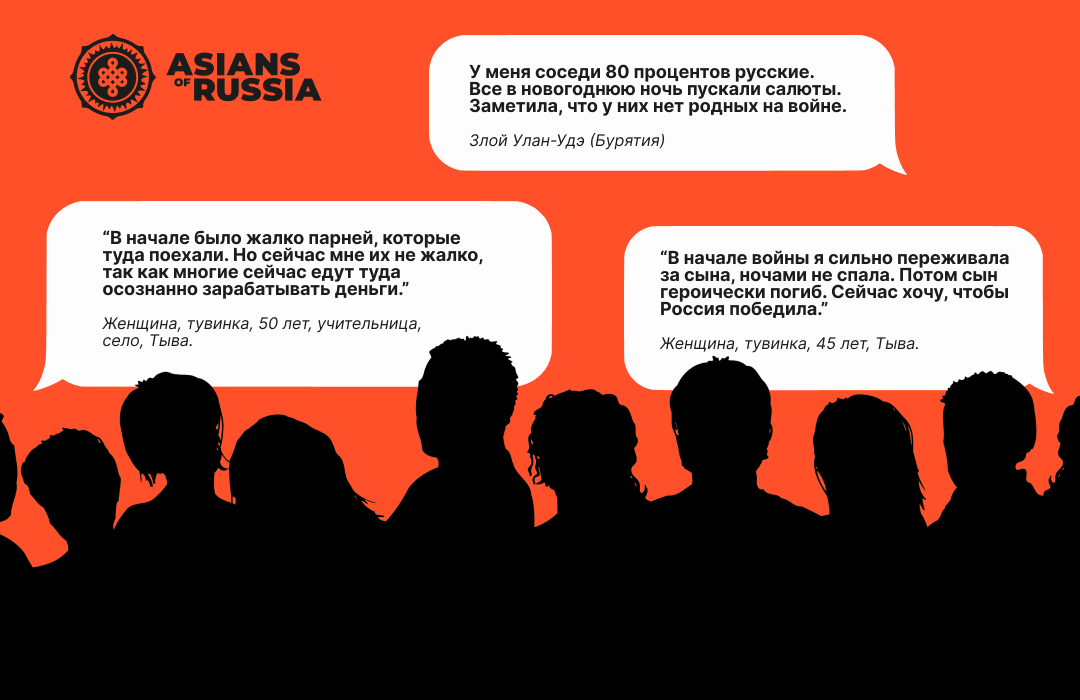
"At the beginning of the war, I was very worried about my son, I couldn’t sleep at night. Then my son died heroically. Now I want Russia to win.”
– Female, Tuvan, 45 years old. official, village, Tyva.
At the same time, the opposite position is also observed. The dividing line in relation to war is most often observed between the older and younger generations. Some of the older generation is more inclined to believe state propaganda and perceive the war with Ukraine in terms of the Second World War and the fight against evil. The younger generation, despite the fact that they are exposed to propaganda in schools during the “Conversations about the important” classes, have more diverse sources of information, and are also subject to mobilization, which is why they probably have a more critical attitude towards Russian military aggression in Ukraine:
"I am from Tuva, and I have no acquaintances whose relatives or friends would not have died in the Northern Military District. It seems that there is an ostentation that supposedly the people have rallied, are helping our guys, sending parcels with necessary things, but among the young people there is still misunderstanding and denial. They don’t understand why volunteer? Why go to certain death? Many conflicts on this basis occur, especially among the older generation with the younger. Adults, mature people, It’s as if you want to behave as if this is like the Second World War, a “Holy War,” but the difference is colossal, and they either don’t want to understand it, or they really don’t understand.”
– Girl, Tuvan, 28 years old, office worker, city, Tyva.
“Unfortunately, the population supports the war; in their opinion, their men are fighting for Russia, which means they must support Russia.”
– Female, Tuvan, 53 years old, city, Tyva.
“Adults, mature people seem to want to behave as if this is like the Second World War, the Holy War, but the difference is colossal, and they either don’t want to understand it, or they really don’t understand.”
– Girl, Tuvan, 28 years old, office worker, city, Tyva.
“Here we must first figure out why this war began in the first place. And how can we defend our homeland if no one invaded our territory.”
– Evil Ulan-Ude (Buryatia), https://vk.com/zloi_03, 09/07/2022.
“Before the war, I suspected corruption and theft of Russian power led by Putin, after the start of the war I already saw that this monster stopped hiding and showed his true face.”
– Female, Tuvan, 53 years old, city, Tyva.
"We don't need to fight because there are some politicians, some big businessmen who want more money and power. That's my opinion..."
– Woman, Buryat, about 60 years old, Irkutsk region.
However, not many people can afford to take a public anti-war position. The polarization of society in the context of attitudes towards the ongoing special operation fueled conflicts within families. Some people felt socially and ideologically isolated, unable to express their views for fear of public condemnation and the potential negative consequences of such a position. People are afraid of denunciations, additional conflicts and a greater gap with loved ones:
"At the beginning, I watched all the news, looked for videos myself specifically. But I became very anxious and cried every day, so for my own sake I decided to live in an information vacuum and with rose-colored glasses."
– Girl, Tuvan, 25 years old, student, city, Tyva.
"My family is against this war, my friends too, my colleagues are mostly against it, there are doubters and there are supporters. There were conflicts at work with colleagues, when those who supported the war began to talk nonsense about the West, NATO, America, the Nazis in Ukraine, I always put forward arguments against their understanding of the situation, which was incorrect, that no one attacked Russia and was not going to attack, and although they understood that I was telling the truth, they still stood their ground."
– Female, Tuvan, 53 years old, city, Tyva.
“I can have an open discussion with friends and my family, since I am surrounded by like-minded people. I can’t with my mother, because six months after I started, she and I were constantly fighting because of different views.”
– Female, Tuvan, 28 years old, office worker, city, Tyva.
"There are those who do not support the war, but it is a whisper, a quiet whisper, but it is there. They discuss it only with those very close to them and those who will not tell."
– Female, Tuvan, 53 years old, city, Tyva.
"[I talk about the war - editor's note] Only openly with close people. Be careful with your acquaintances."
– Female, Tuvan, 34 years old, entrepreneur, city, Tyva.
It should be added that the fear of possible denunciations is justified: for example, the case of Elena Bagaeva, a teacher from Buryatia who received a significant fine for “discrediting the army,” was widely discussed online. The case of discredit was fabricated on the basis that Bagaeva, in the school environment, expressed to her students a view of the war that was different from the propaganda narrative. This was recorded on video by one of her students. One of the commentators compared this situation with the story of Pavlik Morozov.
Finally, there is a category of people for whom the war in Ukraine is something very distant (literally), which does not have a direct, tangible impact on everyday life:
“Basically, I live in the outback, it didn’t affect my life in any way.”
– Woman, Buryat, about 60 years old, Irkutsk region.
“At the beginning it was scary, now I’m neutral.”
– Male, Tuvan, 23 years old, city.
Are Russian soldiers in Ukraine heroes?
A separate point of ideological disagreement within communities is the topic of glorification of participants in a military operation. So, on a Buryat forum, one of the young women wrote that her boyfriend had just left for the war in Ukraine, and asked to pray for all Russian guys so that they would return home safely to their families. One of the responses to her publication looked like this: “Maybe it’s just not worth going to a foreign country to kill, then you won’t have to pray?” (Evil Ulan-Ude (Buryatia), https://vk.com/zloi_03, 12/16/2023.)
In another Tuvan forum, a user reported that in her village the bodies of those killed in Ukraine were being brought in en masse, and complained that the best were dying: “In half a month in January, about 20 bodies of brave, worthy sons were brought in. Won’t we run out of our guys? It turns out there will be people who are married, drunks. Worthy sons are dying there.” They answered her: “people don’t go there with their head in their heads. On the contrary, only those who don’t have money go there.” However, there were also supportive comments: “Of course, worthy sons go there. Strong and brave. Not only for money, but also for Russia.” (Tuvan discussions for those over 30 and over, https://vk.com/tuva_komu_za_30, 01/14/2023.)
Why do some people fight in Ukraine for money?
The topic of financial motivation for participation in hostilities in Ukraine causes great resonance on social networks. Thus, one of the respondents expressed the problematic nature and condemned such people:
“At the beginning I felt sorry for the guys who went there. But now I don’t feel sorry for them, since many now go there consciously to earn money.”
– Woman, Tuvan, 50 years old, teacher, village, Tyva.
Indeed, contract service in the army has historically been and remains one of the most stable and the only really working social elevator in the republics. Now that Russian military institutions, along with state propaganda channels, are actively recruiting and recruiting people to take part in hostilities in Ukraine, promising huge pay for locals, family benefits and subsidies, some people see this as a potential way to escape poverty and improve their family lives.
In the audience under study, this approach is most often assessed negatively, and on both sides of the barricades. Money contradicts the patriotic call to defend the nation, that is, a person is either ready to heroically give his life for Russia, or sees his own “selfish” interest in this. Moreover, volunteers who went to war of their own free will are often contrasted with conscripts who were sent to the front against their will.
Meanwhile, on Internet forums, there are also stories of people who see participation in the war as the only chance of material survival for their families. For example, one teacher on a Buryat forum talked about a watchman from the school where he teaches: a man has children, his wife has cancer, and the bailiffs are actually forcing him to sign a contract with the army, saying that this is the only way to pay off the loans he took out and the fines imposed on him for non-payment.
On the forums there are also stories of women asking about the possibility of employment in medical service in a combat zone:
"Tell me how to sign a contract for health care in Ukraine for a young woman without a medical education? Or do I need to take courses as a nurse? I want to sign a contract with the Ministry of Defense for health care, with a good salary to cover the loans. I have a lot of loans - I survive by force, it has become impossible to live, I don’t have enough money, especially because of the problems we are estranged from my husband. I think that if I die in Ukraine, at least my children will get the money. There is no other way out.”
– Tuvan discussions for those over 30 and over, https://vk.com/tuva_komu_za_30, 10/07/2023.
Another woman, a mother of many children raising children alone, is also determined to leave for Ukraine:
"Hello, I’ll write briefly, I am a mother of many children, my husband left us and lives with another woman. I filed for divorce and alimony, but they will come into force only in a month. I am a nurse by training. I live on rent, my accounts are frozen because of a debt of 120 thousand rubles, and I am not allowed to travel. Now, due to a hopeless situation, I have come to the decision to conclude a contract with the Ministry of Defense for my home in Ukraine. I have questions: 1. Will a person not allowed to travel abroad be allowed to sign a contract? 2. If I go on my own, will they give my children to my husband? He can do this in order not to pay alimony, although he doesn’t need the children, he doesn’t even want to communicate with them on the phone, when the children call him, he’s angry with me that I’m forcing them to call him. I understand that there is nothing good in the war, but I have no choice.”
– Tuvan discussions for those over 30 and over, https://vk.com/tuva_komu_za_30, 09/11/2023.
User responses to such stories vary. Some wave their arms and say that children need a woman; others point out that these women have stupid husbands and they should go to war; someone advises not to go to the front, but to get a job in one of the cities in the European part of Russia. Also, a mother with many children is offered to temporarily send her children to a shelter while serving in Ukraine.
In cases where people go to war, seeing no other alternative to solve material problems, as the results of the study show, most often there is neither cynicism nor ideological commitment. Presumably, such people do not care much about whom they fight with or for whom they work (or even what happens to them because of this), if this action is their only chance, as it seems to them, to change the life of the whole family for the better.
Are sanctions effective?
In this context, the impact of the sanctions imposed on Russia by Western countries for a significant part of the population of the studied localities is quite ambiguous. Respondents had mixed feelings about this topic. The answers varied significantly depending on the level of wealth of the respondents.
While some saw sanctions as a necessary tool to put pressure on the Russian government, others saw them as a source of economic hardship for ordinary citizens. However, the majority of respondents agreed that what they felt the sanctions were doing most was making life more difficult for ordinary people, increasing the cost of living and limiting access to certain goods and services.
On the one hand, wealthier respondents felt an increase in prices for equipment and cars, as well as an increase in the cost of foreign trips:
"It has become very difficult to travel. There are no direct flights. Cards in other countries do not work; you need to take cash, only cash. The dollar has grown very much, it has become too expensive to go somewhere."
– Girl, Tuvan, 24 years old, student, city, Tyva.
"Car prices have skyrocketed because it has become more difficult to import them. Some car companies have left the market completely."
– Male, Tuvan, 50 years old, taxi driver, village, Tyva.
Someone faced sanctions restrictions at enterprises:
“Sanctions, sanctions, I have felt them so far only in terms of the fact that certain types of work are not supplied to us for work, yes, that is, we have many suppliers, they are foreign. And we receive them through third countries and, of course, accordingly, the cost for them is higher for work, in fact, the delivery time is longer, that is, we are looking for some analogues on the Chinese market, but in terms of, for example, it’s one thing if I went somewhere, I would go, yes, actively, then, of course, it would, for example, it would have an impact if I, for example, wanted to go somewhere, to a foreign European country, since our consulates have all ceased to operate on the territory, that is, these are additional problems with obtaining, for example, a visa of some kind, that is, going somewhere for some, well, at your own expense, that is, paying fees, in general, that’s how sanctions are, well, that’s just for work.”
– Female, Buryat, 30 years old, Irkutsk region.
On the other hand, the direct impact of the sanctions policy was felt least of all by less wealthy residents, since even before the war they could not afford imported goods, much less foreign trips. However, all respondents admitted that they indirectly faced the consequences of sanctions in the form of increased prices for food and everyday goods. According to respondents, sanctions are burdensome and lead to higher prices, but they can be circumvented, so they do not have a critical impact on their household budgets and the economic situation in the country.
How are ethnic anti-war movements treated?
Of the political or civil forces in Russia that respondents trust and sympathize with, the organizations Novaya Tyva, Asians of Russia, and less often the organizations Free Buryatia, Free Kalmykia, Free Yakutia, as well as FBK and politicians Khodorkovsky and Navalny were mentioned
"Inside Russia there are no openly active political or civil forces, the colossus of repression is at work. I really sympathize with the movements of indigenous activists New Tyva, Free Buryatia, Free Kalmykia, Free Yakutia, anti-war media Asians of Russia, by the way, I have subscribed to it since 2021. I believe that the activities of these movements are very necessary, the authorities are afraid of them, for example, New Tuva published a video of those mobilized from Tyva spread rot in Donetsk, they were immediately transferred to Lugansk to the 55th brigade, they published a video about a Tuvan woman, and there was a lot of that, and in 2023 the Ministry of Justice declared Novaya Tuva a foreign agent, and this is proof that they are doing everything right.”
– Female, Tuvan nurse, 53 years old, city, Tyva.
At the same time, many interview participants were indifferent or skeptical, indicating a lack of trust in the political processes in the country. There is noticeably more trust and interest in local organizations with a national profile or transnational organizations (for example, Asians of Russia), which unite activists from national minorities and draw attention to the situation of these minorities both during the war and within the Russian state.
At that time, others showed indifference or skepticism towards the political processes in the country. Some respondents expressed loyalty to the authorities in Moscow and considered the protests unacceptable:
"There is no opposition in Tuva, there used to be some women, but now they have also quieted down. Now, in such difficult times, we need to support the authorities. If not, then this is good for the West."
– Male, Tuvan, 50 years old, taxi driver, village, Tyva.
Many respondents mentioned the women's protests at the beginning of the war, expressed respect for the brave women, but admitted that these protests did not bring the desired results.
"I heard about a rally of Tuvan women. When they were pushed into UAZ cars with brute force. Among the protesters was an honored teacher, my colleague, she used to be our head teacher. She is a brave woman. But unfortunately, the Tuvan authorities suppressed her and she had to leave the country."
– Woman, Tuvan, 70 years old, pensioner, village, Tyva.
Many people considered or decided to emigrate to avoid conscription. The first emigration stop was Mongolia, where thousands of Buryat men arrived. Posts appeared on the Internet accusing such people of cowardice, which caused polarization of views. Some participants in the discussion argued that the war was realizing the goals of wealthy Moscow at the expense of the lives of the Buryats, while others called for a “patriotic duty” to their homeland. In general, attitudes towards the war in Buryatia reflect the complex social, economic and political realities of the region. The majority of respondents and participants in discussions on social networks who are critical of the authorities do not see space for open political protests:
"Well, why should we protest, if at the top they decided, the politicians decided that our protests will have an impact. Only we can be taken to jail and fined."
– Woman, Buryat, 60 years old, Irkutsk region.
The most popular form of passive resistance is emigration abroad or anonymous writing on the Internet.
In Buryatia, respondents' views of organizations opposing military action, including Free Buryatia, were largely critical. Some respondents treated it with suspicion, viewing it as a destabilizing organization in the service of the United States:
"This is an organization that is financed by Western intelligence services directly through dummy people, through this and that. And our citizens, our compatriots, so to speak, some sincerely, and some for money, so to speak. I don’t know what their motive is, but here in Buryatia they provoke and ask such questions, so to speak. And they shield the West as a whole. They shield themselves and say that they are all great, and our government is morons and fools. That’s how it is. And this Fri Buryatia here tried to organize all sorts of meetings, all sorts of events, even helped, offered some people to emigrate abroad, there they offered some kind of help. Well, I think that with such people we have no way at all.”
– Male, Buryat, 40 years old, Buryatia.
Some respondents seemed to have some sympathy for the organization, but they described the goals it set for itself as less than realistic.
“I heard the Foundation of Free Buryatia, but it’s a little out of tune. Because there are so few of them, and they have such exaggerated feelings, how to say, they idealize independence a little.”
– Woman, Buryat, 60 years old, Irkutsk region.
Analysis of interviews and Internet content shows that although some part of Buryat society does not support military aggression against Ukraine and is very critical of the authorities’ policies, many do not see the meaning and possibility of political protests in Buryatia.
What about the image of Sergei Shoigu in Tuva?
Separately, the attitude of the Tuvan audience to perhaps the most famous fellow countryman - Sergei Shoigu, Minister of Defense of the Russian Federation, a native of the Republic of Tyva, was examined. The range of opinions about him and his activities, in particular in relation to his native region, varies widely. Some expressed respect for his achievements as Secretary of Defense, but carefully added about their own experiences:
"Shoigu is a respected person. He cares for his people. Thanks to him, a lot of things have been done in Tuva. But there are not very good people above him."
– Woman, Tuvan, 70 years old, pensioner, village, Tyva.
Others openly criticized him for his role in the war effort and the casualties he suffered:
"I have a negative attitude towards Shoigu, before the war I knew that he was at the head of corruption in Tyva, and now he is a cannibal for me. He was a thief, he became a cannibal terrorist, he eats his people in the literal sense. For Tyva, a person like Shoigu is dangerous. Let him answer for his crimes together with Putin in The Hague. The fact that he is my fellow countryman gives me a feeling of disgust and disgust."
– Woman, Tuvan, 53 years old, nurse, city, Tyva.
The Minister of Defense, who was from Tuva, was expected to look after the interests of the Tuvans. Instead, the population observed mobilization in the republic on a larger scale than in other regions. Also, the military bases built by his decree, which before the war were perceived as important places of work in a region with high levels of unemployment and debt, in fact became a direct and fairly massive channel for sending Tuvans to combat zones in Ukraine and, as a result, very high mortality rates.
Some respondents and online discussion participants suggested that the bases were built to provide "cannon fodder" for a planned war. Some respondents also accused Shoigu of corruption and inefficiency, as a result of which the Russian army suffered heavy losses. Some respondents expressed personal disappointment and a change in perception of Shoigu over time, especially in the context of the military operation.
Initial pride in his accomplishments gave way to feelings of shame and disappointment at his role in the war effort. In general, what ten years ago was called the phenomenon of the “cult of Shoigu” in the Russian-language media now definitely ceases to be so in the context of the ongoing war and the role of the Tuvans in it.
What about the image of the “fighting Buryats” in Buryatia?
The media cliché “fighting Buryats,” launched in 2014 by propaganda institutions, was picked up in 2022 by Ukrainian media, and then by non-state Russian media. Analysis of the interviews allows us to say that many Buryats regard this constructed image as offensive, as well as an attempt to “shift the blame” for war crimes and the cruelty of the actions of the Russian army towards the civilian population in Ukraine solely on the Buryat soldiers:
"This term was invented by the Ukrainians, Ukrainian telegram channels, and actively began to promote it. No one in their right mind calls themselves Putin's fighting Buryats. This is a fake that was invented by the Ukrainians in order to somehow involve, so to speak, the Buryats and precisely to dig up this situation, this national soil, so that the Buryats would, so to speak, get nervous and somehow They reacted to this. And then our Buryats began to adopt it and really began to call themselves that. They say, yes, really, we are Putin’s Buryats, that’s all we are. And really, I look at these guys and just admire them, well done.”
– Male, Buryat, 40 years old, Buryatia.
At the same time, the majority of respondents note that such demonization is not only unfair, but also does not reflect the real state of affairs. They emphasize that the Buryats, like representatives of other nationalities, are part of the multinational composition of the Russian army and contribute to the country's defense capability on an equal basis with others. Also, respondents indicate that such an image can contribute to increased tension and bias in society, as well as increase the feeling of isolation within Russian society among the Buryats themselves.
Critical respondents see this as an attempt to divert attention from the real problems associated with military operations and shift responsibility for the negative aspects of the conflict to specific ethnic groups. This, in their opinion, is not only unfair to the Buryats, but also counterproductive in the context of searching for ways to resolve the conflict.
Are there conversations about (de)coloniality in the republics and, if so, in what context?
As part of the study, we observe a regularly occurring question asked by representatives of the indigenous peoples of Siberia: what and for whom are we fighting? As in the case of the issues analyzed above, this topic is also controversial among the population and evokes different, often polar, responses.
People are reacting to a narrative actively promoted by propaganda: Russian soldiers are fighting in Ukraine for Russia and its sovereignty, the integrity of which is being encroached upon by the “West.” Эта идея, локализируемая поддерживающими “СВО” местными, форматируется в мифическую угрозу того, что, если бы Россия не атаковала первой, этот самый Запад сам бы пошел войной на Россию и, в конечном итоге, добрался до Бурятии и Тувы. Этим голосам, хоть они и являются — по очевидным причинам — самыми громкими и повторяются ритуально, противопоставляются другие, критически настроенные.
Так, сообщению одной из пользовательниц бурятского форума: “почитать героев своих обязательно надо. Парни за нас сражаются” , отвечают: “не за нас, а за имперские амбиции царя из кремля” (Злой Улан-Удэ (Бурятия), https://vk.com/zloi_03 [31.08.2023]. Кроме того, на местных форумах упоминаются скандалы в российской армии, связанные с дискриминацией, унижением достоинства и жестокими телесными наказаниями в отношении солдат из этнических меньшинств. Помимо этого, нередко поднимается тема расизма в России:
“В это тяжелое время очень много наших парней погибли за русский мир. Вопрос: В России ведь у нас расизм есть. Обзывают нас чурками все время. Мы еще русских даже не можем назвать русскими открыто, называем их граждане. В других странах n word не могут говорить. А у нас называют чурками. Русских ведь сделали еще государствообразующим народом.”
– Тувинские обсуждения кому за 30 и более, https://vk.com/tuva_komu_za_30 [24.11.2023].
Подобные послания встречаются многократно, иногда в кратких, но выразительных формах:
“[Путин] дает деньги, но зато уничтожает наши народы на войнах.”
– Тувинские обсуждения кому за 30 и более, https://vk.com/tuva_komu_za_30 [18.06.2023].
“Этот Путин радуется за земли, а тувинцы умирают.”
– Тувинские обсуждения кому за 30 и более, https://vk.com/tuva_komu_za_30 [15.05.2022].
“Все проблемы у нас из-за того что у нас нет статуса независимого государства. Деньги все контролирует Москва. Язык тоже мы теряем. Еще и алкоголизация населения. Наши молодые парни тоже на войне погибают. Русским только наша земля нужна, мы сами не нужны.”
– Тувинские обсуждения кому за 30 и более, https://vk.com/tuva_komu_za_30 [24.11.2023].
Приведенные цитаты указывают на следующий аспект восприятия происходящего внутри сообществ: война в Украине представляет собой экзистенциальную угрозу не для России, а для коренных народов Сибири, которые отправляются на нее во имя имперских целей Кремля. Такие интернет-настроения усиливаются присутствием среди бурят и тувинцев ощущения их диспропорционально высокой численности в воюющей армии и, как следствие, диспропорционально высокими потерями. Эта проблема для части людей предстает как практически экзистенциальная — коренные народы малочисленны, а процент дееспособных мужчин, погибших на войне, растет, соответственно, политика российских властей может привести (намеренно или нет) к фактическому истреблению этих народов.
Респонденты и комментаторы местных социальных сетей открыто выражают беспокойство о будущем своих народов. При этом, динамика этнического баланса в республиках, по их мнению, находится под угрозой не только из-за проблемы гибели на войне и русификации:
“Наших хотят съесть "черные". Армяне возглавляют все наше строительство, одни киргизы в торговле, город заполнен "черными". Сколько их взяли в жены тувинок. Когда в СПИД-центре идешь на анализы, там 30-40% "черных". Когда местные наши парни погибают, чтобы заработать немного денег, "черные" тут обнаглели и разбогатели.”
– Тувинские обсуждения кому за 30 и более, https://vk.com/tuva_komu_za_30 [04.09.2022].
“Наших мужчин не станет. За кого замуж выходить будем и от кого детей рожать будем? От китайцев?”
– Злой Улан-Удэ (Бурятия), https://vk.com/zloi_03 [25.09.2022]
В рамках исследования любопытна первая из приведенных выше двух цитат: автор сообщения ранее выражал недовольство по поводу расистского отношения русского населения к тувинцам, но сам открыто расиализирует другие этнические группы. В данном случае другими, "черными", называются экономические мигранты из бывших республик СССР. Во второй цитате, хотя и не наблюдается открытого расистского аспекта, но, также, прослеживается похожее беспокойство. Складывается впечатление, что часть коренного населения исследуемых локальностей ощущает себя под угрозой не только двух “великих гегемонов” — России и Китая — но и со стороны прибывающих в регионы экономических мигрантов из других стран. Резюмируя, эти настроения можно выразить следующей формулировкой: мы там погибаем за русский мир, а между тем наши республики перестают быть нашими с точки зрения населения.
В связи с этим, наблюдаются отдельные размышления относительно колониальности отношений между республикой и федеральным центром. Так, в тувинских социальных сетях встречаются следующие обсуждения:
“Все проблемы у нас из-за того что у нас нет статуса независимого государства. Деньги все контролирует Москва. Язык тоже мы теряем. Еще и алкоголизация населения. Наши молодые парни тоже на войне погибают. Русским только наша земля нужна, мы сами не нужны.”
– Тувинские обсуждения кому за 30 и более, https://vk.com/tuva_komu_za_30 [20.05.2022].
“У Тувы ничего нет, чтобы стать независимым государством. Территория тоже маленькая, численность тоже небольшая. Тувинцам это объясняешь, все равно не понимают. Еду которую едят, все благодаря России. Образование тоже российское. Если станете отдельным государством как вы собираетесь учить своих детей? Я не говорю что нужно подлизываться русским, просто говорю что к ним нужно с уважением относиться. Украина и Россия были ведь братьями. Сейчас смотрите что происходит. Украина то намного сильнее Тувы. Если Путин не будет им помогать, то украинцы станут рабами. Если мы будем выходить из России у нас тоже ничего не будет. У нас ничего нет. Нефть, газ все Россия нам дает. Я только за Россию, за российских солдат и за Путина!”
– Тувинские обсуждения кому за 30 и более, https://vk.com/tuva_komu_za_30, 6.05.2022.
Вне зависимости от отношения к идее независимости, как в отдельные респонденты, так и комментаторы на интернет-форумах выражают озабоченность все ухудшающимся качеством своей жизни. На передний план чаще всего выходят бытовые проблемы: рост цен в магазинах при стоящих на месте доходах; собственная трудовая ситуация или состояние рынка, в котором функционирует чье-то предприятие. Внезапно возникают проблемы, которые ранее были непредсказуемыми. При этом, масштаб и экзистенциальный характер этих проблем разнообразны: что делать в сибирской зиме, когда случается авария отопления и не хватает мужчин, которые нарубили бы дрова в тайге? Как найти места в выбранном детском саду или школе для детей, если приоритет отдается семьям участников "специальной военной операции"? Что делать, если на работе принудительно собирают деньги для нужд фронта, но зарплаты и так низкие при росте цен на продукты и бытовые товары? Также, молодое население регионов жалуется на отсутствие привычных услуг и товаров, прямых рейсов во многие страны, сильное удорожание зарубежных поездок и т.д.
Описанная проблема порождает дискуссии о социальном неравенстве и классовых различиях вдобавок к существующим системам дискриминации:
“Не знаю, что вы думаете, я думаю война это игра богатых людей, а умирают бедные люди (...) Ужасно, посмотрите что происходит!? Денег в республике нет, богатые продолжают богатеть, бедные дальше беднеть.”
– Тувинские обсуждения кому за 30 и более, https://vk.com/tuva_komu_za_30 [04.09.2022].
“Сам работаю в органах. То, что происходит в Украине, почему объявили мобилизацию и призывают к этому простой народ? Сразу заметно кого призывают - безработных, людей без рабочих мест, простой народ с регионов, это любому д...бу понятно. Очень странные вещи происходят. Почему не соберут сотрудников фсин, уфсин, полиции, россгвардии и пр., хотя бы 10-20% из них собрали бы и отправили ничего им не будет, они опытные военные, были бы хорошей армией, а не те что всю жизнь живут подработками и сидели просто дома. Например, забрали моего друга детства, который очень любит жизнь, чтобы выжить он забатывает калымами. Когда я узнал это у меня всё сжалось внутри. Это не справедливо! Готовлюсь к поездке, скоро я тоже поеду туда, я поеду к другу, собираю вещи. У меня всё!”
– Тувинские обсуждения кому за 30 и более, https://vk.com/tuva_komu_za_30 [23.01.2023].
Более того, появляется дополнительный вид неравенства — между семьями тех, кто воюет на войне, и теми, чьих близких на фронте нет. Семьям солдат предоставляются различные привилегии, такие как упомянутое выше приоритетное право на доступ к образовательным учреждениям. Впрочем, эти различия еще глубже:
“Привет! Хочу написать одну вещь. Парни на СВО просят, что мы простые люди скинулись им деньгами на всякие нужды, например, на покупку дронов. А у них самих ведь в месяц зарплата около 200 тыс руб. В организации, где я работаю, постоянно собирают деньги на нужды СВО, а наша зарплата всего лишь 20 тыс руб, еле дотягивает до МРОТ. У меня есть подруги, у которых мужья на СВО. Они купили себе новые машины, нарастили ногти и ресницы, красиво и стильно одеты. Почему эти жены не купят своим мужьям теплые вещи? Я бы поняла, если бы у этих парней были такие же маленькие зарплаты как у нас, тогда да, логично, что надо всем миром скидываться на нужды СВО, но 200 тыс руб – огромные деньги.”
– Тувинские обсуждения кому за 30 и более, https://vk.com/tuva_komu_za_30 [16.11.2023].
Новые неравенства, также, судя по высказываниям респондентов и сообщениях в местных социальных сетях, несут этнический и колониальный характер:.
“Я и моя семья поддерживаем наших ребят из Бурятии в Сибирском Военном Округе как можем. Подключили к этому делу своих друзей и знакомых. Нам удалось наладить более-менее постоянный канал. Но, как выяснилось, все, что мы отправляем, каким-то чудесным образом оказывается подписанным как "помощь от г. Москва". Это как, вообще? Мало того, что буряты, как говорится, воюют за троих, так их ещё и за дебилов считают. Если они там думали, что мы не узнаем, так они просчитались. Впредь будем по-другому доставать и отдавать... А москвичи пусть раздуплятся, мы и так налоги платим им, так что пусть не ноют о своей бедности...!”
– Злой Улан-Удэ (Бурятия), https://vk.com/zloi_03 [08.09.2022]
“Вот мне непонятно! - Путин говорит про частичную мобилизацию - берут в первую очередь служивших и т.д до 35 лет читала. Но вот у нас видимо законы для нашей Бурятии не писаны? Берут даже не служивших, и даже 50 лет! Это что? – выпендриться, и большее кол-во людей забрать? В Иркутске такого нет, почему у нас все через одно место? От кого зависит? У меня сын диабетик, и я боюсь что его могут забрать в любой момент.”
– Злой Улан-Удэ (Бурятия), https://vk.com/zloi_03 [23.09.2022]
“У меня соседи 80 процентов русские. Все в новогоднюю ночь пускали салюты. Заметила, что у них нет родных на войне.”
– Тувинские обсуждения кому за 30 и более, https://vk.com/tuva_komu_za_30 [14.01.2024].
В этом контексте, любопытно сообщение от пользовательницы, очевидно, поддерживающей политику российских властей:
“Хочу написать вам такое, благодарю Путина. Мои дети учатся в начальной школе. Их нам кормят, они хорошо растут, полненькие. Фрукты тоже дают. У меня у самой доход маленький.”
– Тувинские обсуждения кому за 30 и более, https://vk.com/tuva_komu_za_30 [26.04.2022].
Это сообщение набрало почти 1200 лайков. Образ Путина как заботливого монарха, бдящего о благополучии своих подданных, исходит из довольно низких ожиданий от государства — лишь бы дети могли ходить в школу и получать там обеды. Одна из пользовательниц делает замечание, что чиновники в Тыве специально “закрывают тайгу во время сбора кедрового ореха”, чтобы люди не могли заработать на его продаже и были вынуждены идти на войну за деньгами. В продолжении дискуссии, другая пользовательница пишет, что “наши мужчины” сражаются за “нормальную, порядочную” жизнь – чтобы Россией не управляли “лесбиянки и трансгендеры”. Ей отвечают:
“О господи еще одна промытая зомби! вот и отправляй своего мужа/брата пушечным мясом на убой, ради интересов кучки элит из кремля. А ты не думала, промытая зомби, что детки чинуш, депутатов да и сами они имеют гражданство других стран а нас при этом призывают к патриотизму?”
– Злой Улан-Удэ (Бурятия), https://vk.com/zloi_03 [23.10.2023].
Conclusions
Отношение к войне, её причинам и методам ведения в исследуемых локальностях разнообразно, нередко полярно. Взгляды респондентов и пользователей местных социальных сетей варьируются от явной поддержки государственной политики до открытой критики. Пространство между этими двумя полюсами заполнено разнообразием позиций, которые формируются под воздействием личного опыта каждого отдельного человека, доступа к альтернативной информации и общения внутри сообщества.
Среди проанализированных высказываний часто встречаются целые формулировки и концепции, используемые в правительственных каналах пропаганды. При этом, среди значительной части сомневающихся или людей с умеренной позицией официальный курс отношения к войне обычно является своего рода ориентиром. “Защита русскоязычного населения”, “борьба с нацизмом”, “защита от потенциального нападения НАТО” и пр. — на желании людей хоть как-то осмыслить и объяснить факт войны эффективно работают все правительственные медиа-ресурсы, предлагая как можно более идеологические и эмоционально окрашенные “праведные” обоснования вторжения. Пропагандисты опираются и на тех, чьи близкие погибли на фронте, искусно манипулируя людьми и семьями, которым, в свою очередь, важно оправдать для себя гибель близких и придать ей какой-то успокаивающий смысл.
Большинство респондентов, включая старшее поколение, в своих информационных источниках не ограничивались только государственными медиа-ресурсами, но, также, черпали информацию из Интернета, в том числе, читая сообщения о войне, опубликованные солдатами из их региона. Доступ к интернету, однако, не гарантирует получения объективной информации. Лишь часть респондентов регулярно читает независимые СМИ. Тем не менее, использование альтернативных источников информации способствует формированию более критического взгляда на происходящее и осознанию пропагандистского характера официальных сообщений.
Согласно проведенному опросу, более молодое население и граждане с высшим образованием склонны к более критическому восприятию событий, в то время как представители старшего поколения и госслужащие, как правило, чаще поддерживают официальную линию или пассивно воспринимают войну. В интервью все респонденты выражали опасения перед открытым обсуждением своего отношения к войне в общественном пространстве и на работе. Подобные обсуждения, если и ведутся, то обычно — в кругу ближайших родственников, однако и там из-за различий во мнениях диалог далеко не всегда складывается.
В то же время, существует точка пересечения для всех групп, вне зависимости от их отношения к развязанной войне в Украине, — это негативные последствия вторжения, с которыми люди сталкиваются на разных уровнях социальной и личной жизни. Сюда относятся и экономические трудности (общий рост цен, отсутствие привычных товаров, усложнение и удорожание заграничных поездок), и эмоциональная травма из-за переживаний по поводу близких на фронте, и беспокойство, связанное с неопределенностью будущего.
Неожиданным открытием в рамках работы над исследованием стала разность уровня свободы высказываний в бурятских и тувинских социальных сетях. Здесь важно добавить, что если на на первых форумах люди общались практически исключительно на русском, то на вторых большая часть коммуникации между пользователями происходила именно на тувинском языке. Предположительно, именно с этим фактом связано то, что среди тувинских комментаторов наблюдалось гораздо больше выражения разной степени антивоенных или антиколониальных взглядов. Тувинцы более свободно (и негативно) обсуждают массовость мобилизации, политиков и чиновников, судьбу республики. Также, на тувинских форумах в обсуждениях часто поднимается тема расизма и дискриминации, с которой жители Тувы сталкиваются в России. Использование тувинского языка, в частности, для обсуждения сложных тем, словно в некотором роде упрощало это обсуждение — и с точки зрения отсутствия в этом случае широкого контроля, так и меньшей самоцензуры. На бурятских же форумах несогласные с официальной политикой голоса тоже встречаются, но в более завуалированной форме.
В обеих локальностях, независимо от отношения к оппозиционным движениям, наблюдается низкий общий уровень политической активности. В ответах респондентов и сообщениях на форумах прослеживается выражение некоторой гражданской апатии и бессилия относительно возможности влиять на политические процессы и принятие решений.
В то же время, присутствует тренд на уменьшение среди населения радикальной поддержки войны и, наоборот, рост желания скорейшего прекращения войны и наступления мира. На это влияет комплекс причин: постоянный рост числа жертв среди солдат, разочарование относительно положения дел на фронте и методах ведения войны, дискриминация этнического населения (диспропорциональная мобилизация, расистское отношение на фронте, высокая смертность в зоне боевых действий), несдержанные обещания правительства по поддержке ветеранов войны и др. Для части населения война в Украине носит колониальный характер, соответствующий имперской истории российского государства. Чаще звучат мнения о том, что коренные народы используются Кремлем в качестве пушечного мяса.
Параллельно среди населения развивается внешняя и внутренняя отстраненность от войны, привыкание и толерантность к новой реальности. На фоне эмоциональной усталости от постоянного фонового беспокойства и отсутствия свободы выражения своей антивоенной и гражданской позиции (соответственно, как-то на все повлиять и исправить), люди стали склоны от этой темы “выключаться” на все более долгие промежутки времени.
Интересным образом, поляризация общества от последнего факта никуда не исчезает. Как показали результаты интервью и анализа местных социальных сетей, люди антивоенных взглядов вынуждены не афишировать свою позиция, позволяя себе обсуждать тему войны только в узком кругу доверенных лиц либо анонимно в интернете. Мировоззренческие конфликты в семьях не прекращаются, а разделенные на группы разностью позиций “варятся” в собственных информационных пузырях. Существовавшие системные неравенства, усиленные возникшими новыми, обостряют проблему социальной стратификации. Общества все больше атомизируются.
По результатам проведенного исследования, очевидна большая необходимость в большем количестве локализованных независимых источников информации, доступных альтернативных образовательных и просветительских проектов в области гражданской сознательности и развития навыков критического мышления, а также безопасных интернет-пространств, где люди могли бы объединяться в сообщества, солидаризироваться и понимать, что они не одни. Также, судя по наблюдаемому напряжению в контексте колониальных отношений республик с Москвой, важно развивать и поощрять деколониальные проекты, направленные на развитие общественной агентности, демократического потенциала, работу с памятью и архивами. Именно такие инициативы, согласно результатам опросов, вызывают у этнического населения республик, наибольший отклик и доверие.