
Translated material
Not reserves, but gold
How a precious metal today has become an instrument of hidden emission. Understanding Russia's gold and foreign exchange reserves

Photo: Anatoly Zhdanov / Kommersan
Russia's gold reserves in the public consciousness have always been more than just a pile of bullion in vaults. Myths have evolved around it for centuries, and this especially concerned the most difficult stages in the country’s history: from the semi-legendary treasury of Ivan the Terrible, which disappeared during the Time of Troubles, and the “gold of Kolchak,” which disappeared without a trace in the Siberian expanses, to the mythical “gold of the party.”
Today, this topic has again acquired a new and unexpected breath due to the rapid rise in gold prices. Some media outlets are trumpeting about the record growth of gold and foreign exchange reserves, others about the rapid melting of the gold reserves of the National Welfare Fund (NWF). How is this possible and where does gold actually “disappear”?
In recent months, the unprepared reader has been bombarded from different flanks of the information field with seemingly absolutely contradictory information about the country’s gold reserves.
On the one hand, pro-government speakers and publications proudly report that Russia’s gold and foreign exchange reserves have reached a historical maximum of $830 billion and a record share of gold in them, which is already 48%. From which it follows that the country is increasing its “safety cushion”, ensuring greater and greater stability.
On the other hand, opposition and independent media are sounding the alarm: gold reserves (NWF) are rapidly melting - in three years they have decreased by more than 70%, from 555 to 160 tons. It turns out that the authorities are “eating up” strategic reserves by financing the budget deficit?
Surprisingly, both sides operate with facts.
Who is right and what is really happening? To understand the real picture, we will have to understand the structure of reserves, the mechanisms for replenishing and spending them, as well as the changes that occurred after 2022.
Anatomy of reserves: what is what
In the public field, the concepts of “gold and foreign exchange reserves”, “reserves of the Central Bank” and “National Welfare Fund” are often confused, although there is a fundamental difference between them.
What are gold and foreign exchange reserves (GFR)? This is the total volume of international reserves of the Russian Federation, which includes two large blocks: Reserve assets of the Bank of Russia and the gold and foreign exchange component of the National Welfare Fund (NWF).
Now, armed with this knowledge, let's take a look at the dynamics of gold reserves in gold and foreign currency reserves.
schedule 1
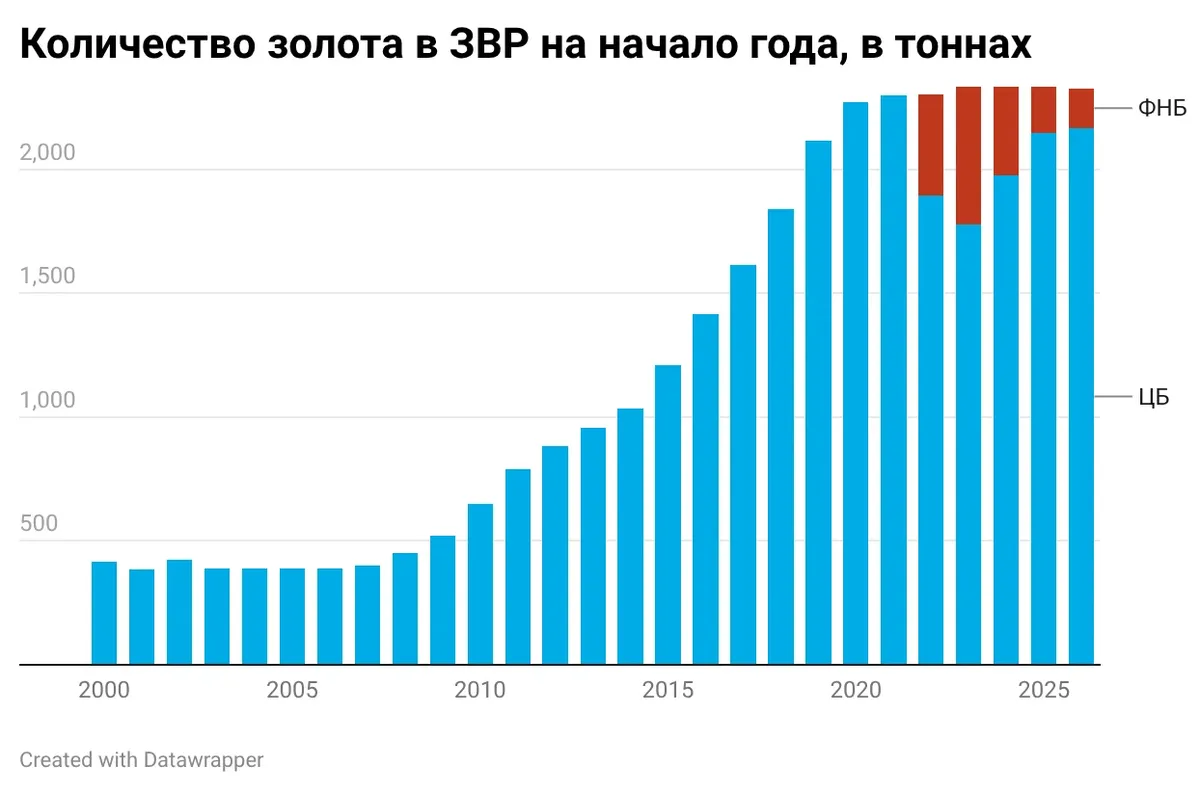
It is easy to notice that the total gold reserves in gold and foreign exchange reserves have remained virtually unchanged since the beginning of 2020. Moreover, until 2021, these were exclusively Central Bank reserves. Gold appeared as part of the National Welfare Fund for the first time only in June 2021 (and immediately more than 340 tons). By the beginning of 2022, there were already more than 405 tons of gold in the National Welfare Fund, and the maximum was reached in May 2022 and amounted to almost 555 tons. After this, the amount of gold in the National Welfare Fund only decreased, and by the beginning of February 2026 it amounted to 155 tons.
But all these significant movements of the metal in the National Welfare Fund had virtually no effect on the amount of gold in reserves. The fact is that in almost all gold purchase and sale transactions, the second party to the transactions was the Central Bank.
And if suddenly, after all of the above, you got the impression that gold was simply transferred from one pocket to another and back, then you are, of course, right, but only partly, since the properties of these pockets are very different.
Here we come to the most interesting part. But before that, we will have to dive a little into the recent history of the Central Bank and the National Welfare Fund and understand how and why the goals and instruments of these institutions changed and how this affected the dynamics and composition of gold and foreign currency reserves.
Bet on bet
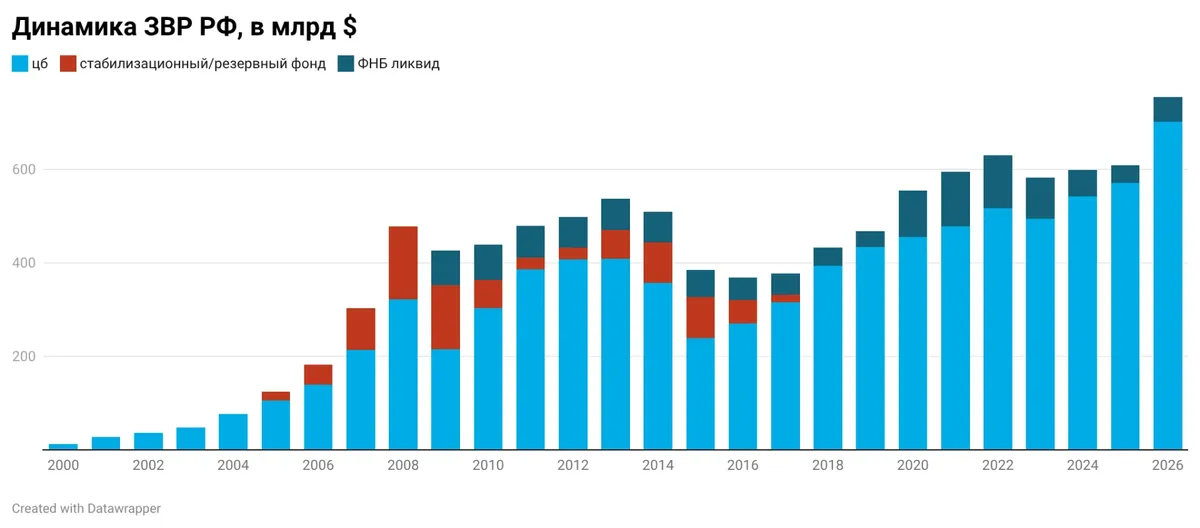
Before the 2008 crisis, one of the main tasks of the Central Bank was to manage the exchange rate. The cycle of rising oil prices that began in 2000 led to a huge influx of foreign currency into the country and, as a result, an excessive (according to the Central Bank) strengthening of the ruble exchange rate. To prevent this, the Bank carried out regular ruble interventions, buying foreign currency. As a result, the volume of foreign currency in the Central Bank’s reserves increased from 8 billion in January 2000 to August 2008 by 50 times and at its peak exceeded $400 billion. Attempts to maintain the exchange rate for the next six months cost the Central Bank more than $200 billion.
After such a large-scale crisis, the Central Bank significantly revised its attitude to currency regulation and began a smooth transition to an inflation targeting system, which was completed by Elvira Nabiullina: after another currency shock in November 2014, the Central Bank first abolished the currency corridor, and then raised the key rate to 17%. From this moment on, it is the key rate that becomes the main and main instrument of the Central Bank.
schedule 2
Kubishka Kudrina
Now a little history of the National Welfare Fund. The rapid rise in oil prices in the early 2000s quickly solved the current problems of both the Russian budget and external debt. And the government thought about the future. The result was the creation in 2004 of the Stabilization Fund, which over time turned into the current National Welfare Fund.
Its idea was simple - all state oil and gas revenues in excess of a certain planned amount were directed to the Fund. If oil prices were below plan, the Fund's funds were spent to cover the budget deficit. Of course, the NWF’s assets were held exclusively in major world currencies and foreign currency bonds of the world’s leading economies. There was no gold in them, because the main task of the fund was to remove price risks when exporting oil, and not turn them into price risks associated with the price of gold.
schedule 3
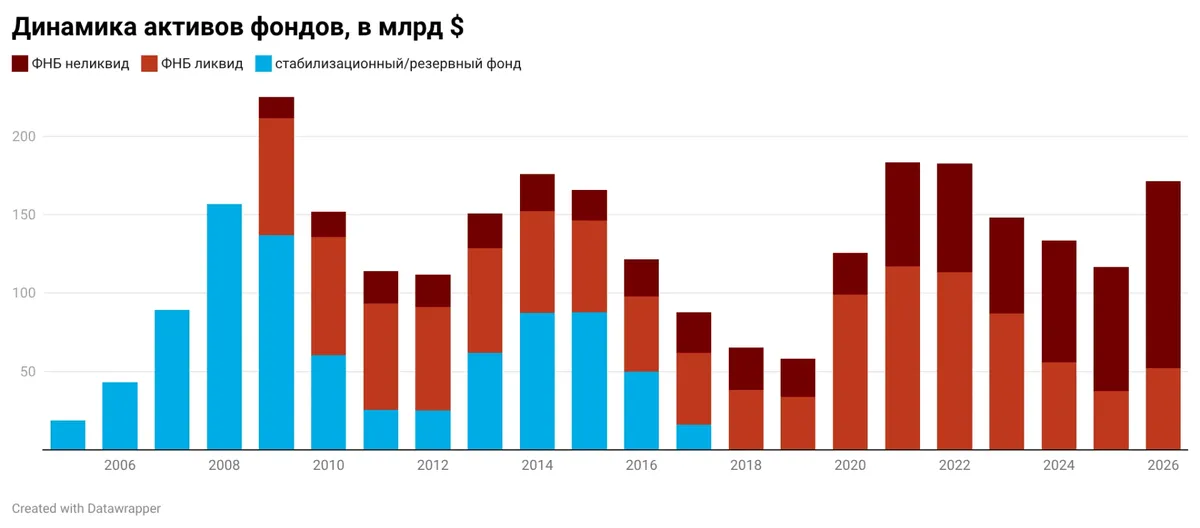
Oil prices continued to rise steadily, and by the beginning of 2008, the fund's assets amounted to almost $157 billion, or more than 12% of GDP. In this regard, it was decided to divide the fund into two parts. Most of it went to the Reserve Fund, which assumed the functions of a budget cushion, but its size was normatively limited by government decree. However, income in excess of this amount was directed to the National Welfare Fund. It was assumed that this fund would become a strategic reserve, and its funds would be used for large infrastructure projects.
But then the rise in oil prices ended.
schedule 4
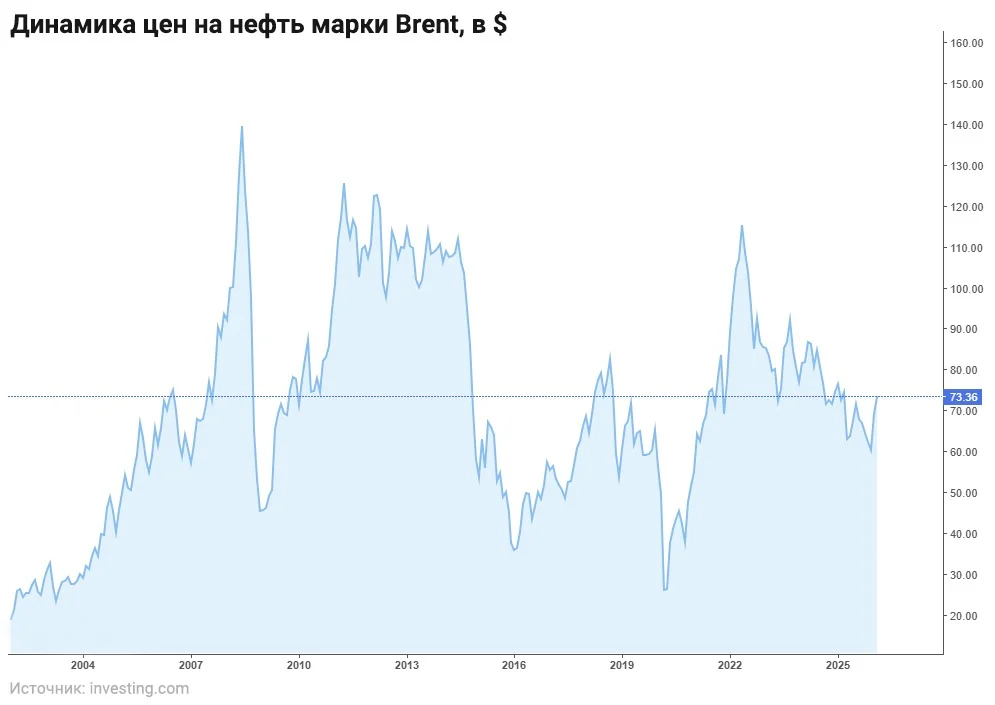
And if the Reserve Fund was able to survive the first price collapse, it could no longer cope with the consequences of the budget crisis that followed Crimea and another drop in oil prices. By the beginning of 2017, its assets had decreased to 16 billion, and by 2018 the fund was liquidated, and the remaining funds were transferred to the National Welfare Fund, whose role has since changed greatly, but more on that later. For now, let's return to gold.
Gold as a means of managing geopolitical risks
Well, where did gold participate in all these processes, you ask? The short answer is nowhere. For this, gold is not the best or most convenient tool. And its reserves until 2007 (as you could already see in the first graph) did not change significantly, fluctuating around 400 tons, and the share in gold and foreign reserves was a record low 2.5% by the beginning of 2008. But if, after studying the chart, you decided that the starting point for changing the strategy of gold reserves was the 2008 crisis, then this is not so. The first large purchases of gold for the reserve occurred back in 2007, after Putin’s Munich speech, and amounted to almost 50 tons. In total, by the beginning of 2014, more than 630 tons of gold were purchased for the Central Bank’s reserves, as a result of which the gold reserves exceeded 1000 tons (as they were preparing for something). But it turned out that this was just the beginning.
schedule 5
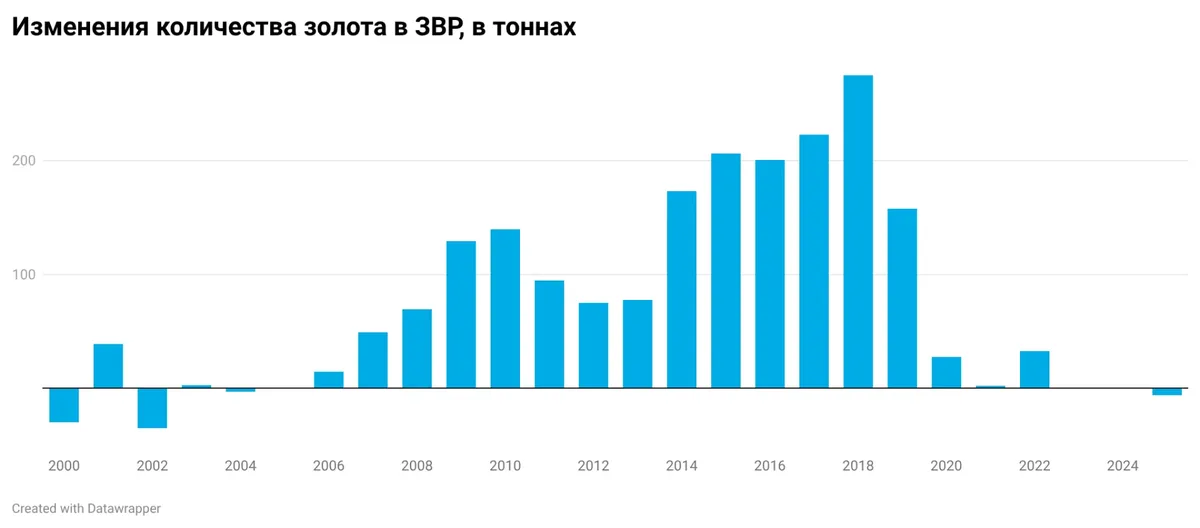
Starting in 2014, the Central Bank bought on average more than 200 tons of gold per year for six years (almost all the gold produced in the Russian Federation), increasing the reserve by more than 1,200 tons and bringing it to 2,271 tons by the beginning of 2020. In April 2020, when the reserve almost reached the level of 2,300 tons, and the share in gold and foreign reserves in value terms confidently exceeded 20%, purchases were stopped, and since then the amount of gold in reserves has not changed significantly. But at the same time, gold began to move in a strange way between the reserves of the Central Bank and the National Welfare Fund, and it is worth dwelling on these strange movements in more detail.
How gold became the main instrument of the National Welfare Fund
By the beginning of 2021, the assets of the NWF reached a record level of $183 billion. Moreover, even the total assets of the NWF and the Reserve Fund in the entire history of their existence were higher only once - at the beginning of 2009 they amounted to $225 billion. However, in the structure of the Fund by this time more than a third was already invested in Russian assets, and the share of liquid assets in foreign currency was less than 2/3: $51 billion, €44 billion, £8.5 billion... and that's it! As you can see, no yuan or gold for you. Which, as we now understand, on the eve of 2022 carried enormous risks. And the Ministry of Finance and the Central Bank quickly began to solve this problem.
By the end of July 2021, US dollars had completely disappeared from the National Welfare Fund, positions in euros and pounds were reduced, and in their place those same 405 tons of gold and more than 200 billion yuan appeared. The Central Bank and the National Welfare Fund simply exchanged assets. Perhaps the calculation was that the risks of freezing the Central Bank’s assets were lower than those of the National Welfare Fund, but as a result, at the beginning of 2022, all foreign exchange assets located in “unfriendly” countries—about $300 billion—were frozen.
In such a situation, there was no need to rush into the already completely formal exchange of assets (rewriting from one balance sheet to another between the National Welfare Fund and the Central Bank), especially since there were no problems with filling the budget in the first half of 2022 - sanctions on oil and gas exports had not yet been introduced, and their prices had risen rapidly. The National Welfare Fund was even able to increase its assets to a new record of $210 billion by June, and gold reserves in the fund grew by another 150 tons (about 30 of which, apparently, were even purchased from the market) and reached 555 tons. But by the end of 2022, large withdrawals of funds from the fund began. And it was no longer possible to replenish them with the previous mechanisms.
The National Welfare Fund is turning into an emission mechanism
Before the introduction of sanctions and blocking, the National Welfare Fund actually acquired and sold assets on the free market. After 2022, these opportunities practically disappeared: most of the foreign currency assets were frozen in foreign accounts, and the sale of gold was also subject to sanctions (including the refusal to recognize the marks of Russian refineries), which greatly complicated its market sale. So the only buyer for the National Welfare Fund was the Central Bank. And since the Central Bank had exactly the same problems with the further sale of these assets, the assets remained on its balance sheet. As a result, the whole process essentially turned into an emission process: the Central Bank simply printed new rubles and exchanged them for the assets of the National Welfare Fund. Of course, in theory, if the National Welfare Fund’s income grew, the fund would buy back these assets to sterilize the ruble mass, but in fact, the fund’s gold and foreign exchange assets only decreased. By the end of December 2024, they decreased by more than three times compared to December 2021 and amounted to $37.5 billion. The amount of gold in assets by this time had dropped below 188 tons. And here the rise in gold prices came to the aid of Russian gold and currency reserves.
schedule 6
Curse of King Midas
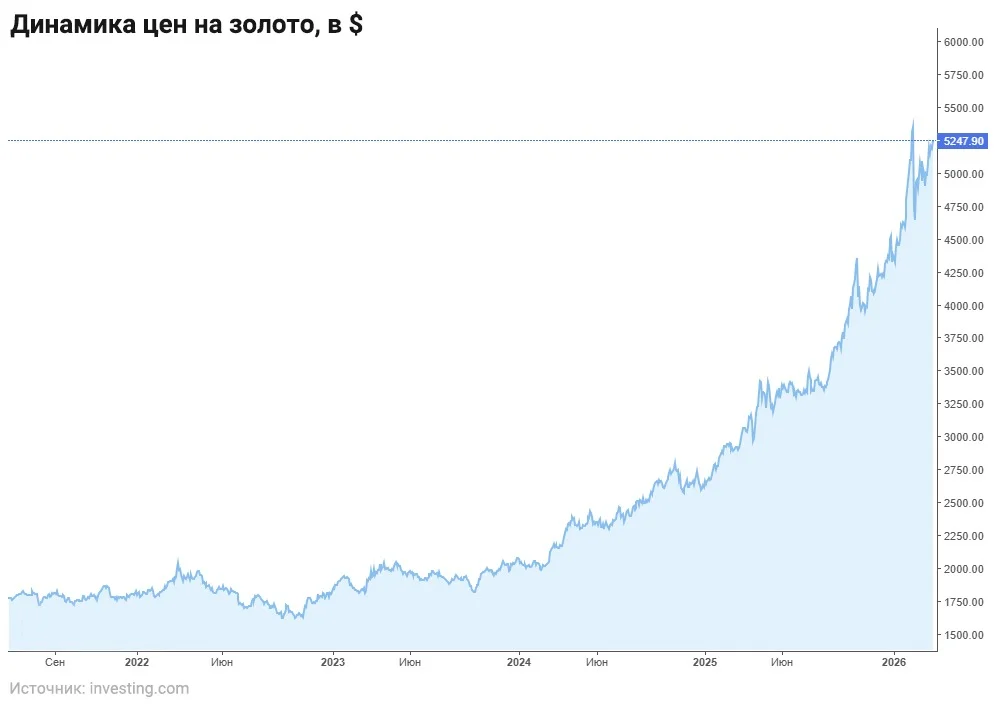
Starting at just over $2,000 per ounce in January 2024, gold prices surpassed $5,000 in January 2026! How did this growth affect the value of Russia's gold and foreign currency reserves? By the end of 2025, reserves amounted to a record $755 billion, and at the end of January this year they already exceeded $833 billion!
schedule 7
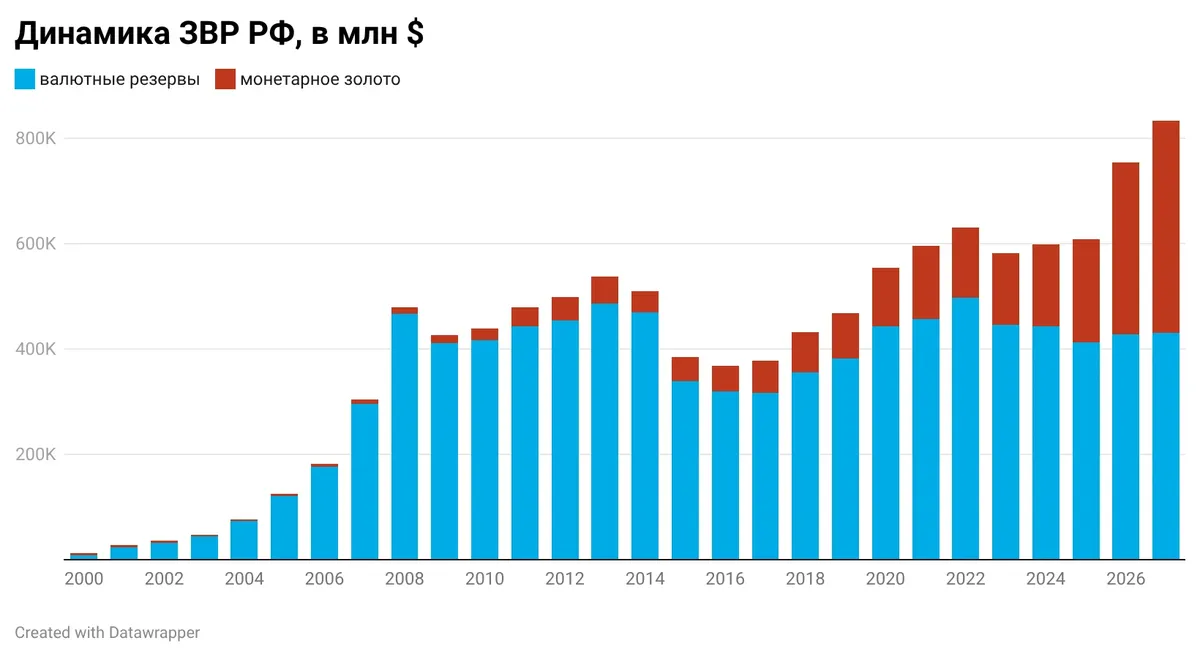
Now let's take a close look at the structure and quality of this reserve and compare it with the last pre-crisis year.
As of January 1, 2008, the Russian Federation's gold and foreign currency reserves amounted to $479 billion, which corresponded to 37% of the country's GDP for the past 2007. By February 1, 2026, the size of reserves increased to $834 billion (about 33% of 2025 GDP). But if in 2008 all these assets were absolutely liquid and consisted of 97% of assets in world currencies and 3% of gold, then in 2026 the picture is completely different. Up to 40% (according to various estimates, from 300 to 330 billion dollars) of assets are blocked, 48% are in gold, the liquidity of which has serious problems. That leaves 12%, or about $100 billion, in reserves, most of which are yuan. And this is only 4% of GDP.
And the Central Bank understands this problem very well - since November 2025, it nevertheless began attempts to actually sell gold on the domestic market, mirroring its purchases from the National Welfare Fund. But the scale is still very modest: for example, only about 9.5 tons of gold were sold in January.
Ivan Karpenko