
Translated material
Magic sessions followed by exposure
How the best writers of the country - from Prilepin to Shaman - celebrated World Writer's Day

Zakhar Prilepin. Photo: Mikhail Tereshchenko / TASS
March is a treacherous month for the state. At the sound of the first drop, contract killings of important people were carried out at all times with special zeal. Today we remember mainly two of them - the death of Paul I and Vladislav Listyev. Biography of Russian emperors, especially such a mysterious one as Pavel Petrovich, is now in fashion. And even though the authors mostly adapt Wikipedia, few people care. The trend towards preserving historical memory in line with the general craving for traditional values is important.
The commemoration of Listyev takes place in another department - ritual. For 31 years now, on March 1, comrades, using the same words, with the same expressions of boring faces and dull eyes, have been sculpting projects about their colleague - the founder of modern TV. The unshakable canon this year was marked by reduced vigilance of its demiurges - in the frame of the revolutionary “Vzglyad” the very young “enemy of the people” Maxim Galkin * suddenly flashed (it seems that for the first time since its abolition, not in a derogatory context). And the canon was crowned with the revelations of the former prosecutor general. “Such crimes are not easily solved,” Yuri Skuratov said authoritatively. Easily! How much has merged in this sound for the Russian heart...
I am far from idealizing that time, and the then explosion of creativity, and Listyev’s personality. But when you watch even very carelessly memorial programs made on your knee, you are left with a feeling of amazement. We are not talking about liberal ideas that are now disgraced; even then, by and large, they remained dreams. What, by the way, Yuri Nikulin says in his quiet manner: we do not have freedom of speech, but freedom of silence. (I wonder what he would say today on this matter?) This is about something else.
From a chaotic cut-up, a kaleidoscope of faces, opinions, gestures, an idea of the spiritual climate of society is born. This is where the breaking point is. Try now to put together a similar cursory mosaic of cultural oracles - and you will become numb from the degree of intellectual poverty compared to the dashing nineties.
I tried it and this is what happened.
I decided to limit myself to writers, especially since it’s World Writer’s Day outside the window. I'll start with Prilepin. Zakhar started a big conversation on a primary topic: who is the main writer in the country today? Of course, both he and his minions know the answer. As the play progressed, interesting nuances emerged. There are many of them, I’ll just say one. Judging by the context, Prilepin’s main rival is Vodolazkin. He turned his critical wrath on him. Poor Evgeniy got it both for writing with “cold blood” and for being excessively cautious. The crowning achievement was the memory of our time together in London.
Distinguished guests from Russia were asked the question: whose Crimea? And here Vodolazkin, Zakhar narrates, became dizzy, spun, got scared and practically avoided answering. I remember that for such caution, many famous people were ostracized. However, Prilepin easily puts such a trifle, as well as the dubious ethics of his entire new project, out of the scope of the epic conversation. I was alarmed by the everyday nature of the denunciation, which now seems to be no longer perceived as such.
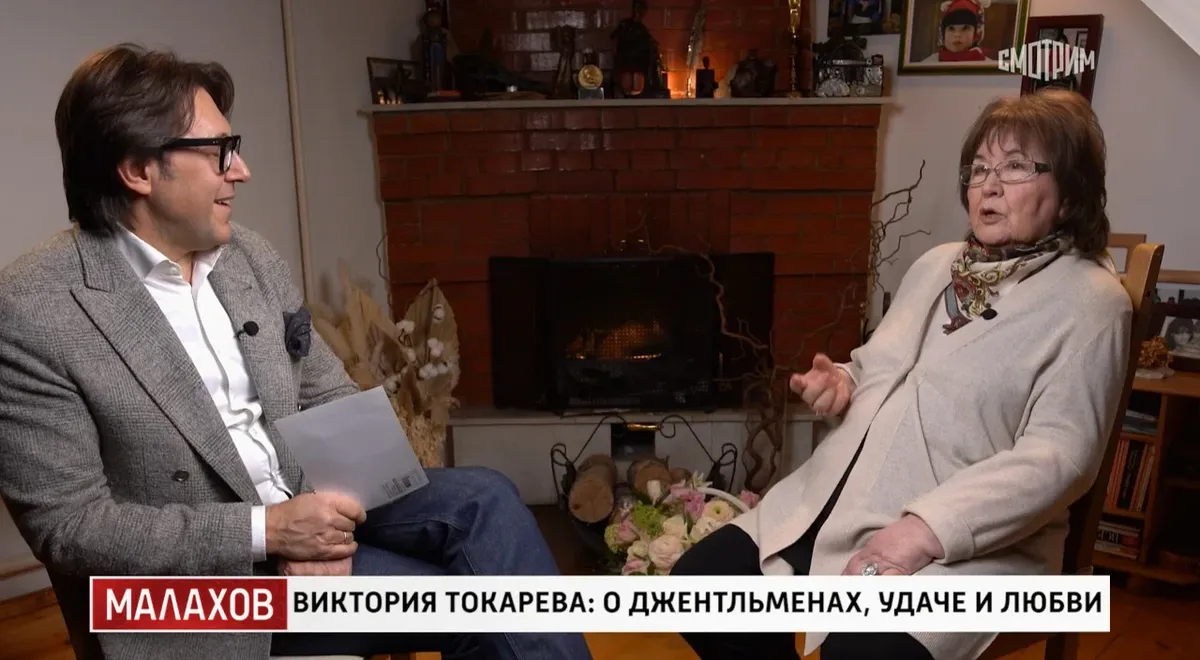
The next heroine, Victoria Tokareva, is far from politics. She is a good writer with her own niche, and rarely appears in public. But then she came to Malakhov, and I pressed myself to the screen in anticipation of a revelation, which was not long in coming. On the threshold of her 90th birthday, Tokareva went into detail about her fiery romance with Georgiy Danelia (she wrote the script for the film “Gentlemen of Fortune”).
Closer to the finale, the rank increased - Victoria Samuilovna appointed herself the greatest love of the director’s life. The romance of the memoir was combined with poisonous everyday sketches like Danelia’s drunkenness and much more, including Yevgeny Yevtushenko’s love of love. The royal lady called him a sexy tourist. And one should not think that age is to blame for the ringing vulgarity. Tokareva is fresh, full of strength and varied feelings.
“What might turn you on today?” - Malakhov asks playfully. “Black caviar,” the engineer of human souls immediately answers. “In general, I like to eat well, sleep well and live well.”
The magic session followed by Tokareva’s revelation was easily surpassed by Alexander Tsypkin. If anyone doesn’t know, this is the second (after Prilepin) great writer of the Russian land. He is a prose writer, a screenwriter, and a playwright. He also holds a mysterious title: strategic communications expert. The expert is simple and unpretentious, just like his work. He is asked a question like: do you work by inspiration or by plan? He answers: I don’t know what inspiration is. I work under a contract.

To complete the picture, we cannot do without the Shaman - after all, he also belongs to the writing workshop. A poet, and what a poet! He arrived at Baikal, licked the sacred lake, and the powerful lines of the future song immediately poured out of it: “You are my dear Baikal, I have been looking for you for a long time.” The process of licking caused different reactions in society, so the singer came to Korchevnikov in order to shed the light of truth on his spiritual impulse.

What does he regret? There would have been even more responses about the fact that he didn’t show up to the lake in leather leggings and dreadlocks. What are you proud of? Because it instantly increased interest in Baikal by as much as 12 percent. Then he swam straight across the lake to his wife and decisively announced the cardinal thing: for society, our series with Mizulina is over. Society breathed a sigh of relief.