
Translated material
Women in politics in the North-West: there is growth, but not always power

International Women's Day in Russia is perceived as a day of honoring, admiring and caring for women of all ages. Vladimir Putin also speaks about this. But initially, March 8 was not intended to be a holiday of mimosa and greeting cards. First of all, this day was supposed to become a symbol of the struggle for women's equality and a symbol of emancipation. “Chronicles.Media” collected and analyzed how many women work in the leadership of the north-western regions and how the number of women in the regional parliaments of the North-West has changed over the past 35 years.
The idea of International Women's Day originated in the USA, and the holiday received its international status the following year at a conference of socialist women in Copenhagen. The date March 8 was established in the early 1920s.
The main meaning of International Women's Day was the fight for women's voting rights without any restrictions. Moreover, it was not only about the right to vote, but also about the right to be elected and participate in the governance of the city, region and country.
A hundred years later, women in Russian politics still remain a minority, although their representation is slowly growing. This can be seen in the example of the regions of North-West Russia.
One regional head for the entire North-West
Today, the only woman heading a region in the Northwestern Federal District is the head of the Nenets Autonomous Okrug (NAO) Irina Gekht. She has held this post since 2025. At the same time, unlike most regional leaders, Hecht was not elected in direct elections: her candidacy was approved by the regional parliament. The Nenets Autonomous Okrug remains one of the few regions of Russia where such an appointment procedure has been preserved.
Irina Gekht is one of two current female governors in the country. The second woman, Maria Kostyuk, has been heading the Jewish Autonomous Region since 2024. Before that, she headed the regional branch of the fund for supporting participants in the special military operation “Defenders of the Fatherland” and even lost her son in the first year of the war. For the north-western regions, a female governor is not the first such experience: St. Petersburg was headed by Valentina Matvienko from 2003 to 2011, who later became Speaker of the Federation Council, and the Murmansk region was led by Marina from 2012 to 2019 Kovtun.
However, it is worth noting that, unlike them, Hecht has nothing to do with the region she leads. She herself comes from the Kurgan region, and from the beginning of the 2000s she worked in the authorities of the Chelyabinsk region, where she rose to the rank of first deputy governor of the region and represented Chelyabinsk in the Federation Council from 2019 to 2024. After that, she briefly headed the government of the Zaporozhye region, occupied by Russia. And perhaps in gratitude for this work she was given the governor’s chair in the Nenets Autonomous Okrug.
Women in parliaments: how representation has changed
There are significantly more women in the regional parliaments of the North-West today than three decades ago - but this was not always the case. For example, after the first elections to the Legislative Assembly of the Vologda Region, not a single woman entered it. In St. Petersburg and the Leningrad region, in the first convocations of regional parliaments there was only one woman out of fifty deputies: Natalia Evdokimova in St. Petersburg and Svetlana Yurkova in the Leningrad region.
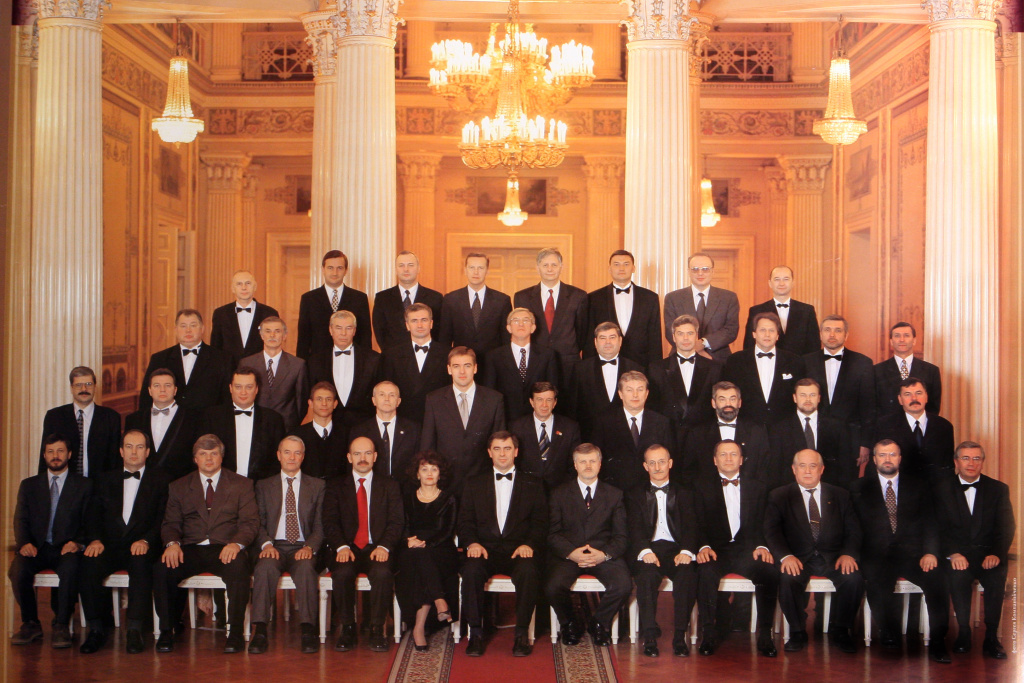
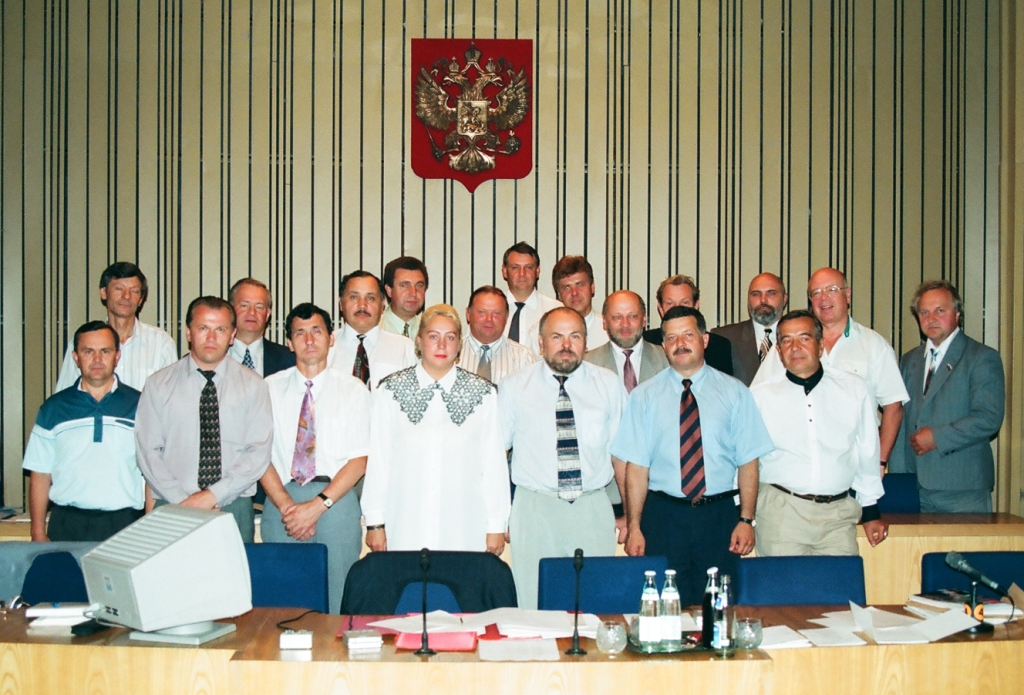
The largest number of women among the deputies of the first convocation of the north-western parliaments were in Karelia - 13 out of 61 deputies or about 21%. At that time, the parliament of the republic was bicameral, and one of the chambers, the House of Representatives, was headed by Valentina Pivnenko. Today she continues her political career at the federal level - in the State Duma. Over the past 35 years, the situation has noticeably improved. In the regional parliaments of the Northwestern Federal District, the share of women has increased - as in many countries of the world.
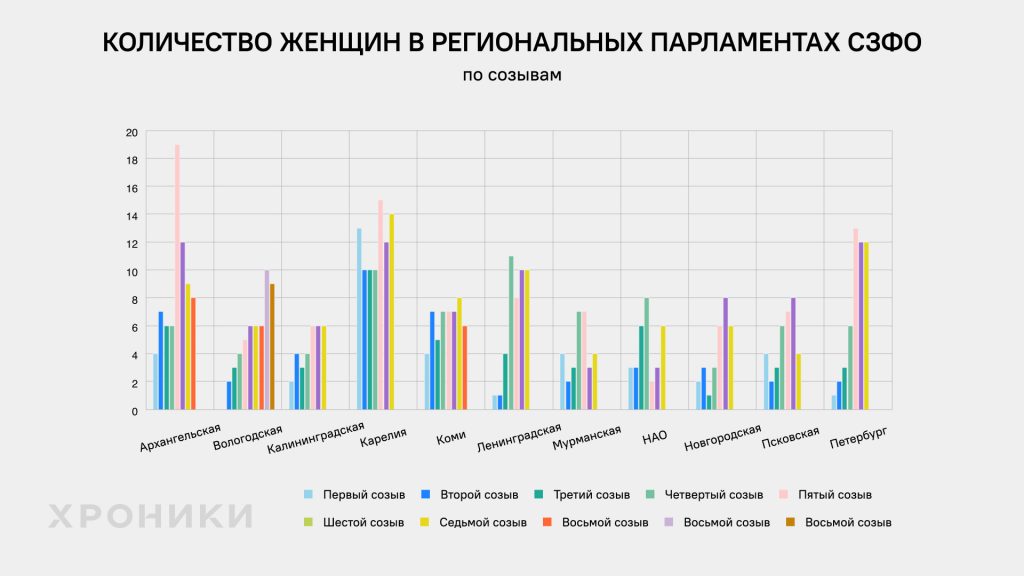
The total number of deputies in the district parliaments varies greatly - from 19 in the Nenets Autonomous Okrug to 50 in St. Petersburg and the Leningrad Region, so we are not comparing the absolute number of deputies, but the relative one.
Today, the highest proportion of women among deputies remains in Karelia: almost 39% of the parliament or 14 deputies here are women. Thus, the republic retains the leadership that was established in the first convocation. This is followed by St. Petersburg - about 22% of the deputy corps (11 women) - and the Nenets Autonomous Okrug, where women occupy about 21% of the seats (4 deputies).
The lowest proportion of women is in the parliaments of the Novgorod and Murmansk regions: 12.5% of deputy mandates each, or four women each.
Women's government
Women are increasingly represented in regional executive power.
As the Chronicle.Media study showed, the composition of the regional governments of the North-West differs markedly in size and structure. In some regions, they include the heads of most relevant departments - as, for example, in the Komi Republic. In others - only the governor and his deputies, as in the Pskov region and the Nenets Autonomous Okrug.
Because of this, the size of governments varies greatly. The largest government is in Komi, where it includes 29 people. The most compact is in the Pskov region: here the highest executive body consists of the governor and his five deputies.
In total, the governments of the north-western regions include 198 people, of whom 76 are women.
Most often, women in the regional governments of the North-West oversee the economy - this area accounts for about 40% of the posts they occupy in the executive branch. Another approximately 20% are responsible for social policy and administrative areas - such as justice, interaction with authorities and internal management. Women also occupy positions related to culture, sports and digital policy.
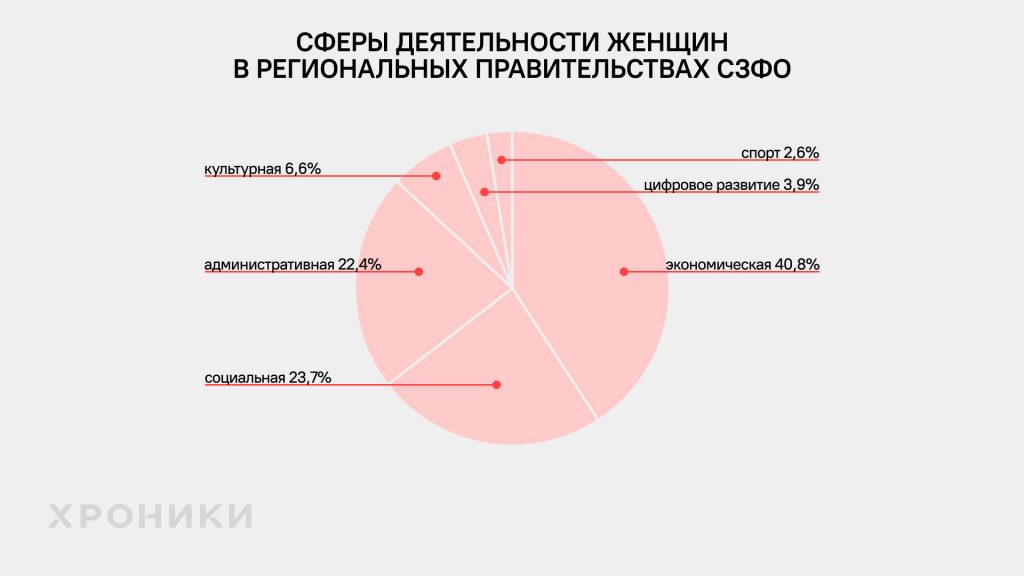
The administrative sphere includes such areas as management of the regional government apparatus, general interdepartmental interaction, representation in regional parliaments, federal and regional authorities, and legal regulation.
The economic sphere includes such areas as industry, agriculture, trade, finance, energy, housing and communal services, tariff regulation, construction and urban planning, natural resources, procurement and property relations.
Digital policy includes such areas as communications, digital technologies and information policy.
The most “women’s government” is in the Murmansk region, where almost three quarters of the composition are women: 14 out of 19 government members. Next come the Pskov region, where women occupy four out of six government positions, and the Nenets Autonomous Okrug: half of the regional administration is women, including the head of the district, Irina Gekht.
St. Petersburg is second to last on this list. Of the 15 members of Alexander Beglov’s government, only two are women - Irina Potekhina and Natalya Chechina. It is worth noting that during the time of Valentina Matvienko there were few women in the city government. For eight years at the head of the city, Matvienko included only two women in the government, and both were her friends - Lyudmila Kostina was responsible for the social sphere and Alla Manilova, who now heads the Russian Museum, oversaw culture and the press.
***
Despite the fact that the number of women in Russian politics is growing, in terms of their level of involvement in governing the country, Russia, according to the World Economic Forum, was in 133rd place in the world in 2021. Russia was not included in later reports.
More surprising is the fact that, even according to polls by the state sociological center VTsIOM, three-quarters of Russians support more active participation of women in politics. At least in words.
Over 35 years, there have been noticeably more women in regional politics in the North-West, especially in governments and parliaments. But even there, they often find themselves in the “social” and administrative bloc, rather than in areas where big money and resources are distributed. Therefore, March 8 in Russia still remains a mimosa holiday, and equal access to power has not become the norm.
Mikhail Mikhnevich, Maxim Privin