
Translated material
Normalization of the aggressor. Discussion about the Russian Pavilion in Venice
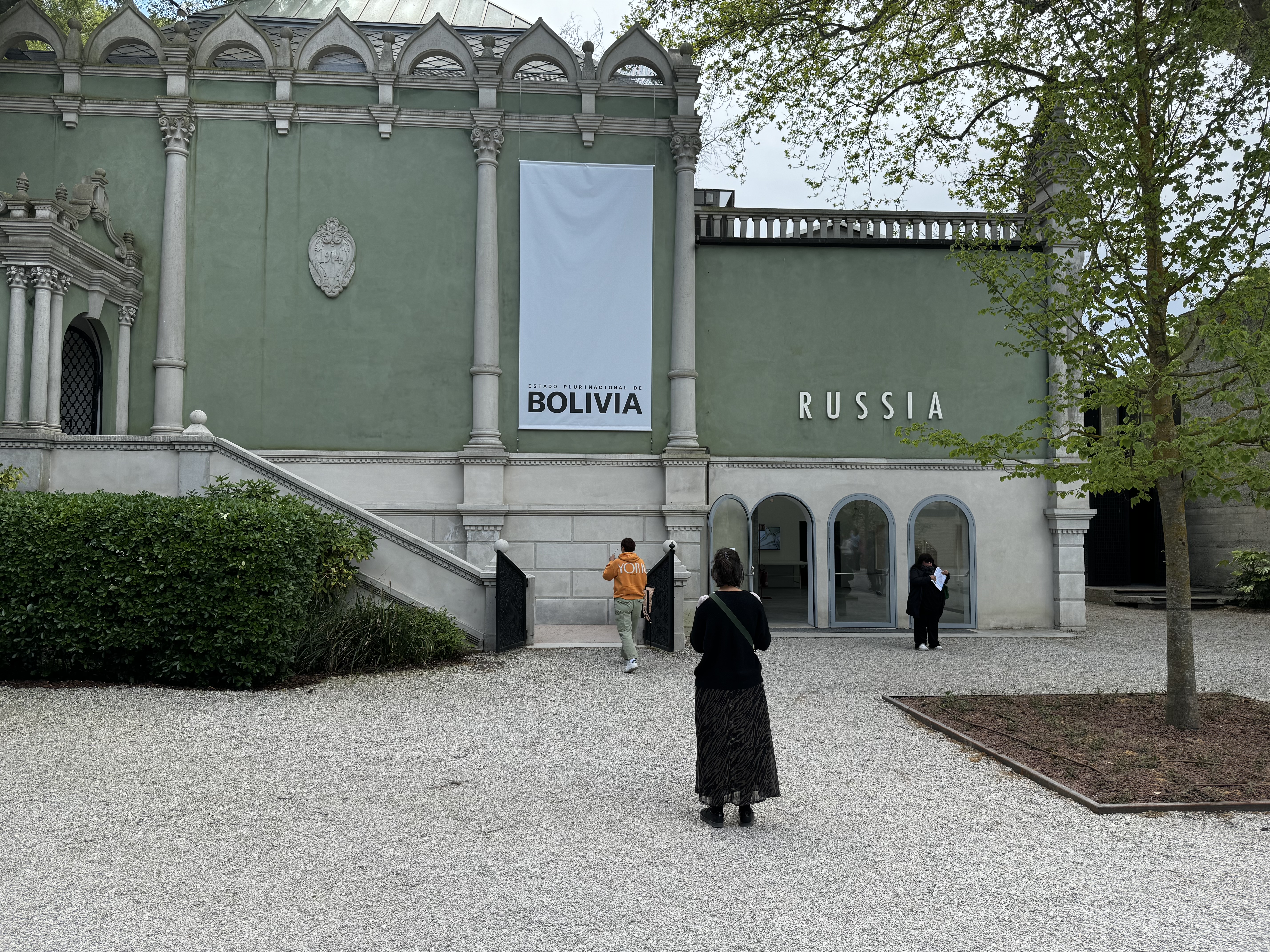
Russia returns to the Venice Biennale of Contemporary Art. In 2022, when the war began, the Russian Federation pavilion was closed. In 2024, Russia leased it to Bolivia. Now Putin’s special representative for cultural cooperation, Mikhail Shvydkoy, has announced that Russia has never left the biennale and has “always been present in the Venetian cultural space.”
The Russian exhibition at the 61st Biennale of Contemporary Art will be called “The Tree is Rooted in the Sky.” There is a joke on social networks that this tree is “Hazel”.
A series of sound performances are planned, on which several dozen authors are working. The first will be shown during the preview on May 6–8, when the biennale will be open only to accredited journalists.
The project is coordinated by the Gnessin Russian Academy of Music. The commissioner of the pavilion since 2021 is Anastasia Karneeva, co-founder of the Smart Art company and daughter of Rostec Deputy Director Nikolai Volobuev.
Bloggers are outraged that Russia, in the midst of war, will be represented at the largest international exhibition of contemporary art. Ukrainian art critic Konstantin Doroshenko recalls that back in 2022, the director of the Hermitage, Mikhail Piotrovsky, called Russian exhibitions abroad “a powerful cultural offensive,” comparing them to a “special operation.” “The leadership of the Venice Biennale should take this into account,” says Doroshenko.
The Russian press is choking with delight at the announcement. that in May of this year, Russian artists and musicians, supervised directly by the Russian government, will take part in the Venice Biennale. What the hell, you ask? Of course, I have never been and will not be the curator of this famous forum. Even though in recent years it has almost turned into a garbage dump, it’s still a pity: I would drive Russian art, which came from modern Russia, out of there with a filthy broom.
This is war.
This web has been woven for decades
These are military operations on the cultural front. And it is as such that they must be understood. And as such they must be resisted. Not only at the level of diasporas and activists, but at the state and institutional level.
A terrorist country waging a genocidal war with tens of thousands of victims, killed children, targeted hunting of people by drones, raped women and girls, tortured in terrible agony by military and civilians, thousands of documented war crimes against citizens of a neighboring independent state in the center of Europe - and now this state, in its usual impudent manner of a gopnik from "Ashtotakov", returns to its own pavilion (stolen after the dissolution of the USSR and then gradually squeezed out of the CIS, and originally built by the architect Shchusev with the money of a Ukrainian philanthropist).
State (I emphasize) pavilion representing the terrorist STATE at the Venice Biennale.
This return would have been impossible without a network of mutual settlements, services, connections in European political circles and cultural institutions. This network has been woven for decades. Just as everything else that Russia is doing now would be impossible.
Among the participants there is not a single artist known even in Russia
I think this is a good reason for a direct artistic statement against the current state of the Russian Federation. You can simply announce an open-air festival, opposite the Russian pavilion. (...) I’m glad that among the participants there is not a single famous artist even in Russia, let alone in the world. Not one of those who are dear to me.
Commentators are worried that Russia is again going to participate in the Venice Biennale. This is, of course, impressive - several dozen unknown participants with their works. But I don't understand one thing: how are they going to deliver all this to Italy?
Through the pipe again? Through the Chukotka-Alaska tunnel? Or will they simply build Venice from domestic plywood in Patriot Park?
Ekaterina Margolis clarifies:
The pavilion itself will most likely remain closed.
The reason is prosaic: the sanctions in force against the Russian Federation make it impossible for professionals and contractors to sign the necessary documents. Venetian contractors, as it turned out, for some reason are not eager to participate in legally dubious schemes.
But it doesn't matter. The solution has been found.
Art has always been able to work with space. And the Russian one has room for maneuver inside the perimeter of the thorn. And the crooked goat is a favorite totem animal and vehicle.
If you can’t open the pavilion, you can perform in front of it.
Therefore, during the preview days of the Biennale, from May 5 to 8, young musicians will take the stage (in the text of the press release it is emphasized: very young musicians - that is, simply children)
They, like street beggars, will perform works from the most diverse traditions of Russia, combining them into the main one - guess which one for yourself at once.
National pavilion without exposition, but with an archive of performances by hired street musicians
The music will be recorded on audio and video, and then these recordings will be available to Biennale visitors... exclusively outside the pavilion.
This creates a rare artistic format: a national pavilion without an exhibition, but with an archive of performances by hired street musicians in front of its own closed door.
One might say, a new genre is site-specific beggars performance.
In the Russian press, of course, this will be called differently: “the return of Russia to the international cultural scene.”
The official rhetoric has already been prepared.
“We didn’t go anywhere,” explains Mikhail Shvydkoy.
“We haven’t started yet,” reminds Vladimir Putin.
And indeed: when the pavilion is closed, there is no exhibition, and concerts are held on the street, it is difficult to say whether anything has already begun.
The conceptual line of the project—appropriation of decolonization and demonstration of the “cultures of the peoples of Russia”—gives a special charm to the situation.
That is, viewers will be invited to get acquainted with the rich cultural diversity of the peoples of the country, whose languages, histories and cultural practices have been formed over the centuries under conditions of colonization, genocide, assimilation and Russification.
To be frank, I do not share the excitement of my colleagues about the Russian Federation’s next appearance at the Venice Biennale. Those Russians who will come will not excite anyone. A group of fifty people does not make an artistic statement. Even if it were fifty geniuses. But it's unlikely. The process is led by the children of some Russian bigwigs. Actually, the company was brought together so that there would be no statements - after all, any statement could result in punishment. It was collected in order to go with the right people to Venice, hang out, show the flag. These are all purely bureaucratic matters, it doesn’t matter.
The Forum of Contemporary Art is ready to host the official exposition of the country waging a criminal war
Another thing is more important: on the part of the Biennale, these are also purely bureaucratic affairs. The most respected (yes, still, for lack of anything else), forum of contemporary art is ready to host the official exposition of the country waging a criminal war. It is completely clear how they will explain this: war is war, and the great Russian culture, rooted not just somewhere, but in heaven, is on schedule. We are for peace. Well, for commerce, of course, Venice is worth it. And as you know, “Venice does not sink”, this is its motto.
I had already forgotten that the commissioner of the Russian pavilion at the Venice Biennale (its freshly painted doors will open very soon) since she was 21 is yet another general’s daughter, Anastasia Karneeva (only a general from Rostec), and her business partner is Lavrov’s daughter, by the way. They say they love art very much, so they quickly figured out how to refuse the services of the long-sincere Gintovt when creating a national exhibition in the tomb of European culture. Instead of portraits of Stalin, there will be Voices of Komi on the walls and the Toloka ensemble (not to be confused with Tolokno from Pussy Riot) at the music stands. And all this “modern art” is now being promoted in the Western press by Mikhail Shvydkoy, who recently gave speeches about the didactic benefits of censorship.
It is stupid and funny to write about the Russian pavilion in Venice, since its very content is an exhaustive criticism of itself. Giving it to Belyaev-Gintovt or Yulia Muzykantskaya would have been a more curatorially meaningful decision. And this brings to mind Kirill Martynov’s recent post, where he writes that the CEO of McDonald’s himself does not use his products, so the organizers, emphasizing the “multilingual polyphony of cultures” and following the general trend of the biennale of a human upside-down zoo, will once again try to mock the indigenous peoples of Russia, who are systematically reduced in their ability to access learning their native languages, leading a traditional way of life and are threatened with physical destruction in war.
Pussy Riot released a statement:
(...) The participation of official Russia in the Biennale is a serious blow to the security of Europe. Since the beginning of the full-scale invasion of Ukraine, cultural “soft power” has become part of Russian military doctrine and a tool of hybrid warfare.
This is the cultural expansion of imperial Russia into the heart of Europe.
Pussy Riot comes to the Biennale with its intervention. We want to express our unconditional support for Ukraine, the victims of Russian war crimes, Russian political prisoners and Ukrainian prisoners of war.
Russia's best citizens are either jailed for anti-war gestures or killed - while Europe opens its doors to Putin's officials and propagandists.
Politicians and officials joined the discussion.
Polish Minister of Culture Marta Cienkowska calls Russia's return scandalous: "Please do not confuse art with conformity. An artist cannot help but notice what is happening around him, just as curators are well aware of the contexts and environments in which they place exhibitions."
Ukraine called on the organizers of the biennale not to allow Russia to participate. The statement was signed by Foreign Minister Andrei Sibiga and Culture Minister Tatyana Berezhnaya. It says Russia is destroying Ukraine's cultural heritage, killing artists and generally "waging a systemic war against Ukrainian culture, identity and historical memory."
“Russia cannot bomb Ukraine, kill civilians and at the same time walk on the red carpet at the Venice Biennale. This is a dangerous normalization of the aggressor. Until Russia ends the war, nothing can remain the same,” Latvian Foreign Minister Baiba Braze wrote on social network X.
Dismayed by the Venice Biennale decision to let Russia open its pavilion. Russia can't bomb Ukraine, kill civilians, and walk the red carpet at the Venice Biennale. This is a dangerous normalization of the aggressor.Until Russia ends its war there can be no business as usual. https://t.co/2iRGapXdUh
— Baiba Braze (@Braze_Baiba) March 5, 2026
The Italian Ministry of Culture claims that it has nothing to do with it:
“The decision on the participation of the Russian Federation in the 61st International Art Exhibition of Venice was made entirely by the La Biennale di Venezia Foundation independently, despite the opposite position of the Italian government. As Minister Alessandro Giuli has repeatedly emphasized, including during various meetings and negotiations with the Ukrainian authorities, Italy pays great attention to the protection of the Ukrainian artistic heritage, which suffered from Russian bombings that have been going on for more than four years. In particular, Italy is involved in the restoration one of the symbolic buildings of the cultural history of Ukraine - the large Orthodox Transfiguration Cathedral in Odessa, seriously damaged during the conflict."
The Italian Association of Anti-War Russians published a statement:
Real art leaves or ends up in prison
We, Russian citizens opposed to Russia's war in Ukraine, call for a stop to the official participation of the Russian Federation in the Venice Biennale 2026. Culture should not become a tool for legitimizing a state waging war against a peaceful country and violating international law. Russian state media daily broadcast aggressive rhetoric against Europe. At the same time, the defense corporation Rostec is engaged in military developments. We are not against Russian artists - many of them are subject to censorship, repression and are forced to leave the country. Real art leaves or ends up in prison. We are against the state representation of the regime. We demand: cancel the official participation of the Russian Federation and create space for independent anti-war artists.
There is also a collective petition open for signing:
In March 2022, following Russia's full-scale invasion of Ukraine, La Biennale di Venezia issued an official statement strongly condemning the aggression and declaring that it would refuse to cooperate with official delegations, institutions or persons associated with the Russian government. This position cemented an important ethical commitment by one of the world's leading cultural institutions.
Today, as Russia's war against Ukraine continues, the announced presence of a Russian state pavilion raises pressing questions about how this principle is being respected.
(...) The Venice Biennale has been a space for artistic freedom, international dialogue and cultural encounter for decades. Venice itself, open to the lagoon and historically shaped by exchanges between cultures, symbolizes a place where art, ideas and history meet openly.
But when a state engaged in a war of aggression appears within the framework of national representation, its presence inevitably carries a political meaning that goes beyond artistic production. This risks normalizing something that cannot be normalized.
Normalization of the aggressor. Discussion about the Russian Pavilion in Venice