
Translated material
Oil burns, incomes rise
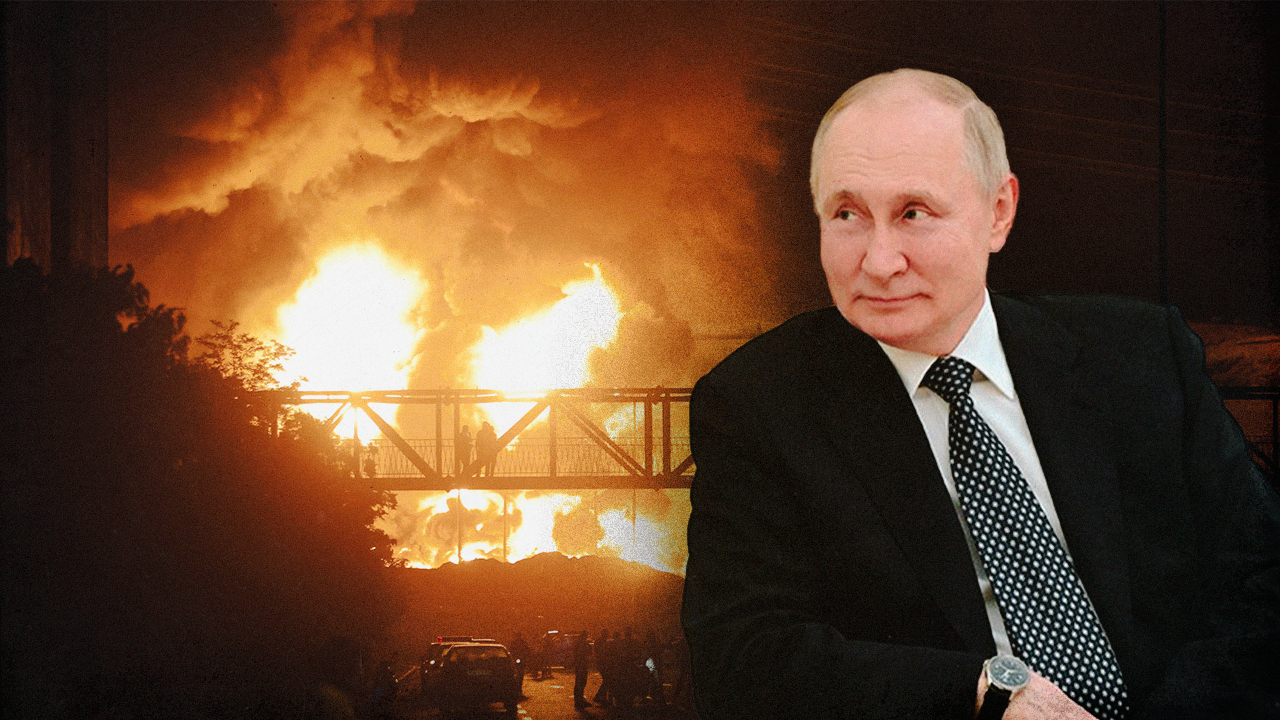
The war in the Middle East and the Russian budget
Amid fears of a protracted war in the Middle East, world oil prices exceeded $100 for the first time since 2022. Fuel prices jumped 30% in a week. And this is not the limit, according to Bloomberg analysts.
On March 8, Israel attacked oil storage facilities in Tehran. The Iranian Red Crescent Society said the explosions released large amounts of toxic hydrocarbon compounds, sulfur and nitrogen oxides.
The war between the United States and Israel against Iran has been going on for more than a week. US President Donald Trump's special envoy Steven Witkoff urges Russia not to provide support to Iran. According to CNN and The Washington Post, Moscow is providing Tehran with data on the deployment and movements of American ground forces, warships and aircraft. According to Deutsche Welle, Iran has only a few military satellites.
Last year, Russia and Iran entered into a strategic partnership agreement covering defense, economics and energy. Iranian drones have become one of the key factors in Russia's war against Ukraine.
Meanwhile, Ukraine has already sent experts and interceptor drones to protect US military bases in Jordan. Vladimir Zelensky, in an interview with The New York Times, again recalled that Middle Eastern countries can persuade the Kremlin to declare a truce in the war with Ukraine. The President of Ukraine also said that the drones that Iran launches across the Middle East contain Russian components.
What benefits Russia can see in a protracted war in the Middle East and how Moscow is helping Tehran, we discuss in the program “Facing the Event” with oil and gas market analyst Boris Aronstein and military expert Sergei Migdal .
According to Russian President Vladimir Putin , due to the blockade of the Strait of Hormuz, oil production in a number of Middle Eastern countries could be completely stopped in the next month. He stated this during a meeting on the situation on the global oil and gas market. According to Putin, a complete switch in Middle Eastern oil supplies without the Strait of Hormuz is unrealistic, and attempts to find new ways to export oil from the Middle East will be difficult and expensive.

The war in the Middle East and the Russian budget
by Radio Liberty Text copied width px height px The URL has been copied to your clipboard
No media source currently available
What is happening on the world oil market against the background of the war in Iran, and how the blockade of the Strait of Hormuz will affect Russia and its oil trade, oil and gas market analyst Boris Aronstein told Radio Liberty:
There are no queues for Russian oil and petroleum products, although there is a shortage on the market
-There are no queues for Russian oil and petroleum products, although the removal of 10-12 million barrels of oil per day from the world trade balance has led to the creation of a deficit in the market. It is not dictated by fundamental economic circumstances such as supply and demand. This is simply a geopolitical shock, similar to the shock that the industry experienced during the Yom Kippur War, when the price of oil jumped 4 times, and during the Iranian revolution of 1979. Indeed, they are now purchasing more Russian oil. There is a special 30-day waiver from the United States, which now allows India to completely legally purchase Russian oil stuck on tankers.
But according to the most recent data, the price of oil has again fallen below $100 per barrel. Brent is trading at $99, WTI at $93. I still hope that a soft scenario will be realized, in which oil will fluctuate in the range from 90 to 100 dollars per barrel. Currently, the share of energy resources in total world GDP is 3.5%. This is still a fairly comfortable level for the global economy as a whole. The average scenario is an almost complete closure of the Strait of Hormuz and intense attacks on the oil and gas structures of Arab countries. In this case, oil prices could exceed $150 per barrel. The worst scenario associated with a complete blockade of the Strait of Hormuz could result in oil prices above $200 per barrel. Here a global economic crisis will already be guaranteed.

If Donald Trump believes that the military objectives of the operation have been achieved, then the market will relatively quickly return to pre-war prices
The development of the situation depends on one person - the President of the United States. If Donald Trump believes that the military objectives of the operation have been achieved and the fire will soon cease, then the market will relatively quickly return to pre-war prices. But victory is a commodity like everything else. It may or may not be sold. I think that the United States, unlike the situation with Venezuela, during the first week Iran itself did not bomb and restrained Israel in terms of bombing Iranian oil and gas infrastructure. They are now turning a blind eye to sanctions against Russian oil, and it will be difficult to lift them. Lukoil had a deadline for selling its assets on February 20. Now no one remembers this period. Rosneft is a co-owner of one of the world's largest oil refining complexes in India. That is, Russian oil will go to a Russian refiner in India. They also prefer not to talk about this.
Moreover, there are some indications that the United States has been negotiating behind the scenes with Russia, persuading it not to help Iran and thus help the United States on a number of issues related to energy prices. In addition, the US is considering the issue of government guarantees for private insurance companies, since insurance has risen to stratospheric heights. It now costs up to $4 million to insure a $100 million tanker for a single trip to the Persian Gulf. The United States is now considering the issue of military escort of oil tankers in order to minimize the risk of missiles or drones hitting them. That is, all these measures as a whole should cool the market a little. And as you can see, it has cooled down a little,” says oil and gas industry analyst Boris Aronshtein.
Russia provides Iran with information to launch attacks on American military targets in the Middle East. The Washington Post reports this with reference to several officials. The data that Russia is transferring to Iran allegedly includes information about American ships and aircraft.
What exactly is Russian-Iranian military cooperation, and what kind of data Russia can transfer to Iran, says military analyst Sergei Migdal :
No amount of Russian help will stop the two best air forces in the world from destroying whatever they want inside Iran.
- Russia, unlike Iran, has a fully-fledged, although not as large as the United States, constellation of reconnaissance satellites. They can track many things that the Iranians themselves cannot track with their satellites. For example, the exact locations where the radars of American warning systems are installed. An AN/TPY-2 missile defense radar near Muwaffaq Salti Air Base in Jordan was reported to have been severely damaged. Indeed, it was hit by drone strikes early in this campaign. Therefore, the same new radar is now being urgently transported from the USA on a huge Galaxy plane.
But in general, Russia’s assistance to Iran can be assessed something like this: two huge heavyweight boxers beat with a continuous series of the hardest blows a lightweight in the corner who is stuck there. The referee does not whistle, and the second, in this case Russia, sometimes brings him a glass of water and wipes his forehead with a towel. Naturally, no amount of Russian help will stop the two best air forces in the world from destroying whatever they want on Iranian territory. Which is exactly what happens. I don’t think that Russian assistance will play a big role in this case. It is clear that the Russian and US authorities do not want to quarrel over this topic. Russia understands that if America wants to destroy Iran, it will destroy it, and Russia will not be able to prevent this. The United States also understands this and wants to continue the negotiation track with Putin on Ukraine and on some other issues, says military expert Sergei Migdal.