
Translated material
A touch of beauty
How the “Masterpieces by Touch” project works, in which world and Armenian art is made accessible to the blind. The author of the project, Erna Revazova, tells

Photo courtesy of Matenadaran
Light lives in the halls of Armenian museums. It lies in Saryan’s brushstrokes and masks, sounds in the silence of Bashinjaghyan’s landscapes, is visible in the measured swaying of the khnotsi on the canvas of Minas Avetisyan and between the lavash skins from the painting of Grigor Khanjyan, is felt in the graphic illustrations of Yervand Kochar, flickers in the miniatures of medieval manuscripts. But for a person who does not see, this light often remains only a word, a retelling, a shadow of someone else’s perception and third-party impression. And then a fair question arises: can a national cultural heritage be considered truly national if it is inaccessible to part of the nation?
This question inspired us to implement the inclusive project “Masterpieces by Touch” (Armenian name - “Talking Canvases”), a project to create tactile copies of masterpieces by Armenian artists. Our project is an ethical statement, a step from “inclusion by necessity” to “culture as a right.” After all, in museums they usually ask “not to touch with your hands.” But what about those who are deprived of the ability to see and perceive the world exclusively by touch? So, a few years ago, from the opposite – “please touch” – the project began.
Now, in the halls of many Armenian museums - the National Gallery, the Matenadaran, the Martiros Saryan House-Museum, the Avetik Isahakyan House-Museum, the Yervand Kochar House-Museum, in the father's house of Hovhanness Tumanyan in the village of Dsegh and in the House-Museum of Paruyr Sevak in the village of Zangakatun - tactile paintings of the "Masterpieces" project have settled, engulfed in light by touch."
Architecture of respect
A tactile copy is not just a relief reproduction. This is the painstaking work of audio teachers, designers, technologists, audio commentators, sound engineers and curators. First, the choice of work. Then - analysis of the composition: where is the main emphasis, how does the eye move, what lines determine the rhythm? After this, the image is translated into the language of volume: depth becomes height, light becomes texture, characters become the difference in surfaces.
Saryan's trees can be softly convex, and the mountains can be rough. In Matenadaran miniatures, the ornament acquires a micro-relief, which allows you to “read” the interweaving of lines with your fingers. This is not a replacement of the original, but a way of dialogue with the image accessible to the blind.
Tactile copies of the project work in tandem with audio comments. The text is like a guide; it helps not only to understand what is shown in the picture, but to feel the mood, scale, and breath of the era. This is intonation. The audio commentary guides you like the hand of a guide who knows where to slow down and where to pause.
A good typhlocommentary does not dictate an emotion, but directs it towards it and leaves room for personal experience. If the painting is alarming, you can hear it in the rhythm of the phrases. If solemnly - in the smoothness and weight of words. If it’s intimate, it’s in the softness of intonation. This is how the text acquires a musicality commensurate with painting. In this union, image and word become equal. Together they create a holistic perception, where art is accessible not only to the eye, but also to the ear, inner vision, and memory.
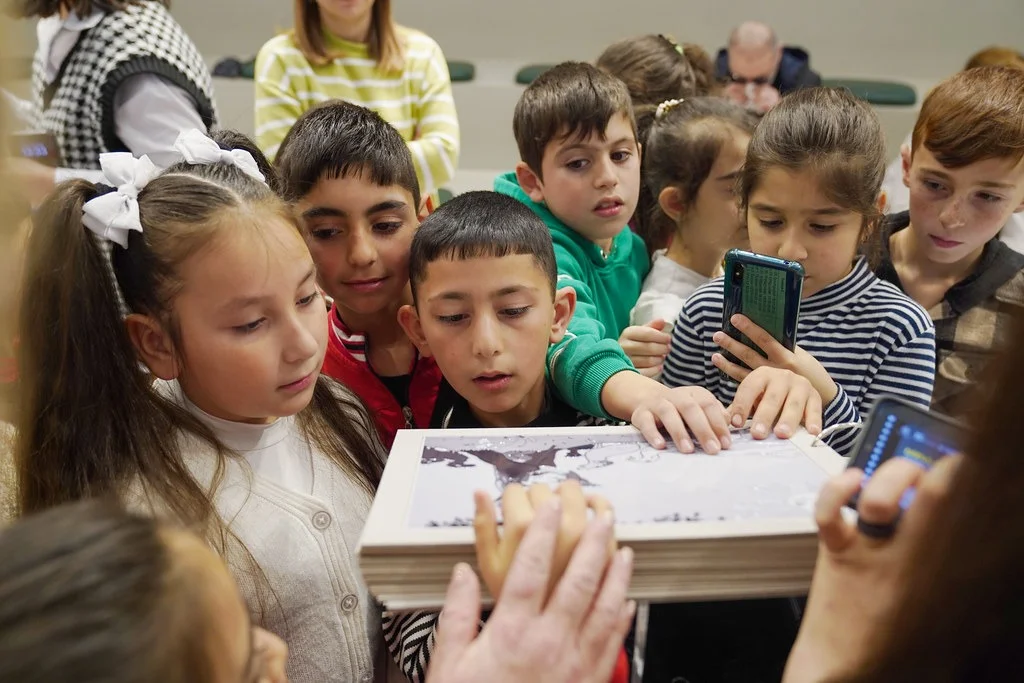
The world around us seems to be designed only for sighted people. We are accustomed to considering vision as the main channel of perception, forgetting that space can speak different languages - through sound, touch, smell, temperature, texture. When a tactile copy of an exhibit appears in a museum, the very logic of space changes: it becomes multi-sensory, open, human. A work of art no longer repels with the phrase “you can’t touch”; on the contrary, it invites communication. Hands become “eyes” and touch becomes a way of knowing.
It is also important that projects like ours change the public perception of blind citizens. They cease to be “guests with special needs” and become full participants in the cultural life of the country. Moreover, their way of perceiving enriches the museum itself. A seeing person, watching another “see” with his hands, suddenly becomes aware of the materiality of line, the weight of form and the physicality of art.
It is also important to understand: creating an accessible environment requires dialogue with the blind people themselves, respect for their experience and a willingness to hear criticism. Formal copying of standards without the live participation of representatives of the target audience turns the accessible environment into decoration: perhaps externally correct, but internally absolutely empty. Therefore, we listen to the opinions of the project experts, learn ourselves with each tactile picture created, and penetrate into a world invisible to a sighted person.
Start
Her face does not require a glance: it is addressed to those who see with their hearts. The blind have been coming to her for centuries, spreading their palms in the air. It is no coincidence that the miraculous “Virgin of Sevan” by an anonymous Armenian painter of the 17th century, which is now kept in the National Gallery of Armenia, became the first painting of our project. They say that it was she who cured the future founder of the Venetian Order, Mkhitar Sebastatsi, from the impending blindness. And this she continues to give to those who do not see the clearest thing - the confidence that there is definitely a path ahead.
There are 15 tactile paintings in the gallery today. Most were created within the framework of the MONKS grant program and donated by our organization to the museum; one, “Passionate Salome” by Surenyants, was commissioned by the gallery itself. A tactile copy of the portrait of the wayward Jewish princess and heroine of the tragedy by Oscar Wilde became part of the exhibition of one exhibit - the original, presented to the viewer after restoration.
When we implemented the project at the Martiros Saryan House-Museum, the space was filled with a new sound and an attentive, focused touch. Children were especially happy, since no one was forbidden to touch the museum exhibits. A week later a group of blind guests from Italy arrived there. I came specifically to “see” the Master’s work. It was a dialogue of feelings, a dialogue with the Master. People speaking a different language instantly understood the language of form, relief and texture. Their fingers slowly followed the lines of Saryan’s landscapes, stopped at the silhouettes of trees, distinguished bulls and plowmen in the arable land, mountain ranges and deep gorges, felt the silhouette of Mount Sipan, barely perceptible with their eyes... Where the sighted person catches color, they felt the texture of the surface, the density of volume, the rhythm of the composition. For us, this became confirmation: tactile interpretation is not an auxiliary tool, but a full-fledged way of encountering art. The project at the Saryan Museum proved that painting can overcome boundaries - geographical and sensory.
“See” Yerevan with your hands
The Museum of the History of the City of Yerevan has also been replenished with tactile exhibits: we created a general plan of the Armenian capital by Alexander Tamanyan in an inclusive version for visitors with visual impairments. The tactile copy is placed next to the original - a hundred-year-old author's copy - and has become part of the permanent exhibition. We have opened up a new way for the blind and not only to get acquainted with the history of the city - through touch. By running their hands over the relief canvas, visitors can feel the lines, shapes, details - and literally “assemble” the image of Yerevan in their imagination. The tactile version of the master plan allows you to “read” the architect’s plan with your hands. Green areas are marked with dotted relief (you can see how many gardens and parks were originally laid out in the city plan by the architect of the Armenian capital), city blocks are highlighted with fragmented forms. The work, like all the paintings in our project, is supplemented with signs in Braille and a audio commentary - the text recorded by famous actors tells the story of the creation of the master plan and reveals the Master's plan.
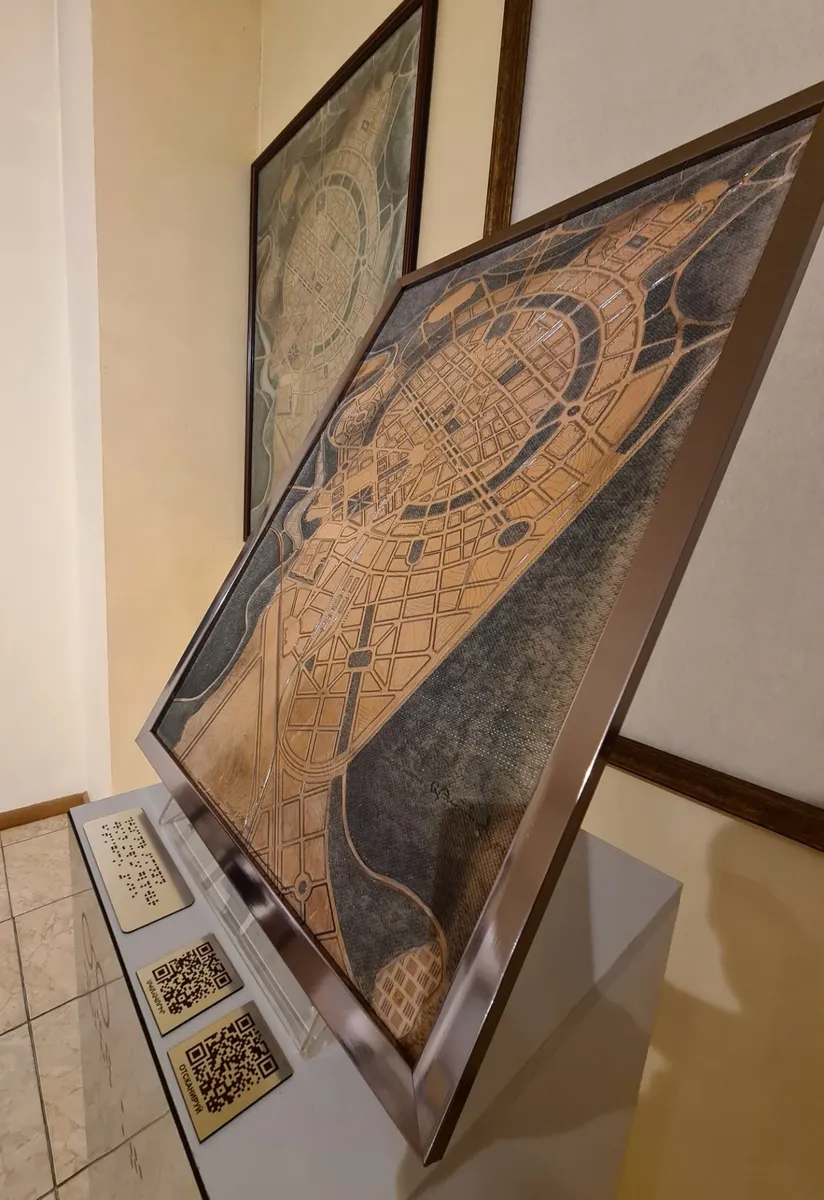
Yeghishe Charents wrote about Tamanyan: “He saw a sunny city...”. Both the author and the entire project team wanted visually impaired and blind visitors to be able to “see” Yerevan through the eyes of a great architect - to feel its scale, rhythm and light of the 12th capital of Armenia. After all, introducing people with visual impairments to art is important not only from an educational and aesthetic point of view, it is also psychological support - an opportunity to overcome limitations, destroy stereotypes and take a step towards internal enrichment. It is this gap that the “Masterpieces by Touch” initiative is gradually filling, a project that makes art tangible.
“Dog and Cat”: the first tactile cartoon
Atamanov’s cartoon “The Dog and the Cat,” based on the fairy tale by Hovhannes Tumanyan, is a meeting of literature and cinema, the Armenian poetic tradition and expressive graphics. Tumanyan wrote his tale with subtle humor. Atamanov translated this story into the language of animation: through clear silhouettes, expressive plasticity, and laconic composition. His “Dog and Cat” is a theater of lines, where every movement is thought out, and every pause is significant. But what if movement can not only be seen, but also felt? What if a cartoon could be “viewed” with your fingertips? Thus, the first Armenian cartoon became the basis for the first tactile animation.
We divided the frames, turning each episode into a relief copy. What previously existed only on the screen can now be studied with your fingers in a museum - high in the mountains, in the village of Dsegh, in the father's house of the Armenian storyteller.
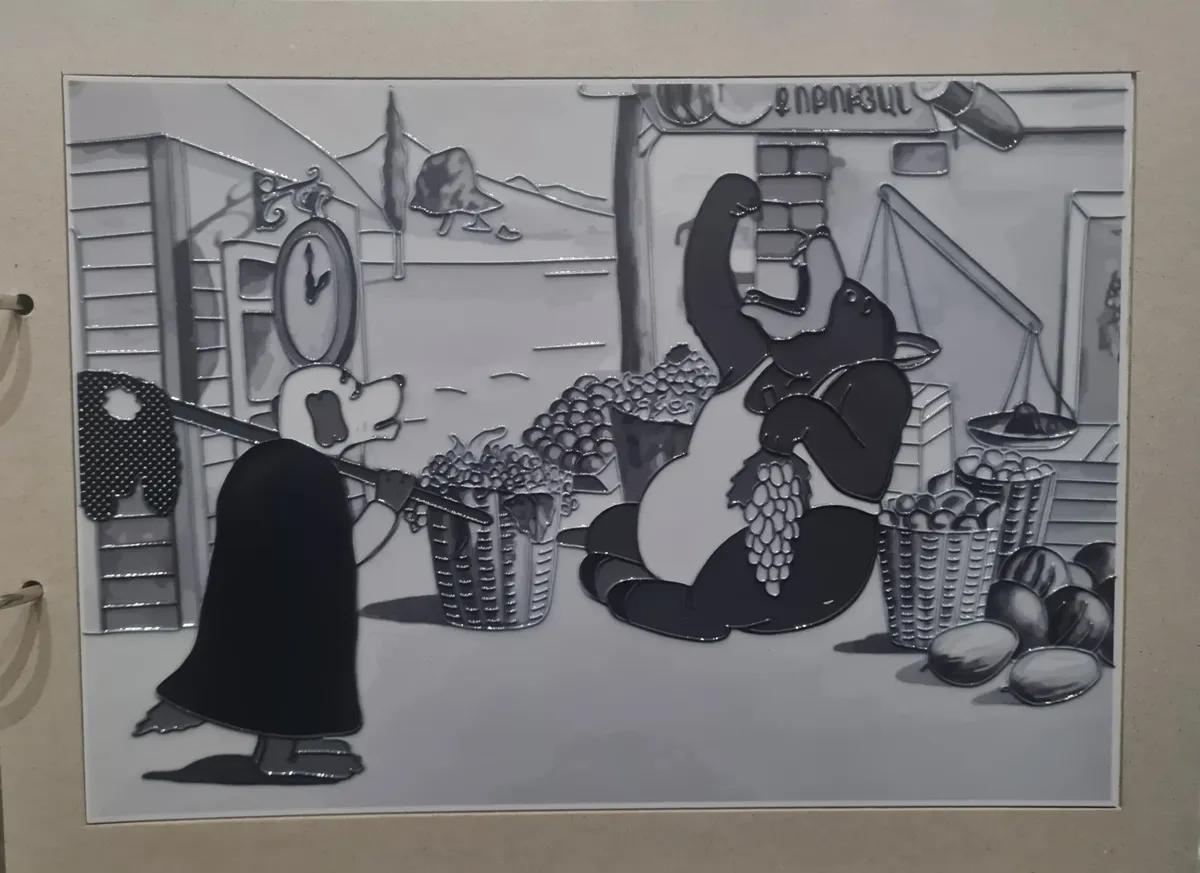
Here is the Dog - trusting, hot-tempered, a little naive. His muzzle stretches forward, his back is tense, his paws are spread out in a fit of emotion. Cat: careful, cunning, flexible. Its tail arches, and its whiskers protrude above the surface in thin strokes. These details can be “read” by slowly sliding over the terrain. Sometimes, to truly see a story, you have to close your eyes. And then the old Armenian cartoon begins to live in a new way - quietly coming to life under your fingers.
Matenadaran: touching the manuscript
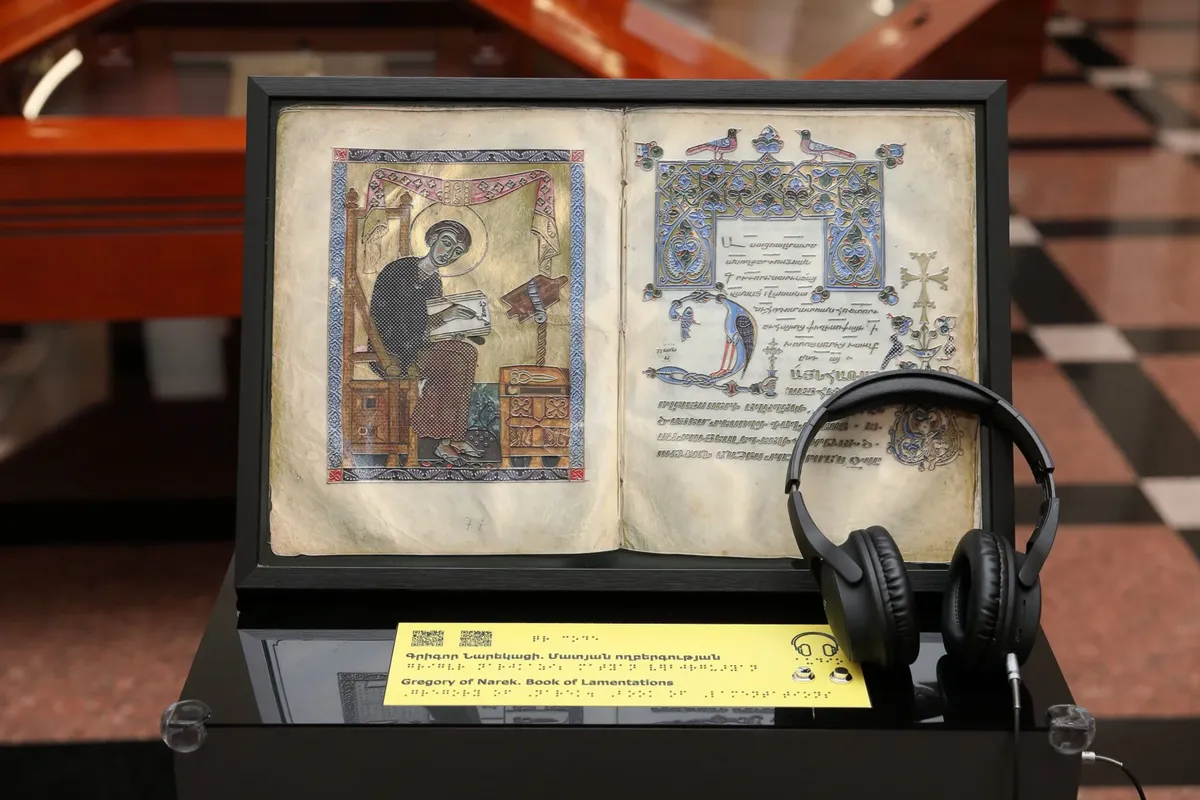
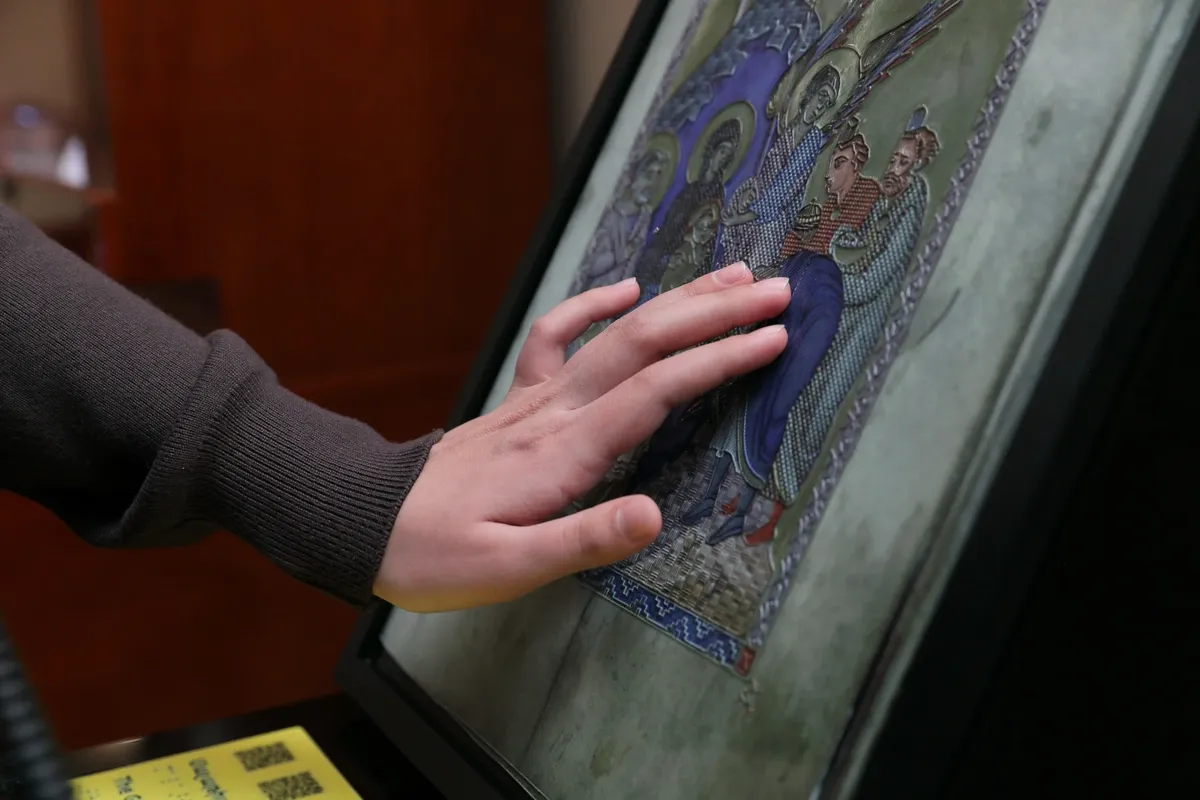
The project takes on a special dimension in the Matenadaran, a repository of Armenian written memory. The miniature here is not an illustration, but theology in color, philosophy in ornament. The gold of the miniature becomes a smooth, warm surface, and the outline becomes a tangible border. Each decision is dictated by respect for the original and attention to the future visitor to the Matenadaran.
The parchment of manuscripts remembers the touch of a scribe, the gold of miniatures remembers the glare from a candle, the colors remember the silence of monastery scriptoriums. But when tactile copies of miniatures are created, ancient writing and decoration take on another dimension - the dimension of touch, in which the past can be read with the fingers. In a tactile interpretation, the Armenian erkatagir becomes a relief: the lines rise above the plane, and the proportions are felt physically. Fingers glide along clear verticals and soft arcs, distinguishing the rhythm of writing in the same way as the eye distinguishes its graphic harmony. The letter ceases to be a sign - it becomes a volume that can be explored and remembered through movement.
Trchnatar , “bird writing,” has a different character, where the lines intertwine, turning into wings, beaks, and tails. In a tactile copy , trchnatar requires special precision: it is important to preserve the grace of the weaves and convey the fragility of the lines through the delicate micro-relief. Where in the original the eye follows the smooth curve of the pen, in the tactile copy the movement is set by the hand. And when the erkatagir sounds in touch, and the trchnatar is revealed in relief, it becomes clear: the memory of a nation lives not only in vision - it is contained in the rhythm of movement.
The first four tactile copies of miniatures, created by order of the Matenadaran, are spreads of folios with the History of Movses Khorenatsi and from Narek - the Book of Sorrowful Songs, a strip miniature “Adoration of the Magi” by Toros Roslin from the Gospel of Malatia (1268) and a scene of the battle of Rostam with his son Zohrab from Ferdowsi’s poem “Shahnameh”.
Armenian culture has survived centuries of loss and rebirth. We take care of manuscripts, restore frescoes, restore canvases. But the true preservation of heritage lies not only in funds, but in the living participation of people. If a child born without sight can touch a miniature and learn how, in the 13th century, the brightest miniaturist of the Armenian Middle Ages depicted the Virgin Mary, the baby Jesus, the Angel and the Magi, if an adult can see with his fingers the relief of Ararat, then art truly belongs to everyone.
This means that the light that lives in the halls of Armenian museums becomes common.
Erna Revazova, president of the cultural association “Sarer”, author of the inclusive project “Masterpieces by Touch”.