
Translated material
What do our kids play? Excerpt from the book “Made in the USSR: Materialization of a New World”
In the USSR, children's toys were more than just entertainment. With its help, adults tried to instill in children the necessary skills, tastes and behavior patterns. What specific requirements did the state, parents and teachers place on toys? Exploring the products of the Tomsk Children's Toy Factory, Alexandra Ermolova answers these questions in her text for the collection “Made in the USSR: Materialization of a New World” edited by Alexander Fokin. Together with the publishing house “New Literary Review” we are publishing an excerpt from it.
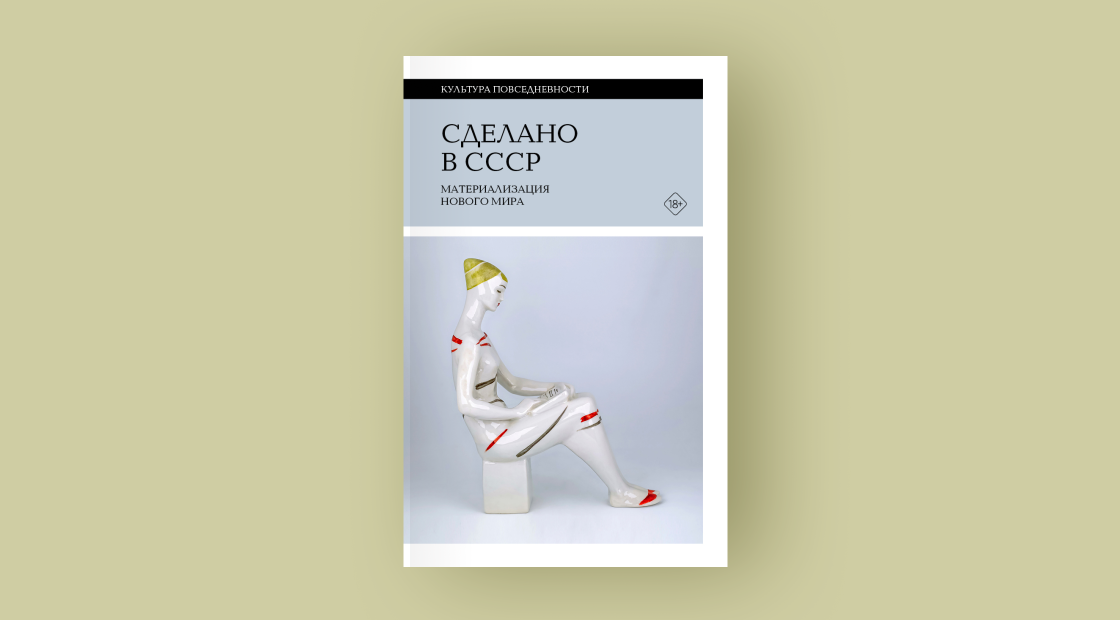
Made in the USSR: materialization of a new world. Edited by Alexander Fokin. Publishing house "New Literary Review", 2026
Raising the younger generation has always been one of the primary tasks of the Soviet state. The implementation of a systematic policy in this direction began from the earliest stages of human development. It was necessary to form in children the correct Soviet identity and a sense of belonging to a large and great country. <...> The task was not only to develop a suitable design that would meet the aesthetic and ideological canons of that time, but also to organize production.
A happy childhood and its provision to every child is an ideologeme that the Soviet state consistently tried to bring to life through intervention in educational, educational and leisure practices. Ideas about what childhood and children's employment should be like in the 1950s–1960s in the USSR can be divided into several areas.
"Developing child"
These are primarily preschool children. Due to their age, it is very difficult to conduct serious ideological and political work with them. They are just beginning to socialize, learning to speak and express their thoughts in words, so their main task in the optics of state influence is play and learning about the world around them. According to annual reports, the [Tomsk] children's toy factory responded to this position of the state towards preschoolers by producing about 15 types of different products for children. Among them are the dolls “Galya”, “Natasha”, “Mila”, “Tanya” and “Baby”, and a bathtub. Interestingly, in the 1930s, dolls with babies and cradles were formally banned as evoking emotions associated with sex education. Twenty years later, the situation changed: the “Mom” doll became a familiar toy for little girls.
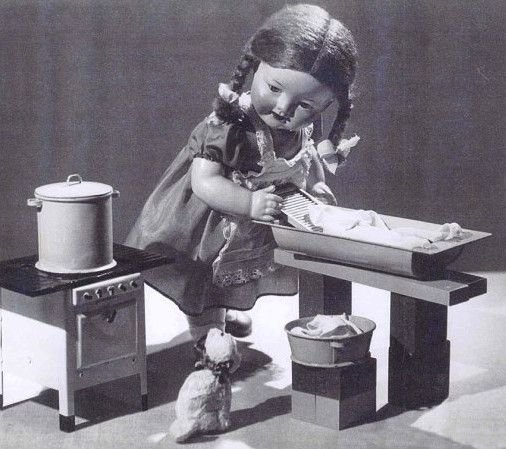
Doll with attributes for “housekeeping”, late 1950s - early 1960s © Author unknown
Toys that help in children's development also include small copies of real objects and natural phenomena. The factory's assortment includes several types of cars, three types of horses (“Rocking Horse” and “Horse No. 4”, “Hero Horse”), animal figurines (roosters, cows, ducks, cats, etc.). Such toys were supposed to satisfy children's need to understand the world around them.
"The child is hardworking"
A young Soviet citizen, from the point of view of the state, had to have a number of qualities, one of which was hard work. Engagement in useful activities should begin from a very early age. It was proposed to start mastering the skills of “real” work from school. In 1958, the Supreme Soviet of the USSR adopted the law “On strengthening the connection between school and life and on the further development of the public education system in the USSR,” the main goal of which was to develop the communist worldview among young people, as well as familiarize them with the basics of working professions.
The products of the [Tomsk] factory were also supposed to contribute to the development of practice-oriented skills in children. In the early 1960s, just after the law was passed, the following items appeared in the assortment: a washboard, a basin, different types of shovels, including construction blades, a watering can and the “Young Architect” set. Not only hard work was encouraged, but also love for the Motherland.
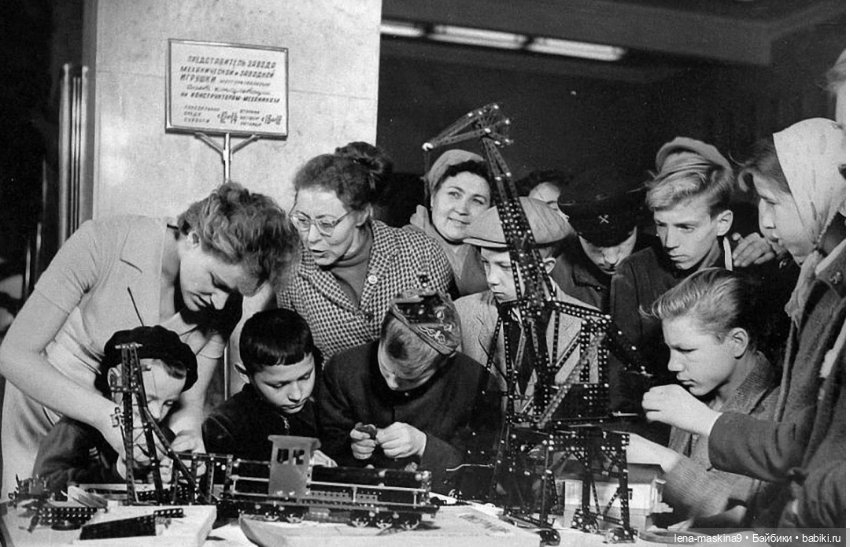
Demonstration of mechanical and wind-up toys from the Moscow Factory in the sales area of Detsky Mir, Moscow, late 1950s - early 1960s © Author not identified
"Patriotic child"
The issue related to how to develop feelings of patriotism in a child is debatable. In a country that had recently experienced a terrible war, patriotism was understood in almost only one meaning - readiness to protect, which means the toys should be appropriate. Historian Larisa Leutner says that in the USSR there was no consensus on this matter. On the one hand, teachers and methodologists of educational institutions opposed it: they believed that paramilitary toys increase the level of aggression among children. On the other hand, members of the Komsomol Central Committee defended the need to produce military toys as one of the main means of patriotic education. There were known cases when the artistic and technical toy council of the Ministry of Education of the RSFSR nevertheless rejected some samples. For example, tin soldiers, pointing out that “the content of the game does not meet the objectives of raising children in the spirit of the peaceful policy of our state, since the main cast of characters in the game is given in terms of military operations.”
Nevertheless, the [Tomsk] factory had such toys in its assortment, albeit in small quantities. This is the machine gun and the cruiser "Slava". Games using such items made it possible to reconstruct military events, lay the foundation for the development of tactical thinking, the ability to balance one’s own strengths and those of the enemy, and team interaction skills - qualities necessary for future defenders of the country.
It is worth noting that in the period from 1961 to 1965, the machine gun was the most produced toy. The factory produced an average of 87,000 pieces per year, for comparison: the second largest production volume was washboards, with an average of 62,000 pieces per year, the third was buckets, scoops, spatulas, with an average of 30,000 pieces per year for each item.
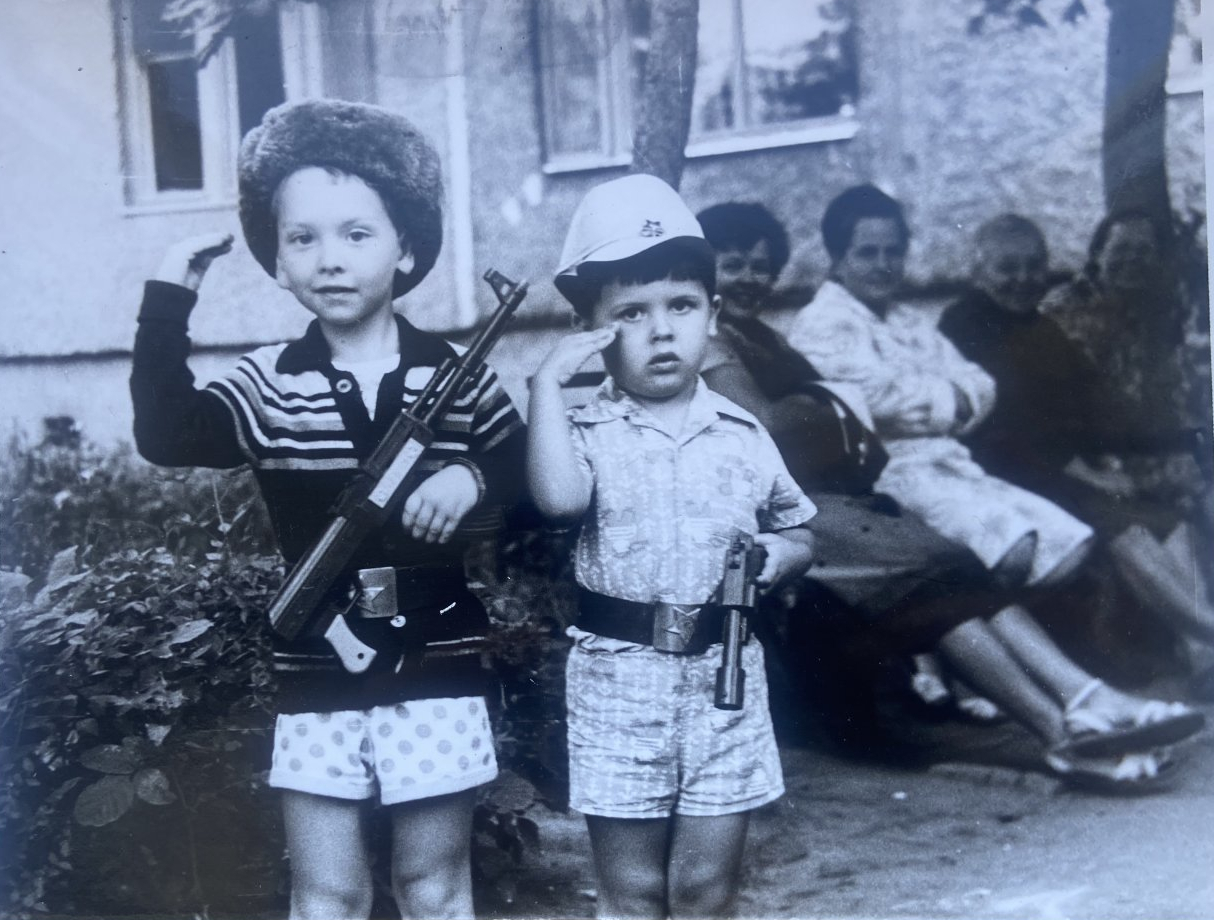
Soviet children with toy weapons, 1960s © Author unknown
"Cultural child"
An important component of the everyday life of Soviet people was the “idea of culture,” first proposed back in the 1920s. Researcher V. Volkov says that “culture” has never been a clearly formulated concept; not a single party or government leader gave instructions on how to become cultural. Soviet people had to develop culture in work, in family life, in everyday life.
The idea of culture was embodied in such practices as reading books, visiting exhibitions, theaters, and libraries. For children, learning to play musical instruments, drawing lessons and aesthetic development were added to the above. The idea of culture in the assortment of the [Tomsk] factory was embodied in the production of toy musical instruments: an organ and an accordion. They belonged, rather, to the category of secondary ones in the educational practices of Soviet children. Unlike the automatic machine, the quantitative production figures were very modest, about 3,000 copies per year. Only a steam locomotive with carriages was produced in smaller volumes.
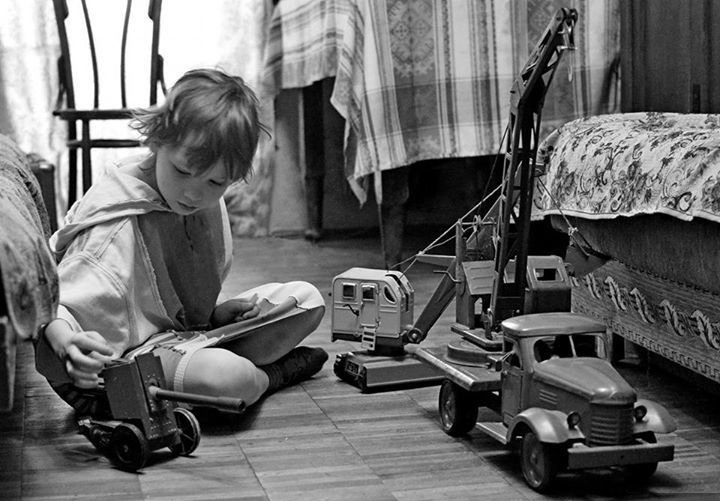
Soviet model of an artillery gun and truck, 1960s © Author unknown
With the range of products it produced, the factory in one way or another tried to respond to the existing demands of the state in the field of educational policy towards children. In production, preference was first given to toys aimed at labor and patriotic education. What demands did parents, teachers and sellers place on manufacturers? A toy is an important element of children’s everyday life; this thesis is confirmed by conversations with respondents. Remembering their childhood, many of them say that there were very few toys, but they still remember each one in detail. Such an experience is not considered a traumatic event in their life, but rather the norm. Some even point out positive aspects, comparing their childhood with the modern situation. It is believed that due to the small number of toys, children were not spoiled and appreciated what they had. Their imagination worked better, as they made toys themselves, drew board games, paper dolls and costumes for them.
The toys were only homemade. From a young age I have been making my own toys. Mostly machine guns and shotguns. My parents didn’t have the opportunity to buy, so my brother and I did everything ourselves.
According to respondents' recollections, the decision about which toy to buy was made only by parents or other older family members. And they often formulated their requests and demands for manufacturers in letters to local newspapers, usually of the nature of anti-advertising.
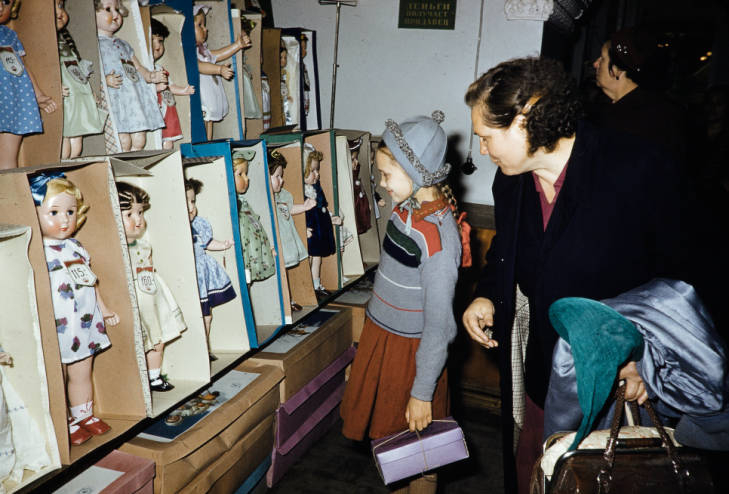
Dolls on the shelves of Detsky Mir, Moscow, late 1950s - early 1960s © Harrison Forman
The reason for negative reviews from parents about the factory's products was poor quality. The toys broke quickly and did not last long for children:
The sound bellows [of the cuckoo and the chicken] are made not from fabric with paper sizing, but from paper, which quickly tears and the “bird” becomes silent.
For a long time, behind the department store window there were bulky, rough cars, without any hint of grace, costing 5 rubles 60 kopecks. Such a car lasts for two days at most, and then its wheels split, and what remains of the car is a heavy, clumsy platform.
In addition, parents complained about the appearance of the toys. They are asymmetrical and unattractive:
“...the doll has no hair or ears, its arms and legs are twisted, the dresses are made of unkempt dark chintz.”
The dissimilarity of the heroes to their real prototypes became the object of feuilletons:
...a tanned boy in shorts ran out of the house.
- And they bought me a toy too! The children shouted in different voices:
- Doggy!
- Frog!
- Bunny!
- Bear!
“Why are they blind,” Gerasim Moiseevich winced in annoyance, “they’re inventing God knows what: a frog, a bear...” The owner of the mysterious toy, as if reading Gerasim Moiseevich’s anxious thoughts, announced:
- You don’t understand anything. This is a cat.
- Cat??! - Little Petya was terribly surprised.
- Well, of course. At the store, dad asked himself when he bought it. And they told him clearly: cat.
“But to tell the truth, the cat’s face is really a little wrong,” thought Gerasim Moiseevich when he looked at the plaster cat more closely.
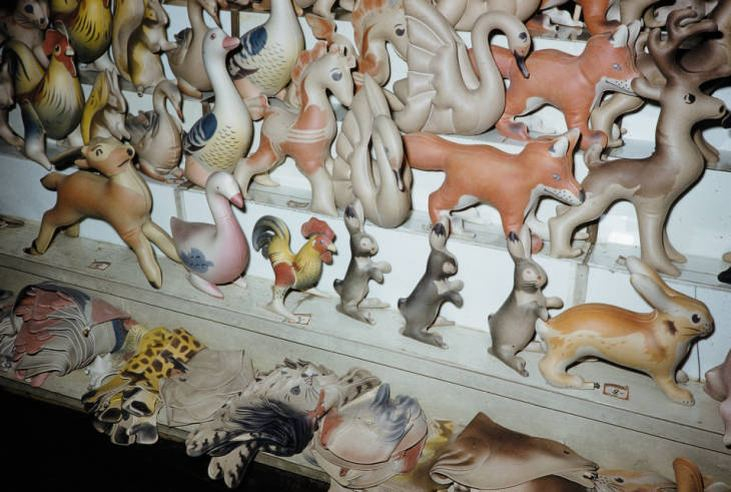
Animal figurines on the shelves of Detsky Mir, Moscow, late 1950s - early 1960s © Harrison Forman
Parents paid much attention to the aesthetic component of the toy, virtually ignoring issues of child safety. Although the potential risks during use were quite real: a splinter from a poorly processed wooden toy, loose small parts that a child could swallow or try to put in his nose. Neither in letters to newspapers nor in archival materials were there any complaints that would indicate parents' concern about such issues. They expressed their attitude to the quality of the toy only through the categories of service life and visual appeal. Educators also adhere to similar rhetoric. For example, the words of the teachers of one of the city’s kindergartens are reported by a journalist from the newspaper “Young Leninist”. They told him that factory dolls are so unattractive that children are afraid of them:
She is dressed simply ugly - tasteless, careless and ugly. On the doll’s feet there are no shoes or slippers, but some stockings tied with an ordinary harsh thread so that they do not fall off.
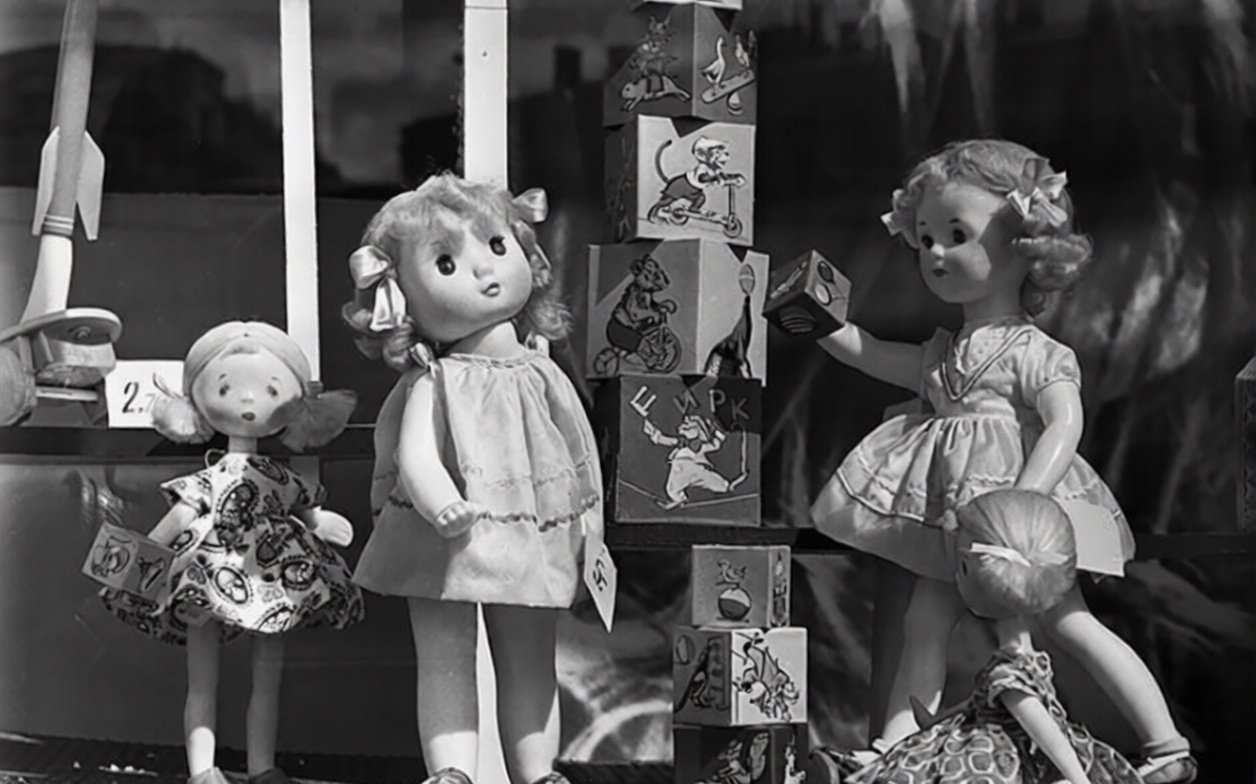
Dolls in the window of the Moscow Children's World, late 1950s - early 1960s. © Author not identified
Speaking about the quality of products, we should not forget that the production of toys took place in a planned economy. The enterprise plan was calculated based not on sales volumes, but on production volumes. This means that it was necessary to produce products at the lowest cost from available materials. Under these conditions, factors such as demand and variety of manufactured goods were actually ignored. While the sellers were in the opposite situation. Here's what the head of the children's department of the Tomsk department store said in 1962:
The Tomsk factory produces few beautiful toys. There is nothing to please the children. Now, for example,” she continues, “the summer season is in full swing, and the factory is not even thinking about producing such necessary game items as rakes, nets, etc.
Many of the factory's products supplied to Tomsk store shelves were defective. Sellers corrected minor nuances themselves right on the job. They attached wheels to cars and painted over white areas on colored toys. The toys arrived with virtually no packaging, which caused many products to spoil. The sellers themselves explained the large number of defects due to poor transportation and lack of appropriate qualifications among factory employees. <...>