
Translated material
Against the System
About the philosopher Habermas, who believed that only a united Europe could resist nationalism and wars

Jurgen Habermas. Photo: imago images / Seeliger
In post-war Germany, the writer Heinrich Böll published the story “And He Didn’t Say a Single Word” - a story about how people are fatally alone: everyone lives in their own flawed, closed world, carries their own misfortune and their own lack of faith. People don’t even know how to share their own grief and don’t know how to share the misfortune of another, they have forgotten how to hear the other. People are the closest people! - they need each other, they need warmth and help, but mutual trust is destroyed: a husband and wife who love each other cannot agree - each of them is locked inside their loneliness. And this is a terrible sentence - to sentence a person to loneliness even next to his loved ones. People are placed in a sterilized herbarium of surrealism, as in a Magritte painting: everyone exists in their own narrow space, people pass by each other without touching, they have lost the opportunity to protect each other and love.
In Europe, tormented by two brutal wars that followed one another, people felt lonely - without support from another. And how can people agree?
They had a common language - it was the language of slogans and appeals, the language of commands and mass enthusiasm. And suddenly it turned out that this language is false and leads to a common grave. A common language of slogans is now impossible, but there is no other language suitable for everyone. The inhuman power invented common rules, common enthusiasm, a common language; and was there ever any other common language than the language of slogans? Now, in the ashes of the empire, how can a lonely person build a bridge to another lonely person?
Aldington’s novel “All Men Are Enemies”, the lonely heroes of Jean Gabin, the empty dead streets of the artists De Chirico or Hofer, the famous formula of Sartre “Hell is others” - everything suggests that connections between people are destroyed. And how to build a new world on post-war ruins, if even a loving man and woman do not know how to talk to each other. We've forgotten how.
What war does is scary not only because of the murders, but also because even the survivor of the massacre is doomed - he is sentenced to die in a vacuum: there is no one to trust, no one will extend a hand to him, no one will warm him. The war speculated on the concepts of “brotherhood” and “family” - but it was brotherhood in arms and the ideal family of a totalitarian state. The inhuman scheme of existence leaves no space for humanity.
Jürgen Habermas made the main theme of his work the theme of communication - building a dialogue between people. One of the paradoxes of philosophy is that, trying to explain and even change life, trying to teach all people to feel and think, philosophy builds a narrowly professional, super-complex vocabulary only for initiates. Habermas spent his entire life challenging the logic of the Empire and the System - that is, the language of slogans and manipulations that left people orphans in the ashes. And instead of the language of slogans, he created a language that claims to explain general communicativeness, a dialogue of one with everyone, but only a few can use this language.
The researcher of Habermas’s work faces the difficult task of translating narrow professional terminology into publicly accessible expressions - in order (even at the cost of losing nuances) to preserve the main thing for which Habermas wrote - to preserve the value of the dialogue of everyone with everyone and everyone with everyone.
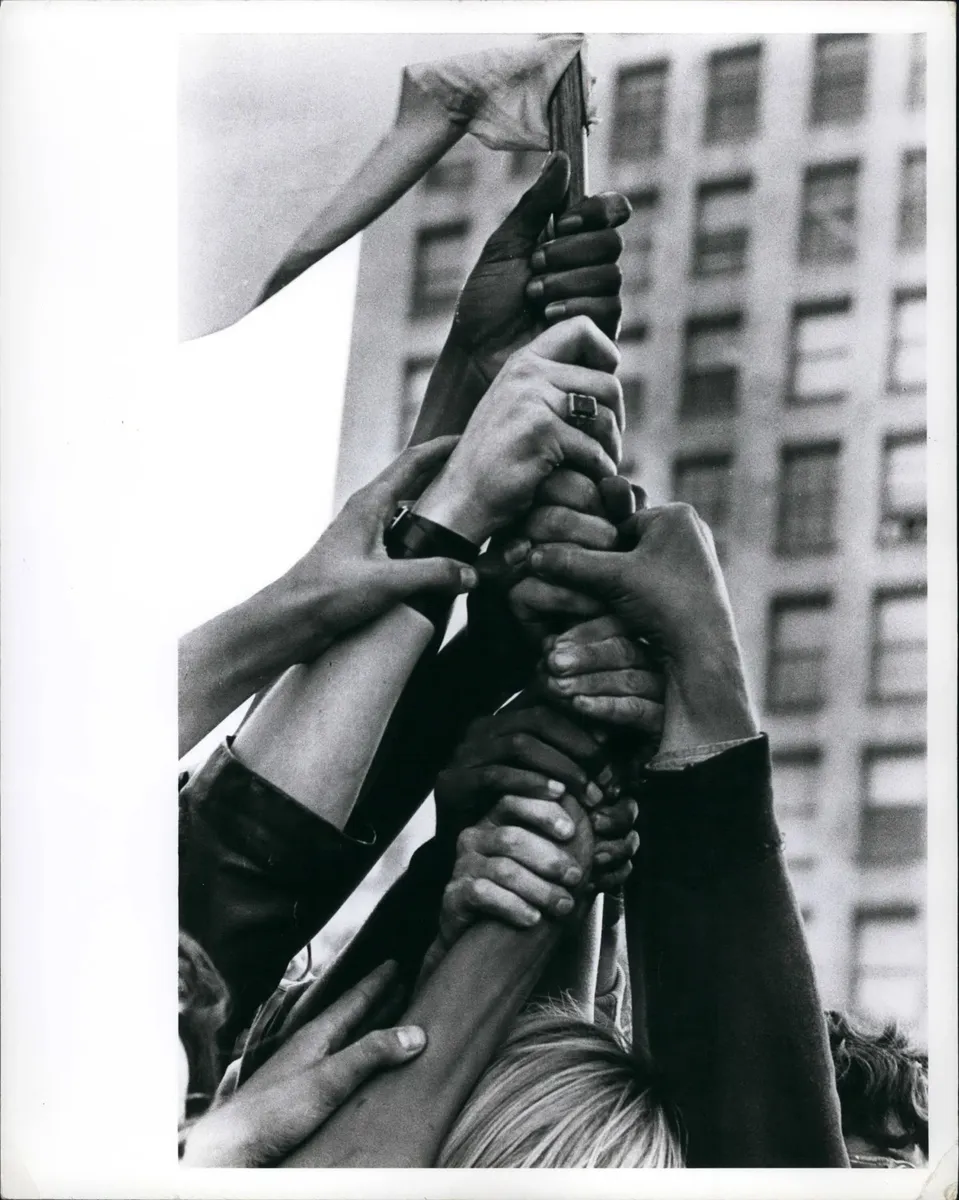
Habermas belongs to the “second generation” of the Frankfurt School of philosophy, that neo-Marxist school of thought that arose in post-war Germany. The Frankfurt School was based on the assertion that Nazism did not completely cripple souls, that it was possible to turn the terrible page and rethink the experience of culture and history. Turning to Marx (a thinker taboo and cursed during the Nazi years) did not exclude the fact that philosophers built their original concepts based on the study of modern industrial society, the laws of which Marx could not predict.
Its main representatives - Adorno, Horkheimer, Marcuse, Fromm, Benjamin, Neumann - were associated with the Institute for Social Research in Frankfurt am Main. They were united by the understanding that the bourgeois class society of their time had mimicked a totalitarian monolithic System, in which (due to the absence of the proletariat) the revolutionary role passes to intellectuals, that is, to themselves and their colleagues. And they accepted this mission of the new intellectual revolutionaries as a working program.
Philosophers criticized the cult of consumption and popular culture, which turns people into passive consumers, criticized the manipulation of mass media, and called the practice of blurring the boundaries between private and public existence totalitarianism. As a matter of fact, when the critical theory of the Frankfurt School is called “neo-Marxism,” this definition is not far from the truth: thinkers such as Fromm and Marcuse were certainly neo-Marxists.
Jürgen Habermas shared the “leftist” views of his teachers and colleagues, but his “neo-Marxism” was not as radical as, for example, Marcuse or Adorno. He was too rational for revolutionary discourse: he sought to overcome the totalitarian laws of the System in the formation of a new ethics of communications between individuals.
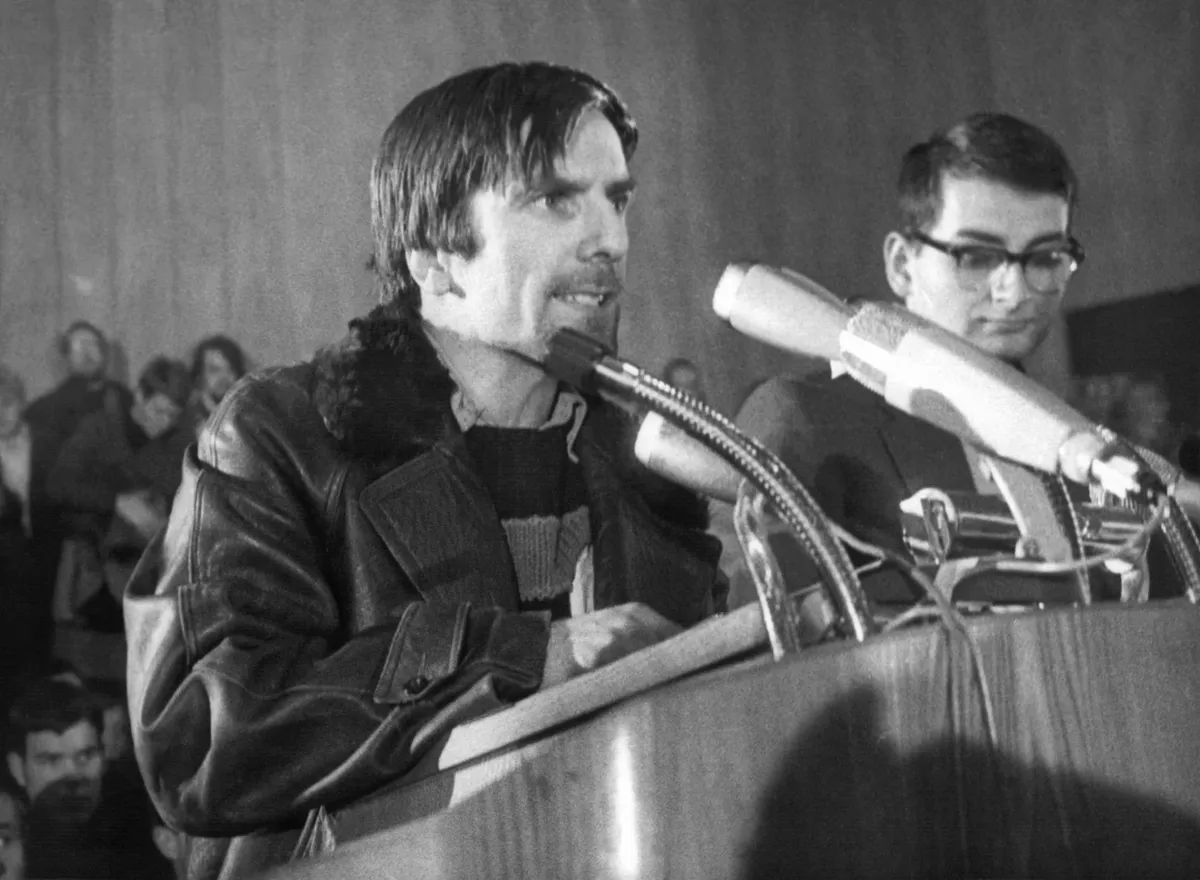
Habermas sympathized with the student movement of 1968, however, he called the leader of the German student movement, a representative of the generation of the German “new left” Dutschke, a “left-wing fascist”, and reproached him for provoking violence. However, like his colleagues,
Habermas used the term System to refer to the totalitarian society whose power he sought to overcome. It is in this gap - between criticism of the System and criticism of the violence provoked by the “new left” - that Habermas’s views lie.
Habermas's views evolved. The main work of the first period is considered to be “Knowledge and Interest” (1968); The central work of his mature years was “The Theory of Communicative Action” (1981). In his latest works, he clarified the views of previous years. Habermas's goal is to free the individual from “systematically distorted communication”, to endow the individual with the ability to communicate with another individual outside the System.
According to Habermas, democracy must be combined with morality, and a new type of ethics with philosophy and politics. The book “The Theory of Communicative Action” was to a certain extent utopian. Habermas combined in his work the fury of the utopian Marx, the thoughtful ethical concept of Schelling, and the “theory of social action” of Weber.
Habermas created the original theory of “communicability” as a development and clarification of Marxist theory: to the phenomena of Labor and Goods, the philosopher added the missing (according to his ideas) phenomenon of “communicability” (that is, the ability to understand another person and empathize with another). Communicativeness, according to Habermas, is a self-sufficient phenomenon - it is a space of personal freedom that makes it possible to build a rationally meaningful society of independent individuals who have entered into a reasonable dialogue.
Over time, the utopianism of this project became obvious.
Habermas introduced into his arsenal of images the concept of “colonization of the life world by the System.” The point is that communication (designed to become a space of freedom, to free the individual from social manipulation) is gradually being mastered by a total capitalist society.
Communicativeness, which in the 70s of the last century was (as Habermas believed) a guarantee of everyone’s personal freedom, in a world dominated by management and not the producer, becomes a tool for the enslavement of the individual. Communication has become a tool for controlling the masses: politics in the modern world becomes PR, public discussion turns into manipulation of the consciousness of the masses, social relations become dependent on management, the service market and the management market become as powerful manipulators of society as the labor and capital markets once were. In the art market, in the everyday life of society, and on the political scene, it is not Product or Labor that rules, but management. The new hypostasis of capitalism operates with management, that is, it assigns to itself the functions of communication. And this is communicativeness of a different kind, by no means the one that Habermas dreamed of: this communicativeness does not liberate the individual, but, on the contrary, enslaves him.
Habermas accepted the challenge of the times and changing reality, clarified his views, looked for more precise words - in order to endow the individual with freedom, to help overcome the System.
Habermas combined in his work the rationalism of an armchair scientist and the civic courage of a publicist. He was not afraid of newspaper controversy - which is unusual for an armchair sage. His public dispute (on the pages of the newspapers Frankfurter Allgemeine Zeitung and Zeit) with the historian Ernst Nolte over the nature of Nazism is memorable.
Habermas refuted Nolte's claim that National Socialism arose as a reaction to Bolshevism. Habermas's courage was to admit the collective guilt of German society for the rise of Nazism. This dispute outgrew newspaper polemics and became a manifesto of civic responsibility.
Courage never left Habermas: he went against fashion trends and conventions, and was ready to reconsider his own statements of the 60s. In 1962, his work “Structural Transformation of the Public” was published - he subsequently debated with himself: in 2022 he published the book “The New Structural Transformation of the Public and Deliberative Politics,” in which he writes about the collapse of public discourses and basic communication structures, including the collapse of contemporary political discourses. For a person who dedicated his work to the establishment of communicative reason, this is an extremely sad statement.
Until the last days of his life, Habermas remained true to himself: in November 2025, he gave a report in Munich on the subjectivity of Europe - he became more and more pessimistic.
Habermas remained a critic of contemporary events until his last days.
The scientist’s view of the Russian-Ukrainian conflict is important; As always, Habermas entered into polemics with the generally accepted trend. In April 2022, when Europe was already heading towards blocking peace negotiations, Habermas advocated negotiations and diplomacy, warning against an escalation of hostilities. In February 2023, he published an article “In Defense of Negotiations,” in which he talks about a certain responsibility of the West for what is happening in Ukraine. Too bold for an armchair scientist - however, he was always like this: he went against the general opinion. It is natural that the philosopher, who was already over 90 years old, was criticized - he was accused of ignorance of the situation, of utopianism, of empty rhetoric and simply of an inability (due to age) to understand the problems of Europe. However, Habermas remained true to himself and his understanding of Europe and its tasks.
The death of Habermas became a milestone in the history of our modern world. In a world that is going crazy today, that has forgotten how to listen and understand, it has become even harder: the one who could philosophically justify the possibility of dialogue between people has left.