
Translated material
The US and Israel have been at war with Iran for three weeks. So far no one is winning
What's next? Ground operation or negotiations?
The war between the United States and Israel with Iran continues into its fourth week. On March 22, Donald Trump demanded that Iran open the Strait of Hormuz within two days, threatening otherwise to bomb the energy infrastructure - that is, to leave Iran without electricity.
The Islamic Revolutionary Guard Corps has vowed to retaliate by striking the energy infrastructure of Israel and other US allies in the Middle East, as well as any energy facilities in the region owned by companies with American participation.
Then Trump changed his mind
On March 23, shortly before the expiration of the American ultimatum, Trump said that the United States and Iran "have had very good and productive conversations about a full and final resolution of the conflict in the Middle East," and therefore he decided to postpone strikes on Iranian power plants for five days.
It is unclear with whom exactly the negotiations were held in Iran. Before the war and in its first weeks, the Secretary of the Supreme National Security Council, Ali Larijani, was responsible for external contacts, including with the United States. But he was killed in an Israeli strike. To whom his functions were transferred was not publicly announced.
According to The Jerusalem Post, the Iranian side in the negotiations is represented by Parliament Speaker Mohammadbagher Ghalibaf, and the American side by Trump's special envoys Steve Witkoff and Jared Kushner.
What is the answer in Iran?
The Iranian news agency Tasnim reported , citing a source in the security forces of the Islamic republic, that there were no negotiations, and Trump “backed down” only because the Iranian strategy is working. The strategy is to spread the damage of the war to as many countries as possible, putting pressure on world markets - and thereby pressure Trump to stop striking Iran.
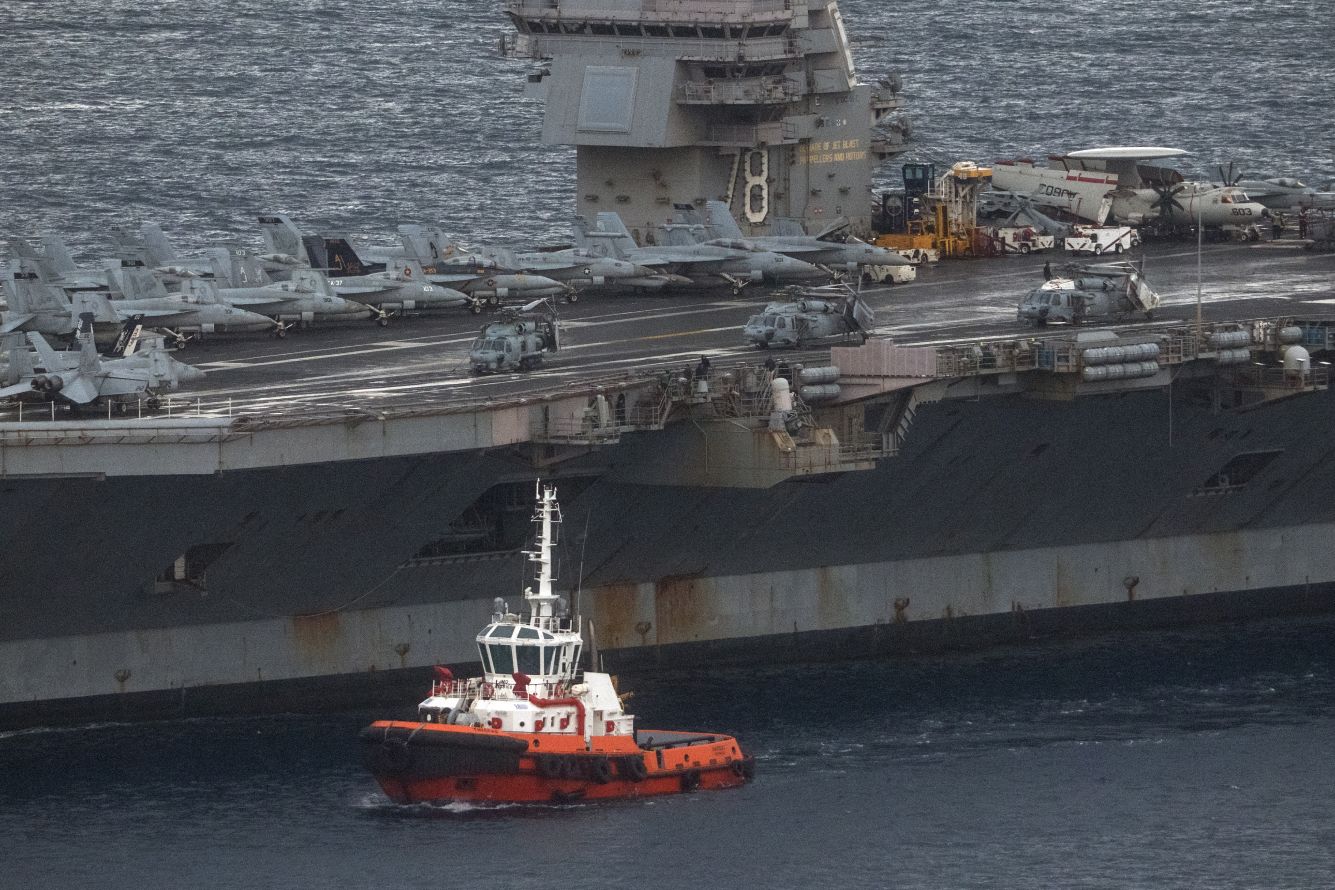
The original US-Israeli war plan appears to have failed completely. This is evidenced by the very fact that Trump is issuing ultimatums, and the transfer of additional forces to the Middle East, including 2,500 Marines, and preparations for sending a third strike group to the region, led by the aircraft carrier George W. Bush (currently located at a base in Norfolk, Virginia).
What was the original plan?
According to The New York Times, it was based largely on the idea of the Mossad, Israel's foreign intelligence agency. Mossad director David Barnea convinced first Israeli Prime Minister Benjamin Netanyahu and then the Donald Trump administration that after killing the leaders of the Iranian regime and massive attacks on military infrastructure, it would be possible to provoke an uprising against the Islamic Republic.
This calculation did not come true. Iranian security forces - the army, police, Islamic Revolutionary Guard Corps (IRGC), Basij militia, intelligence agencies - all maintain complete control on the streets and effectively suppress any attempts to oppose the regime. Forces outside Iran that could launch an armed struggle against the Islamic Republic—primarily the Kurdish militias based in Iraqi Kurdistan—have been slow to act. As a result, the regime weakened externally, but consolidated internally.
What should Trump do now?
The US President is now no longer thinking about regime change in Iran, but about how to lift the blockade of the Strait of Hormuz, which has caused a sharp rise in oil prices - and could lead to a crisis in the global economy. Trump talks about "productive conversations" with Iranian officials and that the US is " getting closer to achieving all of its goals and is considering reducing the intensity of hostilities in the Middle East." Such statements are obviously addressed primarily to the markets - in the hope of calming them down and slowing down price increases.
At the same time, Trump is looking for a way to open the Strait of Hormuz. He calls on the Allies to send ships to protect shipping, but they refuse, not wanting to go to war. According to Politico, Trump has already despaired of getting “kinetic action” from his allies and is ready to settle for at least verbal support for “measures necessary for freedom of navigation in the Strait of Hormuz” - again, in the hope that this will help calm the markets a little.
How does Israel act?
A different approach to the “Hormuz problem” is being promoted by Israeli Prime Minister Benjamin Netanyahu. He insists on further escalation. On March 18, Israeli planes struck the South Pars gas field in the Persian Gulf, apparently with the knowledge and approval of the United States. This field accounts for about 70% of Iran's gas production. All heating in Iran, as well as a significant share of heating in Iraq and Turkey (exports there were suspended immediately after the strike), depend critically on this production.
Iran responded with attacks on gas enterprises in Qatar - and world gas prices immediately soared (Qatar accounts for about 20% of the entire world market). Iran obviously has no intention of abandoning the blockade of the Strait of Hormuz: this is actually the only trump card it has left, and so far it has been successfully playing it.
Iran threatens Europe
On March 21, Iranlaunched two missiles at the British-American airbase at Diego Garcia on a small island in the middle of the Indian Ocean. They did not reach their goal: one fell into the sea, the other was intercepted by an American destroyer. But the main effect of this action, obviously, was to demonstrate that Iran has missiles capable of covering a distance of four thousand kilometers.
Iran has previously claimed that it can produce missiles of this range, but deliberately does not do so. The launch on March 21 is a threat to European countries: if you help the United States and Israel, you will experience the same thing as Qatar and the UAE, which are regularly subjected to rocket attacks.
The threat is most likely empty: Iran is unlikely to have any significant stockpile of long-range missiles, and it is unlikely that it has the ability to produce them in sufficient quantities to regularly bombard Europe and overcome its missile defense system. But Iran may have another goal: convincing Europe that the war must end as soon as possible.
What's next?
To change the nature of the war, the United States and Israel may decide to launch a ground operation. So far, only the scenario of a very limited invasion is being discussed - the capture of Kharg Island in the Persian Gulf, where the largest Iranian oil terminal is located.
On March 23, Trump made it clear that a diplomatic solution was possible. He said that Witkoff and Kushner are negotiating with a certain high-ranking Iranian official (in all likelihood, Ghalibaf) - and agreements in principle have already been reached on most key issues. In particular, Iran allegedly agreed to abandon the development of nuclear weapons. However, Iran has always officially maintained that it is not developing it.
Iran said that the United States only requested negotiations with Ghalibaf, but has not yet received consent.
"Jellyfish"